


I stared at the screen, my stomach in knots.

Olumide Adeyemi
ผู้บุกเบิกการเทรดในแอฟริกาตะวันตก ·  Nigeria
☕ 10 นาทีอ่าน
สิ่งที่คุณจะได้เรียนรู้:
I stared at the screen, my stomach in knots. My account balance read $487. Just three weeks earlier, it was $2,150. I'd gotten cocky after a few good trades on USD/NGN, convinced I'd cracked the code. I went all-in on a 'sure thing' based on a WhatsApp group tip, ignoring every rule in my own plan. The market didn't care about my confidence. It wiped out 77% of my capital in one volatile session. Sitting there in my Lagos apartment, with the generator humming in the background, I had to ask myself the hardest question: is forex trading worth it? Or was I just another statistic, funding some broker's yacht with my hard-earned Naira?
Let's cut through the Instagram hype first. In Nigeria, forex trading isn't some magical shortcut to buying a G-Wagon in six months. The environment here adds unique layers of complexity you won't find in a textbook.
The biggest elephant in the room is regulation, or the relative lack of it for retail traders like you and me. The CBN and SEC are the main players, but their focus is on the big picture: Naira stability and the official banking sector. When it comes to you trading EUR/USD on your phone, the rules are... fuzzy. This means a flood of international brokers can operate here. Some, like Exness or XM, are legit and globally regulated elsewhere. Others are outright sharks.
Then there's the Naira itself. You felt that 48% plunge in 2023, right? Everyone did. That kind of volatility in your home currency changes everything. Trading USD/NGN pairs can feel like riding a bronco. One month you're a genius, the next you're wondering why your stop-loss got blown to pieces by a sudden CBN circular. The CBN also strictly prohibits using the official FX window to fund trading accounts. You're playing in the parallel market, with all its extra costs and spreads.

Warning: That 'unlimited use' offer from an unknown broker? It's a trap. I've seen brokers offer 1:2000 to Nigerian clients. That's not a tool, it's a weapon of mass account destruction. A 5-pip move against you with that use can wipe you out. Always ask: what reputable jurisdiction (like ASIC or FCA) is regulating this broker offering me the moon?
So, is it worth it? Not if you think it's easy money. But if you understand and respect these Nigerian-specific hurdles from day one, you're already ahead of 90% of newcomers who blow up their first account.
Forget the 'get rich' stories. Let's talk about cold, hard cash. Profit in forex isn't just about winning trades. It's what's left after all the costs and taxes are paid. This is where most Nigerian traders get the math wrong.
The Hidden Tax Man
Yes, you have to pay tax. The FIRS considers trading profits capital gains, taxed at 10%. If you make ₦1,000,000 profit in a year, you owe ₦100,000. You must file a return within 90 days of December 31st. I learned this the awkward way after a good year, scrambling to sort my liability. It's a cost of doing business, plain and simple.
The Cost of Doing Business: Spreads & Commissions
Your broker isn't a charity. They make money on the spread (the difference between buy and sell price) and sometimes commissions. Look at these real spreads for EUR/USD from brokers serving Nigeria:
| Broker | Typical EUR/USD Spread (Standard Account) |
|---|---|
| IC Markets | 0.0 pips + commission |
| OctaFX | From 0.7 pips |
| XM | From 0.8 pips |
| AvaTrade | From 0.9 pips |
| Tickmill | From 1.6 pips (Classic) |
A 2-pip spread vs. a 0.7-pip spread might not seem like much, but it adds up fast, especially if you're a scalping strategy trader. On a ₦100,000 position, that's a difference of hundreds of Naira on every single trade just to break even. I once traded with a broker offering 'zero spread' but high commissions. I didn't do the math properly and was basically working for them, paying out more in fees than I was making on small moves. Always use a position size calculator that includes your specific spread and commission costs.
The Deposit Dilemma
Funding your account is its own adventure. Local bank transfers can be slow. Cards get declined. This is why brokers that support direct Naira deposits and local payment channels are gold. Minimum deposits can be as low as $1 or ₦100, which is great for starting small. But remember, trading with $10 (about ₦15,000) and expecting life-changing money is a fantasy. Your position sizes will be microscopic, and fees will eat you alive.

💡 เคล็ดลับจาก Winston
Your first ₦100,000 profit is not for lifestyle inflation. It's your risk capital reserve. Reinvest it into your trading business by increasing your base capital slowly, allowing for larger positions while keeping your risk percentage the same.
“That 'unlimited use' offer isn't a tool, it's a weapon of mass account destruction.”
Theory is one thing. Let me show you what this actually looked like in my trading journal.
The Lesson That Cost Me $1,663: It was 2018. I was fixated on GBP/USD. The chart looked perfect for a breakout. I had ₦500,000 (about $1,380 at the time) in my account. Greed took over. Instead of my usual 2% risk, I put on a position risking 12%. My logic? 'This is the one.' The breakout failed, reversed hard, and hit my stop. Loss: $1,663. I felt physically sick. That loss represented months of saving. I didn't trade for two weeks after. That trade taught me more about risk management than any book ever could. It burned the rule of never risking more than 1-2% per trade into my soul.
The Win That Proved the Process: Fast forward to 2022. I was watching XAU/USD (Gold). My system, using confluence between a key support level and the RSI indicator showing oversold conditions, gave a signal. I entered at $1,812.50 per ounce. My risk was 1.5% of my account ($225). I set a take-profit at $1,842 and a stop-loss at $1,802. The trade took 8 days to play out. It required patience as it churned. It hit my target. Profit: $1,950. Not explosive, but consistent. The key? The risk was defined and tiny relative to the account. The profit was nearly 9 times the risk. That's the math that works long-term.
These two trades sit side-by-side in my journal. One is a monument to hubris, the other to discipline. The difference between them is the answer to 'is it worth it?'
Based on my scars and a few trophies, here's what I believe you genuinely need to make forex trading worth the effort in Nigeria.
1. Treat It Like a Business, Not a Hustle. You need a business plan. That means a written trading plan with entry/exit rules, a risk management bible (max daily loss, max per trade risk), and a profit-taking strategy. You need to track every trade in a journal - entry, exit, reason, emotion. This is non-negotiable.
2. Education Before Execution. Don't deposit a single Naira until you understand what a pip definition is, how use works, and what a margin call looks like. Demo trade for at least 3-6 months. Not to make fake money, but to make every mistake possible with zero cost. Test your emotions when a demo trade goes -5%. If you can't handle it there, you'll implode with real money.
3. Choose Your Broker Like a Partner. This is critical. You need a broker that is regulated by a reputable authority (ASIC, FCA, CySEC), offers fair spreads, reliable deposits/withdrawals in Naira, and has a proven track record. Do your homework. Read reviews like our IC Markets review or Pepperstone review to know what to look for.
4. Specialize and Simplify. You don't need to trade 28 pairs. Pick one or two major pairs, like EUR/USD, and learn everything about them. Master one trading style, be it swing trading or day trading. Use 1-3 indicators max. I used to have 8 indicators on my screen. It was noise. Now I might just use price action and the MACD indicator for confirmation. Clarity leads to confidence.

Pro Tip: Start with a 'live simulation' account. Many brokers offer accounts with a $50-$100 minimum. Fund it with money you can afford to lose completely. This is your final exam. The psychology changes when it's real money, even a small amount. If you can be consistently profitable over 6 months with this micro account, then you can consider scaling up.
💡 เคล็ดลับจาก Winston
In Nigeria, internet and power stability are part of your risk management. Always know your broker's mobile app inside out and have a backup power source for your router. A trade can't manage itself during 'NEPA took light'.
“The Nigerian market, with its volatility, is a brutal but excellent teacher. It forces you to be tough.”
So, after 12 years, countless sleepless nights during Naira crashes, and both exhilarating wins and humiliating losses... is forex trading worth it in Nigeria?
My answer is a conditional yes.
It's worth it if:
- You see it as a multi-year skill acquisition journey, not a get-rich-quick scheme.
- You have disciplined capital you can afford to lose without affecting your livelihood.
- You are a relentless student, willing to learn from your own mistakes (which you will make).
- You want to build a genuine, location-independent skill in a global market.
It is NOT worth it if:
- You need to make money next month to pay rent.
- You're easily swayed by FOMO (Fear Of Missing Out) from social media 'gurus'.
- You think high use is your friend.
- You aren't prepared for the emotional rollercoaster of winning and losing real money.
The Nigerian market, with its volatility and challenges, can actually be a brutal but excellent teacher. It forces you to be tough, to manage risk aggressively, and to value consistency over crazy wins. The potential is real - the market turnover hitting $8.6 billion in 2025 shows there's massive liquidity and opportunity. But that opportunity isn't handed out, it's taken by the prepared, the patient, and the disciplined.
The final truth? Forex trading won't change your life. But the person you become by learning to do it well - disciplined, analytical, resilient under pressure - that person can change your life. That's what makes it worth it.
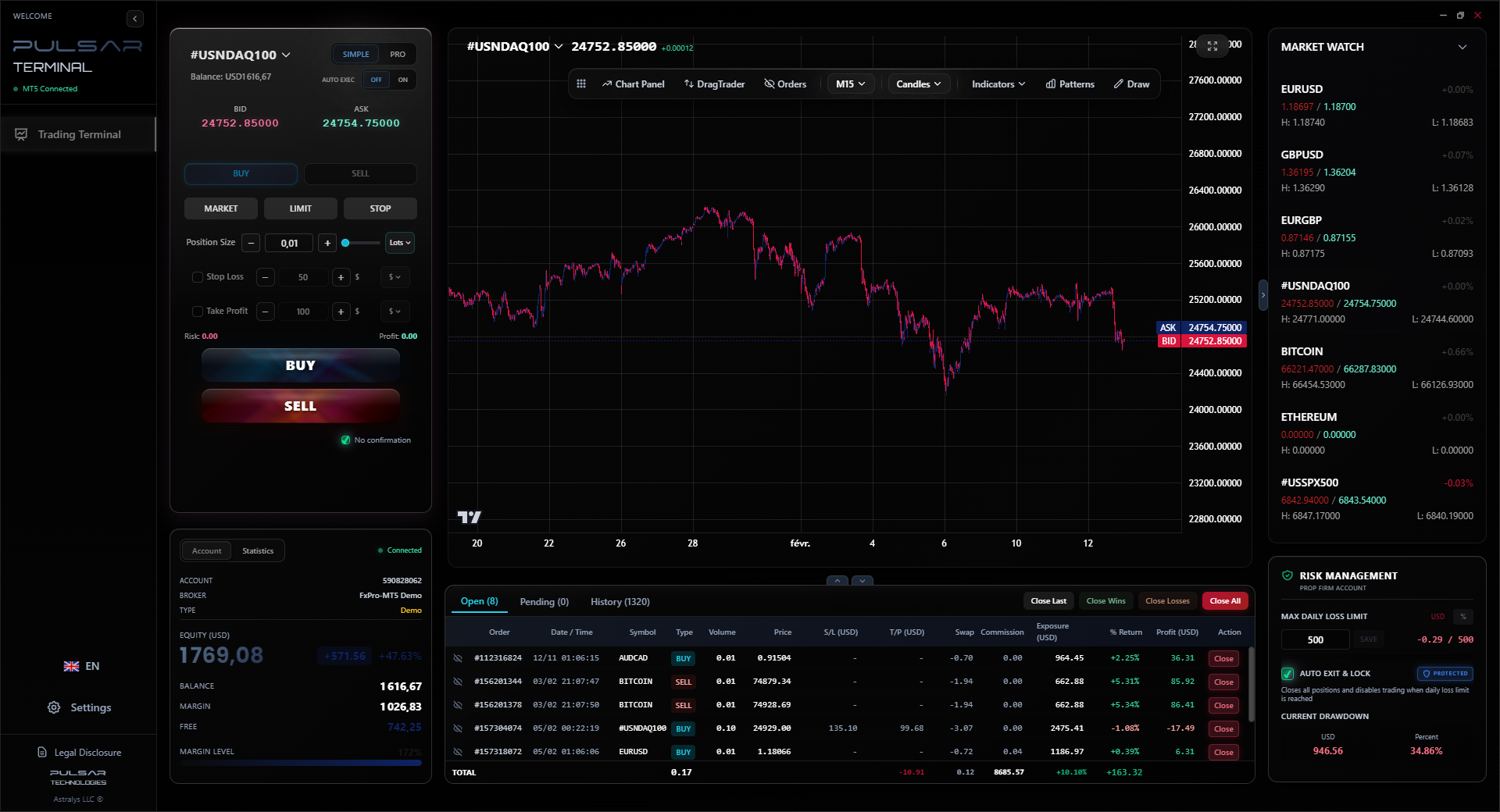
Sticking to a detailed trading plan with multiple take-profit levels is key to long-term success, and tools like Pulsar Terminal let you set and manage complex multi-TP/SL orders directly on your MT5 charts.
Pulsar Terminal
เครื่องมือ MT5 ครบวงจร: ลากวางคำสั่ง, multi-TP/SL, trailing stop, grid trading, Volume Profile และการป้องกัน prop firm ใช้งานโดยเทรดเดอร์กว่า 1,000 คนทุกวัน
If you've read this far and you're still nodding, here's your action plan. Don't skip a step.
- Open a Demo Account: Today. Pick a major broker like the ones mentioned. Trade it for a minimum of 100 hours of screen time.
- Develop Your Plan: Write down your strategy. What pairs? What time frame? What are your exact entry and exit rules? What is your maximum risk per trade (start with 1%)?
- Micro-Fund an Account: After your demo proves you can follow your plan, open a live account with the smallest possible deposit. ₦20,000-₦50,000. Your goal is not profit. Your goal is to execute 50 trades exactly according to your plan, regardless of outcome.
- Analyze Relentlessly: After those 50 trades, review your journal. What worked? What didn't? Refine your plan. Only then consider adding more capital.
- Stay Legal: Keep simple records of your trades. When you start making consistent profits, consult a local accountant to understand your tax filing obligations. It's cheaper than a fine.
This path is slow. It's boring at times. It's the opposite of the hype. But it's the only path I've seen that leads to a trader still being in the game, and thriving, five years from now.
FAQ
Q1Is forex trading actually legal for individuals in Nigeria?
Yes, it is completely legal for individuals to trade forex online in Nigeria. There are no laws prohibiting it. However, the regulatory environment for the online retail side is still developing. The key point is that you cannot use the official Central Bank of Nigeria (CBN) foreign exchange window to fund your trading account.
Q2How much money do I really need to start forex trading in Nigeria?
You can technically start with as little as $1 or ₦100 with some brokers. But realistically, to trade properly with sensible risk management, you need enough so that your minimum position size covers the spread and potential commissions. A more practical starting amount for a 'live simulation' is between ₦50,000 and ₦200,000. This allows you to feel real market pressure without risking financial ruin.
Q3Do I have to pay tax on my forex trading profits in Nigeria?
Yes. The Federal Inland Revenue Service (FIRS) treats trading profits as capital gains, which are taxed at a rate of 10%. You are required to file a tax return and pay what you owe. It's your responsibility to keep records of your trades and profits.
Q4What is the most common mistake new Nigerian traders make?
Using excessive use. Brokers often offer Nigerians extremely high use (1:1000 or more). New traders see this as a way to make huge money with little capital, but it's the fastest way to lose everything. A small move against you with that use will trigger a margin call and wipe out your account. Always use the lowest use that allows you to execute your strategy.
Q5Which trading platform is best for beginners in Nigeria?
MetaTrader 4 (MT4) is still the most popular and beginner-friendly for a reason. It's stable, widely supported by all brokers, and has a huge library of free indicators and tools. MetaTrader 5 (MT5) is its more advanced successor. Start with MT4, get comfortable, and you can always move to MT5 later.
Q6Can I trade the Nigerian Naira (NGN) in forex?
Yes, but mainly as USD/NGN. It's a very popular pair for Nigerian traders because they understand the local economic drivers. However, be warned: it can be extremely volatile due to local economic news and CBN policies. The spreads are often much wider than on major pairs like EUR/USD.
Q7How long does it take to become consistently profitable?
Throw out any notion of '3 months'. A more realistic timeline is 2-3 years of dedicated learning, practice, and losing small amounts of money. The first year is mostly about learning how not to lose. The second year is about finding a strategy that fits your personality. Consistency often comes in the third year, if you've survived the first two with your discipline intact.
บทเรียนจาก Prof. Winston
สรุปสาระสำคัญ:
- ✓Risk a maximum of 1-2% of capital per trade.
- ✓Demo trade for 3-6 months minimum before live money.
- ✓Choose brokers regulated by ASIC, FCA, or CySEC.
- ✓10% capital gains tax applies to your profits.
บทความนี้มีประโยชน์แค่ไหน?
คลิกดาวเพื่อให้คะแนน
ข้อมูลเชิงลึกการเทรดรายสัปดาห์
การวิเคราะห์และกลยุทธ์รายสัปดาห์ฟรี ไม่มีสแปม
เกี่ยวกับผู้เขียน
Olumide Adeyemi
ผู้บุกเบิกการเทรดในแอฟริกาตะวันตก
หนึ่งในนักการศึกษาฟอเร็กซ์ที่กระตือรือร้นที่สุดของไนจีเรีย 8 ปีประสบการณ์เทรดจากลากอส เชี่ยวชาญกลยุทธ์ทุนต่ำและความท้าทาย prop firm สำหรับเทรดเดอร์ในแอฟริกา
ความคิดเห็น
คำเตือนความเสี่ยง
การซื้อขายตราสารทางการเงินมีความเสี่ยงสูงและอาจไม่เหมาะสำหรับนักลงทุนทุกคน ผลการดำเนินงานในอดีตไม่ได้รับประกันผลลัพธ์ในอนาคต เนื้อหานี้มีวัตถุประสงค์เพื่อการศึกษาเท่านั้นและไม่ควรถือเป็นคำแนะนำในการลงทุน โปรดทำการวิจัยของคุณเองก่อนการซื้อขาย
คุณอาจชอบสิ่งนี้

Cara Trading Forex Sukses: 7 Prinsip dari Trader Profesional
Cara trading forex sukses dengan 7 prinsip trader pro: manajemen modal, disiplin, journal trading, backtest. Data nyata, bukan janji profit palsu.
Jam Trading Forex Terbaik untuk Trader Indonesia: Panduan Lengkap dengan Tabel Waktu
Panduan jam trading forex untuk trader Indonesia. Tabel 4 sesi dunia, jam emas 20:00-00:00, sesi mana yang harus dihindari. Data akurat + tips dari trader berpengalaman.
Top 5 Sàn Forex Uy Tín Nhất 2026: Review Jujur dari Trader Indonesia
Top 5 sàn forex uy tín 2026 untuk trader Indonesia. Review jujur: spread, deposit, withdraw, dukungan lokal. Exness, XM, IC Markets & lebih.
รับ Pulsar Terminal
เครื่องคำนวณทั้งหมดนี้ถูกสร้างไว้ใน Pulsar Terminal พร้อมข้อมูลเรียลไทม์จากบัญชี MT5 ของคุณ
รับ Pulsar Terminal