


If you're trying to learn forex in Nigeria right now, you've probably heard the same old story: 'Deposit $100, get 1:1000 use, and become a millionaire in six months.' Let me stop you right there.

Olumide Adeyemi
ผู้บุกเบิกการเทรดในแอฟริกาตะวันตก ·  Nigeria
☕ 10 นาทีอ่าน
สิ่งที่คุณจะได้เรียนรู้:
- 1The Nigerian Forex Reality: It's Legal, But Unregulated (And That's a Problem)
- 2Real Costs & Numbers: What They Don't Show You on the Ad
- 3Choosing a Broker in 2026: Beyond the Hype
- 4My First Big Trading Mistake (And What It Taught Me)
- 5Building a Strategy That Works Here
- 6Managing Your Money & Your Mind
- 7Your First 100 Hours: A Practical Plan for 2026
If you're trying to learn forex in Nigeria right now, you've probably heard the same old story: 'Deposit $100, get 1:1000 use, and become a millionaire in six months.' Let me stop you right there. That's a fast track to losing your money. I know because I believed it too, back in 2014. I blew my first ₦150,000 account in three weeks chasing that dream. The real path to learning forex here isn't about magic use or secret signals. It's about understanding our unique market, the real costs, the taxman, and building a strategy that survives Naira volatility. I'll walk you through exactly what I wish someone had told me.
First things first: trading forex as an individual in Nigeria is completely legal. You won't get arrested for placing a trade on EUR/USD. But here's the critical part almost no one mentions: the online retail forex space isn't specifically regulated by the SEC or CBN. They watch the big banks and official markets, but the platforms you and I use daily operate in a grey area.
This means you're almost certainly using an international broker regulated abroad - think the FSCA in South Africa, CySEC in Cyprus, or the ASIC in Australia. Your protection comes from those foreign bodies, not from Nigerian law. This changes everything about how you choose a broker. You can't just pick the one with the flashiest Instagram ads. You must verify their actual international license.

Warning: A broker having a 'local office' in Lagos doesn't mean they are regulated by the CBN for retail forex trading. Always check their primary regulatory license on the regulator's official website.
And then there's the taxman. Yes, you have to pay tax. Profits from forex trading are subject to Capital Gains Tax at 10%. You must declare this to the FIRS. I learned this the hard way in 2019 after a good year; a friendly accountant saved me from a nasty penalty. Keep a detailed trade journal - it's your best friend come tax season.

💡 เคล็ดลับจาก Winston
Forget the use arms race. The most powerful use you have is compound growth on a consistently profitable, small-risk strategy. A 2% gain per week with 1:30 use beats a 20% gain one week and a 30% loss the next with 1:500.
Let's talk real numbers, because spreads and fees will eat your account if you're not careful. When you learn forex, the first lesson is that 'free' trading is a myth.
Broker Costs: The Silent Account Killer
Spreads vary wildly. On a standard account with a broker like XM or AvaTrade, you might see EUR/USD spreads around 0.8 to 1.0 pips. That's the cost of entry. On a raw spread account from a broker like IC Markets or Pepperstone, you could get 0.0 pips, but you'll pay a commission - often around $6-$7 per standard lot (100,000 units). Which is better? It depends entirely on your trading style. For a high-frequency scalping strategy, the raw spread + commission model is usually cheaper. For a swing trader placing a few trades a week, a commission-free account might be simpler.
Here’s a quick comparison based on my experience:
| Broker Type | Typical EUR/USD Spread | Commission | Best For... |
|---|---|---|---|
| Commission-Free | 0.8 - 1.5 pips | $0 | New traders, swing traders keeping costs simple |
| Raw Spread/ECN | 0.0 - 0.3 pips | $6-$7 per lot | Scalpers, high-volume traders, algorithmic trading |
The Naira Problem
This is the biggest hidden cost for Nigerian traders. The Naira has been on a wild ride. It lost over 50% of its value against the dollar in 2023 alone. Why does this matter? Because you fund your trading account in dollars (or a Naira-equivalent). If you deposit ₦500,000 when the rate is ₦800/$, you have $625. If the Naira strengthens to ₦700/$ by the time you withdraw, your $625 is now only ₦437,500 - you've lost ₦62,500 without placing a single trade. Some brokers like Exness and HFM offer NGN-denominated accounts to hedge this risk. Use them.

Pro Tip: Always check a broker's deposit/withdrawal fees for your preferred method. Local bank transfers can have fees, and card withdrawals might incur conversion charges. Factor this into your position size calculator.
“High use amplifies losses faster than gains.”
With the CBN's recent reforms aiming to stabilize the Naira, the broker landscape is adapting. Here’s my blunt take on picking one.
Regulation is Non-Negotiable. I don't care about their bonus offers. I need to see a top-tier license: FCA (UK), ASIC (Australia), or FSCA (South Africa). Many brokers serving Nigeria operate under their Seychelles (FSA) or BVI licenses, which are lighter-touch. I use these sometimes, but I never keep my entire capital there. Diversify your risk.
Payment Methods are Key. You need a broker that accepts payments that actually work in Nigeria. My go-to list:
- Local bank transfer (direct to their Nigerian bank account)
- Credit/debit cards (Mastercard/Visa)
- Cryptocurrency (USDT is a lifesaver for speed)
- E-wallets like Skrill or Neteller
Brokers like Exness and HFM are popular here for a reason: they've built local payment bridges. IC Markets and Pepperstone are also solid choices for their raw spreads, though funding might require a card or crypto.
use is a Tool, Not a Goal. Yes, you can get 1:1000 or even 'unlimited' use. In 2014, I used 1:500 on a micro account. I turned $200 into $1,200 in two days... and then back to $50 in one horrible London session. High use amplifies losses faster than gains. When you're starting out, I'd cap it at 1:50 max. It forces you to focus on good trade structure, not lottery tickets.
Platform Matters. MT4 and MT5 are the standards. Most educational content uses them. If a broker only has a weird proprietary platform, walk away. You want to learn forex on the tools the pros actually use.
Let me be vulnerable for a second. My most expensive lesson didn't come from a bad trade setup. It came from ignoring my own rules.
It was April 2018. I had a decent swing trading strategy on Gold (XAU/USD). My rule was: maximum 2% risk per trade, always use a stop-loss. The XAU/USD guide I followed stressed its volatility. I saw a 'sure thing' setup. A strong bullish pin bar on the daily chart after a pullback to a key support level. I entered at $1304.50 with a stop at $1299.50. That was a 0.5% risk. So far, so good.
Then price dipped. It touched $1300. My gut screamed 'this is wrong, get out.' But my ego said, 'The support is still holding, be strong.' I moved my stop-loss down to $1295, doubling my risk. Price rallied to $1308. I was in profit! Ego validated. Then it tanked. It blew through my new stop, kept going, and I just... watched. I couldn't press the close button. I was down 5% on my account. A margin call warning popped up. Finally, I closed manually at $1289. Total loss: 7.3% of my account.
I broke every rule: I moved a stop-loss to avoid a small loss, I ignored price action contradicting my thesis, and I let a trade turn into a 'hope' position. That one trade wiped out three weeks of disciplined profits. The lesson was brutal: psychology is 80% of this game. Your strategy is useless if you don't have the discipline to follow it. Now, I use tools that automate my exits. I set my stop and take-profit and I don't touch them unless my original analysis is fundamentally invalidated.
💡 เคล็ดลับจาก Winston
Your trading journal is your most valuable indicator. If you're not reviewing why you entered, why you exited, and what you felt, you're just gambling with a fancy charting package.
“Your strategy is useless if you don't have the discipline to follow it.”
Forget finding a 'winning strategy' online. Your job is to build a strong one that fits your life and our market hours.
Start with Timeframes. Are you a student or have a 9-5? Don't try to scalp the 1-minute chart. You'll get slaughtered. Swing trading on the 4-hour or daily charts is more forgiving. You can analyse in the evening and manage trades around your schedule.
Keep It Stupidly Simple (K.I.S.S.). My core strategy uses just three things: Price Action (support/resistance), the RSI indicator for overbought/oversold zones, and the MACD indicator for trend confirmation. I spent years adding more indicators, only to realize they just gave me more reasons to hesitate.
Backtest and Journal. Before you risk one kobo, test your strategy on historical data. MT4 has a strategy tester. Then, journal every live trade. Not just 'bought EUR/USD.' Write: 'Why did I enter? What did I feel? Why did I exit?' This is how you learn forex for real.
Focus on Major Pairs First. Start with EUR/USD. It's the most liquid, has the tightest spreads, and moves in clear trends. There's a reason we have a dedicated EUR/USD guide. Master one pair before adding others.

Example: A simple swing trade on GBP/USD. You identify support at 1.2500 on the daily chart. Price bounces with a bullish candle. You enter at 1.2520. You place your stop-loss at 1.2480 (40 pips risk). Your take-profit is at 1.2620 (100 pips reward). That's a 1:2.5 risk/reward ratio. You risk 1% of your account. Now, you walk away and let the trade work.
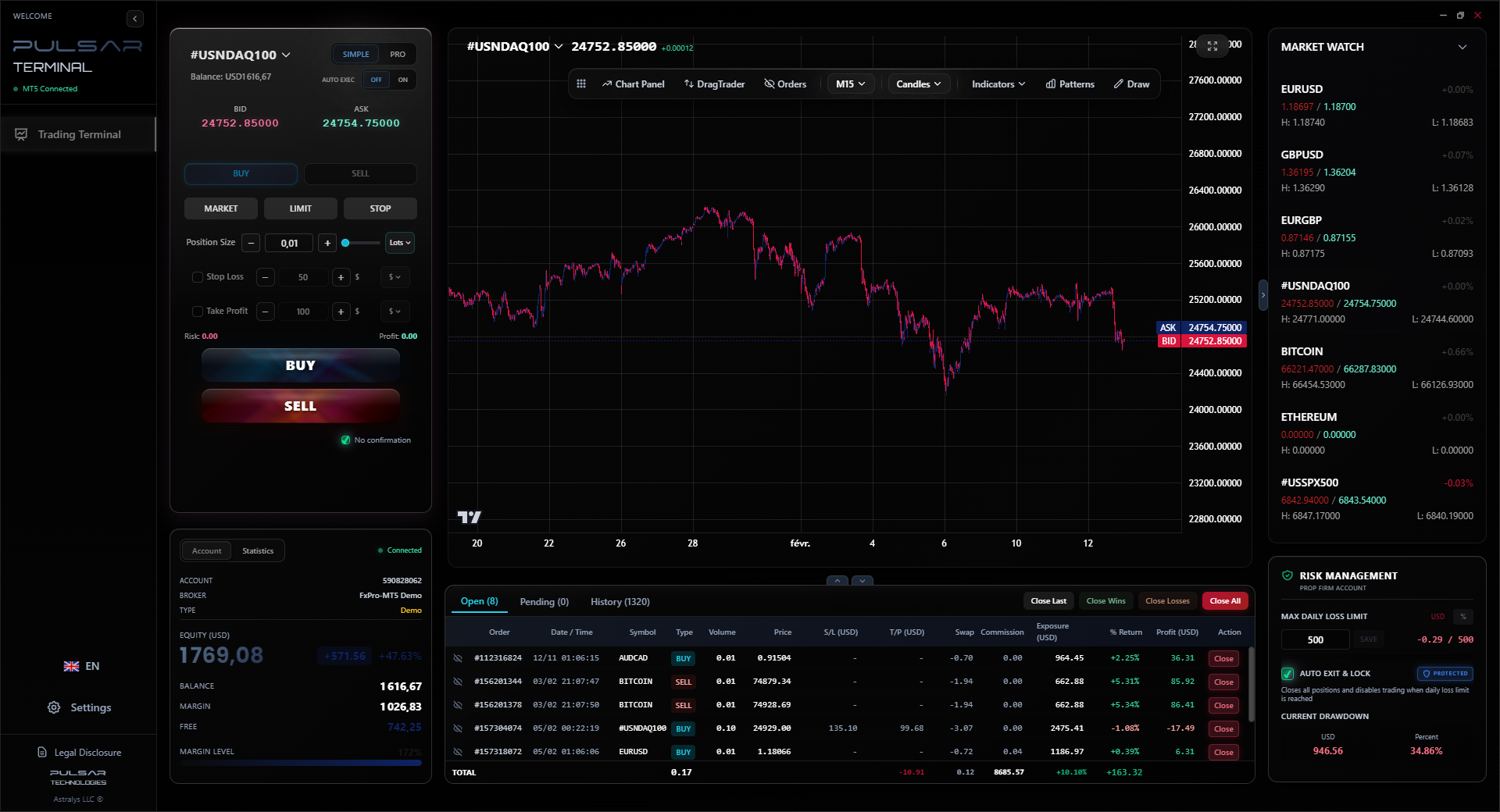
Sticking to a disciplined exit plan is the hardest part, which is why tools like Pulsar Terminal that automate stop-loss, take-profit, and trailing stop orders directly on MT5 are game-changers for enforcing your rules.
Pulsar Terminal
เครื่องมือ MT5 ครบวงจร: ลากวางคำสั่ง, multi-TP/SL, trailing stop, grid trading, Volume Profile และการป้องกัน prop firm ใช้งานโดยเทรดเดอร์กว่า 1,000 คนทุกวัน
This is the chapter that separates survivors from casualties.
Risk Management is Your Sacred Law. Never, ever risk more than 1-2% of your account on a single trade. Use a position size calculator for every entry. If your account is $1,000, a 2% risk is $20. If your stop-loss is 50 pips away on EUR/USD, that means your position size should be 0.04 lots. This math keeps you in the game after a losing streak.
The Psychology of Loss. You will have losing trades. Probably 40-60% of them. I have a 55% win rate. That means I'm wrong almost half the time. The key is that my average winning trade is much bigger than my average loser. You must become comfortable with being wrong. If a trade hits your stop-loss, it's not a failure. It's a successful execution of your plan. The failure is not having a stop-loss.
Beware of 'Prop Firm' Hype. Passing a prop firm challenge is a popular goal. It requires strict daily loss limits (often 5%). This is an excellent discipline trainer, but remember it's a high-pressure test, not a sustainable trading mode. The rules are brutal for a reason.
Create a Routine. My trading day: 7 PM WAT, I review the daily charts for 30 mins. I mark key levels. I set alerts. I do not trade based on this review. I wait for London or New York session opens for confirmation. Emotion is lowest when you're not staring at a blinking screen.
💡 เคล็ดลับจาก Winston
The Naira's volatility isn't just a risk; it's a teacher. It forces you to think in terms of percentage returns on capital, not raw Naira figures. That's a fundamental shift every serious trader must make.
“The forex market isn't going anywhere. Your job isn't to be a genius, it's to be a disciplined executor.”
Here's exactly what I'd do if I was starting from zero today with the knowledge I have.
Weeks 1-2: Education & Simulation.
- Open a demo account with a reputable broker like XM or Pepperstone.
- Learn the absolute basics: what a pip is, what spread means, how use works.
- Practice placing market orders, limit orders, and setting stop-loss/take-profit on your demo.
- Don't even think about 'making money.' Just get comfortable with the platform.
Weeks 3-6: Strategy & Backtesting.
- Pick one simple strategy (like the price action/RSI one I mentioned).
- Go back on your demo chart and 'paper trade' it for the last 3 months. Write down every hypothetical entry and exit.
- Calculate your hypothetical win rate and profit/loss.
- Tweak one variable at a time (e.g., only take trades in the direction of the daily trend).
Weeks 7-12: Live Trading (Micro Account).
- Fund a live account with the absolute minimum you can. For Exness, that's $10. This is real money, so the psychology is real.
- Your only goal for this period is to follow your trading plan on 20 consecutive trades. Not to be profitable. To be disciplined.
- Journal relentlessly. After 20 trades, review everything. Only then should you consider adding more capital.
The forex market isn't going anywhere. The Naira will keep moving. The opportunity is constant. Your job isn't to be a genius. Your job is to be a disciplined executor of a simple plan. That's how you truly learn forex and last in this game.
FAQ
Q1Is forex trading legal and taxable in Nigeria?
Yes, it's legal for individuals to trade forex. And yes, it's taxable. You are required to pay a 10% Capital Gains Tax on your net annual trading profits to the Federal Inland Revenue Service (FIRS). Keep detailed records of all your trades for your tax return.
Q2What is the best broker for beginners in Nigeria?
There's no single 'best,' but look for brokers that combine strong international regulation (like FSCA or ASIC) with easy funding options for Nigerians. Brokers like Exness and HFM offer NGN accounts and local bank transfers, which simplifies the process. Always start with a demo account to test their platform.
Q3How much money do I need to start forex trading in Nigeria?
You can start with very little. Some brokers like FBS or InstaForex allow minimum deposits of $1. However, I strongly advise starting with a minimum of $100-$200 on a micro account. This gives you enough buffer to practice proper risk management (e.g., risking $2 per trade) without being wiped out by a few losses or fees.
Q4Why is the Naira's value important for my forex trading?
You fund and withdraw from your trading account in US Dollars or its Naira equivalent. If the Naira depreciates against the dollar between your deposit and withdrawal, the Naira value of your dollar profits shrinks. Conversely, if the Naira strengthens, you could lose money on the currency conversion alone, even if your trades were profitable.
Q5Can I use high use like 1:1000?
Technically, yes, many brokers offer it. But you absolutely should not, especially as a beginner. High use is a double-edged sword that magnifies losses incredibly fast. It's the number one reason new traders blow up accounts. I recommend using no more than 1:50 while you're learning.
Q6What is the most common mistake new Nigerian traders make?
Two big ones: 1) Chasing high use and 'get-rich-quick' signals instead of learning proper risk management. 2) Not accounting for the cost of converting Naira to dollars and back, which can turn a winning trading strategy into a net loss.
Q7What time should I trade the forex market from Nigeria?
The most liquid and volatile sessions are the London session (8 AM - 5 PM GMT, which is 9 AM - 6 PM Nigerian Time) and the overlap with the New York session (1 PM - 5 PM GMT, 2 PM - 6 PM Nigerian Time). These times offer the best trading opportunities for major pairs like EUR/USD and GBP/USD.
บทเรียนจาก Prof. Winston
สรุปสาระสำคัญ:
- ✓Risk a maximum of 1-2% per trade, no exceptions.
- ✓Verify your broker's international license, not their local ads.
- ✓Factor the 10% Capital Gains Tax into your profit goals.
- ✓Master one major currency pair before adding others.
- ✓A 55% win rate can be highly profitable with good risk/reward.
บทความนี้มีประโยชน์แค่ไหน?
คลิกดาวเพื่อให้คะแนน
ข้อมูลเชิงลึกการเทรดรายสัปดาห์
การวิเคราะห์และกลยุทธ์รายสัปดาห์ฟรี ไม่มีสแปม
เกี่ยวกับผู้เขียน
Olumide Adeyemi
ผู้บุกเบิกการเทรดในแอฟริกาตะวันตก
หนึ่งในนักการศึกษาฟอเร็กซ์ที่กระตือรือร้นที่สุดของไนจีเรีย 8 ปีประสบการณ์เทรดจากลากอส เชี่ยวชาญกลยุทธ์ทุนต่ำและความท้าทาย prop firm สำหรับเทรดเดอร์ในแอฟริกา
ความคิดเห็น
คำเตือนความเสี่ยง
การซื้อขายตราสารทางการเงินมีความเสี่ยงสูงและอาจไม่เหมาะสำหรับนักลงทุนทุกคน ผลการดำเนินงานในอดีตไม่ได้รับประกันผลลัพธ์ในอนาคต เนื้อหานี้มีวัตถุประสงค์เพื่อการศึกษาเท่านั้นและไม่ควรถือเป็นคำแนะนำในการลงทุน โปรดทำการวิจัยของคุณเองก่อนการซื้อขาย
คุณอาจชอบสิ่งนี้

Cara Trading Forex Sukses: 7 Prinsip dari Trader Profesional
Cara trading forex sukses dengan 7 prinsip trader pro: manajemen modal, disiplin, journal trading, backtest. Data nyata, bukan janji profit palsu.
Jam Trading Forex Terbaik untuk Trader Indonesia: Panduan Lengkap dengan Tabel Waktu
Panduan jam trading forex untuk trader Indonesia. Tabel 4 sesi dunia, jam emas 20:00-00:00, sesi mana yang harus dihindari. Data akurat + tips dari trader berpengalaman.
Top 5 Sàn Forex Uy Tín Nhất 2026: Review Jujur dari Trader Indonesia
Top 5 sàn forex uy tín 2026 untuk trader Indonesia. Review jujur: spread, deposit, withdraw, dukungan lokal. Exness, XM, IC Markets & lebih.
รับ Pulsar Terminal
เครื่องคำนวณทั้งหมดนี้ถูกสร้างไว้ใน Pulsar Terminal พร้อมข้อมูลเรียลไทม์จากบัญชี MT5 ของคุณ
รับ Pulsar Terminal