


Over 70% of new Nigerian forex traders lose their first deposit within three months.

Olumide Adeyemi
ผู้บุกเบิกการเทรดในแอฟริกาตะวันตก ·  Nigeria
☕ 9 นาทีอ่าน
สิ่งที่คุณจะได้เรียนรู้:
- 1The Nigerian Forex Reality: It's Not What You See on Instagram
- 2Brokers and Regulations: Navigating the Grey Zone
- 3Building a Foundation That Actually Works
- 4The Psychology of the Nigerian Trader
- 5Pitfalls I Fell Into (So You Don't Have To)
- 6A Structured Learning Path for the Nigerian Beginner
- 7Making the Transition: From Learning to Earning
Over 70% of new Nigerian forex traders lose their first deposit within three months. I was almost one of them. Learning forex trading in Nigeria isn't just about charts and pips, it's a fight against unique local pressures: a volatile Naira, confusing broker regulations, and the constant lure of 'get-rich-quick' signal sellers. This guide is what I wish I'd had when I started.
Let's be blunt. The landscape here is flooded with two extremes: slick Instagram gurus promising Lamborghinis from a $100 account, and a deep-seated public suspicion that forex is just a scam. The truth, as always, is in the messy middle.
When I started, I believed the hype. I funded a $500 account, convinced I'd double it in a month by copying some Telegram signals. I didn't understand the spread definition, didn't have a position size calculator, and got obliterated in two weeks. The signal seller blamed 'market volatility.' My bank account blamed me.
The real environment for learning forex trading in Nigeria is defined by the Naira. Its wild swings against the USD aren't just a trade pair (USD/NGN isn't commonly available to retail traders). It's a macroeconomic backdrop that influences everything. When the Naira is in freefall, the urge to 'hedge' or 'profit' from the chaos is intense, and that emotion leads to reckless trades. You're not just learning a market, you're learning to manage your reaction to a national economic stress test.

Warning: Any 'mentor' who guarantees profits or shows off luxury cars as 'proof' is selling a dream, not education. Real trading is boring, disciplined, and mostly about not losing money.

💡 เคล็ดลับจาก Winston
The Naira's volatility is a background hum, not a trading signal. Never let your personal need for dollars dictate your trade entries. The chart is the only truth that matters.
“Learning forex trading in Nigeria isn't just about charts and pips, it's a fight against unique local pressures.”
This is the single biggest headache for Nigerian traders. There is no local retail forex regulatory body like the SEC in the US or the FCA in the UK. The Central Bank of Nigeria (CBN) has historically been hostile to retail forex trading, focusing instead on the official exchange markets.
So, where does that leave you? Operating in a grey zone. You'll be using international brokers. This means you need to be twice as diligent.
Choosing Your Platform
You want brokers with a solid international reputation, solid execution, and crucially, reliable deposit and withdrawal methods for Nigeria. I've had personal experience with a few. Exness has been popular here for years due to its local bank transfer options, but always compare spreads. IC Markets offers raw spreads which are great for scalping strategies. XM and Pepperstone are also common choices among serious traders I know.
The Funding Problem
Funding is where you'll feel the pinch. International wire transfers are expensive and slow. Most traders rely on cryptocurrencies (USDT) or broker-specific local transfer partners. Always test a small withdrawal first before committing large capital. I learned this the hard way, waiting three anxious weeks for a $200 test withdrawal to clear.

Pro Tip: Your broker is not your bank. Do not keep your life savings in a trading account. Withdraw profits regularly to your Nigerian bank account. It makes the profits real and protects you from any remote broker insolvency.
“The real environment is defined by the Naira. Its wild swings are a macroeconomic backdrop that influences everything.”
Forget the 1000-indicator setups. Learning forex trading in Nigeria, or anywhere, starts with brutal simplicity. You need a framework, not a crystal ball.
I spent my first year jumping from one complicated strategy to another. The breakthrough came when I stripped everything back to price action and one or two indicators. My main chart now is just candlesticks, support/resistance lines, and the RSI indicator for spotting potential reversals when it's overbought or oversold.
Start with the Majors
Don't get fancy with exotic pairs. Stick to majors like EUR/USD and GBP/USD. They have the tightest spreads and most predictable liquidity. Gold (XAU/USD) is also a favourite here, often moving on global risk sentiment.
Define Your Trading Style
Are you sitting at a desk all day? Scalping might seem tempting, but it's high stress and requires lightning-fast execution. Do you have a day job? Then swing trading, where you hold trades for days, is far more realistic. I'm a swing trader. It fits my life and lets me avoid the noise of every minor pip definition movement.
The Non-Negotiables: Journal and Risk
Every trade must be recorded. Entry, exit, reason, emotion. I review mine every Sunday. More importantly, you must risk a fixed percentage per trade. Never, ever risk more than 1-2% of your account on a single idea. Use a position size calculator religiously. This one habit is the line between a setback and a blown account.
“The real environment is defined by the Naira. Its wild swings are a macroeconomic backdrop that influences everything.”
This is the secret sauce nobody talks about enough. Our environment trains us for impatience. Hyperinflation, rapid currency devaluation, and a hustle culture make us seek quick returns. This is poison for a forex trader.
I had to unlearn this. In early 2023, with the Naira crashing, I felt a panic to 'do something.' I forced three trades on USD/JPY, ignoring my rules. Result? A $450 loss in one afternoon. That was my tuition fee for learning that the market doesn't care about your personal financial anxiety.
Fighting 'FOMO' and Pride
You will see people in forums boasting about wins. Ignore them. Your journey is yours alone. The fear of missing out (FOMO) will make you enter late. Pride will make you hold a losing trade, hoping it'll break even. I've been there. I once watched a losing trade in GBP/USD go 50 pips against me, then 100, refusing to close because 'it had to come back.' It didn't. I finally hit my stop-loss, which was now a much larger loss than I'd planned. That was a direct ticket to a margin call warning.
Developing the discipline to follow your plan, especially when it's losing, is the hardest part of learning forex trading in Nigeria. It's a daily mental workout.
💡 เคล็ดลับจาก Winston
Your first live account should be so small that losing it feels like paying for a moderately expensive dinner, not a life-altering disaster. This emotional distance is critical for clear thinking.
“Developing the discipline to follow your plan, especially when it's losing, is the hardest part.”
Let me be the cautionary tale. Here are the concrete mistakes that cost me real money.
1. Overleveraging: Nigerian brokers often offer high use like 1:500 or even 1:1000. It's a trap. I used 1:200 on a EUR/USD trade. A tiny 25-pip move against me wiped out 5% of my account. It felt like a robbery. Now I rarely exceed 1:30.
2. Trading Around CBN Announcements: Trying to guess the CBN's next move on the Naira is a gamble, not trading. The volatility is insane and retail traders are the last to know. I learned to simply reduce my position size or stay out altogether during major local economic announcements.
3. Ignoring Time Zones: The London and New York sessions are where the real volume is. Trading the Asian session from Nigeria can be slow and choppy. I wasted months trading at the wrong times.
4. Not Accounting for Spread Widening: During high volatility (like major US news), spreads can blow out. Your stop-loss might get filled at a much worse price than you set. A tight scalping strategy can be destroyed by this. I switched to swing trading partly because of this.

Example: You buy EUR/USD at 1.0850 with a 1-pip spread. Your stop-loss is at 1.0830 (20 pips away). If news hits and the spread widens to 5 pips, your stop gets triggered at 1.0825. You just lost 25 pips, not 20. That's a 25% bigger loss than you planned for.
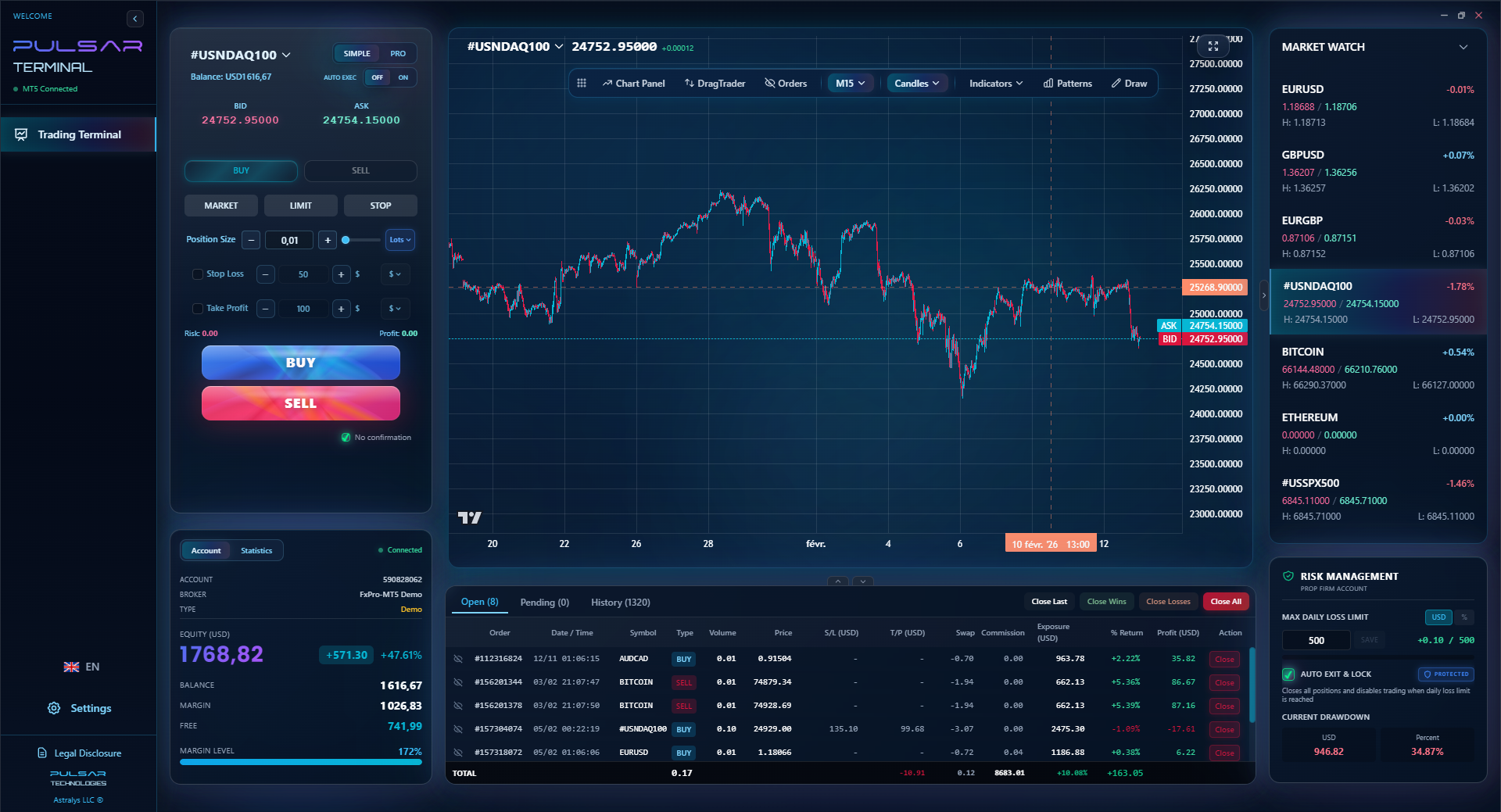
Managing multiple trades and protecting profits during Naira-related volatility is easier with tools that automate risk management, like Pulsar Terminal's trailing stop and partial closure features on MT5.
Pulsar Terminal
เครื่องมือ MT5 ครบวงจร: ลากวางคำสั่ง, multi-TP/SL, trailing stop, grid trading, Volume Profile และการป้องกัน prop firm ใช้งานโดยเทรดเดอร์กว่า 1,000 คนทุกวัน
“Developing the discipline to follow your plan, especially when it's losing, is the hardest part.”
Here's a realistic 6-month roadmap. It's slow, but it builds real skill.
Months 1-2: Demolition & Theory.
- Demolish the 'get rich quick' mindset. Accept this is a skill.
- Learn absolute basics: what is a pip definition, what is a spread, what is use.
- Understand what moves currencies (interest rates, geopolitics, economic data).
- Open a demo account. Don't even think about real money.
Months 3-4: Platform & Price Action.
- Master your trading platform (MT4/MT5). Learn how to place orders, set stops, and take profits.
- Study pure price action. Learn to draw support and resistance.
- Introduce ONE indicator, like the MACD indicator, and learn what it really tells you.
- Start a trading journal on your demo trades.
Months 5-6: Strategy & Risk Simulation.
- Define your rules. When will you enter? Where will you place your stop-loss? How will you take profit?
- Test this strategy on demo for at least 50 trades. Record every single one.
- Calculate your win rate and risk-reward ratio. Are you risking 1% to make 2%? Good.
- Only after 50 consistent, rule-following demo trades should you consider a tiny live account ($100-$200).
The goal of these six months isn't profit. It's survival. It's learning to lose small and consistently execute a plan.
“Your first goal is not to make 100%. Your first goal is to survive for 3 months without blowing up.”
When you finally go live, it will feel different. The numbers are real. This is where your journal and risk management are your armor.
Start with a micro account if possible. Your first goal is not to make 100%. Your first goal is to survive for 3 months without blowing up. Your second goal is to achieve a consistent, small gain each month, even if it's just 2-5%.
I remember my first profitable month after that long demo period. I made 4.2% on a $200 account. That's $8.40. It felt more rewarding than any hypothetical demo 'win' because I had managed my fear and followed my plan. The money proved the discipline.
As you grow, you'll face new challenges: scaling your position size without fear, dealing with winning streaks (they can make you overconfident), and the boredom of discipline. This is the real work of learning forex trading in Nigeria. It's a marathon of self-improvement, measured in pips and percentages, not in flashy cars.
Finally, never stop learning. The market changes. Connect with other serious traders, not for signals, but for perspective. And always, always protect your capital. In a country with economic uncertainty, the preservation of what you have is the first step to building more.
FAQ
Q1Is forex trading legal in Nigeria?
Retail forex trading operates in a regulatory grey area. The CBN does not license or regulate international retail forex brokers. Nigerians trade using brokers regulated overseas (like CySEC, ASIC, FCA). It's not explicitly illegal for you as an individual to trade, but you have no local regulatory protection.
Q2What is the minimum amount to start forex trading in Nigeria?
You can start a demo account with $0. For a live account, some brokers allow you to start with as little as $10-$30. However, I strongly advise starting with a minimum of $100-$200 if you're going live. This allows for proper position size and realistic risk management without being wiped out by a single small loss.
Q3Which broker is best for Nigerian traders?
There's no single 'best' broker. It depends on your needs. Look for brokers with reliable deposit/withdrawal methods for Nigeria (local transfers, crypto), good customer support, and tight spreads. Popular choices include Exness, IC Markets, XM, and Pepperstone. Always do your own research and start with a small test deposit.
Q4How do I withdraw my forex profits to my Nigerian bank account?
Most brokers offer withdrawal back to the method you used to deposit. If you deposited via cryptocurrency (USDT), you'll withdraw to your crypto wallet and then sell on a local P2P platform. Some brokers have local partners for bank transfers. Withdrawals can take from a few hours (crypto) to several business days (bank transfer). Always do a small test withdrawal first.
Q5Can I make a living from forex trading in Nigeria?
It's possible, but it's incredibly difficult and takes years of disciplined practice and a significant capital base. Do not quit your job to trade. Treat it as a serious side business until your trading profits consistently exceed your salary for at least 2 years. Most 'full-time traders' you see online are making money from selling courses, not from trading.
Q6What time should I trade forex in Nigeria?
The most active and liquid sessions are the London session (1 PM - 10 PM Nigerian Time) and the overlapping London/New York session (3 PM - 5 PM Nigerian Time). This is when you'll find the best opportunities and tightest spreads. Avoid the late-night Asian session unless you have a specific strategy for it.
บทเรียนจาก Prof. Winston
สรุปสาระสำคัญ:
- ✓Risk max 1-2% per trade, always.
- ✓The London/New York overlap is your prime time.
- ✓A trading journal is non-negotiable.
- ✓Broker funding methods matter more than bonuses.
บทความนี้มีประโยชน์แค่ไหน?
คลิกดาวเพื่อให้คะแนน
ข้อมูลเชิงลึกการเทรดรายสัปดาห์
การวิเคราะห์และกลยุทธ์รายสัปดาห์ฟรี ไม่มีสแปม
เกี่ยวกับผู้เขียน
Olumide Adeyemi
ผู้บุกเบิกการเทรดในแอฟริกาตะวันตก
หนึ่งในนักการศึกษาฟอเร็กซ์ที่กระตือรือร้นที่สุดของไนจีเรีย 8 ปีประสบการณ์เทรดจากลากอส เชี่ยวชาญกลยุทธ์ทุนต่ำและความท้าทาย prop firm สำหรับเทรดเดอร์ในแอฟริกา
ความคิดเห็น
คำเตือนความเสี่ยง
การซื้อขายตราสารทางการเงินมีความเสี่ยงสูงและอาจไม่เหมาะสำหรับนักลงทุนทุกคน ผลการดำเนินงานในอดีตไม่ได้รับประกันผลลัพธ์ในอนาคต เนื้อหานี้มีวัตถุประสงค์เพื่อการศึกษาเท่านั้นและไม่ควรถือเป็นคำแนะนำในการลงทุน โปรดทำการวิจัยของคุณเองก่อนการซื้อขาย
คุณอาจชอบสิ่งนี้

Cara Trading Forex Sukses: 7 Prinsip dari Trader Profesional
Cara trading forex sukses dengan 7 prinsip trader pro: manajemen modal, disiplin, journal trading, backtest. Data nyata, bukan janji profit palsu.
Jam Trading Forex Terbaik untuk Trader Indonesia: Panduan Lengkap dengan Tabel Waktu
Panduan jam trading forex untuk trader Indonesia. Tabel 4 sesi dunia, jam emas 20:00-00:00, sesi mana yang harus dihindari. Data akurat + tips dari trader berpengalaman.
Top 5 Sàn Forex Uy Tín Nhất 2026: Review Jujur dari Trader Indonesia
Top 5 sàn forex uy tín 2026 untuk trader Indonesia. Review jujur: spread, deposit, withdraw, dukungan lokal. Exness, XM, IC Markets & lebih.
รับ Pulsar Terminal
เครื่องคำนวณทั้งหมดนี้ถูกสร้างไว้ใน Pulsar Terminal พร้อมข้อมูลเรียลไทม์จากบัญชี MT5 ของคุณ
รับ Pulsar Terminal