


Here's a fact that should wake you up: over 80% of the world's daily forex volume trades during the London session and its overlap with New York.

David van der Merwe
เทรดเดอร์ตลาดเกิดใหม่ ·  South Africa
☕ 10 นาทีอ่าน
สิ่งที่คุณจะได้เรียนรู้:
- 1Why London Time is Your Trading Prime Time
- 2The London-New York Overlap: The Real Power Hour
- 3Crafting Your South African Trading Schedule
- 4Regulations, Brokers, and Getting Your Money Right
- 5Essential Tools and the Right Mindset
- 6Pitfalls I've Fallen Into (So You Don't Have To)
- 7Putting It All Together: A London Session Trade Example
Here's a fact that should wake you up: over 80% of the world's daily forex volume trades during the London session and its overlap with New York. For you, sitting in Johannesburg or Cape Town, that's not some distant market noise. It's a daily, predictable explosion of opportunity happening right on your clock, from 10 AM to 7 PM SAST. If you're not structuring your entire trading day around London time forex, you're leaving money on the table and fighting for scraps during the thin, whippy Asian session. I've traded through enough Rand crashes and booms to tell you that understanding this session isn't just helpful, it's non-negotiable.
Let's cut through the noise. The London session (10:00 AM - 7:00 PM SAST) is the heavyweight champion of the forex day. It's when the big banks, hedge funds, and institutional money in Europe are all at their desks. This isn't retail speculation; this is the real flow that moves markets.
For a South African trader, this has two massive implications. First, liquidity goes through the roof. That means the spreads on your major pairs like EUR/USD and GBP/USD tighten right up. I've seen spreads on IC Markets go down to 0.0 pips during this frenzy. Compare that to the 2-3% your local bank might charge for a forex transaction, and you see the edge.
Second, volatility picks up. Real, sustained moves happen. This is where trends are born and breakouts gain momentum. Trying to scalp during the dead Asian hours (our early morning) is like trying to catch a greased pig. The London session gives you a proper market to work with. It's especially critical for trading USD/ZAR, as European demand for commodities and emerging market assets directly impacts our Rand.

Example: On a typical day, the average true range (ATR) for EUR/USD might be 60 pips. During the first two hours of the London session, it's not uncommon to see 30-40 of those pips happen. That's over half the day's movement in a concentrated window.

💡 เคล็ดลับจาก Winston
The first candle of the London session (10:00-10:15 AM SAST on a 15-min chart) often shows false direction. Wait for the second or third candle to confirm the real institutional flow.
“If you're not structuring your entire trading day around London time forex, you're leaving money on the table.”
If the London session is prime time, the overlap with New York (3:00 PM - 7:00 PM SAST) is the super-prime, ultra-liquidity, volatility-on-steroids event. This is the single most important four hours of the trading day. Full stop.
From 3 PM SAST, the New York desks come online while London is still in full swing. The trading volume during this window can account for well over 50% of the entire day's global forex turnover. For you, this means:
- Slippage becomes minimal. Your market orders get filled at the price you see.
- News reactions are explosive. Major US economic data (like Non-Farm Payrolls) is often released at 4:30 PM SAST, right in the heart of this overlap. The resulting moves are sharp and decisive.
- It's the best environment for day trading and scalping. The high volume supports quick entries and exits. I built my early career as a scalping strategy practitioner almost exclusively during this overlap.
A personal lesson: I once tried to hold a swing trade in GBP/JPY through this overlap without adjusting my stop. A surprise headline hit at 4:15 PM SAST, and the 90-pip spike against me happened in under two minutes. I learned the hard way that your risk management needs to be airtight during these hours. Consider using a trailing stop, which you can automate with tools like Pulsar Terminal to lock in profits as the market runs.
“The London-New York overlap is the single most important four hours of the trading day. Full stop.”
You have a geographical and temporal advantage. Use it. Here’s how I structure a trading day based in SA:
Pre-London (7:00 AM - 10:00 AM SAST): This is the tail end of Asia/start of Europe. It's analysis time, not action time. Review your charts, mark up key support/resistance levels, and set alerts. Check the economic calendar for any European or UK news due at 11:00 AM SAST (9:00 AM UK). Do not force trades here.
London Open (10:00 AM - 1:00 PM SAST): The first hour is often the most volatile. Institutional orders flood the market. I look for breakouts of the Asian session range. Be ready. Have your platform open and your position size calculator handy.
Mid-London (1:00 PM - 3:00 PM SAST): Sometimes a lull sets in as Europe goes to lunch. It's a good time to assess early trades, manage positions, or prepare for the overlap.
The Overlap (3:00 PM - 7:00 PM SAST): Trading time. This is when I'm most active. Focus on the major pairs and crosses. Be extra vigilant around 4:30 PM SAST for US news.
Post-Overlap (7:00 PM onwards SAST): London closes, New York winds down. Volume dries up. I close any day trades. It's time to review, journal, and walk away. Trying to trade after 8 PM SAST is usually a frustrating exercise in watching paint dry.
Choosing Your Pairs
Stick to the most liquid pairs during these hours: EUR/USD, GBP/USD, USD/JPY, and of course, USD/ZAR. The EUR/USD guide is essential reading, as it's the most traded instrument in the world and behaves predictably with London volume.
💡 เคล็ดลับจาก Winston
If you're trading USD/ZAR, keep one eye on the EUR/USD chart during London hours. Big moves in the Euro often lead the Rand by a few minutes, giving you a predictive edge.
“The London-New York overlap is the single most important four hours of the trading day. Full stop.”
Trading with London liquidity is one thing. Doing it with a reliable, well-regulated broker is another. In South Africa, the Financial Sector Conduct Authority (FSCA) is your watchdog. Always check a broker's FSP number.
The 1:30 use cap for retail traders is a reality. It's there to protect you from yourself, frankly. The talk of a possible increase to 1:200 by 2026 is just that - talk. Plan with 1:30.
Funding your account has gotten easier. Use brokers that support Instant EFT or PayShap. I've had deposits hit my Pepperstone review account in minutes, not days. This agility is crucial when you need to act on a London session setup.
Here’s a quick comparison of some FSCA-regulated brokers relevant for session trading:
| Broker | Key Feature for London Session | Min. Deposit (approx.) |
|---|---|---|
| IC Markets | Raw spreads, often 0.0 pips on majors during peak hours. | $200 (R~3,700) |
| XM | Strong ZAR support, low minimum deposit. | R75 |
| AvaTrade | FSCA licensed, user-friendly platforms. | $0 (R0) |
| FP Markets | Good all-rounder with tight spreads. | $100 (R~1,850) |
Remember, your broker's server time matters. Most are set to GMT+2 or GMT+3. Ensure you know the offset to your SAST so your economic calendar times match up. A margin call at the wrong time because you miscalculated session open is a brutal teacher.
“I treat the 10 AM - 7 PM SAST window as my 'office hours.' The volatility will punish distraction.”
Trading the London session isn't just about watching the clock. You need the right setup.
Platforms: MT4/MT5 are the standards. Their stability during high volume is proven. I use MT5 with the Pulsar Terminal add-on for advanced order management. Dragging and dropping multiple take-profit levels onto a chart as the London volatility kicks off is a game-saver.
Indicators: Keep it simple. Volume is your primary indicator during these hours. I use a simple Volume Profile tool to see where the big trades are going through. For confirmation, the MACD indicator on a 1-hour or 15-minute chart can help identify momentum shifts as London gets going.
Mindset: This is a professional session. It demands focus. You can't be half-watching while at your day job (though I know many try). The volatility will punish distraction. I treat the 10 AM - 7 PM SAST window as my "office hours." I also know when to step back. If I take two losing trades in the first 90 minutes of London, I'm done for the day. The session will still be there tomorrow.

Warning: The high volatility is a double-edged sword. A 50-pip stop-loss can get hit much faster than during the Asian session. Always calculate your risk per trade as a percentage of your capital, not just a pip distance. A 2% loss rule is non-negotiable.
💡 เคล็ดลับจาก Winston
Set a phone alert for 2:55 PM SAST. That's your 5-minute warning before the volatility of the London-New York overlap hits. Get focused, check your open trades, and be ready.
“I treat the 10 AM - 7 PM SAST window as my 'office hours.' The volatility will punish distraction.”
Let me be vulnerable. I've blown up an account. It was 2018, and it was directly related to a misunderstanding of London time forex.
Mistake 1: Overtrading the Open. The first hour is exciting. I mistook high volume for a clear direction. I'd jump in on every little spike, racking up commissions and spread definition costs. I once placed 7 trades in the first 45 minutes. Six were losers. The net loss was small, but the psychological damage was huge.
Mistake 2: Ignoring the Economic Calendar. UK GDP data was due at 11:00 AM SAST. I was in a short GBP/USD trade from the Asian session, thinking I was clever. The data smashed expectations. GBP ripped 80 pips higher in seconds, blowing through my stop and my daily loss limit. I learned: never hold a sensitive position into major news for that region.
Mistake 3: Trading Exhaustion. The overlap finishes at 7 PM. That's a long day if you start at 10 AM. I'd try to "catch one more move" in the thin New York afternoon. The moves are erratic, spreads widen, and it's pure gambling. My win rate after 7:30 PM SAST is historically terrible.
The Fixes:
- Wait 30-60 minutes after the London open for the initial frenzy to settle and a direction to establish.
- Use an economic calendar. If major news is within 30 minutes, either don't trade or use a pending order outside the expected volatility range.
- Set a hard stop time. Mine is 7:15 PM SAST. No new trades after that. This discipline alone saved my second trading account.
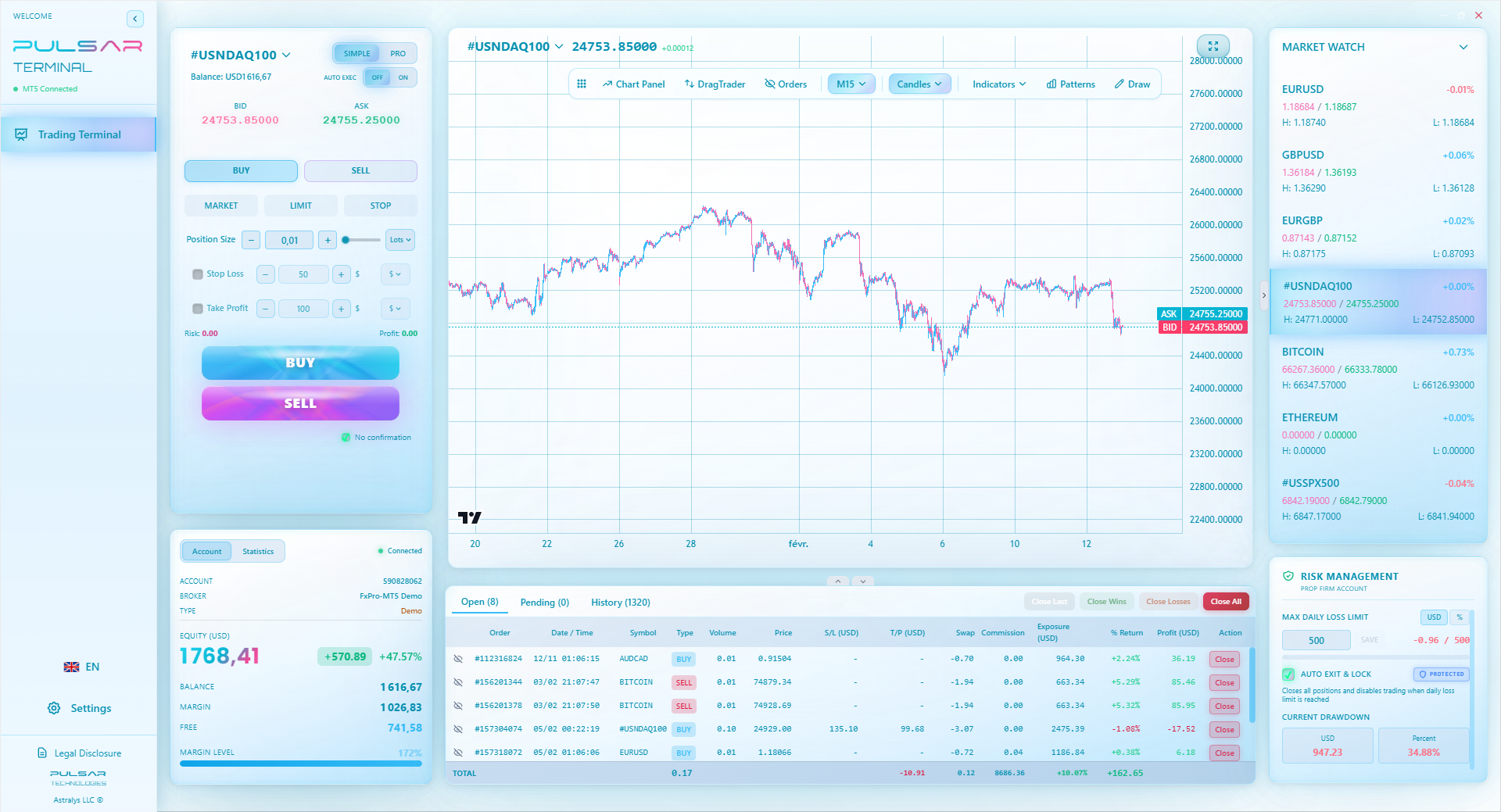
Managing complex trades with multiple profit targets during the fast-paced London session is easier with tools that automate partial closures and trailing stops directly on your MT5 chart.
Pulsar Terminal
เครื่องมือ MT5 ครบวงจร: ลากวางคำสั่ง, multi-TP/SL, trailing stop, grid trading, Volume Profile และการป้องกัน prop firm ใช้งานโดยเทรดเดอร์กว่า 1,000 คนทุกวัน
“I learned the hard way that your risk management needs to be airtight during these hours.”
Let's walk through a real trade I took recently on USD/ZAR, putting these principles into action.
Date: April 3, 2025 Pre-Session Analysis (9:00 AM SAST): USD/ZAR had been in a steady downtrend on the daily chart. The Asian session saw it consolidate in a tight 30-pip range around R18.45. I marked resistance at R18.52 (previous day's high) and support at R18.38.
The Setup (10:30 AM SAST): London volume was established. Price tested R18.52 resistance and showed clear rejection - a bearish pin bar on the 15-minute chart. The RSI indicator was curling down from near 60. My thesis: London sellers would push it back down towards the Asian range low.
The Trade:
- Entry: Sell at R18.505
- Stop Loss: R18.575 (just above the resistance level)
- Take Profit 1: R18.420 (partial profit)
- Take Profit 2: R18.380 (Asian session support)
The Result: The trade played out perfectly over the next 3 hours. Price drifted down, accelerated during the London-New York overlap, and hit my first TP. I moved my stop to breakeven. It then tapped R18.385, just shy of my second TP, before bouncing. I closed the remainder at R18.40.
Why It Worked:
- I waited for London liquidity (not trading the Asian chop).
- I traded with the broader daily trend.
- I used clear, recent price levels for my stops and targets.
- I took partial profit, reducing risk as the trade went my way during the volatile overlap.
This is the rhythm you're looking for. It's not about catching the absolute high or low. It's about using the predictable energy of the London time forex window to execute a clear plan. For managing multiple take-profit levels like this seamlessly, a tool that integrates with MT5 is useful.
FAQ
Q1What exactly are the London session hours in South African time?
The core London forex session runs from 10:00 AM to 7:00 PM South African Standard Time (SAST). The most volatile and liquid period is the overlap with New York, from 3:00 PM to 7:00 PM SAST.
Q2Is it better to trade during the London or New York session from South Africa?
For South Africans, the London session is more accessible and still offers tremendous liquidity. However, the London-New York overlap (3-7 PM SAST) is objectively the best period, combining the highest volume of both sessions. The pure New York session (after 7 PM SAST) sees dropping volume and is less ideal.
Q3What are the best currency pairs to trade during London hours?
Focus on the majors involving the Euro, Pound, and US Dollar: EUR/USD, GBP/USD, and USD/JPY. These have the tightest spreads and most reliable momentum during London hours. USD/ZAR is also highly active due to European interest in emerging markets.
Q4I have a day job until 5 PM. Can I still trade the London session?
Yes, but you'll be focusing on the tail end of the overlap. The 5 PM - 7 PM SAST window is still highly active. Your strategy should adapt: look for continuation or reversal setups from moves that began earlier, rather than trying to catch the initial breakout. Swing trading setups identified before London open can also be managed during this time.
Q5How does the FSCA's 1:30 use cap affect trading the volatile London session?
It forces smarter position sizing. You can't just throw a tiny margin at a huge position. You must calculate your risk based on your capital, not the use offered. This is actually a good thing. It prevents you from being wiped out by a single, sharp London session spike. Always use a position size calculator.
Q6Are international brokers better for trading the London session than local South African brokers?
Not necessarily 'better,' but many top international brokers like IC Markets or Pepperstone are FSCA-regulated and offer superior trading conditions - specifically, tighter spreads and faster execution - which are critical during high-speed London volatility. Always verify their FSCA status. Check our Exness review and others for specifics.
Q7What's the biggest mistake new traders make during the London open?
Overtrading the first 30 minutes. The initial surge of volume creates false breakouts and whipsaws. The smart move is to watch for the first 60-90 minutes, let the market establish a range or direction, and then trade the re-test of a key level with the added confirmation of high volume.
บทเรียนจาก Prof. Winston
สรุปสาระสำคัญ:
- ✓Trade the London session: 10 AM - 7 PM SAST.
- ✓Maximize the 4-hour London-New York overlap (3-7 PM SAST).
- ✓Use tight-spread brokers for major pairs during peak volume.
- ✓Never hold sensitive positions into major regional news.
- ✓Set a hard stop time after 7:15 PM SAST.
บทความนี้มีประโยชน์แค่ไหน?
คลิกดาวเพื่อให้คะแนน
ข้อมูลเชิงลึกการเทรดรายสัปดาห์
การวิเคราะห์และกลยุทธ์รายสัปดาห์ฟรี ไม่มีสแปม
เกี่ยวกับผู้เขียน
David van der Merwe
เทรดเดอร์ตลาดเกิดใหม่
เทรดเดอร์ประจำโจฮันเนสเบิร์ก มีประสบการณ์ 11 ปีในสกุลเงินตลาดเกิดใหม่ เชี่ยวชาญคู่ ZAR การเทรดภายใต้กฎระเบียบ FSCA และการวิเคราะห์ตลาดแอฟริกาใต้
ความคิดเห็น
คำเตือนความเสี่ยง
การซื้อขายตราสารทางการเงินมีความเสี่ยงสูงและอาจไม่เหมาะสำหรับนักลงทุนทุกคน ผลการดำเนินงานในอดีตไม่ได้รับประกันผลลัพธ์ในอนาคต เนื้อหานี้มีวัตถุประสงค์เพื่อการศึกษาเท่านั้นและไม่ควรถือเป็นคำแนะนำในการลงทุน โปรดทำการวิจัยของคุณเองก่อนการซื้อขาย
คุณอาจชอบสิ่งนี้

Cara Trading Forex Sukses: 7 Prinsip dari Trader Profesional
Cara trading forex sukses dengan 7 prinsip trader pro: manajemen modal, disiplin, journal trading, backtest. Data nyata, bukan janji profit palsu.
Jam Trading Forex Terbaik untuk Trader Indonesia: Panduan Lengkap dengan Tabel Waktu
Panduan jam trading forex untuk trader Indonesia. Tabel 4 sesi dunia, jam emas 20:00-00:00, sesi mana yang harus dihindari. Data akurat + tips dari trader berpengalaman.
Top 5 Sàn Forex Uy Tín Nhất 2026: Review Jujur dari Trader Indonesia
Top 5 sàn forex uy tín 2026 untuk trader Indonesia. Review jujur: spread, deposit, withdraw, dukungan lokal. Exness, XM, IC Markets & lebih.
รับ Pulsar Terminal
เครื่องคำนวณทั้งหมดนี้ถูกสร้างไว้ใน Pulsar Terminal พร้อมข้อมูลเรียลไทม์จากบัญชี MT5 ของคุณ
รับ Pulsar Terminal