


Most people get the momentum meaning in forex completely wrong.

David van der Merwe
เทรดเดอร์ตลาดเกิดใหม่ ·  South Africa
☕ 12 นาทีอ่าน
สิ่งที่คุณจะได้เรียนรู้:
- 1What Momentum Really Means (It's Not What You Think)
- 2Your Toolbox: How to Actually Measure Momentum
- 3Trading Momentum in the South African Market: The Realities
- 4The Pitfalls: Where South African Momentum Traders Go Wrong
- 5A Simple Momentum Trading Plan You Can Start With
- 6The Foundation: Your Broker and Platform in South Africa
Most people get the momentum meaning in forex completely wrong. They think it's about buying when things are going up. It's not. Real momentum trading is about buying when things are going up and have the fuel to keep going. It's the difference between jumping on a moving bus and jumping in front of one. Here in South Africa, with our volatile Rand and growing market, understanding this distinction is what separates the 72% who blow up their accounts from the few who build consistent profits. I'll show you how to spot the real moves, not just the noise.
Let's clear this up right away. Momentum isn't just price going up. Any chart can show a green candle. The momentum meaning in forex is about the rate of change and the force behind the move. Think of it like a rugby player breaking through the line. The initial break is one thing, but the real opportunity is when he's got a full head of steam, the defense is scrambling, and he's got a clear path to the try line. That's momentum.
In trading terms, it's the combination of speed and volume. A price can rise slowly on low volume - that's weak, and it'll reverse on you quickly. A price that surges on high volume has conviction. It has momentum. This is why so many new traders get chopped up. They see a few up candles on the USD/ZAR chart and jump in, only to get caught when the move fizzles because there was no real power behind it.
I learned this the hard way back in 2018. The EUR/USD had a nice little run-up over a week. I thought, "Great, momentum!" and bought in at 1.2350. The price crawled another 10 pips, then reversed hard. I ended up taking a 40-pip loss. Why? I looked at the volume profile afterward (a tool I wish I'd used then). The entire move was on declining volume. No real force. I was chasing a ghost.

Warning: Don't confuse a short-term retracement in a strong trend with a momentum reversal. A strong trend will have pullbacks. The momentum is still intact if the pullbacks are shallow and on low volume.

💡 เคล็ดลับจาก Winston
Momentum is a measure of force, not fortune. Trade the confirmation of force, not the hope of it.
You can't trade what you can't measure. Guessing doesn't work. You need objective tools. Here are the ones I've relied on for over a decade, adjusted for our South African context where we often trade majors and the ZAR pairs.
The Momentum Indicator (The Obvious One)
This is the straightforward one. It calculates the difference between the current closing price and the closing price n periods ago. When the line is above zero, price is higher than it was n periods ago - uptrend momentum. Below zero is downtrend momentum. Simple. But its real power is in divergence.
If price makes a new high but the Momentum Indicator makes a lower high, that's a bearish divergence. The engine is running out of steam. I caught a great short on Gold (XAU/USD) using this in 2022. Price peaked at $1877, but the Momentum indicator peaked lower. I shorted at $1870 and rode it down to $1820. That's momentum warning you before the price collapses.
The RSI – Your Overbought/Oversold Gauge
The RSI indicator is a momentum oscillator. It's fantastic, but South African traders often misuse it. Reading it as overbought (>70) or oversold (<30) is just the start. In a strong trend, the RSI can stay overbought or oversold for a very long time. Trying to short every time the EUR/USD RSI hits 75 in a bull market is a recipe for disaster.
The smarter way? Look for RSI failure swings. If the RSI makes a lower high while price makes a higher high during an uptrend, that's your warning sign. Also, watch the 50 level. In an uptrend, the RSI tends to find support at 50 on pullbacks. If it breaks below 50, the uptrend momentum might be broken.
MACD – The Trend Momentum Confirmer
The MACD indicator is a bit more complex but incredibly useful. It shows the relationship between two moving averages. I use it for two things: 1) The crossover of the MACD line and the signal line for entry signals, and 2) The histogram to gauge the strength of the momentum.
When the histogram bars are getting taller, momentum is accelerating. When they start shrinking, momentum is waning, even if the price is still moving in the same direction. It's like watching the rev counter on a car. The speed (price) might still be high, but if the revs (histogram) are dropping, you're about to lose power.

Pro Tip: Don't use these indicators in isolation. I wait for at least two to agree. For example, a Momentum bearish divergence plus the RSI showing a failure swing. That confluence dramatically increases your odds.
Here’s a quick comparison of how I use them:
| Indicator | Primary Use | South African Market Note |
|---|---|---|
| Momentum | Spotting divergences & rate of change. | Great on volatile pairs like USD/ZAR, but use a longer period (14-20) to filter noise. |
| RSI | Identifying exhaustion & trend strength via the 50 level. | On ZAR pairs, be wary of false signals around SA market open (9am SAST) due to sudden liquidity shifts. |
| MACD | Confirming trend direction & measuring acceleration/deceleration. | The standard (12,26,9) settings work well on majors like EUR/USD. For faster pairs, try (8,17,9). |
“Letting a winner turn into a loser is the most demoralizing thing in trading.”
Trading from South Africa isn't the same as trading from London or New York. We have unique advantages and headaches. You need a strategy that accounts for our time zone, our currency's personality, and our regulatory environment.
First, the Rand. USD/ZAR, EUR/ZAR - these are our home games. They can be incredibly trendy, but the spreads are wider and the moves can be news-driven and gap-prone. Trading pure momentum on these pairs requires a wider stop-loss and a very keen eye on local news (SARB announcements, political headlines, load-shedding schedules). I prefer to apply momentum strategies to the major pairs (EUR/USD, GBP/USD) where liquidity is deeper and spreads are tighter, often below 1 pip with a good broker like IC Markets or Pepperstone.
Our trading day is also key. The sweet spot for momentum is during the London (10am-1pm SAST) and London/New York overlap (3pm-5pm SAST). This is when volume and volatility peak, creating the strongest, most reliable momentum moves. Waking up at 2am to trade the Tokyo session for momentum? Not worth it for most of us. The moves are thinner and easier to get whipsawed in.
Now, let's talk about the upcoming 1:200 use cap for majors (expected early 2026). This is a game-saver disguised as a limitation. High use is the number one reason for those 72% account blow-ups. Momentum trading can lead to quick losses if you're wrong. With a 1:200 cap, your position size is automatically limited, forcing better risk management. It protects you from yourself. Always calculate your risk with a position size calculator before entering any trade, regardless of the use available.

Example: Let's say you have a ZAR 20,000 account and you want to buy EUR/USD, risking 1% (ZAR 200). Your stop-loss is 20 pips away. With EUR/USD at 1.0850, a 1 pip move on a standard lot is $10. To risk ZAR 200 (~$11), you can only afford to risk about 11 USD. That means your position size should be roughly 0.05 lots. High use might let you trade 1 lot, but that would risk your entire account on a 20-pip move. The cap helps prevent this suicide.
💡 เคล็ดลับจาก Winston
The higher timeframe trend is the tide. Your momentum trade is the wave. Never swim against the tide.
I've made these mistakes. My friends have made them. Let's skip the pain and go straight to the lessons.
1. Chasing the Pop. This is the big one. You see USD/ZAR rocket 50 pips in 5 minutes. FOMO kicks in. You buy at the top. The move exhausts, reverses, and you're left holding a bag. Real momentum entries are not in the middle of a vertical spike. They are either early in the move as the trend confirms, or on a controlled pullback to a key support level in an uptrend. Wait for the pullback.
2. Ignoring the Higher Timeframe. You're looking at a beautiful momentum setup on the 15-minute chart. But on the 4-hour chart, price is smack against a massive resistance level. Guess which one wins? Always check the next higher timeframe (at least one) to see if you're trading with or against the larger trend. Trading with the higher timeframe momentum is like swimming with the current.
3. Forgetting About the Spread. On a volatile pair like GBP/ZAR, the spread can be 15-20 pips easily. If you're in a scalping strategy looking for 30-pip profits, you've just given away half your potential profit before you start. Your momentum move needs to be strong enough to overcome the transaction cost. This is why I stick to majors for short-term momentum plays.
4. No Exit Plan. You caught a great momentum move. It's up 80 pips. Greed says, "It'll go to 100!" Then it reverses and you give back 50. You must have a profit-taking plan. Use a trailing stop, or scale out (take partial profits at predefined levels). Letting a winner turn into a loser is the most demoralizing thing in trading.
A personal story: In early 2025, I was long on Gold during a strong uptrend. I was up 120 pips. I got greedy, moved my stop to breakeven, and decided to "let it run." A surprise hawkish Fed comment came out, Gold dumped 200 pips in minutes, and I was stopped out at breakeven. I turned a great winner into a pointless trade. Now, I always use a trailing stop or take at least half off the table when I'm up a solid amount.
“Your strategy is only as good as the tools you use. For momentum trading, execution speed and low costs are critical.”
Theory is useless without action. Here's a basic, actionable framework for a momentum trade. Let's use EUR/USD as an example.
Step 1: Find the Trend on the 4-Hour Chart. Is the price above its 50-period moving average? Are the highs and lows generally rising? If yes, we only look for long (buy) setups on lower timeframes. No guessing.
Step 2: Wait for a Pullback on the 1-Hour Chart. In our uptrend, price pulls back to a previous support level or the rising 20-period MA. The pullback should show slowing selling pressure (smaller red candles, declining volume).
Step 3: Confirm Momentum on the 15-Minute Chart. As price approaches the support level on the 1-hour, switch to the 15-minute chart. Wait for a bullish reversal candle (like a hammer or engulfing pattern). Now, check your indicators:
- Momentum Indicator: Is it starting to turn up from a low level?
- RSI: Is it bouncing from above 30 or, better yet, from the 50 area?
- MACD: Is the histogram starting to rise, or is a bullish crossover imminent?
If you have at least two confirmations, you have a signal.
Step 4: Execute with Discipline.
- Entry: Buy on a break of the high of the reversal candle.
- Stop-Loss: Place it 10-15 pips below the low of the pullback.
- Take Profit: Aim for a risk-reward ratio of at least 1:2. If your stop is 15 pips, your target should be 30 pips away. Or, use the previous swing high as a target.
This isn't a guaranteed win, but it's a disciplined process that puts probability on your side. It forces you to trade with the trend, wait for confirmation, and manage your risk. This is the core of the momentum meaning in forex: disciplined exploitation of confirmed force.
Pro Tip: Keep a trading journal. Write down every trade: the setup, why you took it, your emotional state, the outcome. Review it weekly. Your biggest improvements will come from analyzing your own decisions, not from hunting for a new indicator.
💡 เคล็ดลับจาก Winston
Your first profit target should be to recover your risk. Once your stop-loss is at breakeven, you're trading with the market's money. That changes everything.
Executing a disciplined momentum plan requires precise order management, which tools like Pulsar Terminal provide directly on your MT5 charts.
Pulsar Terminal
เครื่องมือ MT5 ครบวงจร: ลากวางคำสั่ง, multi-TP/SL, trailing stop, grid trading, Volume Profile และการป้องกัน prop firm ใช้งานโดยเทรดเดอร์กว่า 1,000 คนทุกวัน
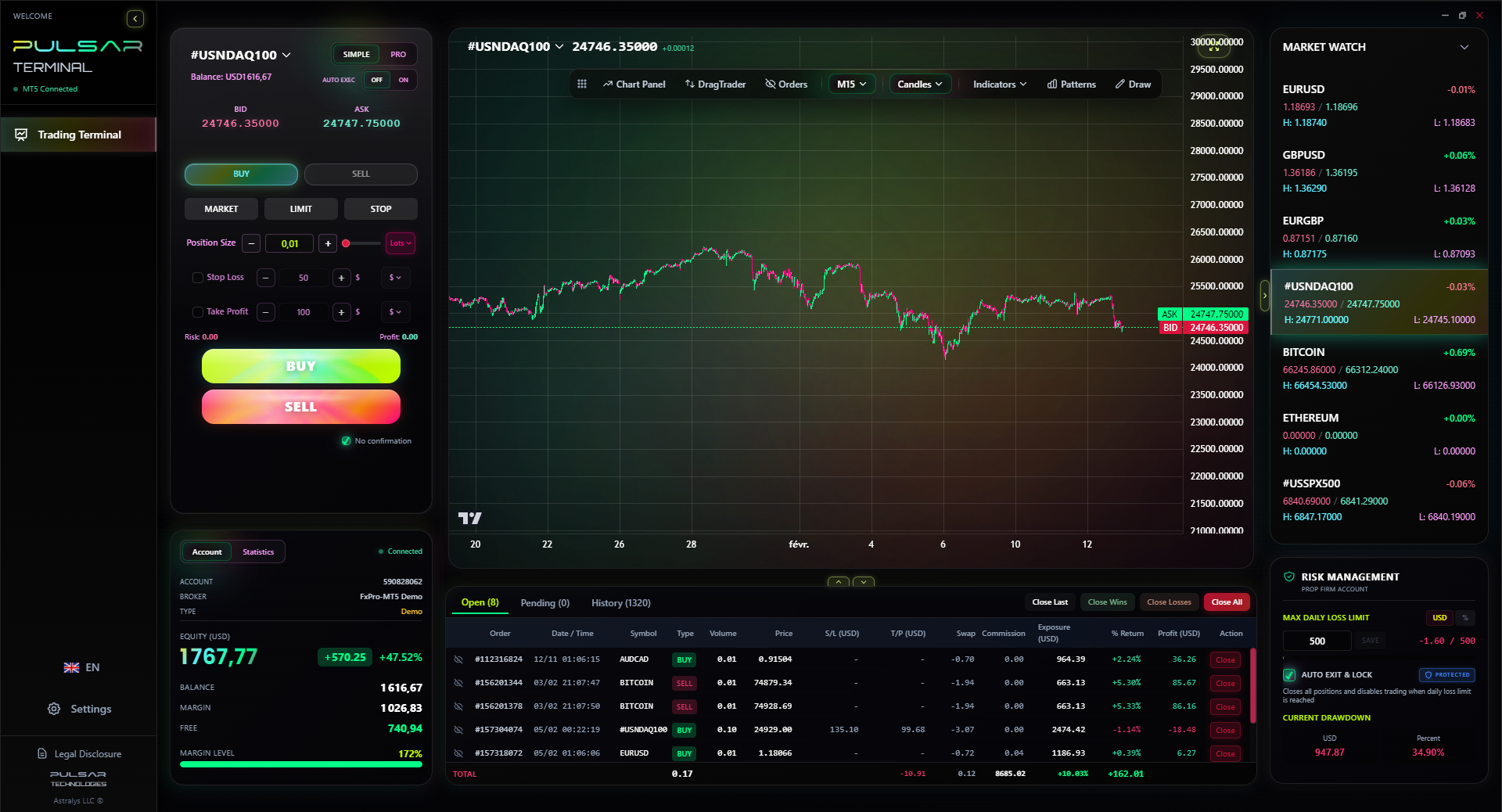
Your strategy is only as good as the tools you use. For momentum trading, two things are critical: execution speed and low costs.
Execution Speed: When you click buy on a momentum breakout, you need to get filled at or near that price. Slippage (getting a worse price) can kill a good setup. Look for brokers with a reputation for fast, reliable execution. Many South African traders use international brokers with strong reputations and local regulation.
Low Costs: This means tight spreads and transparent commissions. Every pip you save on the spread is a pip added to your profit. For example:
- Exness offers tight spreads on its Pro account.
- IC Markets is famous for its raw spreads starting from 0.0 pips on majors (with a small commission).
- XM offers commission-free accounts with competitive spreads and a very low minimum deposit, which is great for starting out.
Always check if the broker is FSCA regulated. It's your safety net. Funding in ZAR is also a huge plus to avoid bank conversion fees. Brokers like Khwezi Trade (fully local) or the international ones with ZAR accounts make this easy.
For platforms, MetaTrader 4 or 5 is the standard for a reason. They're stable, have all the indicators we've discussed, and support automated trading if you go down that route later. The community and resources around MT4/5 are massive. cTrader is another excellent option, known for its clean interface and great order execution, offered by brokers like Pepperstone.
Remember, the platform is your cockpit. Get comfortable with it. Practice setting up charts, drawing lines, and placing orders on a demo account before you risk a single cent.
FAQ
Q1What is the simplest way to understand momentum in forex?
Think of it as the speed and power of a price move, not just its direction. It's the difference between a car slowly rolling downhill and one accelerating with the pedal down. You want to trade the accelerating car.
Q2Is momentum trading suitable for beginners in South Africa?
It can be, but with major caveats. Beginners often confuse any price move for momentum. Start by practicing identifying real momentum (using RSI and volume) on a demo account for at least 3 months. Understand the risks, especially with ZAR pairs which have wider spreads. Begin with the major currency pairs where costs are lower.
Q3What's the best time of day to trade momentum from South Africa?
The London session (10am SAST onwards) and the London/New York overlap (3pm-5pm SAST) are prime time. This is when the highest volume and most decisive trends occur, providing the cleanest momentum signals.
Q4How does the proposed 1:200 use cap affect momentum trading?
It's a positive constraint. Momentum trades can move fast against you. The cap prevents you from using dangerously high use that would blow up your account on a single failed trade. It forces better position sizing and risk management, which is the foundation of long-term survival.
Q5Which momentum indicator is the best?
There is no single "best" one. They work best in combination. I use the RSI to gauge overbought/oversold conditions and the MACD to confirm trend direction and strength. The standard Momentum indicator is great for spotting divergences. Don't rely on just one.
Q6Can I use momentum trading for long-term investing in forex?
Not really. Momentum trading is inherently a short-to-medium-term strategy. It's about capturing the force of a move, which eventually fades. For long-term positioning, you'd use fundamental analysis and look at broader macroeconomic trends. Momentum is more suited to swing trading over days or weeks, not months or years.
Q7Why do so many momentum traders fail?
The main reasons are poor risk management (using too much use), chasing prices that have already moved too far, and having no clear exit plan. They focus on the entry but don't know when to take profits or cut losses. A solid plan for all three is non-negotiable.
บทเรียนจาก Prof. Winston
สรุปสาระสำคัญ:
- ✓Momentum = Rate of Change x Trading Volume.
- ✓Always confirm with 2+ indicators (e.g., RSI + MACD).
- ✓Trade major pairs (EUR/USD) for lower costs & cleaner signals.
- ✓Use the 1:200 use cap as a risk-management tool.
- ✓London/New York overlap (3-5pm SAST) is prime momentum time.
บทความนี้มีประโยชน์แค่ไหน?
คลิกดาวเพื่อให้คะแนน
ข้อมูลเชิงลึกการเทรดรายสัปดาห์
การวิเคราะห์และกลยุทธ์รายสัปดาห์ฟรี ไม่มีสแปม
เกี่ยวกับผู้เขียน
David van der Merwe
เทรดเดอร์ตลาดเกิดใหม่
เทรดเดอร์ประจำโจฮันเนสเบิร์ก มีประสบการณ์ 11 ปีในสกุลเงินตลาดเกิดใหม่ เชี่ยวชาญคู่ ZAR การเทรดภายใต้กฎระเบียบ FSCA และการวิเคราะห์ตลาดแอฟริกาใต้
ความคิดเห็น
คำเตือนความเสี่ยง
การซื้อขายตราสารทางการเงินมีความเสี่ยงสูงและอาจไม่เหมาะสำหรับนักลงทุนทุกคน ผลการดำเนินงานในอดีตไม่ได้รับประกันผลลัพธ์ในอนาคต เนื้อหานี้มีวัตถุประสงค์เพื่อการศึกษาเท่านั้นและไม่ควรถือเป็นคำแนะนำในการลงทุน โปรดทำการวิจัยของคุณเองก่อนการซื้อขาย
คุณอาจชอบสิ่งนี้

Cara Trading Forex Sukses: 7 Prinsip dari Trader Profesional
Cara trading forex sukses dengan 7 prinsip trader pro: manajemen modal, disiplin, journal trading, backtest. Data nyata, bukan janji profit palsu.
Jam Trading Forex Terbaik untuk Trader Indonesia: Panduan Lengkap dengan Tabel Waktu
Panduan jam trading forex untuk trader Indonesia. Tabel 4 sesi dunia, jam emas 20:00-00:00, sesi mana yang harus dihindari. Data akurat + tips dari trader berpengalaman.
Top 5 Sàn Forex Uy Tín Nhất 2026: Review Jujur dari Trader Indonesia
Top 5 sàn forex uy tín 2026 untuk trader Indonesia. Review jujur: spread, deposit, withdraw, dukungan lokal. Exness, XM, IC Markets & lebih.
รับ Pulsar Terminal
เครื่องคำนวณทั้งหมดนี้ถูกสร้างไว้ใน Pulsar Terminal พร้อมข้อมูลเรียลไทม์จากบัญชี MT5 ของคุณ
รับ Pulsar Terminal