


I blew a $100,000 funded account in 2022.

James Mitchell
นักวิเคราะห์การเทรดอาวุโส
☕ 9 นาทีอ่าน
สิ่งที่คุณจะได้เรียนรู้:
I blew a $100,000 funded account in 2022. Not from a bad trade, but from a rule I didn't fully understand. I was using a platform that looked like MT4, felt like MT4, but wasn't the MT4 I knew. The firm's 'daily loss limit' was calculated on a trailing basis from the day's high, not from the opening balance. A small win, then a pullback, and I was locked out. Gone. That $4,000 in potential profit vanished because I assumed all prop firm rules were the same. That experience taught me that trading with mt4 prop firms in the US isn't just about charts; it's about navigating a tricky regulatory and operational maze.
Let's get the biggest misconception out of the way first. If you're in the US and dreaming of trading a classic MT4 terminal with a prop firm, you need a serious reality check. The platform you grew up with is largely unavailable from regulated US brokers. This isn't the prop firms being difficult; it's about hard US regulations.
The National Futures Association (NFA) has rules like 'First-In, First-Out' (FIFO) and a strict 'no hedging' policy. MT4's core architecture wasn't built for that. MetaQuotes, the company behind MT4, has also pulled support from brokers they deem unregulated. The result? Most legitimate prop firms serving US clients have moved on.
So what are you actually trading on? You'll see platforms like cTrader, TradeLocker, or DXtrade. Sometimes, a firm's platform will look eerily similar to MT4 - it might even be a white-labeled version - but it's been heavily modified to comply. Don't get attached to the old MT4 interface. Your energy is better spent learning the rules of the new platform and, more importantly, the prop firm's specific rulebook. I learned this the hard way, assuming the mechanics were identical. They weren't.

Warning: If a firm is aggressively marketing 'real MT4' to US traders in 2024, be very skeptical. It might indicate they are operating outside the regulatory perimeter, which adds a whole other layer of risk to your capital and payouts.

💡 เคล็ดลับจาก Winston
The evaluation fee is a sunk cost. The moment you pay it, forget it exists. Trading to 'make it back' is the fastest path to breaking your rules.
Forget the YouTube ads showing lambos. The standard model is an evaluation, often called a 'challenge.' You pay a fee, they give you a simulated account with specific goals, and if you pass, you get a funded account. It's a filter. A very effective one.
The Numbers Game
Let's talk real stats, because they're brutal. Industry-wide, only about 5% to 10% of traders pass the initial evaluation. Only about 7% of those who start ever see a payout. Think about that. For every 100 people who buy a challenge, maybe 5 get funded, and 3 or 4 get paid. Firms like Topstep have reported a 12.4% pass rate. This isn't because the markets are impossible; it's because the rules are designed to test discipline above all else.
You're not just trading against the market; you're trading against a rulebook. The most common killer? The daily loss limit, usually between 3% and 5%. It's not just a stop-loss for the day. For many firms, it's a trailing limit from your highest point of the day. Make $300, then give back $301? You've breached the daily loss. Game over. This is where most blow up. I did.
The Funding Model
Once funded, the standard split is 80/20 in your favor. Some futures firms go to 90/10. You see a 100% split? Read the fine print. There's almost always a monthly subscription or fee on the account. The profit is yours, but you're paying for the 'seat.' It's a cost of doing business.

Example: You pass a challenge and get a $100,000 account. You have a great month and make a 5% return, or $5,000. With an 80% split, you get $4,000. The firm takes $1,000. That's a very good month. Now, protect that capital like it's your own, because your future payouts depend on it. A single bad month can trigger a margin call or account termination.
“The evaluation fee is gone. Trade the account in front of you.”
Let's break down where your money goes. This is the business side they don't highlight in the promo videos.
| Fee Type | Typical Cost | What It Is |
|---|---|---|
| Evaluation Fee | $100 - $500 | Your 'tuition' to take the challenge. Non-refundable. |
| Account Reset/Retry | $50 - $100 | Cheaper than a new challenge if you fail near the end. |
| Monthly Subscription | $80 - $200 | Common on 'scaling' or 100% profit split accounts. |
| Platform/Data Fees | $0 - $150/month | Sometimes bundled, sometimes extra for live futures data. |
| Profit Split | 20% - 10% | The firm's cut of your net profits. |
Your first goal isn't to make profit. It's to cover your costs. If your evaluation fee was $250, and your first payout is $400, your real net is $150. That's okay. This is a marathon.
I made a classic mistake early on. I passed a challenge, got funded, and immediately traded too large, trying to 'make up' for the evaluation fee I'd spent. I turned a $300 profit into a $50 loss in one session by overleveraging on a EUR/USD news spike. I violated my own risk rules because I was mentally accounting for that sunk cost. The fee is gone. Trade the account in front of you.
Payouts usually come via bank wire (slow, maybe a fee), or fintech apps like Deel (faster). More are offering crypto. Always factor in processing time and any withdrawal fees when planning your cash flow.
💡 เคล็ดลับจาก Winston
Your first funded account isn't for buying a car. It's for buying your second, larger funded account. Reinvest in your track record.
This is the core of the prop firm game. Your trading edge means nothing if you don't master their rulebook.
1. The Daily Loss Limit (DLL): This is the king. It's usually 3-5% of the account's starting equity or the highest equity of the day (the trailing version). The trailing version is a silent killer. You can be in profit for the day and still violate it on a pullback.
2. Maximum Overall Loss (Drawdown): This is your total runway. Often 8-12% from the starting balance. Hit this, and the account is dead. No resets. The DLL protects you from hitting this in one day, but a series of small losses will creep up on you.
3. Consistency Rules: Some firms require a minimum number of trading days. Others forbid making all your profit in one or two trades. They want to see steady, disciplined execution, not lottery tickets.
4. Trading Restrictions: No holding trades over weekends, no news trading on major events, no exotic instruments. These vary wildly. I once had a profitable gold trade closed automatically on a Friday because I forgot their 'no weekend holdings' rule. I missed a $1,200 move in my favor on Sunday night. My fault for not knowing the manual.

Pro Tip: Before you place a single trade, read the firm's FAQ and rulebook twice. Then, create a physical cheat sheet with their exact DLL formula, profit target, and restricted instruments. Keep it next to your screen. Your position size calculator must be set to their rules, not generic ones.
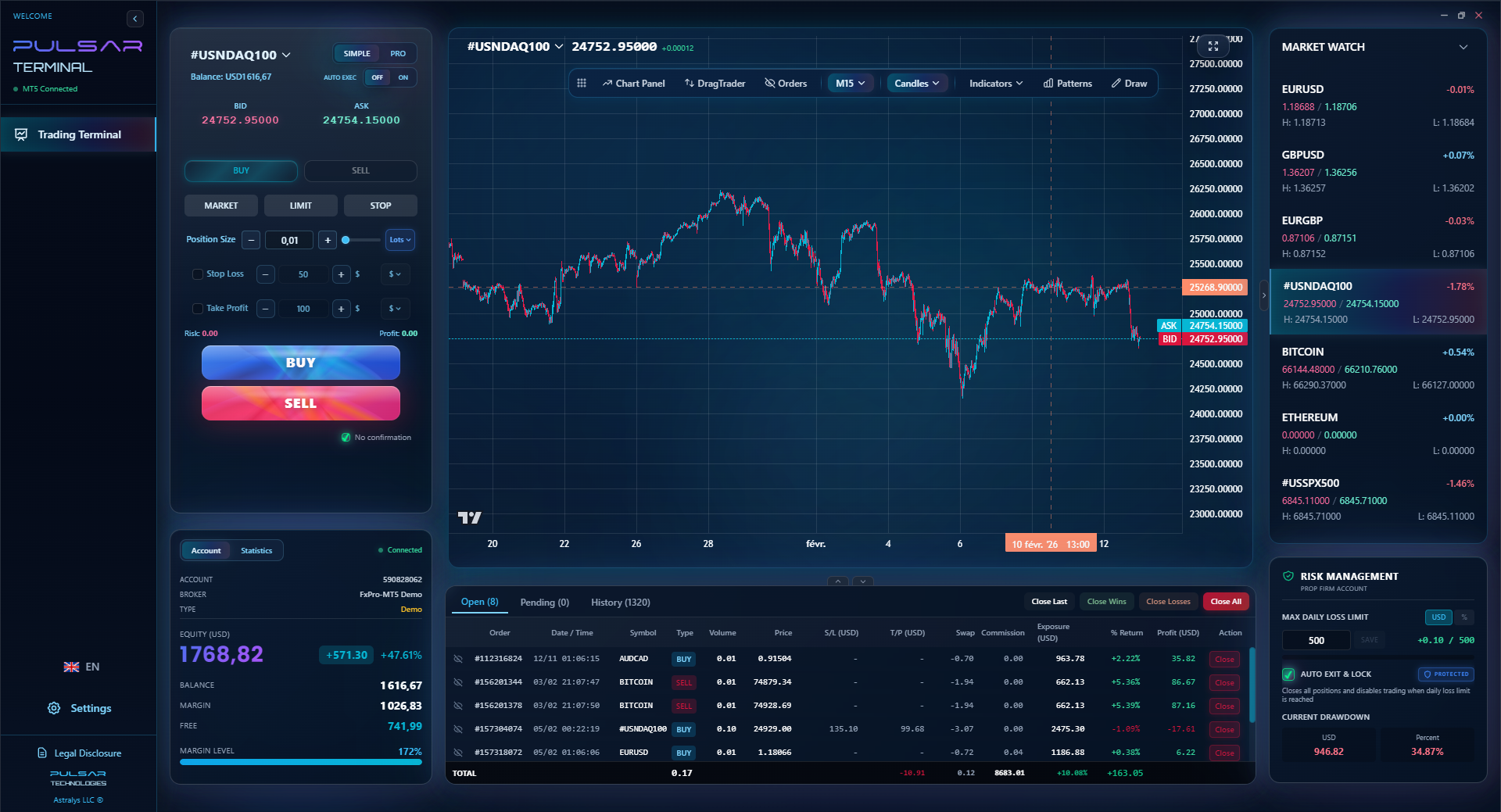
Manually tracking a prop firm's trailing daily loss limit is stressful and error-prone; Pulsar Terminal can automate this protection and other firm-specific rules directly on your trading platform.
Pulsar Terminal
เครื่องมือ MT5 ครบวงจร: ลากวางคำสั่ง, multi-TP/SL, trailing stop, grid trading, Volume Profile และการป้องกัน prop firm ใช้งานโดยเทรดเดอร์กว่า 1,000 คนทุกวัน
“Your primary job is to defend the daily loss limit, not to predict the next big move.”
Since real MT4 is rare, your choice of firm is tied to the platform they offer. You need to be comfortable with it.
cTrader: This is a fantastic, professional platform. It's intuitive, clean, and has great execution. Many top-tier prop firms use it. If you see cTrader, it's often a good sign of a serious operation.
TradeLocker & DXtrade: These are newer, web-based platforms built with prop firm rules in mind. They often have the firm's rules (like drawdown) displayed right on the dashboard. They can feel a bit less polished than cTrader or MT4, but the integration is seamless.
TradingView Integration: Some firms allow you to execute directly from TradingView charts. This is great for analysts who live on TradingView, but always test the execution speed in a demo.
When researching firms, look past the payout percentage. Dig into:
- Payout Reliability: Search user reviews on forums (not just the firm's site) for payout horror stories.
- Rule Clarity: Are their rules crystal clear, or full of legalese?
- Customer Support: Test it. Send a pre-sales question. See how long they take to reply.
- Broker Partnership: Who is their executing broker? Is it a reputable name like Pepperstone or IC Markets? This matters for execution quality.
My personal checklist now includes a week of trading their demo with my scalping strategy to feel out the platform's latency and how their rules are enforced in real-time.
💡 เคล็ดลับจาก Winston
If you can't explain a firm's daily loss limit rule in one simple sentence, you shouldn't be trading with them yet. Clarity is safety.
Here’s what I wish someone had told me before I blew that first account.
Start Small, Think Tiny. Your first goal is to pass an evaluation, not get rich. Buy the smallest, cheapest challenge they offer. The pressure is lower, and the lessons are the same. A $10,000 account challenge teaches you just as much as a $100,000 one, for a fraction of the fee.
Trade Like a Risk Manager, Not a Prophet. Your primary job is to defend the daily loss limit. I use a mental model: once I'm up 2% on the day, my personal daily stop-loss moves to breakeven. I might leave a runner, but the core position is locked in. This habit alone saved me countless times.
Embrace the Simplicity. Prop firm rules force simplicity. You can't hold 20 positions, you can't hedge, you can't swing trade through major news. This is a blessing. It forces you to find a few, high-probability setups. I went from using 7 indicators to basically just price action and the RSI indicator for divergence. Less noise, better decisions.
Document Everything. Keep a journal. Not just of trades, but of your mental state. Did you almost breach the DLL because you were overtrading after a loss? Write it down. The psychological game is 80% of this.
Finally, understand this is a business relationship. You are a contractor using their capital. Be professional. Withdraw profits regularly, communicate clearly if there's an issue, and always, always know the rules better than their support team does. That's how you build longevity and scale up.
FAQ
Q1Can I really use MT4 with a US prop firm?
In 2024, it's highly unlikely with a reputable firm. US regulations make it very difficult. You will almost certainly be using an alternative platform like cTrader, TradeLocker, or a proprietary platform designed to comply with NFA rules like FIFO.
Q2What's the most common reason traders fail prop firm challenges?
Violating the daily loss limit (DLL). It's not just about ending the day down too much. Many firms use a trailing DLL, calculated from your highest profit point during the day. A win followed by a small pullback can trigger a violation, which is a brutal lesson in risk management.
Q3Is the 80% profit split standard?
For forex-focused firms, 80/20 (you keep 80%) is very common. For futures prop firms, 90/10 splits are more typical. Always read the terms, as some firms offer higher splits but charge a mandatory monthly subscription fee on the account.
Q4How quickly can I get a payout from a prop firm?
Most firms have a first payout period (e.g., 30 days) and then bi-weekly or monthly payout schedules. Once you request a withdrawal, processing can take 2-5 business days for a bank wire, or 1-2 days for fintech/crypto payments. Don't expect instant cash.
Q5What's the difference between a 'demo' and 'funded' account with a prop firm?
The evaluation account is a simulated 'demo' with strict rules you must pass. The 'funded' account is also simulated in the sense that you're not trading the firm's actual capital in the live market immediately. However, your trading is mirrored by the firm's risk systems, and your profits/losses are real for the purpose of your split. It's a 'simulated live' environment.
Q6Are prop firms regulated in the US?
They operate in a gray area. They often structure themselves as evaluation service providers, not investment managers, to avoid direct SEC or CFTC registration. However, this is changing, and scrutiny is increasing. Always choose a firm with a clear track record and transparent broker partnerships.
บทเรียนจาก Prof. Winston
สรุปสาระสำคัญ:
- ✓Real MT4 is nearly dead for US prop traders; adapt to cTrader or TradeLocker.
- ✓Only 5-10% pass challenges; discipline beats strategy every time.
- ✓Master the trailing daily loss limit - it's the #1 account killer.
- ✓Treat the first $4,000 payout as capital to fund your next challenge.
บทความนี้มีประโยชน์แค่ไหน?
คลิกดาวเพื่อให้คะแนน
ข้อมูลเชิงลึกการเทรดรายสัปดาห์
การวิเคราะห์และกลยุทธ์รายสัปดาห์ฟรี ไม่มีสแปม
เกี่ยวกับผู้เขียน
James Mitchell
นักวิเคราะห์การเทรดอาวุโส
ประจำอยู่ที่นิวยอร์ก มีประสบการณ์การเทรดมากกว่า 9 ปี เน้นคู่ USD หลัก ความท้าทายของ prop firm และกฎระเบียบการเงินของสหรัฐฯ
ความคิดเห็น
คำเตือนความเสี่ยง
การซื้อขายตราสารทางการเงินมีความเสี่ยงสูงและอาจไม่เหมาะสำหรับนักลงทุนทุกคน ผลการดำเนินงานในอดีตไม่ได้รับประกันผลลัพธ์ในอนาคต เนื้อหานี้มีวัตถุประสงค์เพื่อการศึกษาเท่านั้นและไม่ควรถือเป็นคำแนะนำในการลงทุน โปรดทำการวิจัยของคุณเองก่อนการซื้อขาย
คุณอาจชอบสิ่งนี้

Cara Trading Forex Sukses: 7 Prinsip dari Trader Profesional
Cara trading forex sukses dengan 7 prinsip trader pro: manajemen modal, disiplin, journal trading, backtest. Data nyata, bukan janji profit palsu.
Jam Trading Forex Terbaik untuk Trader Indonesia: Panduan Lengkap dengan Tabel Waktu
Panduan jam trading forex untuk trader Indonesia. Tabel 4 sesi dunia, jam emas 20:00-00:00, sesi mana yang harus dihindari. Data akurat + tips dari trader berpengalaman.
Top 5 Sàn Forex Uy Tín Nhất 2026: Review Jujur dari Trader Indonesia
Top 5 sàn forex uy tín 2026 untuk trader Indonesia. Review jujur: spread, deposit, withdraw, dukungan lokal. Exness, XM, IC Markets & lebih.
รับ Pulsar Terminal
เครื่องคำนวณทั้งหมดนี้ถูกสร้างไว้ใน Pulsar Terminal พร้อมข้อมูลเรียลไทม์จากบัญชี MT5 ของคุณ
รับ Pulsar Terminal