


You've seen the ads, haven't you? The ones promising a 'no loss forex trading strategy' that prints money while you sleep.

Olumide Adeyemi
ผู้บุกเบิกการเทรดในแอฟริกาตะวันตก ·  Nigeria
☕ 9 นาทีอ่าน
สิ่งที่คุณจะได้เรียนรู้:
- 1The 'No Loss' Myth and Why It's Dangerous
- 2The Nigerian Regulatory Reality for Forex Traders
- 3Realistic Risk Management: Your True 'No Loss' Armor
- 4Building a Resilient Strategy with an Edge
- 5The Psychology of Accepting Losses
- 6Tools to Manage Trades, Not Eliminate Loss
- 7Your Action Plan: From Myth to Sustainable Practice
You've seen the ads, haven't you? The ones promising a 'no loss forex trading strategy' that prints money while you sleep. Maybe a WhatsApp group is selling it for ₦50,000. Let me be straight with you: if someone is selling you a strategy with 'no loss' in the name, they are selling you a dream designed to empty your wallet. Real trading isn't about avoiding losses. It's about managing them so well that your winners pay for everything and leave you with profit. Let's talk about what's real, what's regulated, and how you can actually protect your capital trading from Nigeria.
I need to be blunt here. A strategy that guarantees no losses doesn't exist in forex. Full stop. The markets are far too unpredictable. Anyone telling you otherwise is either lying to you or lying to themselves. I learned this the expensive way early on. I bought a 'foolproof' system from a popular online guru. It worked for two weeks in a demo account. The moment I funded a live account with $500, the market conditions shifted, and I watched that system blow through 30% of my capital in three trades. The guru's response? 'You didn't follow the rules perfectly.' The real issue was the strategy had no realistic plan for when it was wrong.
Brokers are required to warn you about this. You've probably seen the disclaimer: 'Between 69-83% of retail CFD accounts lose money.' That's not a suggestion; it's a statistical fact from years of data. A 'no loss' promise preys on our natural desire for safety and quick profits. In Nigeria, where financial opportunities can feel scarce, this pitch is especially potent - and especially harmful. It distracts you from the real work: learning how to lose small and win big.

Warning: Any course, signal service, or 'mentor' that focuses on a 'no loss' outcome is a major red flag. Their business model is your registration fee, not your trading success.

💡 เคล็ดลับจาก Winston
The market's job is to make you feel wrong. Your job is to have a plan so precise that being wrong has a predefined, affordable cost.
Trading from Nigeria comes with its own set of rules. Knowing them isn't just about compliance; it's about protecting yourself from shady operations that often peddle these 'guaranteed' schemes.
The Central Bank of Nigeria (CBN) and the Securities and Exchange Commission (SEC) are the main watchdogs. The rules have been evolving fast. In late 2024, the CBN introduced a new Foreign Exchange Code and unified the official market. One crucial rule for you: the CBN prohibits using official foreign exchange windows to fund your trading account. This is why funding your broker can be a headache. Many banks have limited Naira card transactions for international brokers, pushing traders toward wire transfers or cryptocurrencies.
Here’s the nuanced part: while the CBN wants brokers serving Nigerians to be licensed by them, many of us use international brokers regulated abroad (like the FCA in the UK or ASIC in Australia). These brokers, such as Exness or IC Markets, operate under their home licenses. It's a common practice, but it means your primary protection comes from that foreign regulator, not the CBN. Always, always check your broker's license.
And remember the taxman. Profits from forex trading are subject to a 10% Capital Gains Tax by the FIRS. A 'no loss' strategy would make tax season simple, but since you will have profits (and losses), keep good records.
“A loss is just feedback. It says, 'The market conditions for this setup weren't right this time.' That's all.”
Forget no loss. Think 'controlled loss.' This is the only sustainable edge you have. Your goal is to design a system where a losing trade doesn't derail your account. Here’s the practical math that changed my trading.
The 1% Rule (And Why I Use 0.5%)
The classic rule is to risk no more than 1% of your account per trade. On a ₦500,000 account, that's ₦5,000. I'm more conservative. I risk 0.5%. Why? Because strings of losses happen. I once had 7 losses in a row on a strategy I was testing. At 1% risk, that's a 7% drawdown. Painful, but survivable. At 5% risk (which many new traders do), that's a 35% wipeout. Game over. Use a position size calculator for every single trade. Don't guess.
The Power of the Stop-Loss
Your stop-loss is your best friend. It's the cost of being wrong. Place it at a logical level where your trade idea is invalidated, not based on how much money you're willing to lose. On a EUR/USD trade, if your analysis says the trend reverses if price hits a certain support level, your stop goes just below that. This defines your risk per pip.

Example: You buy EUR/USD at 1.0850 with a stop at 1.0820 (30 pips risk). Your account is $1,000. You're willing to risk 0.5% ($5). Your position size = $5 / (30 pips * $0.10 per pip on a micro lot) = 1.67 micro lots. You round down to 1.6 lots. The math is non-negotiable.
The Profit Factor Goal
This is the key metric. It's (Total Gross Profit) / (Total Gross Loss). Aim for a strategy with a historical profit factor above 1.5. This means for every ₦1 you lose, you make ₦1.50. That's a realistic, positive edge. A 'no loss' strategy would have an infinite profit factor, which is a fantasy.
So what should you focus on instead of a ghost? A simple, rules-based strategy you can execute consistently. Complexity isn't sophistication.
Start with one or two currency pairs. EUR/USD and XAU/USD (Gold) are popular for good reason: they have good liquidity and clear trends. Learn their personality.
Combine a trend-following tool with a momentum filter. Here’s a basic framework I used for years:
- Identify the Trend: Use a moving average like the 50-period EMA on the 4-hour chart. Price above it = potential uptrend. Price below = potential downtrend.
- Wait for a Pullback: In an uptrend, wait for price to dip back towards the moving average. This gives you a better entry price.
- Look for Momentum Confirmation: Use the RSI indicator on the 1-hour chart. On a pullback in an uptrend, look for the RSI to dip near 40 (not below 30) and then start turning back up. This shows the pullback might be ending.
- Enter with a Stop: Place your buy order with a stop-loss below the recent pullback low.
This isn't a 'no loss' system. It's a 'higher probability' system. You'll still have losses. But if you backtest it, you might find it wins 55-60% of the time with a decent risk-to-reward ratio. That's a real edge. For more active styles, a scalping strategy has different rules, but the principle is the same: define your edge, then protect it with strict risk management.
💡 เคล็ดลับจาก Winston
If you can't state your maximum loss for a trade before you enter it, you aren't trading. You're gambling. Write it down.
“Forget no loss. Think 'controlled loss.' This is the only sustainable edge you have.”
This is the hardest part. Our ego hates being wrong. In Nigeria, where 'sharpness' is prized, taking a loss can feel like a personal failure. It's not. It's a business expense.
I used to move my stop-loss further away when a trade went against me, hoping it would come back. It's called 'widening your stop.' I turned a planned ₦2,000 loss into a ₦8,000 loss more times than I care to admit. That single bad habit delayed my profitability by a year. A loss is just feedback. It says, 'The market conditions for this setup weren't right this time.' That's all.
The traders who blow up are the ones who try to avoid a series of small, controlled losses and instead take one enormous, catastrophic loss. They get margin called. Your broker's margin call is the market's way of forcing you to take the loss you refused to take yourself. Let a losing trade hit your pre-set stop. It means your plan is working. Then, turn off the screen and walk away. The next setup will come.

Pro Tip: Keep a trade journal. Write down the reason for every trade, including the planned loss. When the loss hits, note it without emotion. Reviewing a page of small, planned losses feels disciplined. Reviewing one huge, uncontrolled loss feels like a disaster.
Instead of chasing a loss-free fantasy, use tools that help you execute your risk management flawlessly. This is where technology is a true ally.
A good trading platform lets you set stop-loss and take-profit orders the moment you enter a trade. This is crucial. It takes emotion out of the equation. Advanced tools can help you manage partial closures or trail your stop to lock in profits as a trade moves your way - this is how you cultivate winning trades.
For example, managing a trailing stop manually can be stressful. You're watching the screen, debating when to move it. An automated tool can follow a set of rules you define, like moving the stop to breakeven once price moves 1.5x your risk, then trailing it by a set distance. This protects profits and lets you run winning trades without constant micromanagement. The goal isn't to prevent a loss from ever occurring; it's to ensure that when a winning trade finally comes along, you capture as much of it as possible to offset all those small, planned losses.
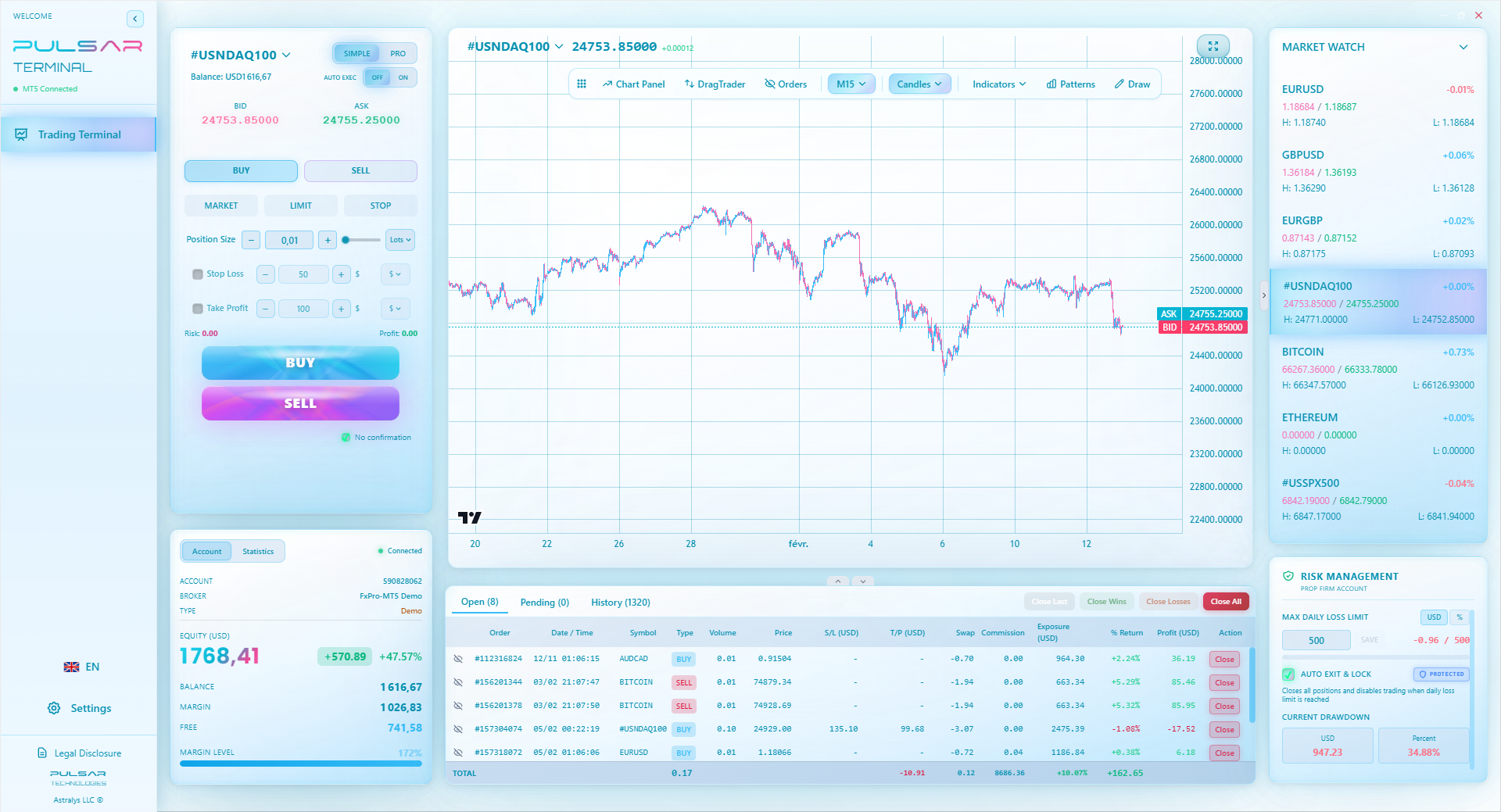
Managing trades with precision is key to protecting profits, and Pulsar Terminal automates complex order types like trailing stops and breakeven levels directly on your MT5 charts.
Pulsar Terminal
เครื่องมือ MT5 ครบวงจร: ลากวางคำสั่ง, multi-TP/SL, trailing stop, grid trading, Volume Profile และการป้องกัน prop firm ใช้งานโดยเทรดเดอร์กว่า 1,000 คนทุกวัน
“Complexity isn't sophistication. A simple, rules-based strategy you can execute consistently is worth more than a thousand complex indicators.”
Let's turn this into a practical, week-by-week plan.
Weeks 1-2: Education & Demo.
- Open a demo account with a reputable broker like XM or Pepperstone.
- Learn how to place a trade, set a stop-loss, and calculate position size. Paper trade the simple trend-pullback strategy. Don't chase profit; chase perfect execution of the rules.
Weeks 3-4: Define Your Numbers.
- Decide your maximum risk per trade (I recommend 0.5% of your future live account).
- Decide your risk-to-reward ratio. Never take a trade where your potential reward is less than your risk. Start with aiming for 1:1.5 or better.
- Study the MACD indicator or RSI to understand momentum.
Weeks 5-6: Live Trading (Micro Account).
- Fund a live account with the smallest amount possible - money you can afford to lose completely.
- Your only goal is to follow your risk management rules for 20 trades. Ignore your P&L. Focus on whether you took every trade at the correct size with a stop-loss.
Ongoing: Review and Refine.
- After 50 trades, look at your journal. What's your win rate? Your average win vs. average loss? This is your real edge. Now you can refine, not chase ghosts.
This path won't give you 'no loss.' But it will give you a fighting chance to be in the minority that succeeds at swing trading or any other style over the long term.
FAQ
Q1Is forex trading completely illegal in Nigeria?
No, it's legal. The Central Bank of Nigeria (CBN) and SEC regulate it. However, you cannot use official CBN forex windows to fund your account. Most Nigerian traders use international brokers regulated overseas.
Q2What's the biggest mistake new Nigerian traders make?
Risking far too much per trade. They see a small account, want quick profits, and risk 5-10% per trade. A few losses destroy the account. Start with 0.5-1% risk, no exceptions.
Q3Do I have to pay tax on my forex trading profits in Nigeria?
Yes. The Federal Inland Revenue Service (FIRS) requires you to pay a 10% Capital Gains Tax on your net annual trading profits. Keep detailed records of all your trades.
Q4Can a good strategy have a 100% win rate?
Absolutely not. Over a meaningful number of trades (50+), any strategy will have losses. A high win rate often comes with a poor risk-to-reward ratio (e.g., risking ₦1000 to make ₦200). It's the combination of win rate and reward size that matters.
Q5How do I fund my international broker account from Nigeria?
It can be challenging due to bank restrictions. Common methods include international wire transfers (which can be expensive), using approved fintech platforms, or depositing via cryptocurrencies if your broker supports it. Always check your broker's supported options.
Q6What is a realistic monthly return for a skilled trader?
Aim for consistency, not crazy percentages. A skilled, disciplined trader targeting 2-5% per month on their account balance is doing exceptionally well. Anyone promising you 20%+ per month is almost certainly running a scam.
บทเรียนจาก Prof. Winston
สรุปสาระสำคัญ:
- ✓Risk a maximum of 0.5% of your account per trade.
- ✓Aim for a risk-to-reward ratio of at least 1:1.5.
- ✓A 55% win rate with good risk management beats a 90% win rate with poor management.
- ✓Your stop-loss is the admission ticket for being in the trade. Never enter without one.
บทความนี้มีประโยชน์แค่ไหน?
คลิกดาวเพื่อให้คะแนน
ข้อมูลเชิงลึกการเทรดรายสัปดาห์
การวิเคราะห์และกลยุทธ์รายสัปดาห์ฟรี ไม่มีสแปม
เกี่ยวกับผู้เขียน
Olumide Adeyemi
ผู้บุกเบิกการเทรดในแอฟริกาตะวันตก
หนึ่งในนักการศึกษาฟอเร็กซ์ที่กระตือรือร้นที่สุดของไนจีเรีย 8 ปีประสบการณ์เทรดจากลากอส เชี่ยวชาญกลยุทธ์ทุนต่ำและความท้าทาย prop firm สำหรับเทรดเดอร์ในแอฟริกา
ความคิดเห็น
คำเตือนความเสี่ยง
การซื้อขายตราสารทางการเงินมีความเสี่ยงสูงและอาจไม่เหมาะสำหรับนักลงทุนทุกคน ผลการดำเนินงานในอดีตไม่ได้รับประกันผลลัพธ์ในอนาคต เนื้อหานี้มีวัตถุประสงค์เพื่อการศึกษาเท่านั้นและไม่ควรถือเป็นคำแนะนำในการลงทุน โปรดทำการวิจัยของคุณเองก่อนการซื้อขาย
คุณอาจชอบสิ่งนี้

Cara Trading Forex Sukses: 7 Prinsip dari Trader Profesional
Cara trading forex sukses dengan 7 prinsip trader pro: manajemen modal, disiplin, journal trading, backtest. Data nyata, bukan janji profit palsu.
Jam Trading Forex Terbaik untuk Trader Indonesia: Panduan Lengkap dengan Tabel Waktu
Panduan jam trading forex untuk trader Indonesia. Tabel 4 sesi dunia, jam emas 20:00-00:00, sesi mana yang harus dihindari. Data akurat + tips dari trader berpengalaman.
Top 5 Sàn Forex Uy Tín Nhất 2026: Review Jujur dari Trader Indonesia
Top 5 sàn forex uy tín 2026 untuk trader Indonesia. Review jujur: spread, deposit, withdraw, dukungan lokal. Exness, XM, IC Markets & lebih.
รับ Pulsar Terminal
เครื่องคำนวณทั้งหมดนี้ถูกสร้างไว้ใน Pulsar Terminal พร้อมข้อมูลเรียลไทม์จากบัญชี MT5 ของคุณ
รับ Pulsar Terminal