


Here's a number that should make you pause: there are over 200,000 active forex traders in South Africa right now.

David van der Merwe
เทรดเดอร์ตลาดเกิดใหม่ ·  South Africa
☕ 12 นาทีอ่าน
สิ่งที่คุณจะได้เรียนรู้:
- 1The Non-Negotiable: FSCA Regulation and What It Really Means
- 2Beyond the Spread: The Real Cost of Trading in ZAR
- 3MT4, MT5, or cTrader? Picking Your Trading Battlefield
- 4Getting Money In and Out: EFTs, Cards, and SARB Rules
- 5use: Your Double-Edged Sword (Capped at 30:1)
- 6Side-by-Side: Top FSCA-Regulated Platforms for South Africans
- 7Your Action Plan: From Zero to First Trade
Here's a number that should make you pause: there are over 200,000 active forex traders in South Africa right now. But here's the kicker: a huge chunk of them are using platforms that either cost them too much or, worse, aren't properly regulated. Picking your online forex platform isn't just about fancy charts; it's your first and most important trade. Get it wrong, and you're fighting an uphill battle before you've even placed an order. Let's break down what really matters for a trader sitting in Johannesburg, Cape Town, or Durban.
Forget the flashy ads promising 1:500 use. In South Africa, your first and only question should be: "Are you licensed by the FSCA?" The Financial Sector Conduct Authority is our watchdog. Since 2021, they've capped use for retail traders at 30:1. That might sound restrictive if you're coming from YouTube videos showing offshore accounts, but trust me, it's a lifesaver.
An FSCA license isn't just a piece of paper. It means the broker must keep your money in a separate, segregated account. If the broker goes under (it happens more than you think), your capital is theoretically protected from being used to pay their debts. They also have to maintain minimum capital levels and follow strict anti-money laundering rules.

Warning: You'll see brokers like IFX Brokers offering use up to 1:500. This is almost always done through an offshore entity, not their FSCA-licensed arm. You trade under that entity's rules, which often means you forfeit FSCA protection. It's a calculated risk many take, but you should know exactly what you're giving up.
I learned this the hard way early on. I funded an account with a "global" broker that wasn't FSCA-regulated because their spreads were tiny. When I tried to withdraw R45,000 in profits, it was a nightmare of delays and unexplained "processing fees." I got my money, but it took six weeks. With my FSCA-regulated broker now, withdrawals hit my FNB account in 24 hours. That peace of mind is worth every pip.
Always verify the FSP number on the FSCA's public register. Don't just take the broker's word for it.

💡 เคล็ดลับจาก Winston
A platform is a tool, not a strategy. I've seen traders spend R10,000 on a fancy terminal but not R100 on a proper trading journal. The best edge comes from your mind, not your software.
“The FSCA's 30:1 use cap isn't a restriction; it's a seatbelt for new traders.”
Everyone looks at the spread. It's the most obvious cost. But for a South African trader, the total cost of trading has a few hidden layers that can eat into your profits if you're not careful.
The Obvious Cost: Spreads and Commissions
Look at the table below. This is the real data you need to compare. A "zero spread" account usually means you pay a commission per lot. A wider spread account has the commission built in.
| Broker | Typical EUR/USD Spread | Commission (if applicable) | Best For |
|---|---|---|---|
| IC Markets (Raw) | 0.0 pips | $7 round turn | High-volume traders, scalpers |
| XM (Standard) | 0.6-0.8 pips | None | Beginners, smaller accounts |
| Exness (Zero) | 0.0 pips | None | Those wanting raw spreads without commission |
| Pepperstone (Razor) | 0.0 pips | $7 round turn | Algorithmic traders |
Let's do some quick math. If you trade 10 standard lots of EUR/USD in a month on a Razor account at IC Markets, that's 10 lots * $7 = $70 in commissions. On XM's standard account with a 0.7 pip average spread, the cost is 10 lots * 0.7 pips * $10 per pip = $70. The cost is identical! The difference is in the execution model and how the cost is presented.
The Hidden Costs for South Africans
- Currency Conversion: This is the big one. If you deposit ZAR into a USD-denominated account, your broker converts it at their rate, which often includes a 1-2% markup. The solution? Look for brokers like XM or Khwezi Trade that offer ZAR-denominated accounts. It keeps everything in Rands and saves you on double conversion (in and out).
- Overnight Financing (Swap): Holding a position past 5 PM New York time incurs a swap fee. These rates are based on interbank interest rates. For a long-term swing trading position, these can add up or work in your favor. Always check the swap rates on your platform before holding for days.
- Bank Fees: Even if your broker doesn't charge for deposits/withdrawals, your bank might. A standard EFT might cost you R50-R100. Using a service like Ozow or a broker-integrated solution can sometimes be cheaper.
I once got caught by swap fees on a long USD/ZAR trade I held for two weeks. The positive swap (I was earning it) was actually a nice little bonus. But on a short EUR/ZAR trade, I was paying it. It changed my profit calculation entirely. Always factor it in.
“Your first ten live trades should be about testing the broker, not making money.”
Your online forex platform is your office, your charting suite, and your execution terminal. In South Africa, MetaTrader 4 is still the king, but it's worth understanding the contenders.
MetaTrader 4 (MT4): The old reliable. Its dominance means every indicator, script, and Expert Advisor (EA) you can imagine is available for it. The community support is massive. The downside? It's a bit long in the tooth. It doesn't handle trading other asset classes like stocks or commodities as natively as newer platforms. Most local brokers like Exness and XM offer it.
MetaTrader 5 (MT5): This is MT4's more powerful younger brother. It has more timeframes, a better economic calendar, and a more strong back-testing engine for automated strategies. The adoption is growing, especially among brokers like IC Markets and Pepperstone. If you plan to trade more than just forex, or if you're serious about algorithmic trading, MT5 is the way forward.
cTrader: This is the sleek, modern alternative. Its charting is superior out-of-the-box, and its order execution interface is incredibly intuitive. It's known for very transparent pricing (great for scalping strategy). The downside? Far fewer custom indicators and EAs compared to the MetaTrader environment.
My personal journey: I started on MT4, swore by it for years. I resisted MT5. Then I tried to run a complex multi-currency correlation EA. MT4 choked. MT5 handled it smoothly. I switched and never looked back. The depth of analysis tools, especially for market profile, is just better. Don't be afraid to download demo accounts for all three and spend a week with each.
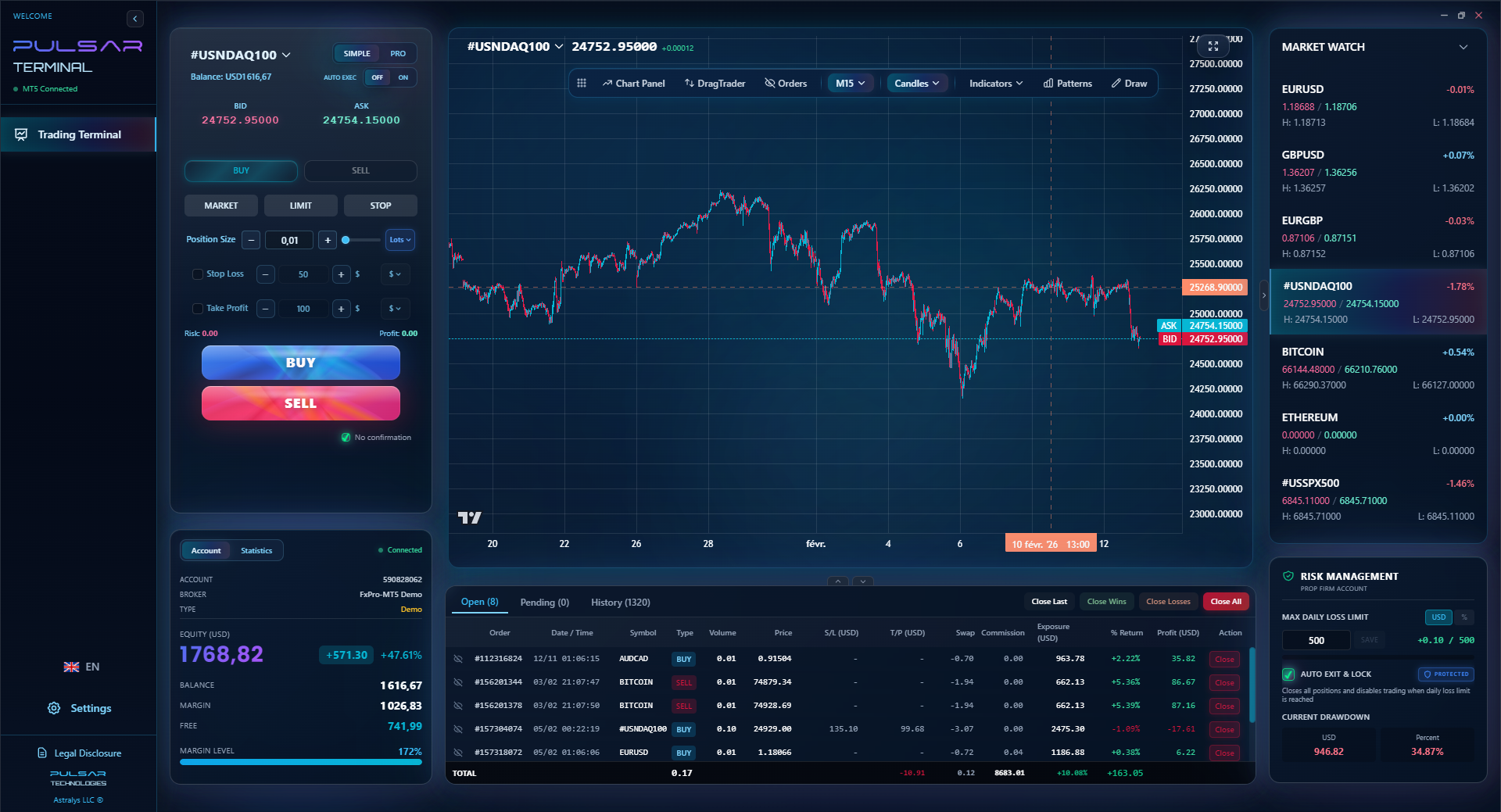
Managing complex trades and protecting profits requires tools that go beyond basic platform orders, which is where advanced trade management software becomes essential.
Pulsar Terminal
เครื่องมือ MT5 ครบวงจร: ลากวางคำสั่ง, multi-TP/SL, trailing stop, grid trading, Volume Profile และการป้องกัน prop firm ใช้งานโดยเทรดเดอร์กว่า 1,000 คนทุกวัน
“Your first ten live trades should be about testing the broker, not making money.”
This is where trading gets real. You need to fund your account, and you definitely want to get your profits out. For South Africans, this process has a specific local flavor and some recent regulatory wrinkles.
The most common methods are:
- Local Bank Transfer (EFT): Slow but reliable. Usually takes 1-3 business days. Watch for bank fees.
- Credit/Debit Cards (Visa/Mastercard): Almost instant for deposits. Withdrawals back to the card can take 2-5 days. Some banks still treat forex broker deposits as "cash advances" with high fees - check with your bank first.
- E-Wallets: Options like PayPal, Skrill, and Neteller are available at many international brokers. Processing is fast, but they have their own fee structures and conversion costs.

Pro Tip: If you can, use a ZAR-denominated account and fund it via EFT in Rands. This avoids the hidden currency conversion fee your broker slaps on when you deposit ZAR into a USD account. It simplifies your accounting, too.
Now, the important bit: Exchange Control. The South African Reserve Bank (SARB) governs how much money you can move offshore. As an individual, you have a Single Discretionary Allowance (SDA) of R1 million per calendar year to invest offshore without tax clearance. Funding a forex trading account with an international broker falls under this allowance.
The New Hurdle (Late 2025 Onwards): SARB introduced new rules requiring tax compliance checks for certain outflows. While this primarily targets corporate dividends, it's a sign of tightening controls. For you, the retail trader, it underscores the importance of using a reputable, FSCA-regulated broker. They handle the compliance reporting. If you use a shady offshore bucket shop, you might face questions from SARS later when you try to bring large profits back home. Keep your records clean: all deposit/withdrawal confirmations, trade statements, and broker communications.
💡 เคล็ดลับจาก Winston
Test a broker's true colors during high volatility. Open a demo trade just before a major US news event. If the platform freezes or the spread widens to 50 pips, imagine that happening with your real money. That's your answer.
“In South Africa, a ZAR-denominated account isn't just convenient; it's a cost-saving tool.”
Let's talk about use. The FSCA's 30:1 cap for retail clients on major forex pairs feels like a limitation if you've got a R5,000 account. You want to make it big, fast. I get it. But I'm going to tell you why this rule is probably the best thing that ever happened to new traders in South Africa.
use amplifies both gains AND losses. At 30:1, a 3.33% move against you wipes out your margin. At 1:500 (offered offshore), a 0.2% move does the same thing. That's a sneeze in the market. You can get a margin call before you've even finished your morning coffee.
Here's a real example from my second year trading. I had a R10,000 account with an offshore broker at 1:200 use. I went all in on a USD/ZAR trade, convinced the Rand would weaken. A positive news flash out of Pretoria caused a sudden 0.5% spike in the ZAR. My position was liquidated. I lost R2,100 in about 90 seconds. At 1:30 use, that same move would have been a manageable R315 drawdown. I would have survived to see my original analysis (which was correct) play out over the next day.
The 30:1 cap forces you to use proper position size calculator. It forces discipline. It makes you think about trade structure - maybe using a partial take-profit at one level and letting the rest run, rather than going for one huge, leveraged win.
Think of use like chilli in a potjie. A little enhances the flavor. Too much, and you ruin the whole meal. The FSCA, in this case, is your wise ouma limiting how much chilli you can add.
“In South Africa, a ZAR-denominated account isn't just convenient; it's a cost-saving tool.”
Based on spreads, platform choice, and local suitability, here’s my breakdown of the leading contenders. Remember, the "best" broker depends entirely on your style.
| Broker | Minimum Deposit | Key Platform(s) | Best For... | One Big Consideration |
|---|---|---|---|---|
| IC Markets | $200 (~R3,700) | MT4, MT5, cTrader | Serious traders, scalpers, algo traders. Raw spreads are exceptional. | Minimum deposit is higher, but worth it for active traders. Their MT5 integration is top-tier. |
| Exness | $10 (~R185) | MT4, MT5 | Beginners, small account traders. Easy start, good ZAR support. | Some find their withdrawal process for larger amounts requires more documentation. |
| XM | $5 (~R90) | MT4, MT5 | Absolute beginners, educational focus. Huge library of learning materials. | Spreads on standard accounts are higher than raw accounts elsewhere. |
| Pepperstone | $200 (~R3,700) | MT4, MT5, cTrader | All-round excellence. Great charting tools and reliable execution. | Similar to IC Markets, it's a pro-focused environment. Might be overwhelming for a first-timer. |
| Khwezi Trade | R500 | Proprietary & MT4 | Traders who want full local support, phone calls, ZAR account. | The trading conditions (spreads, execution) may not be as tight as the top global brokers. |
My advice? Pick two that seem to fit your profile. Open a demo account with each. Test their execution speed during volatile news events (like SARB interest rate announcements). Test their customer support with a dummy question. See which platform interface makes sense to you. Then, and only then, fund the smallest real account you can and test it with live, small trades for a month.
💡 เคล็ดลับจาก Winston
Your first real withdrawal is more important than your first winning trade. It proves the entire loop - deposit, trade, profit, access - works. Do it early, even if it's just for R200.
“The 'best' broker is the one you understand and that doesn't fight you on withdrawals.”
Okay, let's make this practical. Here's your step-by-step guide to getting started safely and smartly.
- Education First: Don't deposit a cent yet. Understand what a pip definition is, what a spread definition means, and how margin works. The FSCA website has good basic resources, as do brokers like XM.
- Shortlist Brokers: Based on this guide, pick 2-3 FSCA-regulated brokers. Check their FSP number on the FSCA register.
- Go Demo: Download their platforms (MT5 is my recommendation for future-proofing). Practice for at least a month. Try a swing trading strategy on XAU/USD guide and a scalping strategy on EUR/USD guide. Get a feel for the charts and tools like the RSI indicator and MACD indicator.
- Plan Your Money: Decide on your risk capital. This is money you can afford to lose completely. Never use rent or savings for essentials.
- Open a Live Account: Start with the broker whose demo felt most intuitive. Opt for a ZAR account if available. Deposit the minimum amount, not your full risk capital.
- Trade Tiny: Your first ten live trades should be at the smallest possible lot size (0.01 lots). You're not trying to make money; you're testing the live execution, the emotional feel, and the withdrawal process. Withdraw a small profit just to prove to yourself the system works.
- Scale Up Gradually: Only once steps 1-6 are complete should you consider adding more capital to your account and increasing position sizes according to a solid risk management plan.
The biggest mistake I see? Guys jumping from step 1 to step 5 in a single afternoon, fueled by FOMO. That's a surefire recipe for funding the broker's bonus pool, not your own bank account. Take your time. The market will be here tomorrow.
FAQ
Q1Is forex trading legal in South Africa?
Yes, absolutely. It is completely legal provided you trade through a broker that is licensed as a Financial Service Provider (FSP) by the Financial Sector Conduct Authority (FSCA). Always verify the broker's FSP number on the FSCA's official website before depositing any money.
Q2Can I use international brokers like Forex.com or OANDA in South Africa?
Many international brokers do not accept South African clients directly due to our specific regulatory and exchange control environment. Some, like IG, do have a local FSCA-licensed entity (IG South Africa). It's always safer to choose a broker that actively holds an FSCA license rather than trying to use an international entity that may not be set up to handle SARB compliance.
Q3What is the best online forex platform for beginners in South Africa?
For a complete beginner, XM is a strong contender due to its very low minimum deposit ($5), extensive educational materials, and user-friendly MT4/MT5 platforms. Exness is also beginner-friendly with a low minimum. The key is to use their demo accounts extensively before going live.
Q4How much money do I need to start forex trading in South Africa?
You can technically start with as little as R90 (the $5 minimum at XM). However, starting with such a small amount teaches you more about the platform than about realistic trading. A more practical starting point is R2,000 - R5,000. This allows you to trade sensible micro-lot sizes (0.01-0.05 lots) and experience realistic psychology and risk management without risking a life-changing sum.
Q5Why are my withdrawal options sometimes different from my deposit options?
This is common due to anti-money laundering (AML) regulations. Brokers often require withdrawals to be sent back to the original source of funding. If you deposit via a credit card, your first withdrawal(s) will usually need to go back to that same card. After that, you may be able to add a bank account for future withdrawals. Always check the broker's specific policy.
Q6Do I pay tax on my forex trading profits in South Africa?
Yes. Profits from forex trading are generally considered taxable income by the South African Revenue Service (SARS). It falls under "gross income" and is subject to your marginal income tax rate. It is your responsibility to declare this income. Keep careful records of all trades, deposits, and withdrawals. Consulting with a tax practitioner familiar with trading is highly recommended.
บทเรียนจาก Prof. Winston
สรุปสาระสำคัญ:
- ✓Verify the FSP number. Always. No exceptions.
- ✓Start with a demo for one full market cycle (at least a month).
- ✓Your first live deposit should be the broker's minimum, not your full bankroll.
- ✓Factor in ZAR conversion fees - they can turn a winning strategy into a loser.
- ✓Plan your first withdrawal before you place your first trade.
บทความนี้มีประโยชน์แค่ไหน?
คลิกดาวเพื่อให้คะแนน
ข้อมูลเชิงลึกการเทรดรายสัปดาห์
การวิเคราะห์และกลยุทธ์รายสัปดาห์ฟรี ไม่มีสแปม
เกี่ยวกับผู้เขียน
David van der Merwe
เทรดเดอร์ตลาดเกิดใหม่
เทรดเดอร์ประจำโจฮันเนสเบิร์ก มีประสบการณ์ 11 ปีในสกุลเงินตลาดเกิดใหม่ เชี่ยวชาญคู่ ZAR การเทรดภายใต้กฎระเบียบ FSCA และการวิเคราะห์ตลาดแอฟริกาใต้
ความคิดเห็น
คำเตือนความเสี่ยง
การซื้อขายตราสารทางการเงินมีความเสี่ยงสูงและอาจไม่เหมาะสำหรับนักลงทุนทุกคน ผลการดำเนินงานในอดีตไม่ได้รับประกันผลลัพธ์ในอนาคต เนื้อหานี้มีวัตถุประสงค์เพื่อการศึกษาเท่านั้นและไม่ควรถือเป็นคำแนะนำในการลงทุน โปรดทำการวิจัยของคุณเองก่อนการซื้อขาย
คุณอาจชอบสิ่งนี้

Cara Trading Forex Sukses: 7 Prinsip dari Trader Profesional
Cara trading forex sukses dengan 7 prinsip trader pro: manajemen modal, disiplin, journal trading, backtest. Data nyata, bukan janji profit palsu.
Jam Trading Forex Terbaik untuk Trader Indonesia: Panduan Lengkap dengan Tabel Waktu
Panduan jam trading forex untuk trader Indonesia. Tabel 4 sesi dunia, jam emas 20:00-00:00, sesi mana yang harus dihindari. Data akurat + tips dari trader berpengalaman.
Top 5 Sàn Forex Uy Tín Nhất 2026: Review Jujur dari Trader Indonesia
Top 5 sàn forex uy tín 2026 untuk trader Indonesia. Review jujur: spread, deposit, withdraw, dukungan lokal. Exness, XM, IC Markets & lebih.
รับ Pulsar Terminal
เครื่องคำนวณทั้งหมดนี้ถูกสร้างไว้ใน Pulsar Terminal พร้อมข้อมูลเรียลไทม์จากบัญชี MT5 ของคุณ
รับ Pulsar Terminal