


I lost $1,850 in under an hour.

Sarah Collins
นักกลยุทธ์การเทรด ·  Australia
☕ 10 นาทีอ่าน
สิ่งที่คุณจะได้เรียนรู้:
- 1The ASIC Rulebook: Your First Filter
- 2Decoding the Real Costs: Spreads, Commissions, and Fees
- 3Platform Showdown: MT4, MT5, cTrader, and Beyond
- 4Execution Quality: The Invisible Game-Changer
- 5Deposits, Withdrawals, and the Aussie Dollar
- 6My Personal Setup and What I Look For Today
- 7The Verdict: Is There a 'Best' Platform?
I lost $1,850 in under an hour. It was 2015, and I was using a flashy, offshore online forex trading platform that promised 'unlimited use.' A volatile move in GBP/JPY hit my stop-loss, then kept going. The platform's 'slippage protection' was a myth. My account went negative, and I got an email demanding I cover the difference. That moment burned two lessons into me: the platform you trade on is your lifeline, and ASIC's regulations exist for a reason. Let's talk about what really matters when you're choosing where to trade from Australia.
Forget bonuses and fancy marketing. The first and most critical filter for any online forex trading platform in Australia is the Australian Financial Services Licence (AFSL) number. If a broker doesn't have one, walk away. Seriously. ASIC isn't perfect, but its rules are the bedrock of your protection here.
The use caps are the big one. Since March 2021, retail clients are capped at 30:1 for majors like AUD/USD and EUR/USD. For gold and minors, it's 20:1. Crypto is just 2:1. I fought these rules when they came in, complaining they'd kill my strategy. I was wrong. They forced me to trade smarter, to use proper position size calculator, and to stop treating my account like a casino chip. The 68% loss rate for retail CFD traders last year tells you why these rules are needed.
Then there's negative balance protection. This is non-negotiable. It means you can't lose more than you deposit. After my 2015 disaster, I'll never trade without it. Client money segregation is another silent guardian. It means your funds are held separately from the broker's operating money. If they go under, your money isn't part of the bankruptcy fire sale.

Warning: You can legally sign up with an unregulated offshore broker. Many do, chasing 500:1 use. But you're giving up every protection listed here. You're on your own if something goes wrong. I learned that the expensive way.

💡 เคล็ดลับจาก Winston
Your platform's reliability is tested at the worst possible moment. If you have doubts during calm markets, it will fail you during a storm.
The platform might be free, but the trading isn't. Your profitability lives and dies in the spread and commission structure. Let's get specific with Australian brokers.
You'll typically choose between two account types: a 'Standard' account with wider spreads but no commission, or a 'Raw'/'Pro' account with razor-thin spreads plus a commission. Which is better? It depends entirely on your trade size and frequency.
The Spread Reality Check
For the Aussie trader, AUD/USD is often the home pair. A good ASIC broker like Pepperstone or IC Markets will offer spreads from 0.0 to 0.7 pips on their raw accounts. On a standard account, expect 0.9 pips or more. That difference might seem tiny, but it adds up fast.
Let's do the math on a $10,000 position (0.1 lots) on AUD/USD. A 0.2 pip spread costs you $0.20. A 1.0 pip spread costs you $1.00. That's 5 times more, right out of the gate, on every single trade. Over hundreds of trades, that's a car payment.
Commission Models
If you go the raw spread route, you pay a commission. Fusion Markets is famous for its low $2.25 per side ($4.50 round turn). Others might charge $3.50 per side. You need to factor this into your expected profit per trade. For a scalping strategy taking small gains, commissions can eat you alive. For a swing trading approach holding for 50+ pips, they're negligible.

Example: Trade 1 lot (100,000 units) EUR/USD. Raw Spread: 0.1 pips ($1 cost) + $7 commission = $8 total cost. Standard Spread: 1.0 pip spread ($10 cost) + $0 commission = $10 total cost. Sometimes, the 'commission-free' account is actually more expensive.
Don't forget the hidden costs: swap rates for holding overnight, and potential inactivity fees if you step away from the markets for a year or two.
“The platform you trade on is your lifeline, not just a piece of software.”
The software is your cockpit. You need to feel at home in it. In Australia, you're mostly choosing between MetaTrader 4, MetaTrader 5, cTrader, or a broker's proprietary platform.
MetaTrader 4 (MT4): The old faithful. It's everywhere. Every indicator, every Expert Advisor (EA), every script is built for it. Its charting is solid, not spectacular. For pure forex trading, it's still completely adequate. I used it for a decade. Its biggest strength is the environment and familiarity.
MetaTrader 5 (MT5): MT4's younger, more capable sibling. It handles more asset classes (great if you trade ASX200 CFDs), has a better economic calendar, and more timeframes. But, the EA environment isn't as vast. Most top brokers like IC Markets and Pepperstone offer it. If you're starting fresh, I'd lean towards MT5.
cTrader: This is the sleek, modern alternative. Its charting is exceptional - clean, intuitive, and powerful. The order entry is fantastic. It feels like a professional tool. Brokers like Pepperstone and IC Markets offer it too, often with even tighter spreads on their ECN models. I switched to cTrader for my discretionary trading about three years ago and haven't looked back.
The broker's own platform? Test it with a demo account. Sometimes they're great, sometimes they're clunky. But remember, if you leave that broker, you lose all your custom setups. With MT4/5 or cTrader, you can take your platform template to any broker that supports it.

Pro Tip: Your platform choice should match your strategy. Are you an algorithmic trader? MT4's EA community is unmatched. A visual, discretionary trader who loves clean charts? cTrader is a joy. Always, always test it on a demo for at least two weeks.
💡 เคล็ดลับจาก Winston
The 'commission-free' account is often the most expensive. Always calculate the total cost per trade: spread cost + commission.
This is where the rubber meets the road. You can have the best strategy in the world, but if your platform's execution is slow or unreliable, you're finished. Execution quality boils down to three things: speed, slippage, and requotes.
Speed: How fast does your market order get filled? In fast markets, milliseconds matter. True ECN/STP brokers (like the ones mentioned) connect you directly to liquidity providers, which generally means faster execution than a dealing desk model.
Slippage: This is the difference between your requested price and your filled price. It happens during high volatility (like news events). Good platforms have minimal slippage. Bad ones have massive, always-negative slippage. I once had a 15-pip slippage on a GBP news trade on a dodgy platform. That's a $150 loss on a mini lot before the trade even started.
Requotes: The absolute worst. This is when you click 'buy,' and the platform comes back saying, 'Sorry, price is now 1.1050, not 1.1045. Do you accept?' By the time you click yes, the price is gone. A platform that frequently requotes is fundamentally broken for active trading.
How do you check this? You can't, until you trade. But you can research. Look for broker reviews that specifically mention execution. Start small with a new broker. Place some real trades with tiny lots and watch the execution report like a hawk. See the exact fill price and time. If it feels off, it probably is.
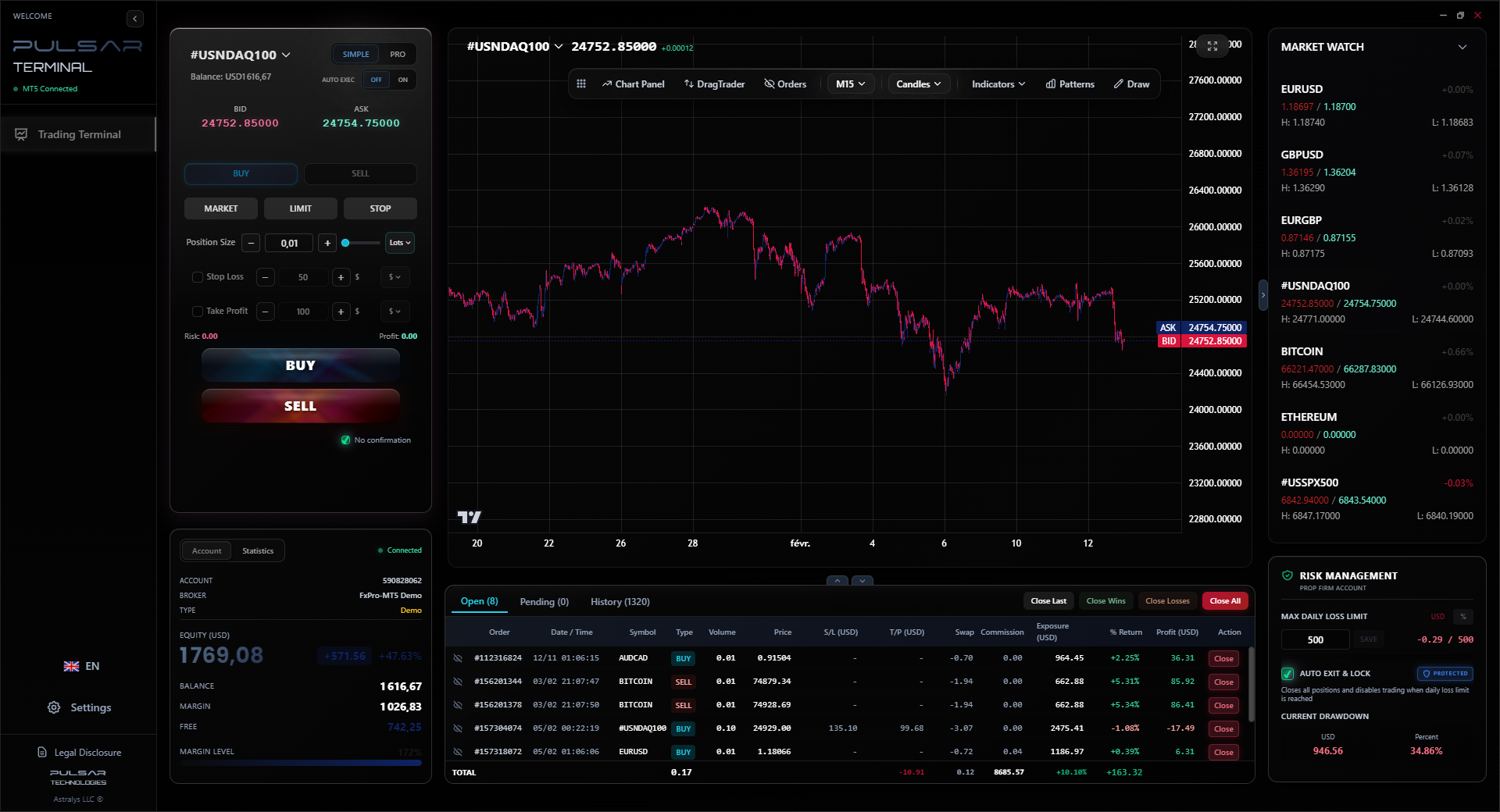
When every millisecond and precise order placement counts, a tool like Pulsar Terminal that integrates directly with MT5 for advanced drag-and-drop orders and multi-level take-profits can be the edge you need.
Pulsar Terminal
เครื่องมือ MT5 ครบวงจร: ลากวางคำสั่ง, multi-TP/SL, trailing stop, grid trading, Volume Profile และการป้องกัน prop firm ใช้งานโดยเทรดเดอร์กว่า 1,000 คนทุกวัน
“A 0.2 pip spread costs you $0.20. A 1.0 pip spread costs you $1.00. That's 5 times more, right out of the gate.”
The practical stuff matters. You want to fund your account and get your profits out without hassle or huge fees. Thankfully, Australian brokers are generally excellent here.
Most ASIC-regulated brokers offer fee-free AUD deposits via bank transfer, POLi, PayID, and BPAY. Processing is usually same-day or next-day. Credit/debit card deposits can be instant but check if your bank charges a cash advance fee.
Withdrawals are typically processed back to your original funding method. They're usually free, but your own bank might charge a small incoming wire fee. The key is simplicity: you're dealing in AUD, with an Australian company, to your Australian bank account. No international currency conversion nonsense.
Remember the AUSTRAC rule: transfers of AUD $10,000 or more in or out of the country get reported. This isn't a tax on your trading; it's a standard anti-money laundering check. Just something to be aware of if you're moving large sums.
Contrast this with funding an offshore broker. You might be sending USD or EUR via an international wire, paying $20-$30 in bank fees, losing on the exchange rate, and waiting 3-5 business days. The convenience of local banking is a massive, underrated perk of using a proper Australian online forex trading platform.
After 12 years, my needs have changed. I'm not chasing 1000-pip swings anymore. I'm after consistency and reducing friction. Here's my current checklist, born from countless mistakes.
- ASIC Regulation: Non-negotiable. My current primary broker is an ASIC-licensed entity. The peace of mind is worth any perceived use restriction.
- cTrader Platform: I use cTrader on a raw spread account for my manual trading. The charts are superb, and the order execution is precise. For my algorithmic trades, I still have an MT4 account running.
- AUD/USD Spread Under 0.5 pips: As an Aussie, I trade this pair a lot. I won't accept a standard spread over 1 pip anymore. It's just too costly.
- Reliable Mobile App: I don't trade on my phone, but I need to monitor and manage positions. The broker's mobile app must be stable and allow me to set stops and take profits easily.
- No Dealing Desk (NDD) Execution: I want direct market access. I don't want my broker trading against me.
A mistake I made recently? I opened an account with a well-regarded international broker for a specific futures product. While their platform was powerful, the funding process was a multi-day ordeal involving currency conversion. I closed the account after two weeks. The hassle wasn't worth the marginal benefit. Stick to the strengths of your local market.
The platform is your foundation. A shaky foundation will collapse, no matter how beautiful your trading house is. Take the time to get this choice right.
💡 เคล็ดลับจาก Winston
Spend a week building your chart template on a demo. If the platform frustrates you then, imagine how you'll feel when real money is on the line.
“Your own experience with a demo and a small live account is the only review that truly matters.”
No. There's no single 'best' online forex trading platform for everyone in Australia. But there is a best-for-you.
For the new trader who needs simplicity and education: A broker like Vantage or a major with a great demo and learning resources on their proprietary platform might be the gentlest start. Use it to learn the basics of a pip definition and spread definition without overwhelming tech.
For the active retail trader (scalper/day trader): You need speed and low cost. Your shortlist should be IC Markets, Pepperstone, or FP Markets on their Raw/ECN accounts with MT5 or cTrader. Test the execution with small live trades.
For the swing trader or analyst: Charting depth and tools might be your priority. MT5 or cTrader with a broker offering good swap rates (if you hold positions long-term) is key. The MACD indicator or RSI indicator works the same on all of them, but the clarity of the chart matters.
For the algorithmic/EA trader: You're likely wedded to MT4 or MT5. Your choice is driven by which broker offers the most stable, reliable VPS (Virtual Private Server) hosting and uninterrupted execution for your bots.
The final step is always the same: open a demo account. Then, open a live account with the minimum deposit. Trade small for a month. Test the deposits, the execution, the customer service when you have a question. Your own experience is the only review that truly matters. Don't rush this decision. The right platform becomes an extension of your mind. The wrong one is a constant source of frustration and loss.
FAQ
Q1Can I use MetaTrader 4 in Australia?
Absolutely. MT4 is still widely supported by almost every ASIC-regulated broker, including IC Markets, Pepperstone, and FP Markets. It's a perfectly viable platform, especially for forex-focused trading and using automated scripts (Expert Advisors).
Q2What's the minimum deposit for an Australian forex trading account?
It varies. Some brokers like Fusion Markets have no minimum. Pepperstone's minimum is $10. Others like IC Markets are around $200. The minimum deposit isn't a measure of quality. Start with whatever you're comfortable risking, but remember, you need to trade with proper position sizing, so an account that's too small can be just as dangerous as one that's too large.
Q3Are trading bonuses allowed with ASIC brokers?
No. ASIC bans brokers from offering bonuses, incentives, or promotions (like deposit match bonuses) for CFD products to retail clients. This is a protective rule. If you see an 'ASIC' broker offering a bonus, be very suspicious - they might be operating under a different license for that promotion.
Q4Do I pay tax on forex trading profits in Australia?
Yes. Profits from trading are generally considered assessable income by the ATO. It's not a separate 'capital gains' event if you're trading frequently (considered a business). You must keep detailed records of all trades, including entries, exits, and fees. Speak to a tax accountant who understands financial markets.
Q5What happens if my broker goes bankrupt?
This is where ASIC's client money segregation rules are critical. Your funds should be held in a separate trust account with a licensed Australian bank. In theory, these funds are not available to the broker's creditors. This offers a significant layer of protection compared to unregulated brokers where your deposit is often just company revenue.
Q6Is 30:1 use enough?
It's more than enough for sensible trading. High use is a shortcut to a margin call. At 30:1, a 3.33% move against you wipes out your margin. That's a normal daily swing in many pairs. The limit forces you to use appropriate risk, which is the foundation of long-term survival. I've found it sufficient for all strategies except the most reckless.
บทเรียนจาก Prof. Winston
สรุปสาระสำคัญ:
- ✓ASIC regulation is your primary shield against catastrophic loss.
- ✓Calculate total trade cost: Spread + Commission.
- ✓Test execution with real money, in small size, first.
- ✓Match the platform (MT4, MT5, cTrader) to your strategy's core need.
บทความนี้มีประโยชน์แค่ไหน?
คลิกดาวเพื่อให้คะแนน
ข้อมูลเชิงลึกการเทรดรายสัปดาห์
การวิเคราะห์และกลยุทธ์รายสัปดาห์ฟรี ไม่มีสแปม
เกี่ยวกับผู้เขียน
Sarah Collins
นักกลยุทธ์การเทรด
นักวางกลยุทธ์เทรดดิ้งประจำลอนดอน มีประสบการณ์ 12 ปีในตลาดการเงิน อดีตนักวิเคราะห์ที่บริษัทนายหน้าใน City of London ครอบคลุมคู่ GBP ตลาดยุโรป และการเทรดภายใต้กฎระเบียบ FCA
ความคิดเห็น
คำเตือนความเสี่ยง
การซื้อขายตราสารทางการเงินมีความเสี่ยงสูงและอาจไม่เหมาะสำหรับนักลงทุนทุกคน ผลการดำเนินงานในอดีตไม่ได้รับประกันผลลัพธ์ในอนาคต เนื้อหานี้มีวัตถุประสงค์เพื่อการศึกษาเท่านั้นและไม่ควรถือเป็นคำแนะนำในการลงทุน โปรดทำการวิจัยของคุณเองก่อนการซื้อขาย
คุณอาจชอบสิ่งนี้

Cara Trading Forex Sukses: 7 Prinsip dari Trader Profesional
Cara trading forex sukses dengan 7 prinsip trader pro: manajemen modal, disiplin, journal trading, backtest. Data nyata, bukan janji profit palsu.
Jam Trading Forex Terbaik untuk Trader Indonesia: Panduan Lengkap dengan Tabel Waktu
Panduan jam trading forex untuk trader Indonesia. Tabel 4 sesi dunia, jam emas 20:00-00:00, sesi mana yang harus dihindari. Data akurat + tips dari trader berpengalaman.
Top 5 Sàn Forex Uy Tín Nhất 2026: Review Jujur dari Trader Indonesia
Top 5 sàn forex uy tín 2026 untuk trader Indonesia. Review jujur: spread, deposit, withdraw, dukungan lokal. Exness, XM, IC Markets & lebih.
รับ Pulsar Terminal
เครื่องคำนวณทั้งหมดนี้ถูกสร้างไว้ใน Pulsar Terminal พร้อมข้อมูลเรียลไทม์จากบัญชี MT5 ของคุณ
รับ Pulsar Terminal