


Let's cut through the hype.

James Mitchell
นักวิเคราะห์การเทรดอาวุโส
☕ 11 นาทีอ่าน
สิ่งที่คุณจะได้เรียนรู้:
- 1What Are Options Prop Firms, Really?
- 2The Regulatory Wild West (And The Sheriff Is Coming)
- 3Costs & Fees: The Real Math Behind The 'Challenge'
- 4The Brutal Rules: It's All About Risk, Not Genius
- 5How to Actually Pass the Evaluation (A Realistic Plan)
- 6Top Firms & Platforms: A Quick, Opinionated Rundown
- 7Life After Funding: Payouts, Scaling, and Reality
- 8Final Verdict: Should You Do It?
Let's cut through the hype. The promise of trading a firm's capital for a huge profit split is a fantasy for 93% of you. I'm not here to sell you a dream. I'm here to show you the real, often ugly, mechanics of options trading prop firms. The industry is a minefield of fees, insane risk rules, and regulatory uncertainty. But for that 7% who can navigate it, the capital access is real. I'll prove it by breaking down the exact numbers, the traps, and what you're really signing up for.
Forget the slick marketing. An options trading prop firm isn't giving you free money. It's running a high-stakes audition where you pay for the privilege to try out. Their business model is simple: collect evaluation fees from thousands of hopefuls, fund the tiny fraction who pass their gauntlet, and take a cut of their profits. The key legal loophole? They're trading their own capital, not client funds. This lets many skate by without being a full-blown SEC-registered broker-dealer (for now).
They provide the infrastructure - a trading platform, data feeds, and most importantly, the buying power. In return, you follow their rulebook to the letter. It's a trade-off: you get access to serious capital you'd never have as a retail trader, but you surrender a chunk of your freedom. Think of it as trading with a hyper-vigilant, profit-hungry partner looking over your shoulder.

Warning: The 'educational service' label is a common dodge. You're not a student; you're a revenue source. If you fail the challenge, they keep your fee. If you pass and blow up the account, they lose. Their entire model is designed to find traders who won't blow up.

💡 เคล็ดลับจาก Winston
When sizing a trade for a prop challenge, calculate your position based on the firm's maximum loss limit, not your account balance. Your goal is to survive 20 consecutive losses, not to get rich on trade #1.
Here's where it gets messy. As of right now, most of these evaluation-based firms exist in a gray area. The SEC and FINRA regulate brokers who handle client money. The CFTC and NFA oversee futures. But if a firm says it's just letting you trade its money after you pass a test? Well, that's been a tough one for regulators to pin down.
The Looming Crackdown
This is changing, fast. By 2026, I expect a hammer to drop. Regulators are circling, asking the obvious question: if you're charging fees and taking a profit share, aren't you basically a Commodity Trading Advisor (CTA) or an investment advisor? That comes with a mountain of paperwork, capital requirements, and licensing.
The result? We're already seeing a shakeout. About 80-100 firms folded in 2024 alone. The survivors will be the ones who get serious about compliance. Many will likely form hybrid models, partnering with actual licensed brokers to handle the live trading. For you, this means the firms that survive will be more legitimate, but their rules might get even stricter. Don't be the last one holding the bag when a firm gets shut down by the CFTC.

Pro Tip: Before you pay a dime, check if the firm has any visible regulatory affiliation (like being a FINRA member) or a clear partnership with a known, regulated broker. It's not a guarantee, but it's a hell of a lot better than nothing.
“Passing isn't about a secret indicator. It's about discipline so rigid it would bore a statue.”
This is the part they don't highlight in the YouTube ads. Let's talk real numbers, because this is where most traders get rinsed.
First, the evaluation fee. This is your ticket to the game. It can be as low as $35 or as high as $1,200+ for a larger account. Let's say you go for a mid-tier $100,000 account challenge for $99. Sounds okay, right?
Now, remember the industry-wide pass rate: 5-10%. Let's be generous and say 10%. Statistically, you're paying $99 for a 90% chance of getting nothing but a learning experience. And that's just your first attempt. Most people fail multiple times.
If you pass, there's often an 'activation' or 'funding' fee - another $130-$160 to get your 'live' funded account. Only then do you start the profit split, which is usually between 70% and 90% in your favor.
Here's a brutal personal example: I tried a popular firm's challenge back in 2020. Paid $149. Got cocky on a Tesla earnings strangle, blew through the daily loss limit on a gamma spike, and failed in 3 days. That was a $149 lesson in humility and the importance of a position size calculator. I didn't try again.
| Item | Typical Cost | What It Gets You |
|---|---|---|
| Evaluation Fee | $35 - $1,200+ | A simulated account to prove yourself. 90%+ lose this fee. |
| Activation Fee | $100 - $200 | One-time fee to access the live, funded capital. |
| Profit Split | You keep 70%-90% | The actual payout on your profits. |
| Payout Fee | Sometimes $0, sometimes a small wire fee | Getting your money out. |
The bottom line: treat the evaluation fee as a tuition payment you'll likely lose. If you can't afford to light that money on fire, you shouldn't be doing this.
You might be a theta-decay wizard or a volatility maestro. The prop firm does not care. Their rules are designed for one thing: survival. Your survival ensures their profit share. This means limits that feel suffocating.
Daily Loss Limits: This is the big one. Often a fixed dollar amount or a percentage of your starting capital. Hit it, and your challenge or account is dead. No excuses. A 5% daily loss on a $100k account is $5,000. It can disappear faster than you think with a poorly timed XAU/USD trade.
Trailing Drawdown: Even sneakier. Your max loss isn't static; it 'trails' up behind your peak equity. If you start at $100k with a 10% max trailing drawdown ($10k), and you run up to $110k, your new loss threshold is $100k ($110k - $10k). You can be in profit overall but still get a margin call if you give back too much from your high. This kills more accounts than any other rule.
Greek Limits: For options-specific firms, this is the real cage. You'll have hard limits on your net delta, gamma, vega, and theta. You might want to load up on short vega before earnings, but the firm's risk system will say 'hell no.' There are also net premium-at-risk caps (how much you can collect or pay in options premiums).
Event & Overnight Restrictions: Many firms ban or severely restrict holding positions through major news events (like Fed announcements) or over weekends. They don't want gamma or gap risk blowing up their capital while they sleep.
The lesson? Winning in a prop firm isn't about hitting home runs. It's about grinding out singles, managing losers instantly, and never, ever threatening the firm's capital. It's a mindset of extreme conservatism.
💡 เคล็ดลับจาก Winston
The best platform for a prop challenge is the one you can operate blindfolded. Speed and familiarity prevent costly errors during volatile moves. Don't try to learn a new platform while under evaluation pressure.
“Treat the evaluation fee as a tuition payment you'll likely lose. If you can't afford to light that money on fire, you shouldn't be doing this.”
Passing isn't about a secret indicator. It's about discipline so rigid it would bore a statue. Here's a battle plan from someone who's seen both sides.
1. Treat It Like a Job, Not a Lottery Ticket. Your goal for the evaluation period is not to get rich. Your sole goal is to not break a single rule. Profit is a secondary bonus.
2. Risk Micro-Scaling. The standard advice is to risk 1% per trade. For a prop challenge, I'd say cut that in half. Risk 0.5% of your starting account balance per trade. On a $50k account, that's $250. Yes, it feels tiny. That's the point. You need to survive a string of 10 losers in a row, which will happen. Use a position size calculator for every single entry.
3. Have a Mechanical Edge, Not a 'Feeling'. You need a rule-based system for entries and exits. It can be simple. For example, 'Only sell credit spreads on indices when the RSI indicator is above 70 and IV rank is >50.' Backtest it. Then follow it without deviation during the challenge. This isn't the time for creativity.
4. The Power of the Scratch Trade. Your best friend in a challenge is the ability to exit a trade at breakeven or a tiny loss before it threatens your daily limit. If a trade goes against you immediately, just get out. Pay the commission and move on. Protecting capital is everything.
5. Platform Choice Matters. If they offer a choice, pick a platform you know cold. Wasting time figuring out how to place a complex order on ThinkorSwim while your position moves against you is a sure way to fail. If you're used to MT5, find a firm that offers it.
I passed a challenge once by trading one single instrument - the EUR/USD - and using a boring 20-period moving average crossover for swing trading over 4-hour charts. I took 8 trades in 30 days, won 5, lost 3. My total profit was a pathetic 1.8%. But I didn't violate a single rule, and that's all that mattered.
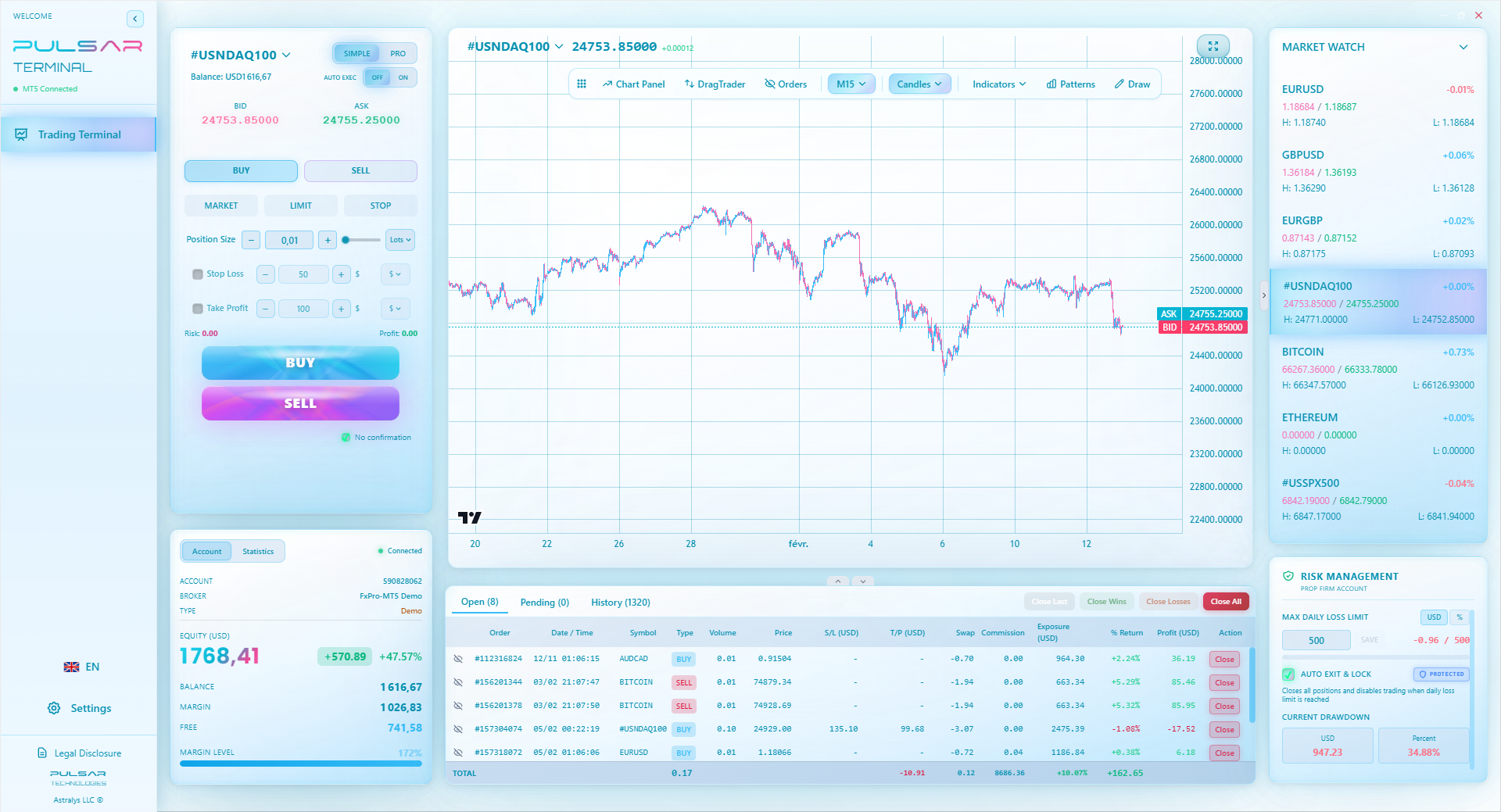
Managing multiple profit targets and strict loss limits is non-negotiable in a prop challenge, and Pulsar Terminal's drag-and-drop order tools make executing those complex rules on MT5 simple and precise.
Pulsar Terminal
เครื่องมือ MT5 ครบวงจร: ลากวางคำสั่ง, multi-TP/SL, trailing stop, grid trading, Volume Profile และการป้องกัน prop firm ใช้งานโดยเทรดเดอร์กว่า 1,000 คนทุกวัน
Not all firms are created equal. Some are outright scams, some are mediocre, and a few are legit. Here's my blunt take on a few notable ones and the platforms they use.
Firms with Options Focus:
- Topstep: The OG for futures, but their TopstepX platform is solid. Known for clear rules and decent support. Their evaluation fees are transparent. A good starting point if you're new to the prop world.
- Apex Trader Funding: Huge in the futures space, often running 'discount' sales on evaluations. Their rules are standard, but read the fine print on payouts. They've scaled massively, which has pros and cons.
Platforms You'll Encounter:
- ThinkorSwim (by TD Ameritrade): The gold standard for retail options traders. Incredible analysis tools, but can be overwhelming. If a firm offers this, it's a major plus.
- TradeStation: Powerful and reliable, great for active traders. Their options analytics are strong.
- Sterling Trader Pro: A professional-grade direct market access (DMA) platform. Blazing fast, but with a steep learning curve. You'll see this at more serious firms.
- MetaTrader 5 (MT5): Common among forex & CFD-focused firms branching into options. Its options functionality is… basic. If you're a serious options trader, an MT5-only firm might not be for you. For other strategies, brokers like IC Markets or Pepperstone offer great MT5 access.
My advice? Start small. Pick a firm with a low-cost evaluation for a small account. Learn their specific rule set and payout process before you commit serious money. And always, always read the latest reviews - the landscape changes monthly.
“Winning in a prop firm isn't about hitting home runs. It's about grinding out singles and never threatening the firm's capital.”
You passed. Congrats. Now the real work begins, and so do the new headaches.
Getting Paid: Payout schedules vary - weekly, bi-weekly, monthly. Some offer 'on-demand' for a fee. The first payout is always the slowest as they verify your banking details. Expect it to take 5-10 business days. They'll send it via wire, ACH, or sometimes PayPal. Don't be shocked if they take a small processing fee.
Scaling Plans: Most firms have a scaling plan. If you hit certain profit targets over a few months without violating rules, they'll increase your capital. Going from $50k to $100k is common. The catch? Your daily loss limit and drawdown usually scale proportionally. More capital means you can lose more money faster if you're careless.
The Psychological Shift: This messed me up the first time. Trading a funded account feels different than the challenge. Suddenly, the 'real' money pressure hits. You might freeze up. The key is to stick to the exact same system that got you funded. Don't change a thing.
The Inevitable Blow-Up: Statistically, most funded traders eventually blow their account. They get complacent, break their rules, take a huge gamble, and it's over. The firm might offer a 'reset' for a discounted fee, putting you back in a challenge. This is a critical moment. If you blew up due to discipline failure, take a long break before even considering it.
The dream of scaling to a $1M account is possible, but it's a marathon of consistent, boring, risk-averse trading. It's less 'Wolf of Wall Street' and more 'accountant of Wall Street.'
💡 เคล็ดลับจาก Winston
If a firm's rules seem too good to be true - like no daily loss limit - run. They are either incompetent or planning to shut down before paying anyone. Strict rules protect both you and the firm's longevity.
So, are options trading prop firms worth it? Here's my honest take.
Yes, if:
- You have a proven, mechanical trading strategy with a positive expectancy, but lack the capital to make it meaningful.
- You possess monastic discipline and can follow rules that feel overly restrictive.
- You can afford to lose the evaluation fee (and several more) without it affecting your life.
- You understand this is a long-term capital acquisition game, not a get-rich-quick scheme.
No, if:
- You're a beginner still learning what a pip or spread is.
- You're emotionally volatile or a 'revenge trader.'
- You're looking for a magic bullet to fix a losing strategy.
- The evaluation fee is a significant part of your trading capital.
For me, the prop firm path was a valuable pressure test. It forced a level of discipline I didn't know I needed. I made more money trading my own account with fewer restrictions, but the lessons on risk management were priceless. The industry is at a crossroads. If you step in, do it with your eyes wide open, your risk tiny, and your expectations lower than a snake's belly.
FAQ
Q1Do I need a Series 7 license to trade with an options prop firm?
Almost certainly not. Since you're trading the firm's proprietary capital and not soliciting or handling client funds, you typically don't need a Series 7. Some firms might require you to pass the SIE or Series 57 exams as part of their internal compliance, but they'll guide you through that if needed. This is a key distinction from working at a traditional broker-dealer.
Q2What's the single biggest mistake traders make in prop firm challenges?
Oversizing. Hands down. They see a $100,000 account and immediately think in $100,000 chunks. They risk 5% ($5,000) on a single trade to 'get ahead fast,' get stopped out, and are instantly halfway to their daily loss limit. The correct mindset is to pretend the account is 1/10th of its size. Trade small to survive.
Q3Can I use automated trading or algorithms with a prop firm?
It's rare and usually a hard 'no' during the evaluation phase. They need to see your discretion and risk management. Even with a funded account, most firms prohibit fully automated trading (bots) unless you have explicit, written permission. They need to ensure your algo aligns with their risk parameters, which is a huge compliance headache for them.
Q4How are taxes handled on prop firm payouts?
You are responsible for all taxes. The firm will send you a 1099-MISC or 1099-NEC form at the end of the year for your profit share (the money they pay you). This income is typically treated as self-employment income, so you'll owe income tax plus self-employment tax (Social Security & Medicare). Talk to a tax professional.
Q5What happens if the prop firm goes bankrupt or shuts down?
You're likely out of luck. If they shut down, any capital in your trading account is probably their asset, not yours in a segregated client account (like at a real broker). This is a major risk, especially with newer firms. Stick with established firms with a multi-year track record to slightly lower this risk.
Q6Is the profit split really as high as 90%?
It can be, but often with conditions. A firm might offer a 90% split only after you hit certain profit milestones or for a limited time. The standard starting split is often 80/20 in your favor. Always read the profit split agreement carefully - sometimes the high percentage only applies to profits above a certain threshold.
บทเรียนจาก Prof. Winston
สรุปสาระสำคัญ:
- ✓Prop firm success rates are brutally low: ~7% get a payout.
- ✓Risk 0.5% of starting capital, not 1-2%, to survive the challenge.
- ✓The trailing drawdown rule is the #1 account killer.
- ✓Regulatory changes will wipe out many firms by 2026.
- ✓The evaluation fee is a probable loss; budget for it.
บทความนี้มีประโยชน์แค่ไหน?
คลิกดาวเพื่อให้คะแนน
ข้อมูลเชิงลึกการเทรดรายสัปดาห์
การวิเคราะห์และกลยุทธ์รายสัปดาห์ฟรี ไม่มีสแปม
เกี่ยวกับผู้เขียน
James Mitchell
นักวิเคราะห์การเทรดอาวุโส
ประจำอยู่ที่นิวยอร์ก มีประสบการณ์การเทรดมากกว่า 9 ปี เน้นคู่ USD หลัก ความท้าทายของ prop firm และกฎระเบียบการเงินของสหรัฐฯ
ความคิดเห็น
คำเตือนความเสี่ยง
การซื้อขายตราสารทางการเงินมีความเสี่ยงสูงและอาจไม่เหมาะสำหรับนักลงทุนทุกคน ผลการดำเนินงานในอดีตไม่ได้รับประกันผลลัพธ์ในอนาคต เนื้อหานี้มีวัตถุประสงค์เพื่อการศึกษาเท่านั้นและไม่ควรถือเป็นคำแนะนำในการลงทุน โปรดทำการวิจัยของคุณเองก่อนการซื้อขาย
คุณอาจชอบสิ่งนี้

Cara Trading Forex Sukses: 7 Prinsip dari Trader Profesional
Cara trading forex sukses dengan 7 prinsip trader pro: manajemen modal, disiplin, journal trading, backtest. Data nyata, bukan janji profit palsu.
Jam Trading Forex Terbaik untuk Trader Indonesia: Panduan Lengkap dengan Tabel Waktu
Panduan jam trading forex untuk trader Indonesia. Tabel 4 sesi dunia, jam emas 20:00-00:00, sesi mana yang harus dihindari. Data akurat + tips dari trader berpengalaman.
Top 5 Sàn Forex Uy Tín Nhất 2026: Review Jujur dari Trader Indonesia
Top 5 sàn forex uy tín 2026 untuk trader Indonesia. Review jujur: spread, deposit, withdraw, dukungan lokal. Exness, XM, IC Markets & lebih.
รับ Pulsar Terminal
เครื่องคำนวณทั้งหมดนี้ถูกสร้างไว้ใน Pulsar Terminal พร้อมข้อมูลเรียลไทม์จากบัญชี MT5 ของคุณ
รับ Pulsar Terminal