


If you've spent any time on Nigerian trading forums or YouTube, you've seen it: 'Master price action and print money!' It's often sold as a magic bullet, a simple way to read the charts that requires no indicators.

Olumide Adeyemi
ผู้บุกเบิกการเทรดในแอฟริกาตะวันตก ·  Nigeria
☕ 10 นาทีอ่าน
สิ่งที่คุณจะได้เรียนรู้:
- 1What Price Action Really Is (And What It Isn't)
- 2Core Price Action Concepts in a Nigerian Context
- 3Building Your Price Action Strategy: A Step-by-Step Plan
- 4Nigeria-Specific Considerations You Can't Ignore
- 5Managing Risk Like a Pro: Protecting Your Naira
- 6Common Pitfalls & How to Avoid Them
- 7Getting Started: Your Practical Toolkit
If you've spent any time on Nigerian trading forums or YouTube, you've seen it: 'Master price action and print money!' It's often sold as a magic bullet, a simple way to read the charts that requires no indicators. I bought into that hype years ago and blew up a $500 account trying to trade every pin bar I saw. The truth? Price action is powerful, but it's not magic. It's a disciplined way of reading market sentiment, and in Nigeria's unique forex environment - with its 10% capital gains tax, Naira volatility, and specific broker challenges - you need a grounded approach. Let's cut through the noise and build a price action strategy that actually works here.
Let's get this straight first. Price action forex isn't about guessing or finding secret patterns. It's the study of a currency pair's price movement over time to make educated decisions. You're trying to read the story the market is telling through its own movements, not through the filter of a lagging indicator.
What it IS:
- Reading supply and demand through candlestick patterns and chart structures.
- Identifying key areas where buyers and sellers have previously shown interest (support & resistance).
- A framework for managing risk based on clear market structure.
What it ISN'T:
- A guaranteed signal system. That pin bar at a resistance level? It fails often.
- A way to avoid losses. You will have losing trades.
- Something you master in a weekend. It took me two years of consistent screen time to stop forcing trades.
My biggest early mistake was ignoring the higher timeframe structure. I'd see a beautiful bullish engulfing pattern on the 15-minute chart and jump in, only to get crushed because the daily chart was in a strong downtrend. Price action works across all timeframes, but the higher ones (like the 4-hour and daily) give you the direction of the dominant trend. The lower timeframes (1-hour, 15-minute) are for refining your entry. Always start your analysis from the top down.

Warning: Don't fall for the 'naked trading' gurus who say to remove all tools. Use horizontal lines for support/resistance, maybe a simple moving average for dynamic support. Tools help you see the price action story more clearly.
“Price action is powerful, but it's not magic. It's a disciplined way of reading market sentiment.”
These concepts are universal, but how you apply them in Nigeria matters, especially with pairs like USD/NGN.
Support and Resistance: Your Trading Anchor
This is everything. A support level is where buying interest is strong enough to overcome selling pressure, causing the price to bounce. Resistance is the opposite. In Nigeria, with the Naira's volatility, these levels on USD/NGN can be dramatic and news-driven. Don't just draw lines at random swing points. Look for areas where price has reacted multiple times. The more times price tests a level, the more significant it becomes.
I learned this the hard way trading GBP/USD. I drew resistance at a minor high, it broke, and I held onto a losing short trade hoping it would come back. It didn't. A true resistance level had formed 50 pips higher. Now, I only trade at levels that have seen at least two clear reactions.
Candlestick Patterns: The Market's Vocabulary
Single candles and small groups (2-3 candles) tell you about immediate sentiment.
- Pin Bars (aka Pinocchio bars): Show rejection. A long wick above a small body signals sellers stepping in at a high.
- Engulfing Patterns: A candle that completely 'engulfs' the previous candle's body. A bullish engulfing at support can be a powerful reversal signal.
- Inside Bars: A candle contained within the range of the previous candle. Shows consolidation, often before a big move.
Here's the Nigerian angle: During periods of CBN announcements or liquidity crunches, these patterns can become less reliable on exotic pairs. Stick to the majors like EUR/USD or GBP/USD for cleaner pattern recognition. My EUR/USD guide breaks down why it's a great pair for learning price action.
Market Structure: The Big Picture
This is the trend. Is the market making higher highs and higher lows (uptrend)? Or lower highs and lower lows (downtrend)? Or is it ranging? You must know this before you take a trade. Trading a pin bar against the dominant trend is a low-probability gamble, not a strategy.

Pro Tip: Before you place any trade, ask: 'Am I with the trend or against it?' If you're against it, you need a exceptionally strong reason (like a major resistance level breaking) and a tight stop loss.

💡 เคล็ดลับจาก Winston
The market's most important story is told by the sequence of highs and lows. An uptrend that starts making equal highs is tired. A downtrend that can't make a lower low is potentially reversing. Read that story first.
“True price action is about your own reading of the charts, not following someone else's signal.”
Here's a simple, repeatable process. I use this for my swing trading on the 4-hour chart.
- Identify the Trend (Daily Chart): Are we trending up, down, or ranging? Use your eye and mark the clear swing highs and lows.
- Find Key Levels (4-Hour Chart): Draw horizontal lines at major support and resistance zones. These are your potential trade areas.
- Wait for a Setup (1-Hour/4-Hour Chart): Only look for your preferred price action pattern (e.g., bullish engulfing at support in an uptrend) AT these key levels. No level, no trade.
- Plan Your Trade:
- Entry: Enter on a break of the high/low of the signal candle.
- Stop Loss: Place your stop loss on the other side of the key level. If buying at support, put your stop below the support zone.
- Take Profit: Aim for the next key resistance level. A good rule of thumb is to aim for a risk-to-reward ratio of at least 1:2.
Example from my journal:
- Pair: EUR/USD
- Context: Uptrend on daily, pullback to a clear support zone on 4H chart.
- Setup: Bullish pin bar forming right on the support zone.
- Action: Entered long at 1.0850 (break of pin bar high). Stop loss at 1.0820 (30 pips below support). Take profit at 1.0910 (next resistance).
- Result: TP hit for a 60-pip gain. Risk: 30 pips. Reward: 60 pips. (1:2 R:R).
This discipline of waiting for the confluence of trend, level, and pattern filters out 90% of the noise. You might only get 2-3 signals a week. That's okay. Quality over quantity.
“True price action is about your own reading of the charts, not following someone else's signal.”
Trading from Nigeria isn't the same as trading from London. Here’s what changes your price action game.
1. The Naira & USD/NGN: This pair is a beast. Its price action is heavily influenced by CBN policy, FX liquidity, and pure sentiment. Support and resistance levels can vaporize on news. If you trade this, you need a wider stop loss and an understanding that technicals can be overridden by fundamentals instantly. It's a high-risk, high-volatility instrument.
2. Costs & Taxes: That tight 0.6 pip spread on EUR/USD you see advertised? It matters. Slippage and wide spreads can turn a good price action setup into a loser on entry. Always check the typical spread for your broker at your trading time. And remember the 10% capital gains tax. It's on gross profits. Factor that into your profit calculations. If you make a 100,000 Naira profit, 10,000 Naira goes to the taxman. This makes consistent, smaller gains more attractive than chasing home runs.
3. Broker Choice & Execution: Your broker is your lifeline. You need fast, reliable execution, especially for a scalping strategy based on quick price action moves. Brokers with local presence or good P2P deposit options are key. I've had good experiences with Exness for their low spreads on raw accounts and IC Markets for their raw 0.0 pip spreads on majors. Always test a broker's demo account during Lagos market hours to check for requotes or slippage.
4. Psychology & Community: The pressure to 'make it' quickly in Nigeria is real. This leads to overtrading - the absolute killer of price action discipline. You see a setup that's 70% good and you jump in because you need a win. I've been there. Have a written trading plan and stick to it. Also, be wary of signal groups. True price action is about your own reading of the charts.
💡 เคล็ดลับจาก Winston
Your greatest edge in Nigeria isn't a secret pattern; it's patience. Wait for the US/London session overlap for the best liquidity on major pairs, and wait for your A+ setup. The market will always be there tomorrow.
“Your stop loss is your best friend. It's not a failure; it's the cost of doing business.”
Price action gives you entry signals, but risk management keeps you in the game. This is non-negotiable.
Position Sizing: Never risk more than 1-2% of your account on a single trade. If you have a 100,000 Naira account, that's 1,000-2,000 Naira max risk per trade. Use a position size calculator every single time. My worst drawdown came from breaking this rule after three wins in a row. I got cocky, risked 5%, and lost a week's profits in one go.
Stop Losses: Your stop loss is your best friend. It's not a failure; it's the cost of doing business. In price action, your stop should be placed where your trade idea is invalidated. If you're buying at support, and price breaks cleanly below it, your thesis is wrong. Get out.
The 10% Tax Impact: This affects your risk-reward math. If you need to net 100,000 Naira, you actually need to gross about 111,111 Naira. This makes low-risk, high-probability setups even more valuable. Chasing 1:1 risk-reward trades becomes less efficient after tax.

Example: You risk 10,000 Naira aiming for a 20,000 Naira profit (1:2 R:R). Gross profit is 20,000. After 10% tax (2,000), net is 18,000. Your net risk-reward is 10,000:18,000, or about 1:1.8. Still good, but you must account for it.
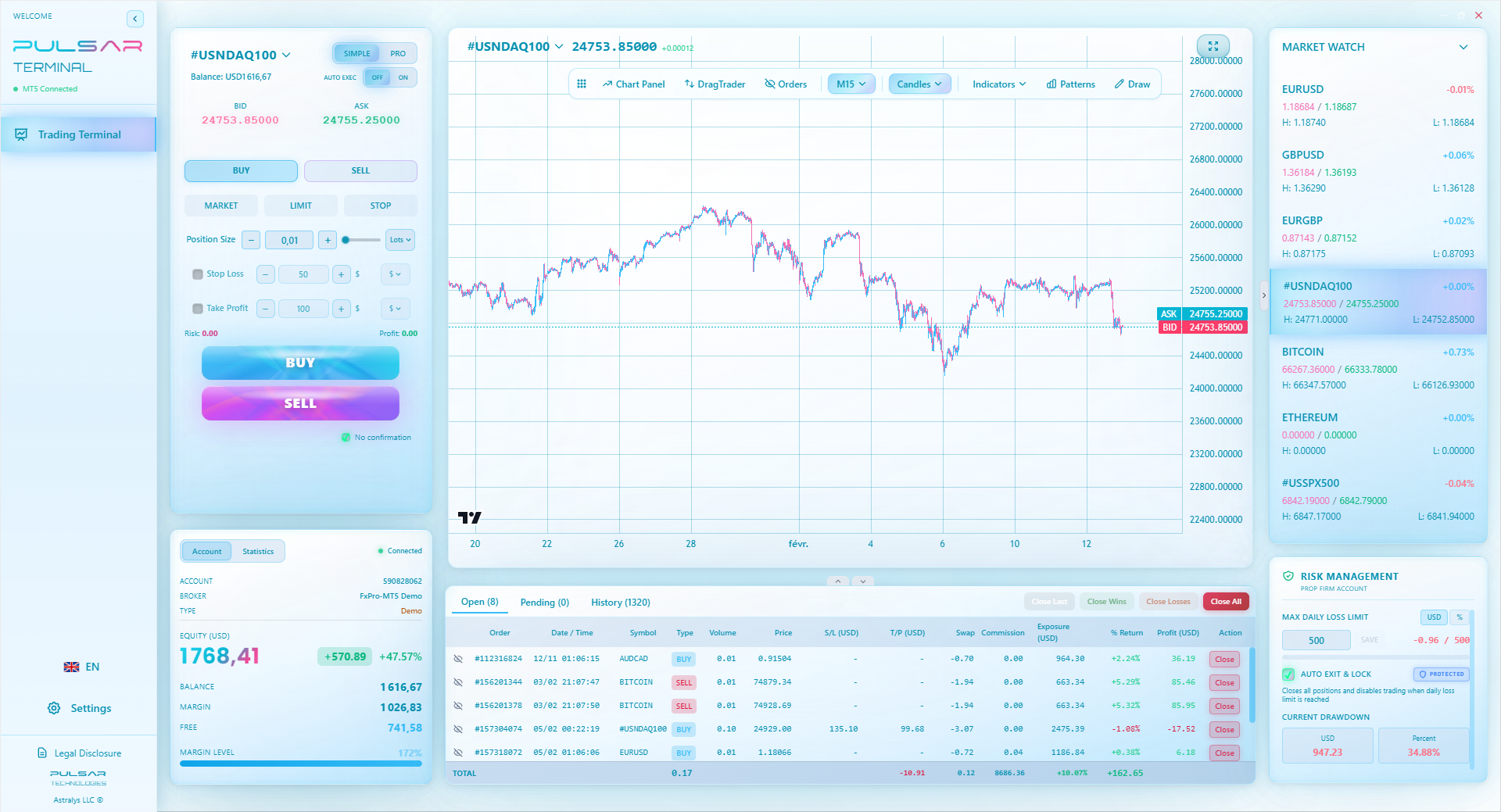
Manually moving stop losses to breakeven is a core price action tactic, and Pulsar Terminal automates this with one click directly on your MT5 chart.
Pulsar Terminal
เครื่องมือ MT5 ครบวงจร: ลากวางคำสั่ง, multi-TP/SL, trailing stop, grid trading, Volume Profile และการป้องกัน prop firm ใช้งานโดยเทรดเดอร์กว่า 1,000 คนทุกวัน
“Your stop loss is your best friend. It's not a failure; it's the cost of doing business.”
I've made these mistakes so you don't have to.
Pitfall 1: Trading Every Pattern. The chart is full of pin bars and dojis. Most are meaningless noise. Only trade patterns that occur at confluent areas (trend + support/resistance).
Pitfall 2: Moving Your Stop Loss. You put a stop at 1.0820. Price goes to 1.0815. 'It's just 5 pips, it'll come back,' you think, and you move the stop lower. This is how small losses become account-killers. Respect your initial stop.
Pitfall 3: Ignoring Fundamentals. In Nigeria, CBN MPC meeting days, FAAC allocations, and oil price news can cause massive gaps. No price action pattern will save you if the market gaps through your stop. Check an economic calendar. Avoid holding trades over major news events.
Pitfall 4: No Trading Journal. You must record every trade: the chart setup, your reasoning, entry/exit, and most importantly, your emotional state. Review it weekly. This is how you learn what your personal edge really is. My journal showed me I was terrible at trading inside bar breakouts but good with engulfing patterns at levels. I stopped taking the former.
💡 เคล็ดลับจาก Winston
Treat your stop loss like a fire alarm. You don't argue with it when it goes off; you exit the building. A stopped-out trade is a completed plan, not a failure. The only failure is not having a stop.
“In Nigeria's dynamic market, the skill of reading supply and demand is priceless.”
- A Reliable Broker: Choose one with tight spreads, solid execution, and a platform you like (MT4/MT5 are classics). Check reviews for Nigerian trader experiences. XM and Pepperstone are also popular here for their conditions and educational resources.
- A Demo Account: Practice for at least 3-6 months. Trade your price action plan until you are consistently profitable on demo. This builds muscle memory without risk.
- Charting Platform: MT4/MT5 is fine. TradingView is excellent for analysis with its clean charts and social features.
- Education (The Right Kind): Avoid 'get rich quick' courses. Look for content that focuses on market structure, risk management, and psychology. BabyPips.com is a great free start.
- A Simple Setup: Don't overload your charts. Start with a clean candlestick chart, a few horizontal lines, and maybe the 20-period or 50-period Exponential Moving Average (EMA) to help identify the trend. That's it. You can explore tools like the RSI indicator or MACD indicator later for confluence, but they are not price action.
Finally, be patient. Price action mastery is a marathon. It's about learning to read the subtle shifts in supply and demand. In Nigeria's dynamic market, that skill is priceless. Start slow, protect your capital, and focus on the process, not the payout.
FAQ
Q1Is price action forex trading legal in Nigeria?
Yes, it is completely legal for individuals in Nigeria to trade forex using strategies like price action. You are allowed to open accounts with both local and international brokers using your personal funds. The key thing to remember is the 10% capital gains tax on your profits.
Q2What is the best timeframe for price action trading?
There's no single 'best' timeframe. It depends on your personality and schedule. Many successful traders use a multi-timeframe approach. They use the daily chart to determine the overall trend, the 4-hour chart to identify key support and resistance levels, and the 1-hour or 15-minute chart to fine-tune their entry using a specific price action pattern. Start with the 4-hour chart for swing trading; it's less noisy than lower timeframes.
Q3How much money do I need to start price action trading in Nigeria?
You can start with a very small amount thanks to brokers offering low minimum deposits. Some brokers like FBS allow you to start with just $1, while others like XTB and Pepperstone have a $0 minimum. However, for practical risk management, I'd recommend starting with a demo account first. When going live, a minimum of $100 (or about 150,000 Naira) allows for proper position sizing without risking a huge percentage of your account on a single trade.
Q4Can I use price action to trade USD/NGN?
You can, but you must be extremely cautious. USD/NGN is highly sensitive to Central Bank of Nigeria (CBN) policies and liquidity news, which can cause sudden, massive moves that ignore technical price action levels. Support and resistance can break easily. If you trade it, use much wider stop losses and never risk more than you're willing to lose. For learning pure price action, I strongly suggest starting with major pairs like EUR/USD or GBP/USD.
Q5Do I need to use indicators with price action?
No, you don't need any. Pure price action trading relies solely on the raw price chart. However, many traders use one or two simple indicators for confluence. A moving average can help visualize the trend, and tools like the RSI indicator can show overbought/oversold conditions at key levels. The key is to keep it simple - the price action signal should be the primary reason for your trade.
Q6How do I handle the 10% capital gains tax with my trading?
You are responsible for declaring and paying the 10% tax on your gross trading profits annually. Keep careful records of all your trades (profits and losses). It's wise to set aside 10% of every profitable trade into a separate account so the money is there when tax time comes. Consulting with a Nigerian tax professional is highly recommended to ensure full compliance.
Q7Why do my price action setups keep failing?
This is common when starting out. Usually, it's for one of three reasons: 1) You're trading patterns in isolation, not at key support/resistance levels. 2) You're trading against the dominant higher timeframe trend. 3) Your stop loss is too tight, and normal market volatility is stopping you out before the trade has room to work. Go back to your trading journal and analyze your losing trades to find your personal recurring error.
บทเรียนจาก Prof. Winston
สรุปสาระสำคัญ:
- ✓Always analyze from higher timeframes down.
- ✓Only trade patterns at confluent support/resistance.
- ✓Never risk more than 2% of your account.
- ✓The 10% tax turns a 1:2 risk-reward into ~1:1.8 net.
บทความนี้มีประโยชน์แค่ไหน?
คลิกดาวเพื่อให้คะแนน
ข้อมูลเชิงลึกการเทรดรายสัปดาห์
การวิเคราะห์และกลยุทธ์รายสัปดาห์ฟรี ไม่มีสแปม
เกี่ยวกับผู้เขียน
Olumide Adeyemi
ผู้บุกเบิกการเทรดในแอฟริกาตะวันตก
หนึ่งในนักการศึกษาฟอเร็กซ์ที่กระตือรือร้นที่สุดของไนจีเรีย 8 ปีประสบการณ์เทรดจากลากอส เชี่ยวชาญกลยุทธ์ทุนต่ำและความท้าทาย prop firm สำหรับเทรดเดอร์ในแอฟริกา
ความคิดเห็น
คำเตือนความเสี่ยง
การซื้อขายตราสารทางการเงินมีความเสี่ยงสูงและอาจไม่เหมาะสำหรับนักลงทุนทุกคน ผลการดำเนินงานในอดีตไม่ได้รับประกันผลลัพธ์ในอนาคต เนื้อหานี้มีวัตถุประสงค์เพื่อการศึกษาเท่านั้นและไม่ควรถือเป็นคำแนะนำในการลงทุน โปรดทำการวิจัยของคุณเองก่อนการซื้อขาย
คุณอาจชอบสิ่งนี้

Cara Trading Forex Sukses: 7 Prinsip dari Trader Profesional
Cara trading forex sukses dengan 7 prinsip trader pro: manajemen modal, disiplin, journal trading, backtest. Data nyata, bukan janji profit palsu.
Jam Trading Forex Terbaik untuk Trader Indonesia: Panduan Lengkap dengan Tabel Waktu
Panduan jam trading forex untuk trader Indonesia. Tabel 4 sesi dunia, jam emas 20:00-00:00, sesi mana yang harus dihindari. Data akurat + tips dari trader berpengalaman.
Top 5 Sàn Forex Uy Tín Nhất 2026: Review Jujur dari Trader Indonesia
Top 5 sàn forex uy tín 2026 untuk trader Indonesia. Review jujur: spread, deposit, withdraw, dukungan lokal. Exness, XM, IC Markets & lebih.
รับ Pulsar Terminal
เครื่องคำนวณทั้งหมดนี้ถูกสร้างไว้ใน Pulsar Terminal พร้อมข้อมูลเรียลไทม์จากบัญชี MT5 ของคุณ
รับ Pulsar Terminal