


Let's cut through the noise.

Olumide Adeyemi
ผู้บุกเบิกการเทรดในแอฟริกาตะวันตก ·  Nigeria
☕ 10 นาทีอ่าน
สิ่งที่คุณจะได้เรียนรู้:
Let's cut through the noise. Everywhere you look online, you'll see lists of the 'richest forex traders in Nigeria' with their supposed net worths plastered next to their photos. It's a seductive fantasy. The truth is messier, more interesting, and far more useful for you as a trader. Most of those figures are pure speculation, and focusing on them misses the real lesson. I've been trading through Nigeria's market evolution for over a decade, and I'm here to tell you what these traders actually represent: not lottery winners, but businesspeople who built something sustainable. Let's set the record straight.
The narrative around the richest forex traders in Nigeria is often built on two shaky pillars: unverified net worth estimates and a cult of personality. You'll see numbers like $20 million for Uche Paragon or $10 million for Dapo Willis. Ask yourself: who verified this? How? Is it trading capital, or revenue from their other ventures? I'm not saying these traders aren't successful. They absolutely are. But the headline figure is almost always a blend of trading profits, income from education businesses (courses, signals, mentorship), brand endorsements, and other investments.
Here's the market reality they operate in. Nigeria's forex market turnover hit $8.6 billion in 2025, a massive 56.4% jump from the year before. That's the playground. The rules, however, have changed. The Investments and Securities Act (ISA) 2025 now requires any platform offering forex services to register with the SEC. While you can still trade with international brokers, the environment is tightening. The smartest traders I know, the ones who last, treat this like a business from day one. They're not just hunting pips; they're building a brand, managing tax obligations (that's 10% on gross profits, by the way), and diversifying their income streams. The real story isn't their bank balance, it's their business model.

Warning: Be deeply skeptical of anyone who flaunts a specific net worth from trading alone. In a market where most lose, sustained, verifiable wealth that size almost always comes from selling education, running a fund, or other ventures built alongside trading.

💡 เคล็ดลับจาก Winston
A net worth figure is a destination. Focus on the process that gets you there: the daily trade journal, the unwavering risk management, the continuous learning. The process, repeated, builds the fortune.
“The 'richest forex traders in Nigeria' have mastered a blend: trading provides the credibility, the education business provides the scale.”
Let's look past the estimated numbers and see what these individuals actually did. This is where you find the real lessons.
Uche Paragon & The Education Empire
Paragon is the name most synonymous with wealth in Nigerian forex. The estimates range wildly, but his real impact is clear: he founded CCI Traders. His wealth likely accelerated not from a single perfect trade, but from scaling an educational community. He turned knowledge (and market reputation) into a sustainable business. That's a classic, smart pivot.
Dapo Willis: The Systematized Approach
Willis is often cited for his disciplined, rule-based methodology. The lesson here isn't "he's worth $10 million." It's that he publicly advocates for a system that removes emotion. In a market driven by sentiment and Naira volatility, that systematic approach is what likely provided consistency, which then built the capital and reputation for other opportunities.
Damilare Ogundare (HabbyFX) & Community Building
Ogundare founded the Habby Forex Trading Academy in 2018. His estimated $5 million net worth story is, again, a story of community. He identified a hunger for knowledge among young Nigerian traders and built a structured academy around it. The trading success validated the teaching; the teaching business amplified the wealth.

Pro Tip: The common thread isn't a secret indicator. It's use of reputation. They traded successfully enough to attract attention, then built a business serving the massive Nigerian demand for forex education. Their 'wealth' is a combination of trading capital and business equity.
“Ignore the headline net worth. Reverse-engineer the process: consistency first, then business diversification.”
I learned this the hard way. Early in my career, I had a great six-month run. Made about $28,000 starting from a $5,000 account. I felt like a king. Then I blew half of it in two weeks of revenge trading after a nasty loss on GBP/USD. The money from trading alone is volatile, stressful, and prone to drawdowns. The traders who build lasting wealth diversify.
Here’s the typical revenue mix for a top-tier Nigerian trading figure:
- Trading Capital: The foundation. This is their own money in the markets. The goal here is consistent growth, not moonshots. They use strict position size calculators and know their risk per trade inside out.
- Educational Products: This is the engine. Online courses, webinars, e-books. A single complete course sold to thousands of students at N50,000-N200,000 generates revenue that dwarfs most trading returns.
- Mentorship/Signals Services: Recurring revenue. Monthly subscriptions for signals or one-on-one coaching. This provides stable, predictable cash flow.
- Asset Management/Prop Firms: Some manage funds or pass prop firm challenges to trade larger capital. My friend passed a $100,000 challenge with a firm like FTMO; the profit split now gives him a steady income stream on top of his own trading.
- Brand Partnerships & Advertising: Broker affiliations, platform promotions, etc.
I once tried to launch a basic course. Spent 80 hours building it, sold it for N30,000. Got 17 sales. That's N510,000 for work done upfront. It taught me more about business than any trading chart. The 'richest forex traders in Nigeria' have mastered this blend.

“Ignore the headline net worth. Reverse-engineer the process: consistency first, then business diversification.”
You can't talk about building serious wealth in Nigerian forex without understanding the rules. It's not sexy, but it's what keeps you in the game. The old days of a complete free-for-all are fading.
The New Rulebook (ISA 2025): The big change is the Investments and Securities Act 2025. Now, any platform offering forex trading services to Nigerians must register with the SEC. This targets local brokerages and educational platforms. For you, the retail trader, it means more scrutiny on who you learn from and where you trade.
Tax Man Cometh: Forget this at your peril. Nigeria charges a 10% Capital Gains Tax on your gross forex profits. It doesn't matter if your broker is in Cyprus or the Seychelles. If you're a Nigerian resident, that tax applies. Building real, bankable wealth means accounting for this from the start. I set aside 15% of every withdrawal into a separate account just for taxes and never touch it.
Broker Choice: Many of the well-known traders use or have used reputable international brokers. Why? Better regulation, tighter spreads, and reliable execution. I've had accounts with several. For instance, the raw spreads on EUR/USD at IC Markets or Pepperstone are essential for my scalping strategy. With Nigerian forex market turnover growing, more international brokers are offering Naira accounts, which simplifies things.

Example: You make a gross profit of N5,000,000 in a year. Your Capital Gains Tax liability is N500,000 (10%). If you haven't saved for that, a huge chunk of your trading capital disappears.
💡 เคล็ดลับจาก Winston
The market doesn't care about your 'why' - your bills, your dreams. It only responds to price. Your job is to build a system that aligns your actions with what the price is actually doing, not what you need it to do.
“A 10% tax on profits is not a suggestion. It's the cost of doing legitimate business. Factor it in from your first withdrawal.”
So, how do you actually walk this path? You stop obsessing over their end result and start reverse-engineering their process. Here is a blunt, step-by-step guide.
Phase 1: Master the Craft (1-3 Years) This is the non-negotiable, boring foundation. No one pays for a plumber who can't fix pipes.
- Focus on ONE Strategy: Don't jump between scalping and swing trading. Pick a time frame and a core methodology (like price action with the RSI indicator for confluence) and grind it on a demo, then a small live account.
- Risk Management is Your God: Your first goal is survival, not riches. Never risk more than 1-2% of your capital on a single trade. Use a stop-loss every. single. time.
- Journal Relentlessly: Write down every trade: entry, exit, why you took it, emotional state. My early journals are cringe-worthy records of impulsive decisions. They were my best teacher.
Phase 2: Validate & Scale (Years 2-4) Once you have 12+ months of consistent, profitable results (real results, not demo fantasies):
- Scale Capital Gradually: Use your own profits to grow your account. Consider prop firm challenges to access larger capital without risking your own savings.
- Document Your Process: Start creating content. A Twitter thread on a trade setup. A short YouTube video analyzing XAU/USD (gold). Share real knowledge, not hype. This builds credibility.
Phase 3: Diversify Income (Year 3+) This is where you build the "wealth" structure.
- Create a Simple Product: Package your core strategy into a PDF guide or a short video course. Sell it at a fair price.
- Consider Community: A small Discord or Telegram group with a monthly fee for deeper insights and trade ideas.
- Never Stop Trading: Your own trading is your R&D lab and your credibility anchor. It must continue.
The richest forex traders in Nigeria didn't skip Phase 1. They endured it, mastered it, and then got smart about Phases 2 and 3.
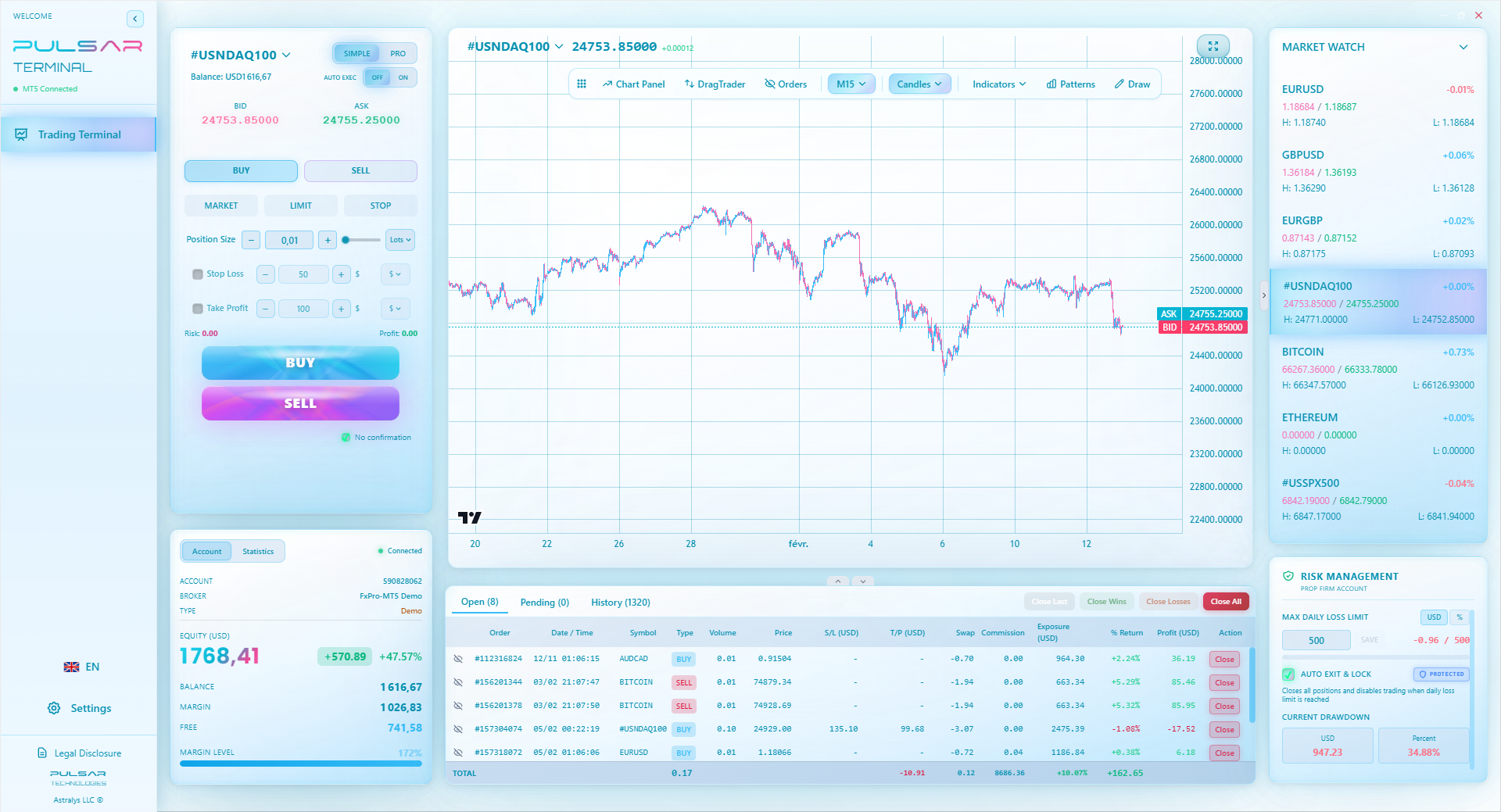
When scaling your trading and managing multiple positions, a tool like Pulsar Terminal that lets you set multi-TP/SL levels and automate trailing stops directly on MT5 is a game-saver for sticking to your plan.
Pulsar Terminal
เครื่องมือ MT5 ครบวงจร: ลากวางคำสั่ง, multi-TP/SL, trailing stop, grid trading, Volume Profile และการป้องกัน prop firm ใช้งานโดยเทรดเดอร์กว่า 1,000 คนทุกวัน
“A 10% tax on profits is not a suggestion. It's the cost of doing legitimate business. Factor it in from your first withdrawal.”
You need the right infrastructure. The traders we're talking about aren't trading on unreliable platforms with huge spreads. Here’s a breakdown of the practical setup.
Trading Platforms: MT4 and MT5 are the undisputed kings in Nigeria. Why? Stability, familiarity, and the vast library of indicators and Expert Advisors (EAs). TradingView is universally used for advanced charting and idea generation. The smart move is to use TradingView for analysis and your broker's platform for execution.
Broker Selection: You want a broker with a solid international license (like ASIC or FSCA), low spreads, and reliable deposits/withdrawals in Naira. Many top traders use or have used brokers like:
| Broker | Key Feature for Nigerian Traders | Good For |
|---|---|---|
| IC Markets | Raw spreads from 0.0 pips | Scalpers, high-volume traders |
| Pepperstone | Tight spreads & great execution | All styles, especially active traders |
| XM | Flexible account types, good bonuses | Beginners, those wanting micro lots |
| Exness | High use & local payment support | Traders comfortable with higher risk |
Essential Tools: Beyond the platform, you need:
- Economic Calendar: To avoid news volatility bombs.
- Reliable Internet & Power Backup: A solar inverter or generator isn't a luxury; it's a trading tool.
- A Position Size Calculator: To remove emotion from your risk math.
My personal setup for years has been TradingView charts, MT5 for execution with IC Markets, and a physical notebook for my journal. Fancy tools come later. Consistency comes first.
💡 เคล็ดลับจาก Winston
Your first N100,000 profit is more important than your first N1,000,000 dream. It proves your method works. Protect that proof of concept with your life. Scale it slowly, methodically. Greed is the cancer of compounding.
“Your edge isn't a secret indicator. It's your discipline, your journal, and your ability to follow your plan when you're dead wrong on a trade.”
I've made most of these mistakes. Let my losses be your lesson.
Pitfall 1: Chasing the Number, Not the Skill. You see '$20 million net worth' and you want that number. So you over-use, trade too big, and blow your account. It happened to me in 2017. I turned $2,000 into $9,500 in three months. Got greedy, thought I was the next Uche Paragon. Put 50% of my account on a USD/JPY trade based on a 'sure thing' tip. It wasn't. Lost $4,700 in a day. The goal is sustainable profitability, not a headline.
Pitfall 2: Neglecting the Business Side. You think trading is just charts. It's not. It's record-keeping, tax planning, and brand building. Ignoring the 10% tax will get you in a world of hurt with FIRS.
Pitfall 3: Buying the 'Secret System'. Every wealthy trader supposedly has a secret. They don't. Their edge is discipline, risk management, and experience. No one sells their real golden goose. I wasted over $1,000 on various 'secret indicator' packages early on. All were repackaged versions of standard tools like the MACD indicator or Stochastic.
Pitfall 4: Underestimating Psychology. The market will test you. When you're down three weeks in a row, the urge to deviate from your plan is immense. The richest forex traders in Nigeria have the psychological resilience to stick to their process through drawdowns. That's a muscle built over time, not bought.
The path to real success in Nigerian forex is a marathon of disciplined trading, smart business diversification, and navigating an evolving regulatory space. Focus on that process, and the numbers will follow.

FAQ
Q1Who is truly the richest forex trader in Nigeria?
There is no publicly verifiable answer. Figures like Uche Paragon or Dapo Willis are frequently cited based on estimated net worth, but these numbers are speculative blends of trading capital, education business revenue, and other investments. The 'richest' is likely the one who has most successfully built a sustainable business around their trading expertise.
Q2Is forex trading illegal in Nigeria?
No, forex trading is legal for Nigerian residents using their personal funds. However, the regulatory environment is tightening. The new Investments and Securities Act (ISA) 2025 requires platforms offering forex services to register with the SEC. Traders should use reputable brokers and be aware of their tax obligations (10% Capital Gains Tax on profits).
Q3How much do I need to start forex trading in Nigeria?
You can start with very little. Some international brokers offer accounts with a minimum deposit of $10 or even less. However, a more realistic starting point for serious learning is $100-$500. The key is not the amount, but risking only 1-2% of it per trade. Never start with money you can't afford to lose.
Q4How do Nigerian forex traders make millions?
They rarely make 'millions' from trading alone. The sustainable wealth model combines consistent trading profits with other income streams: selling educational courses, running mentorship programs, managing funds, and brand partnerships. Trading provides the credibility; the business ventures provide scale and stability.
Q5What is the best broker for forex trading in Nigeria?
There's no single 'best' broker. Look for brokers with strong international regulation (like ASIC, FSCA), low spreads on major pairs, and support for Naira deposits/withdrawals. Popular and reputable choices among experienced traders include IC Markets, Pepperstone, and XM. Always test a broker with a small amount first.
Q6Do I have to pay tax on my forex trading profits in Nigeria?
Yes. Nigerian residents are subject to a 10% Capital Gains Tax on the gross profits from forex trading, regardless of whether the broker is local or international. You are responsible for declaring and paying this tax. Failure to do so can result in penalties and interest.
Q7Can I become a full-time forex trader in Nigeria?
Yes, but it's a high-risk path. Don't even consider it until you have at least 2-3 years of consistent, documented profitability, a strong trading plan, and savings to cover 12+ months of living expenses. Most successful full-timers have diversified income related to trading (education, etc.), not just trading profits.
บทเรียนจาก Prof. Winston
สรุปสาระสำคัญ:
- ✓Wealth is a blend of trading capital and business equity.
- ✓10% Capital Gains Tax applies to all gross forex profits.
- ✓Risk only 1-2% of your capital per trade, always.
- ✓The process, not the profit target, is your real goal.
- ✓Sustainable success requires diversifying beyond just trading.
บทความนี้มีประโยชน์แค่ไหน?
คลิกดาวเพื่อให้คะแนน
ข้อมูลเชิงลึกการเทรดรายสัปดาห์
การวิเคราะห์และกลยุทธ์รายสัปดาห์ฟรี ไม่มีสแปม
เกี่ยวกับผู้เขียน
Olumide Adeyemi
ผู้บุกเบิกการเทรดในแอฟริกาตะวันตก
หนึ่งในนักการศึกษาฟอเร็กซ์ที่กระตือรือร้นที่สุดของไนจีเรีย 8 ปีประสบการณ์เทรดจากลากอส เชี่ยวชาญกลยุทธ์ทุนต่ำและความท้าทาย prop firm สำหรับเทรดเดอร์ในแอฟริกา
ความคิดเห็น
คำเตือนความเสี่ยง
การซื้อขายตราสารทางการเงินมีความเสี่ยงสูงและอาจไม่เหมาะสำหรับนักลงทุนทุกคน ผลการดำเนินงานในอดีตไม่ได้รับประกันผลลัพธ์ในอนาคต เนื้อหานี้มีวัตถุประสงค์เพื่อการศึกษาเท่านั้นและไม่ควรถือเป็นคำแนะนำในการลงทุน โปรดทำการวิจัยของคุณเองก่อนการซื้อขาย
คุณอาจชอบสิ่งนี้

Cara Trading Forex Sukses: 7 Prinsip dari Trader Profesional
Cara trading forex sukses dengan 7 prinsip trader pro: manajemen modal, disiplin, journal trading, backtest. Data nyata, bukan janji profit palsu.
Jam Trading Forex Terbaik untuk Trader Indonesia: Panduan Lengkap dengan Tabel Waktu
Panduan jam trading forex untuk trader Indonesia. Tabel 4 sesi dunia, jam emas 20:00-00:00, sesi mana yang harus dihindari. Data akurat + tips dari trader berpengalaman.
Top 5 Sàn Forex Uy Tín Nhất 2026: Review Jujur dari Trader Indonesia
Top 5 sàn forex uy tín 2026 untuk trader Indonesia. Review jujur: spread, deposit, withdraw, dukungan lokal. Exness, XM, IC Markets & lebih.
รับ Pulsar Terminal
เครื่องคำนวณทั้งหมดนี้ถูกสร้างไว้ใน Pulsar Terminal พร้อมข้อมูลเรียลไทม์จากบัญชี MT5 ของคุณ
รับ Pulsar Terminal