


You've seen the headlines: 'South Africa's Youngest Forex Millionaire' or 'Local Trader Makes Billions.' The stories are everywhere.

David van der Merwe
เทรดเดอร์ตลาดเกิดใหม่ ·  South Africa
☕ 10 นาทีอ่าน
สิ่งที่คุณจะได้เรียนรู้:
- 1The Public Figures and Their Stories
- 2Separating Trading Wealth from Business Wealth
- 3The Real Strategies Behind the Money
- 4The South African Context: Regs, Taxes & Reality
- 5The Psychology of Building Wealth (Not Just Profits)
- 6What They Won't Tell You: The Hard Truths
- 7A Realistic Path Forward (Not a Get-Rich-Quick Scheme)
You've seen the headlines: 'South Africa's Youngest Forex Millionaire' or 'Local Trader Makes Billions.' The stories are everywhere. But here's a fact that cuts through the noise: the FSCA's own data suggests the vast majority of retail traders lose money, not make it. So who are these richest forex traders in South Africa, and what's the real story behind the flashy Instagram posts and seminar tours? I've been in this game for over a decade, and I can tell you the path to real, sustainable wealth looks nothing like the marketing. Let's get honest about the numbers, the methods, and the monumental gap between perception and reality.
When you search for the richest forex traders in South Africa, a few names dominate the conversation. Their reported net worths are all over the map, which should be your first clue about the reliability of 'estimates.'
Ref Wayne (Refiloe Nkele) is perhaps the most prominent. He's cited with figures from $500 million upwards, founded the African Forex Institute, and created Pipcoin. His story is one of building an empire around education and a proprietary digital currency.
Sandile Shezi became famous as the 'youngest self-made millionaire,' with reported net worths around $2.3 million. He co-founded the Global Forex Institute. George van der Riet, his co-founder, is often listed with estimates ranging from $1 million to a staggering $20 million. The variance itself tells a story.
Then you have figures like Jabulani Ngcobo (Cashflow Ngcobo), where one source might claim $2.4 billion and another $2 million. That's not a rounding error; it's a sign of how murky these waters are.
More recently, names from Cape Town's tech-focused scene have emerged. Thabo Nkosi ($32 million est.) is known for algorithmic trading bots. Naledi Mbeki ($28 million est.) built her reputation on risk management. Ayesha Patel ($24 million est.) is cited as a fundamental analysis specialist.
My take? The public net worth of a trader is often a blend of actual trading capital, business revenue from education or software, brand value, and, frankly, marketing. I learned this the hard way early on, chasing the image instead of the process. I once attended a seminar by a 'multi-millionaire trader' whose main strategy, when pressed, was a basic moving average crossover. The real money was in selling the dream, not executing the trade.

Example: If a trader has a reported net worth of $2 million, ask: What percentage is liquid trading capital? What percentage is equity in their education business? What percentage is the value of their social media following? The answers change everything.

💡 เคล็ดลับจาก Winston
A 'rich' trader's most valuable asset isn't their bank balance; it's their trade journal. If you're not reviewing every single trade - win or loss - you're just guessing, not building.
This is the single most important lesson for anyone looking at the richest forex traders in South Africa. You must distinguish between money made from trading and money made from the business of trading.
Most of the publicly celebrated figures have built significant wealth through ancillary businesses:
- Forex Education Academies & Courses: This is a massive revenue stream. Selling knowledge, mentorship, and signals.
- Software & Tools: Developing indicators, bots, or platforms like a position size calculator or trading journals.
- Brand Partnerships & Speaking: Paid appearances, social media promotions, and brand ambassadorships.
- Prop Firm Affiliations: Earning commissions for referring traders to proprietary trading firms.
There's nothing inherently wrong with this. It's smart entrepreneurship. But it's crucial you don't confuse a successful educator with a consistently profitable trader. They are different skill sets. I know a guy who makes R50,000 a month from his YouTube channel teaching about the MACD indicator, but his live account has been stuck at the same balance for two years. His business is thriving; his trading is stagnant.
The pure traders, the ones who make money solely from market speculation, are often the quietest. They have no product to sell you. They don't need the spotlight. They're the fund managers, the algorithmic quants, and the disciplined individuals who treat it like a profession, not a personality.

Warning: If a trader's primary evidence of wealth is luxury cars and watches in social media posts, but they are constantly launching a new 'masterclass,' question the source of that wealth. It's likely the masterclass paid for the car.
“The public net worth of a trader is often a blend of actual trading capital, business revenue from education, brand value, and marketing.”
Forget the 'secret indicators' and 'guaranteed systems' peddled in ads. The strategies used by genuinely wealthy traders are typically boring, disciplined, and risk-averse. They understand that preservation of capital is job one.
Institutional-Grade Risk Management
This isn't just a buzzword. It's the bedrock. It means never risking more than 1-2% of your capital on a single trade. It means having a clear stop-loss and profit target before you enter. The richest forex traders in South Africa who last have this drilled into them. I didn't, at first. In 2015, I put 15% of my account on a 'sure thing' EUR/USD short. It wasn't. I lost R23,000 in a day and got a brutal margin call. That lesson was more valuable than any winning trade.
Specialization Over Diversification
They don't trade 28 currency pairs. They master one or two. They understand the specific quirks of USD/ZAR or the fundamental drivers behind gold (XAU/USD). They become experts in a narrow field.
Algorithmic & Systematic Approaches
Traders like Thabo Nkosi represent this modern wave. Emotion is removed. The system executes based on back-tested logic. This doesn't mean 'set and forget,' but it does mean discipline is automated. Even if you're not a coder, having a strict written trading plan serves the same purpose.
Long-Term Time Horizons
While scalping has its place, building substantial wealth often involves swing trading or longer-term positional plays. They capture macroeconomic trends, not 5-pip flickers. They understand the spread is a cost to be minimized, not an afterthought, which is why they might use brokers like IC Markets or Pepperstone known for tight pricing.
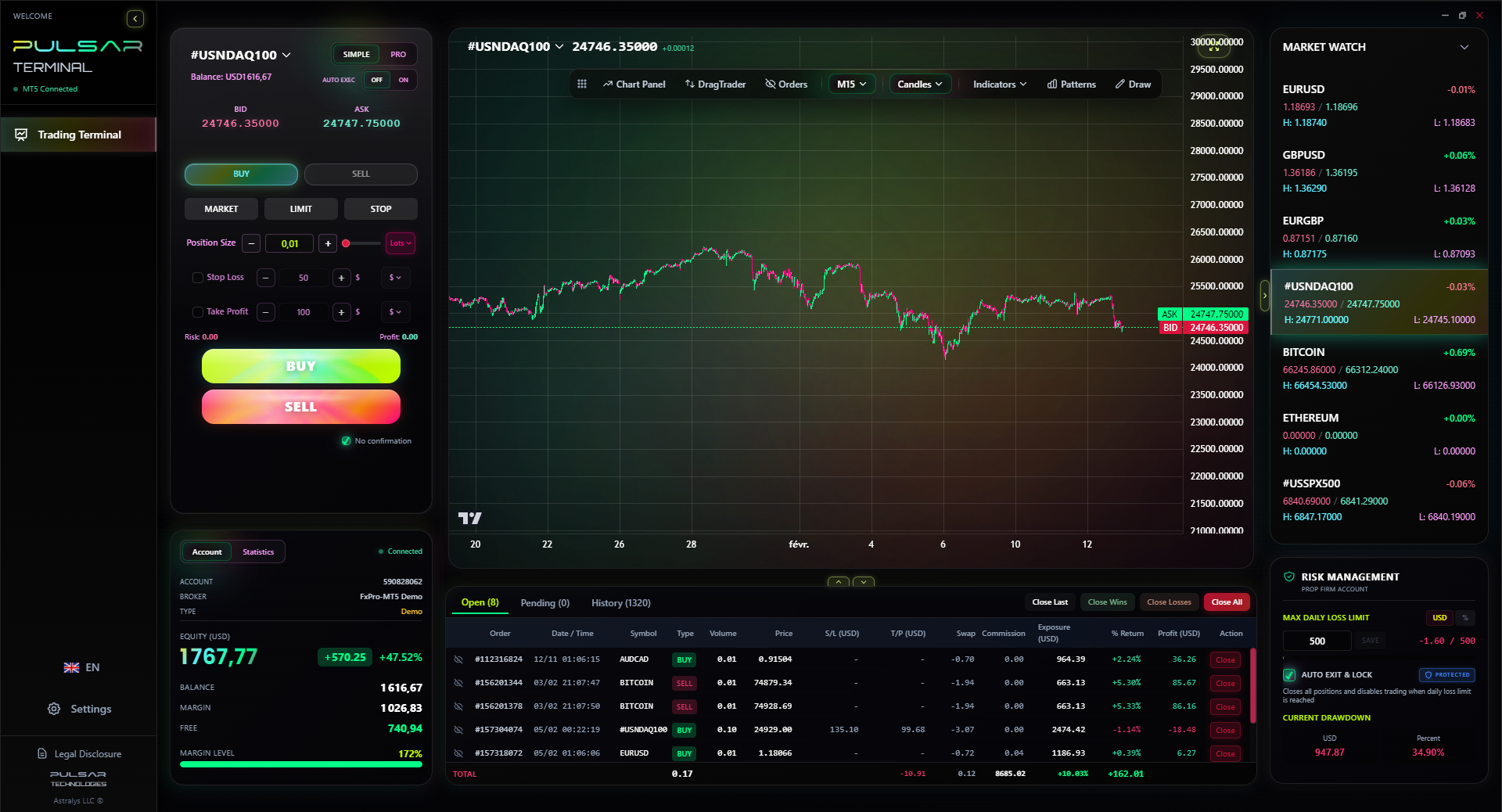
When your strategy depends on precise entries, multiple profit targets, and automated risk management, a tool like Pulsar Terminal turns your MT5 platform into a professional command center.
Pulsar Terminal
เครื่องมือ MT5 ครบวงจร: ลากวางคำสั่ง, multi-TP/SL, trailing stop, grid trading, Volume Profile และการป้องกัน prop firm ใช้งานโดยเทรดเดอร์กว่า 1,000 คนทุกวัน
Building forex wealth in South Africa happens within a specific - and restrictive - framework. Ignoring this is a surefire way to turn paper profits into real-world losses.
The 30:1 use Cap: The FSCA's retail use limit is a game-saver, not a game-spoiler. Trading with 500:1 use, offered by some offshore brokers, is a shortcut to blowing your account. 30:1 forces you to use proper capital. It's a protective barrier many wish they'd had earlier.
The Tax Man Cometh (SARS): Every Rand of net profit is taxable income. It doesn't matter if your broker is in Cyprus or the Seychelles. You must declare it. I learned this after a good year in 2019. I had to work backwards with my bank statements and trade history - a nightmare. Now, I keep a simple spreadsheet: date, pair, P/L, running total. SARS doesn't care about your 'hot streak'; they want their share.
Exchange Controls: Moving large sums in and out of the country involves Authorised Dealers (your bank) and paperwork. You can't just wire $500,000 from your Exness account to your local bank without triggering questions. The wealthiest traders have relationships with private bankers who understand these flows.
The Cost of Trading ZAR Pairs: Want to trade USD/ZAR? Get ready for spreads of 5 pips or more. That's R50 on a standard lot per pip just on the spread. It changes your profit calculus immediately. Your strategy must account for this inherent friction, which is much higher than trading EUR/USD at 0.6 pips.
💡 เคล็ดลับจาก Winston
The FSCA's 30:1 use limit is your best friend. It forces you to use real capital. Anyone promising you riches with 500:1 is selling you a ticket to ruin.
“Your first goal isn't to get rich. Your first goal is to survive. To be a trader next month, next year.”
This is where the real separation occurs. Anyone can get lucky on a trade. Building lasting wealth is a psychological marathon.
Embracing Boredom: The most profitable months of my career have also been the most boring. Execute the plan, take small losses, bank small wins, repeat. No drama. The chase for excitement is a wealth killer.
Detaching from Individual Outcomes: You can't get euphoric about a win or devastated by a loss. Each trade is just one sample in a large data set. I used to check my P&L every 10 minutes. Now, I review it weekly. This mental shift alone added 20% to my annual returns because I stopped interfering with good trades out of fear.
The Survival Mindset: Your first goal isn't to get rich. Your first goal is to survive. To be a trader next month, next year. This mindset forces conservative practices. It makes you respect the market's power to humble you, no matter your previous success.
Continuous, Unsexy Education: The richest forex traders in South Africa are constant learners. But they're not buying the next 'groundbreaking' course. They're reading central bank reports, studying market microstructure, back-testing adjustments to their RSI indicator settings, or learning about new order types. The education never stops, but its focus changes from 'how to trade' to 'how to refine.'
Let's be brutally honest. The public narrative is sanitized.
The Loneliness: Trading is isolating. Making a decision that loses R10,000 is something you sit with alone. The weight of responsibility is entirely on you. There's no team to blame.
The Inconsistency: Even the best have drawdowns, sometimes for months. Your family will ask if you should 'just get a real job.' Your own confidence will be tested. I had a 6-month period in 2020 where I made zero progress. Flat. It felt like failure, but it was just the market's rhythm.
The Opportunity Cost: The hours spent analyzing charts are hours not spent elsewhere. The mental energy is immense. The wealth might be financial, but the cost is time, stress, and relentless focus.
The Target on Your Back: As you become successful, 'friends' will appear asking for tips, or worse, asking you to manage their money. Family will expect loans. Navigating the social dynamics of new wealth is its own challenge.

Pro Tip: Build a 'trading council' - a small group of 2-3 serious, like-minded traders you trust. Not to share signals, but to talk psychology, review trades objectively, and stay sane. This was a lifesaver for me during volatile periods like the 2022 SARB hikes.
💡 เคล็ดลับจาก Winston
Wealth in trading compounds in the quiet periods. The months where you make 2%, lose 1%, make 3%. The dramatic 100% months are usually flukes that get reversed.
“The flash is optional. The grind is mandatory.”
So, how do you actually walk this path? Forget mimicking the Instagram stars. Follow this boring, proven ladder.
- Master the Demo: Not for a week. For 3-6 months. Treat it like real money. Prove to yourself you can have three consecutive profitable months following a written plan. If you can't do it with virtual money, you definitely can't with real money.
- Fund a Micro Account: Start with an amount you can afford to lose completely - R2,000, R5,000. The goal is not profit. The goal is to experience real slippage, real emotions, and real spreads with a broker like XM or Exness that offers small minimum deposits. The lesson is in the feel.
- Scale by Percentage, Not by Rand Value: Your first goal is to grow your account by 10%. Then, focus on growing it another 10%. This compounds. Withdrawing 50% of your profits every time you hit a milestone is a powerful wealth-building habit. It takes money off the table and funds your life.
- Specialize: Pick one major pair (EUR/USD is great for beginners) and one ZAR cross. Learn everything about them.
- Build Systems, Not Opinions: Move from 'I think it will go up' to 'My system gives a long signal here, with a stop loss at X and a target at Y.'
- Get Your Admin Sorted: From day one, keep records for SARS. Have a separate bank account for trading operations. Be a professional.
The richest forex traders in South Africa aren't magical. They're disciplined, patient, and treat trading as a serious business. The flash is optional. The grind is mandatory.
FAQ
Q1Who is currently considered the richest forex trader in South Africa?
There's no officially verified 'richest' trader. Public figures like Ref Wayne (Refiloe Nkele) and Sandile Shezi are often cited, with reported net worths in the millions to hundreds of millions. However, these figures often combine trading capital, business revenue from education, and brand value. The truly wealthiest pure traders are likely private individuals not in the public eye.
Q2Is it legal to become a full-time forex trader in South Africa?
Yes, forex trading is completely legal. You are running a sole proprietorship. The key is compliance: you must register as a provisional taxpayer with SARS and declare all your trading profits as income. You must also use brokers that operate legally, whether they are FSCA-regulated local brokers or reputable international ones.
Q3How much do I need to start forex trading in South Africa?
You can start with very little. Brokers like XM allow deposits as low as $5 (around R90). However, a realistic starting amount for serious practice is between R2,000 and R5,000. This is enough to open a micro or cent account, experience real trading conditions, and practice risk management without catastrophic loss. Remember, the goal of this initial capital is education, not income.
Q4How are forex trading profits taxed by SARS?
SARS views net forex trading profits (profits minus losses and expenses) as ordinary taxable income. It is added to your other income and taxed at your marginal tax rate. You must keep detailed records of every trade, all deposits and withdrawals, and any related expenses (data, software, education). Even profits from offshore brokerage accounts must be declared.
Q5Can I use international brokers like IC Markets or Pepperstone as a South African?
Yes, absolutely. Many South African traders use top international brokers like IC Markets, Pepperstone, and Exness. They often offer tighter spreads, more instruments, and advanced platforms. The trade-off is that they are not regulated by the FSCA, so you rely on their home regulator (e.g., ASIC, CySEC) for dispute resolution. You also still have full SARS tax obligations on any profits made.
Q6What's the biggest mistake aspiring traders make when trying to build wealth?
Confusing a few lucky wins with a sustainable edge, and then over-leveraging based on that false confidence. They risk far too much per trade, seeking rapid growth. The real path is the opposite: using strict risk management (1-2% per trade), focusing on consistency over home runs, and treating trading like a slow, compounding business. The mental shift from gambler to business owner is the most critical one.
บทเรียนจาก Prof. Winston
สรุปสาระสำคัญ:
- ✓Distinguish trading wealth from business-of-trading wealth.
- ✓Real wealth uses max 1-2% risk per trade, always.
- ✓SARS taxes net profits; record-keeping is non-negotiable.
- ✓Mastery beats diversification; become an expert in one pair.
บทความนี้มีประโยชน์แค่ไหน?
คลิกดาวเพื่อให้คะแนน
ข้อมูลเชิงลึกการเทรดรายสัปดาห์
การวิเคราะห์และกลยุทธ์รายสัปดาห์ฟรี ไม่มีสแปม
เกี่ยวกับผู้เขียน
David van der Merwe
เทรดเดอร์ตลาดเกิดใหม่
เทรดเดอร์ประจำโจฮันเนสเบิร์ก มีประสบการณ์ 11 ปีในสกุลเงินตลาดเกิดใหม่ เชี่ยวชาญคู่ ZAR การเทรดภายใต้กฎระเบียบ FSCA และการวิเคราะห์ตลาดแอฟริกาใต้
ความคิดเห็น
คำเตือนความเสี่ยง
การซื้อขายตราสารทางการเงินมีความเสี่ยงสูงและอาจไม่เหมาะสำหรับนักลงทุนทุกคน ผลการดำเนินงานในอดีตไม่ได้รับประกันผลลัพธ์ในอนาคต เนื้อหานี้มีวัตถุประสงค์เพื่อการศึกษาเท่านั้นและไม่ควรถือเป็นคำแนะนำในการลงทุน โปรดทำการวิจัยของคุณเองก่อนการซื้อขาย
คุณอาจชอบสิ่งนี้

Cara Trading Forex Sukses: 7 Prinsip dari Trader Profesional
Cara trading forex sukses dengan 7 prinsip trader pro: manajemen modal, disiplin, journal trading, backtest. Data nyata, bukan janji profit palsu.
Jam Trading Forex Terbaik untuk Trader Indonesia: Panduan Lengkap dengan Tabel Waktu
Panduan jam trading forex untuk trader Indonesia. Tabel 4 sesi dunia, jam emas 20:00-00:00, sesi mana yang harus dihindari. Data akurat + tips dari trader berpengalaman.
Top 5 Sàn Forex Uy Tín Nhất 2026: Review Jujur dari Trader Indonesia
Top 5 sàn forex uy tín 2026 untuk trader Indonesia. Review jujur: spread, deposit, withdraw, dukungan lokal. Exness, XM, IC Markets & lebih.
รับ Pulsar Terminal
เครื่องคำนวณทั้งหมดนี้ถูกสร้างไว้ใน Pulsar Terminal พร้อมข้อมูลเรียลไทม์จากบัญชี MT5 ของคุณ
รับ Pulsar Terminal