


I remember trying to open a Saxo Bank account back in 2023.

Olumide Adeyemi
ผู้บุกเบิกการเทรดในแอฟริกาตะวันตก ·  Nigeria
☕ 12 นาทีอ่าน
สิ่งที่คุณจะได้เรียนรู้:
- 1The 2024 Ban: What Happened and Why It Matters
- 2Forex Rules in Nigeria: What You Can and Can't Do
- 3Saxo's Fee Structure: Was It Worth It?
- 4Your Realistic Broker Options in Nigeria Today
- 5Trading with Naira: Managing Costs and Currency Risk
- 6Platforms and Tools: Beyond the Basic MT5
- 7Building a Sustainable Trading Career from Nigeria
I remember trying to open a Saxo Bank account back in 2023. I was drawn in by their institutional-grade platform and reputation. I spent weeks gathering documents, only to have my application stall in a perpetual 'under review' status. It was frustrating, but it taught me a hard lesson about the shifting sands of international broker access for Nigerian traders. That lesson became crystal clear on July 1, 2024, when Saxo officially stopped accepting new clients from Nigeria. This guide isn't just about what Saxo Bank forex was, it's about understanding why it's gone and, more importantly, what your realistic, legal options are today.
Let's cut straight to the point. As of July 1, 2024, Saxo Bank closed its doors to new Nigerian clients. This wasn't a temporary glitch or a paperwork issue. It was a strategic, permanent shift. They're a Danish bank first, and their decision was about global regulatory alignment and operational focus. For us in Nigeria, it's a stark reminder of our position in the global financial system.
When a tier-1 broker like Saxo exits a market, it sends a signal. It tells you that the regulatory or economic environment is seen as too complex or risky for their business model. For you, the trader, it means one less 'premium' option. But here's the crucial part: it doesn't mean forex trading in Nigeria is illegal. Far from it. It just means we have to be smarter about who we trust with our capital.
This move forced me to re-evaluate my entire broker selection process. I stopped chasing the big European names and started looking seriously at brokers who were committed to the African market, with local support and payment methods that actually work here. The closure of that door opened my eyes to better, more accessible alternatives.

Warning: Any website or individual claiming they can open a new Saxo Bank account for you as a Nigerian resident after July 2024 is almost certainly a scam. Do not send them money or documents.

💡 เคล็ดลับจาก Winston
A broker closing its doors to you is not a personal failure. It's a business decision. Your job is to find the next best open door, not to mourn the closed one.
There's a lot of confusion out there. Let me clear it up with what I've learned, sometimes the hard way. Trading forex as an individual in Nigeria is completely legal. The Central Bank of Nigeria (CBN) regulates currency flows, but they aren't coming after retail traders like you and me for speculating on EUR/USD.
The Regulatory Gap
Here's the key nuance. Nigeria's Securities and Exchange Commission (SEC) regulates stocks and bonds, but they don't have a specific license for retail spot forex brokers. This creates a gap. There are no 'locally regulated' forex brokers in the way you might think. Instead, we rely on international brokers regulated abroad. This is perfectly acceptable, but it puts the onus on you to verify that broker's overseas license.
Your Tax Obligations
This is non-negotiable and often overlooked. Any profit you make from trading, even with a broker based in Cyprus or Australia, is subject to Nigerian tax law. You're liable for a 10% Capital Gains Tax on your gross profits. I learned this after a surprisingly good quarter in 2022. I set aside 10% of the profit immediately; it's just part of the cost of doing business. Keep detailed records of all your trades.
Recent Changes That Affect You
In early 2025, the CBN launched the Nigerian Foreign Exchange (FX) Code. This isn't about stopping you from trading, but about bringing more transparency to the broader financial system. For us, it underscores that forex is a serious, recognized activity. The CBN's focus is on stabilizing the Naira, which directly impacts your cost of living and the value of your trading capital in Naira terms. Understanding this bigger picture is part of being a savvy trader here.
When choosing a broker, this regulatory landscape means your first question shouldn't be about spreads, but about safety. A strong international license (like ASIC in Australia or FCA in the UK) is your primary protection. I have a detailed breakdown of what to look for in my Exness review, which covers their CySEC license, a common standard for brokers serving Nigeria.
“Saxo's model made sense for one type of trader: the high-net-worth individual moving massive size. For the rest of us, it was a very expensive way to trade.”
Let's talk numbers, because this is where the Saxo Bank forex proposition really lived or died for a trader. Their model was built for serious volume, not for the casual retail punter. I'll break down the costs I researched before the ban, so you can see what you're comparing alternatives against.
First, the spreads. On their primary pricing tier, EUR/USD could get as low as 0.6 pips. That's tight, genuinely institutional-grade. But that's not the whole story. On top of that spread, they charged a commission: $50 per lot (where one lot is $100,000 traded). And if your trade size was below a certain threshold, they'd slap on a $10 'ticket fee'. Let's do the math on a 1-lot trade.

Example:
- You buy 1 lot of EUR/USD.
- Spread Cost: 0.6 pips = $6
- Commission: $50
- Potential Ticket Fee: $10
- Total Cost to Open: Up to $66
You read that right. You're down $66 before the market even moves a tick in your favor. Compare that to a typical raw spread account from a broker like IC Markets, where you might pay a $7 commission and a 0.1 pip spread ($1), for a total cost of $8. The difference is staggering.
Saxo's model made sense for one type of trader: the high-net-worth individual or professional moving massive size, where the premium platform and direct market access justified the fees. For the rest of us, it was a very expensive way to trade. Their overnight financing (swap) rates were also on the higher side. I once calculated that holding a 1-lot GBP/JPY position over a weekend with Saxo would have cost me nearly triple what I paid with my current broker.
This fee analysis isn't just academic. It teaches you to always calculate your total cost per trade - spread + commission + any fixed fees. This is the single biggest factor in profitability for a scalping strategy or any high-frequency approach. Saxo's costs would have eaten a scalper alive.
So, Saxo is out. What's in? Here are the categories of brokers that are actively serving Nigerian clients reliably. I've traded with at least one in each category, so this is from lived experience.
International Brokers with Strong Regulation: These are your best bet for security. They hold top-tier licenses but have adapted to serve emerging markets.
- Pepperstone & IC Markets: Both Australian (ASIC regulated) and known for raw spreads and low commissions. Their Razor and Raw Spread accounts are fantastic for active traders. I've used both; execution is lightning-fast. You can read my deep dive on their platforms in this Pepperstone review.
- XM: Heavily marketed here, and for good reason. They're regulated globally, offer a huge range of instruments, and have local account managers. Their minimum deposit is low, which is great for starting out.
Brokers with a Major African Focus: These brokers have built their systems around our payment and support needs.
- Exness: A giant in this region. They accept Naira deposits directly, have instant withdrawals to Nigerian banks, and their local partner network is extensive. Their spreads are variable but can be very competitive. I use them for my Naira-based accounts. Check my full Exness review for the pros and cons.
- HFM: Another strong player with local presence. They offer accounts in Naira and have good educational resources tailored for the market.
A Quick Comparison Table:
| Broker | Key Regulation | Min. Deposit (Approx.) | Naira Deposits? | Best For |
|---|---|---|---|---|
| IC Markets | ASIC (Australia) | $200 | No (USD) | Low-cost, active trading |
| Exness | CySEC (EU) | ₦4,000 | Yes | Easy funding/withdrawal in NGN |
| XM | ASIC, CySEC | $5 | No (USD) | Beginners, educational resources |
| Pepperstone | ASIC, FCA | $200 | No (USD) | Advanced platforms & execution |
My personal setup? I keep two brokers. One international (like IC Markets) for my main USD trading where I want the absolute best execution on my swing trading ideas. And one local-facing broker (like Exness) for quick Naira deposits when I want to test a new strategy with smaller capital. This diversification also protects me if one broker's payment channel has a temporary issue.
“You're liable for a 10% Capital Gains Tax on your gross profits. I learned this after a surprisingly good quarter; it's just part of the cost of doing business.”
This is the reality most Nigerian traders face: you earn in Naira, but you trade in USD. This adds a whole hidden layer of risk and cost that traders in Europe or America never think about. I've lost more money to bad exchange timing than to some bad trades.
The Funding Surcharge: When you deposit Naira to a broker that converts it to USD, you're not getting the official CBN rate. You're getting a commercial rate that includes a spread, often 2-5%. On a ₦500,000 deposit, that's an immediate ₦10,000 to ₦25,000 'fee' before you place a single trade. I learned to treat this like a brokerage commission. I factor it into my overall trading costs for the month.
The Naira-Dollar Rollercoaster: Your trading capital in USD terms shrinks and grows with the USD/NGN rate, independent of your trading skill. In 2024, when the Naira was in freefall, the USD value of my Naira-denominated savings ballooned. It felt like a win, but it was an illusion. When the CBN interventions stabilized the rate in 2025, that 'profit' evaporated. Now, you must separate your trading P&L from your currency conversion P&L. They are two different things.

Pro Tip: If you have a stable income in USD (maybe from freelance work), try to keep your trading capital in USD. Use a domiciliary account and transfer directly to your broker. It cuts out the conversion loss and simplifies your accounting massively.
Calculating Your True Starting Capital: Always think in USD. If you plan to trade with $1,000, don't just multiply by the current exchange rate. Use a position size calculator to work backwards. Add 3-5% for the expected conversion loss. So, for $1,000 at ₦1,500/$ with a 4% loss, you need: ₦1,500,000 + ₦60,000 = ₦1,560,000. Starting with less than this means you're undercapitalized from the get-go, increasing your risk of a margin call.
💡 เคล็ดลับจาก Winston
Your most dangerous trade isn't the one you're about to take; it's the currency conversion from Naira to USD before you even start. Price it in.
Saxo's main draw was its proprietary platform, SaxoTraderGO. It was slick. But being locked out of it forced me to master MetaTrader 5, and honestly, it was a blessing. MT5, when powered up with the right tools, is more than enough for any retail trader.
Most brokers offering XM, IC Markets, or Pepperstone will give you MT5. Your job is to build your workspace. Don't just accept the default charts. Learn to use the MACD indicator and RSI indicator effectively, not just slap them on. I have specific settings for each that took years to refine.
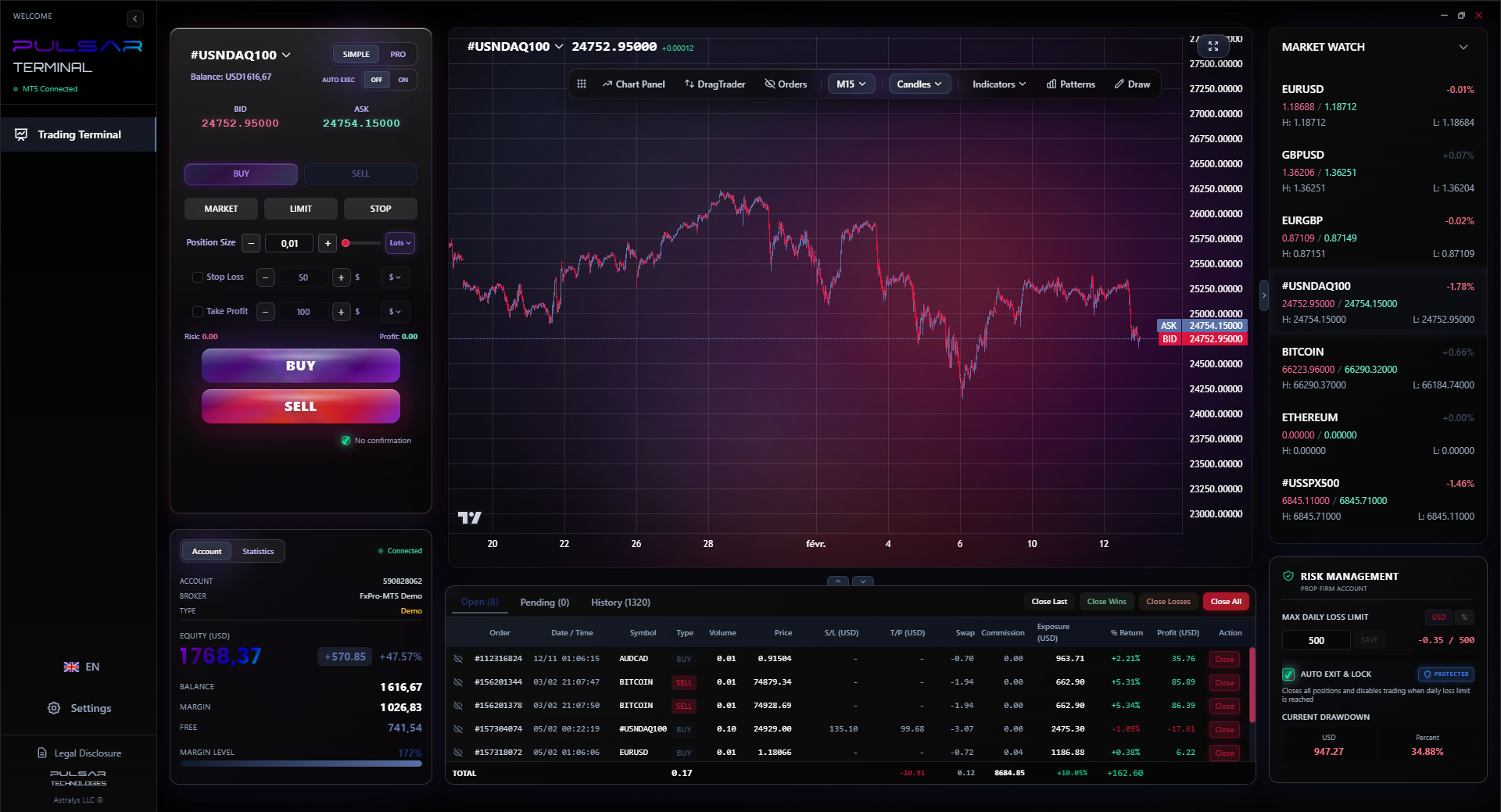
The real game-changer for me was adding advanced trading management software. As your strategy gets complex - using multiple take-profit levels, trailing stops, or managing a grid of orders - doing it manually on MT5 is a nightmare. I used to have sticky notes all over my monitor reminding me to move stops to breakeven. I missed so many moves because I was busy managing an existing trade.
Automating this trade management is crucial. It removes emotion and ensures you never miss a rule you set for yourself. This is especially vital if you're aiming to pass a prop firm challenge, where the daily loss limits are strict and non-negotiable. A good tool will automatically hedge or close positions to protect you from breaching that limit, something you can't do manually while sleeping.
Managing complex trades with multiple take-profit levels and trailing stops manually is nearly impossible, which is why automating that process with a tool like Pulsar Terminal directly on your MT5 is a total game-changer for discipline.
Pulsar Terminal
เครื่องมือ MT5 ครบวงจร: ลากวางคำสั่ง, multi-TP/SL, trailing stop, grid trading, Volume Profile และการป้องกัน prop firm ใช้งานโดยเทรดเดอร์กว่า 1,000 คนทุกวัน
“The path is harder here, with our unique currency challenges. But that constraint can breed creativity and discipline.”
Forget getting rich quick. That's a fantasy sold by YouTube gurus. Building a real career in forex from Nigeria is about discipline, continuous learning, and brutal honesty with your results. Here's the blueprint I wish I had when I started.
Start Small, Think Big: The recommended minimum to start with proper risk management is $500-$1000. But if you only have ₦150,000 (about $100), start there. The goal isn't to make money yet. The goal is to learn to execute your plan, manage emotions, and lose small. I blew my first $200 account in two weeks because I was over-leveraging to 'get to the real money.' That was an expensive lesson in the true definition of a pip and how quickly they can add up against you.
Education Over Signals: Invest in understanding why a market moves. Learn about the CBN's monetary policy announcements, how oil prices affect the Naira, and what global risk sentiment does to a pair like XAU/USD. This context will make you a better trader than any signal service ever could. I spent more on books and reputable courses in my first year than I did on my trading capital.
Track Everything: Not just your P&L. Track your emotional state, your sleep, why you entered a trade, why you exited. Review this journal weekly. You'll start to see patterns - maybe you're overtrading on Tuesday afternoons, or you always cut winners short on EUR/USD. This self-awareness is your most powerful tool.
The Community Myth: Be wary of Nigerian 'forex trading groups' on WhatsApp and Telegram. Many are filled with misinformation and are fronts for selling fake courses or managing people's accounts illegally. Find a small, serious group of 2-3 other traders you trust to review trades and hold each other accountable. That's worth more than a thousand-member broadcast channel.
The path is harder here, with our unique currency challenges and limited broker options. But that constraint can breed creativity and discipline. You learn to be a sharper, more resilient trader because you have to be. Losing access to Saxo Bank forex wasn't a setback; it was a push towards finding better, more cost-effective ways to operate. And in trading, that's always a win.
FAQ
Q1Can I still use Saxo Bank if I am Nigerian?
If you were a verified client of Saxo Bank before July 1, 2024, you can likely still access your account. However, Saxo Bank is no longer accepting any new client applications from Nigerian residents. Attempting to open an account now will result in rejection.
Q2Is forex trading illegal in Nigeria?
No, forex trading is not illegal for individuals in Nigeria. It is a legal activity. The Central Bank of Nigeria (CBN) regulates currency flows, but individuals are free to trade on the international spot forex market through brokers regulated overseas. You are required to pay a 10% capital gains tax on your profits.
Q3What is the best alternative to Saxo Bank for Nigerian traders?
The 'best' alternative depends on your needs. For low-cost trading with excellent execution, consider ASIC-regulated brokers like IC Markets or Pepperstone. For easy Naira deposits, withdrawals, and local support, brokers like Exness or HFM are strong choices. Always prioritize brokers with reputable international regulation.
Q4How much money do I need to start forex trading in Nigeria?
Technically, you can start with as little as $10 or ₦4,000 with some brokers. However, for serious learning with proper risk management (risking 1-2% per trade), a starting capital of $500-$1000 (roughly ₦750,000 - ₦1,500,000) is a more realistic recommendation. Remember to account for a 3-5% conversion loss when funding.
Q5How do I pay taxes on my forex trading profits in Nigeria?
Forex trading profits are subject to a 10% Capital Gains Tax on the gross profit. You are responsible for declaring this income and paying the tax to the Federal Inland Revenue Service (FIRS). Keep detailed, dated records of all your trades, deposits, and withdrawals as proof of your gains and losses.
Q6Why did Saxo Bank stop serving Nigerian clients?
Saxo Bank has not publicly detailed the exact reasons, but such decisions are typically strategic and based on global regulatory priorities, cost of compliance in specific jurisdictions, and a focus on core markets. For a regulated European bank, the evolving regulatory and foreign exchange environment in Nigeria likely presented complexities they chose to step back from.
บทเรียนจาก Prof. Winston
สรุปสาระสำคัญ:
- ✓Saxo Bank banned new Nigerian clients on July 1, 2024.
- ✓You owe 10% Capital Gains Tax on all forex profits.
- ✓Calculate total trade cost: spread + commission + fees.
- ✓Factor a 3-5% loss on Naira to USD conversion.
- ✓Prioritize brokers with ASIC or FCA regulation.
บทความนี้มีประโยชน์แค่ไหน?
คลิกดาวเพื่อให้คะแนน
ข้อมูลเชิงลึกการเทรดรายสัปดาห์
การวิเคราะห์และกลยุทธ์รายสัปดาห์ฟรี ไม่มีสแปม
เกี่ยวกับผู้เขียน
Olumide Adeyemi
ผู้บุกเบิกการเทรดในแอฟริกาตะวันตก
หนึ่งในนักการศึกษาฟอเร็กซ์ที่กระตือรือร้นที่สุดของไนจีเรีย 8 ปีประสบการณ์เทรดจากลากอส เชี่ยวชาญกลยุทธ์ทุนต่ำและความท้าทาย prop firm สำหรับเทรดเดอร์ในแอฟริกา
ความคิดเห็น
คำเตือนความเสี่ยง
การซื้อขายตราสารทางการเงินมีความเสี่ยงสูงและอาจไม่เหมาะสำหรับนักลงทุนทุกคน ผลการดำเนินงานในอดีตไม่ได้รับประกันผลลัพธ์ในอนาคต เนื้อหานี้มีวัตถุประสงค์เพื่อการศึกษาเท่านั้นและไม่ควรถือเป็นคำแนะนำในการลงทุน โปรดทำการวิจัยของคุณเองก่อนการซื้อขาย
คุณอาจชอบสิ่งนี้

Cara Trading Forex Sukses: 7 Prinsip dari Trader Profesional
Cara trading forex sukses dengan 7 prinsip trader pro: manajemen modal, disiplin, journal trading, backtest. Data nyata, bukan janji profit palsu.
Jam Trading Forex Terbaik untuk Trader Indonesia: Panduan Lengkap dengan Tabel Waktu
Panduan jam trading forex untuk trader Indonesia. Tabel 4 sesi dunia, jam emas 20:00-00:00, sesi mana yang harus dihindari. Data akurat + tips dari trader berpengalaman.
Top 5 Sàn Forex Uy Tín Nhất 2026: Review Jujur dari Trader Indonesia
Top 5 sàn forex uy tín 2026 untuk trader Indonesia. Review jujur: spread, deposit, withdraw, dukungan lokal. Exness, XM, IC Markets & lebih.
รับ Pulsar Terminal
เครื่องคำนวณทั้งหมดนี้ถูกสร้างไว้ใน Pulsar Terminal พร้อมข้อมูลเรียลไทม์จากบัญชี MT5 ของคุณ
รับ Pulsar Terminal