


I remember watching the USD/ZAR chart in late 2025, my finger hovering over the sell button.

David van der Merwe
เทรดเดอร์ตลาดเกิดใหม่ ·  South Africa
☕ 10 นาทีอ่าน
สิ่งที่คุณจะได้เรียนรู้:
- 1What is STP Execution? No Desk, No Drama
- 2STP vs. Other Models: What's Available in SA?
- 3The Real Costs: Spreads, Commissions & the ZAR Factor
- 4How to Choose an FSCA-Regulated STP Broker
- 5The Good, The Bad & The Volatile
- 6Trading Strategies & Practical STP Tips
- 7The Future of STP & Trading in SA (2026 Outlook)
I remember watching the USD/ZAR chart in late 2025, my finger hovering over the sell button. The pair was at R18.90, and I was convinced it was topping out. I clicked, and the order filled instantly at R18.899. No requote, no delay. That’s the STP difference. For South African traders, understanding the STP meaning in forex isn't just jargon - it's the difference between getting the price you see and getting a nasty surprise. Let's break down what STP really is, why it matters for your ZAR trades, and how to use it to your advantage.
STP stands for Straight-Through Processing. In plain English, it means your trade order goes from your platform straight to the real market, electronically, without a human dealer at the broker messing with it.
Think of it like this. With an old-school broker (a dealing desk or Market Maker model), you're betting against the house. They take the other side of your trade. If you win, they lose. That creates a conflict of interest you don't want. STP brokers are different. They're just the middleman connecting you to liquidity providers - big banks, financial institutions, and other traders.
When you click buy on EUR/USD, an STP broker's system automatically shops your order to its network of liquidity providers to get you the best available price. It then passes that fill back to you. The broker makes money from a small markup on the spread or a commission, not from your losses. This is why STP is a type of No Dealing Desk (NDD) model.

Warning: Don't confuse 'No Dealing Desk' with 'no conflict of interest.' The conflict is reduced, but brokers still profit from your trading activity via spreads/commissions. Their incentive is for you to trade more, not necessarily to win more.
For us trading the ZAR, this is crucial. Pairs like USD/ZAR can be volatile. You need execution you can trust, not a dealer deciding if they'll give you your price. I learned this the hard way years ago with a different broker on a GBP/ZAR spike. I got a requote that cost me 45 pips. That's R450 on a mini lot. Never again.

💡 เคล็ดลับจาก Winston
The spread isn't a fee, it's the first leg of your journey. If you can't see a clear path to profit beyond it, don't take the trade.
Not all brokers are created equal. Here’s how STP stacks up against the other common models you'll find with FSCA-regulated brokers.
| Model | How It Works | Pros for SA Traders | Cons for SA Traders |
|---|---|---|---|
| Market Maker (Dealing Desk) | Broker acts as counterparty to your trade. | Often lower minimum deposits, fixed spreads. | Potential conflict of interest, requotes during news. |
| STP (Straight-Through Processing) | Order routed automatically to liquidity providers. | Faster execution, better transparency, no requotes. | Slightly wider spreads than pure ECN, variable costs. |
| ECN (Electronic Communication Network) | Order placed directly into an interbank network. | Tightest raw spreads, true market depth. | Commissions per trade, higher minimum deposits. |
Many brokers here offer hybrid models. For example, a broker might use STP for most clients but internalize small, predictable trades. The key is to ask. When I was choosing my current broker, my first question was, "What's your execution model for a standard account on USD/ZAR?"
The ECN Cousin
ECN is often mentioned with STP. They're both NDD, but ECN is usually the premium version. An ECN broker connects you to a live marketplace where prices are streamed from multiple participants. You see the raw spread and pay a commission. STP brokers often aggregate prices from their liquidity providers and show you a single, marked-up spread with no commission. For most retail traders starting out, a good STP broker is the sweet spot between cost and transparency.
Some brokers, like IC Markets and Pepperstone, offer both STP-style and true ECN accounts. It's worth checking which one fits your scalping strategy or swing trading style better.
“STP means your trade goes from your platform straight to the real market, without a dealer deciding your fate.”
Let's talk rands and cents. STP isn't free, and understanding the fee structure stops nasty surprises on your statement.
Spreads: This is the main cost for most STP accounts. The broker adds a markup to the raw interbank spread. For majors like EUR/USD, expect 0.5 to 1.5 pips on a commission-free STP account. For USD/ZAR? Much wider - often 80-150 pips because it's an exotic pair with less liquidity. That's not the broker ripping you off; it's the actual market cost.
Commissions: Some STP/ECN accounts charge a commission per lot. For example, $6 per standard lot round turn (open and close). Do the math: if you're trading 0.1 lots, that's $0.60. Compare this to the spread markup on a commission-free account to see which is cheaper for your typical trade size.
The Hidden ZAR Tax: This is a big one for us. If your trading account is in USD but you fund it with Rands, your bank or payment provider will hit you with a conversion fee (often 2-3%). The solution? Use a broker that offers a ZAR-denominated account. Brokers like Exness and XM offer this. Deposit and withdraw in Rands, and the broker handles the conversion at a better rate. I switched to a ZAR account with my broker and saved hundreds in unnecessary bank fees last year.

Example: You deposit R10,000. Bank conversion fee at 2.5% = R250 gone before you even trade. With a broker ZAR account, that fee is often 0% or a flat R50-100.
Other fees include swap/rollover charges for holding overnight (check these on ZAR pairs!) and potential inactivity fees. Always read the schedule of fees.
Regulation is your safety net. In South Africa, the Financial Sector Conduct Authority (FSCA) is the watchdog. Never, ever trade with an unregulated broker. Here’s your checklist.
- Verify the FSCA License: Go to the FSCA website, find their register, and type in the broker's name or license number. It should say "Authorised Financial Services Provider." Active status is non-negotiable.
- Execution Policy: Dig into the broker's website. Look for their "Execution Policy" or "Order Execution" document. It should clearly state they use an STP/NDD model for your account type.
- Trading Platform: Most of us use MT4 or MT5. Ensure the broker supports it. Some advanced traders prefer cTrader for its clean ECN-style interface. I use MT5 for its better XAU/USD charting and hedging capabilities.
- Deposit/Withdrawal in ZAR: As mentioned, this is a lifesaver. Check the supported methods: EFT, credit card, and maybe e-wallets like Ozow or Peach Payments. Withdrawal times should be under 24 hours for EFT.
- Customer Support: Test them. Call or live chat with a specific question about STP execution on USD/ZAR. If they can't answer clearly, walk away.
Brokers like XM (FSP 49146), AvaTrade (FSP 45984), and Tickmill are well-established with FSCA regulation. But always do your own verification. I once almost signed up with a "regulated" broker whose license had lapsed three months prior. A five-minute check saved me.
💡 เคล็ดลับจาก Winston
Test a broker's 'no requote' promise during the London open on a demo account. That's when the rubber meets the road.
“For ZAR pairs, a variable spread isn't a broker flaw - it's a market reality. Your strategy must account for it.”
STP isn't a magic bullet. Let's weigh it up honestly.
Advantages:
- Transparency: You're getting a price closer to the real market. No dealer intervention.
- Speed: Automated execution means faster fills, critical for news trading or scalping.
- No Requotes: The price you click is (usually) the price you get. This builds trust.
- Better for All Strategies: Whether you're a scalper or a swing trader, consistent execution is key.
Disadvantages:
- Variable Spreads: Spreads can widen massively during high volatility (like SARB interest rate announcements). Your 100-pip spread on USD/ZAR can blow out to 300 pips in seconds. You need a rock-solid risk management plan for this.
- Slippage: This is possible in fast markets. You might get filled at a slightly worse price than you expected. It can be positive too, but usually it's not.
- Potential for Higher Costs: On quiet markets, a fixed-spread Market Maker account might be cheaper. But when it matters, STP is fairer.
My opinion? The advantages far outweigh the disadvantages for any serious trader. The variable spread issue is just a market reality, not a broker flaw. You manage it by not trading during major news if you can't handle the widening, and by using a sensible position size calculator so that spread widening doesn't blow your account.
How do you adapt your trading to an STP environment? Here are some hard-won lessons.
Mind the Spread
Your trade starts in a hole equal to the spread. On USD/ZAR, that hole is big. Your strategy must account for this. A 5-pip scalp on EUR/USD is feasible; a 5-pip scalp on USD/ZAR is eaten by the spread. I focus on larger moves on exotics - 50 pip minimum profit targets.
Use Limit Orders
With STP, placing limit orders inside the spread is often effective. If USD/ZAR bid/ask is R18.500 / R18.650, try placing a buy limit at R18.520. You might get a better fill than the market price when liquidity hits.
Watch Economic Calendars Religiously
Know when South African data (CPI, SARB repo rate) and US data (NFP, Fed) drops. Spreads will widen. Either avoid trading or use extremely wide stops if you must be in the market. I got stopped out on a perfectly good USD/ZAR trade because I forgot about local manufacturing data; the spread widened and my tight stop was hunted.
Technology is Your Friend
Fast execution needs a fast setup. Use a reliable internet connection. Consider a VPS if you trade algorithms. Tools that help you manage orders quickly are useful. For instance, setting a multi-level take profit or a trailing stop manually can be slow. Having a tool that automates this on MT5 ensures you don't miss a move.

Pro Tip: Test your broker's STP execution in a demo account during different market sessions. See how USD/ZAR behaves during London open vs. late Johannesburg afternoon. Get a feel for the typical spread and slippage before risking real money.
💡 เคล็ดลับจาก Winston
A ZAR account saves on bank fees, but always check the broker's own conversion rate against the mid-market rate. Sometimes the 'fee' is hidden in the rate.
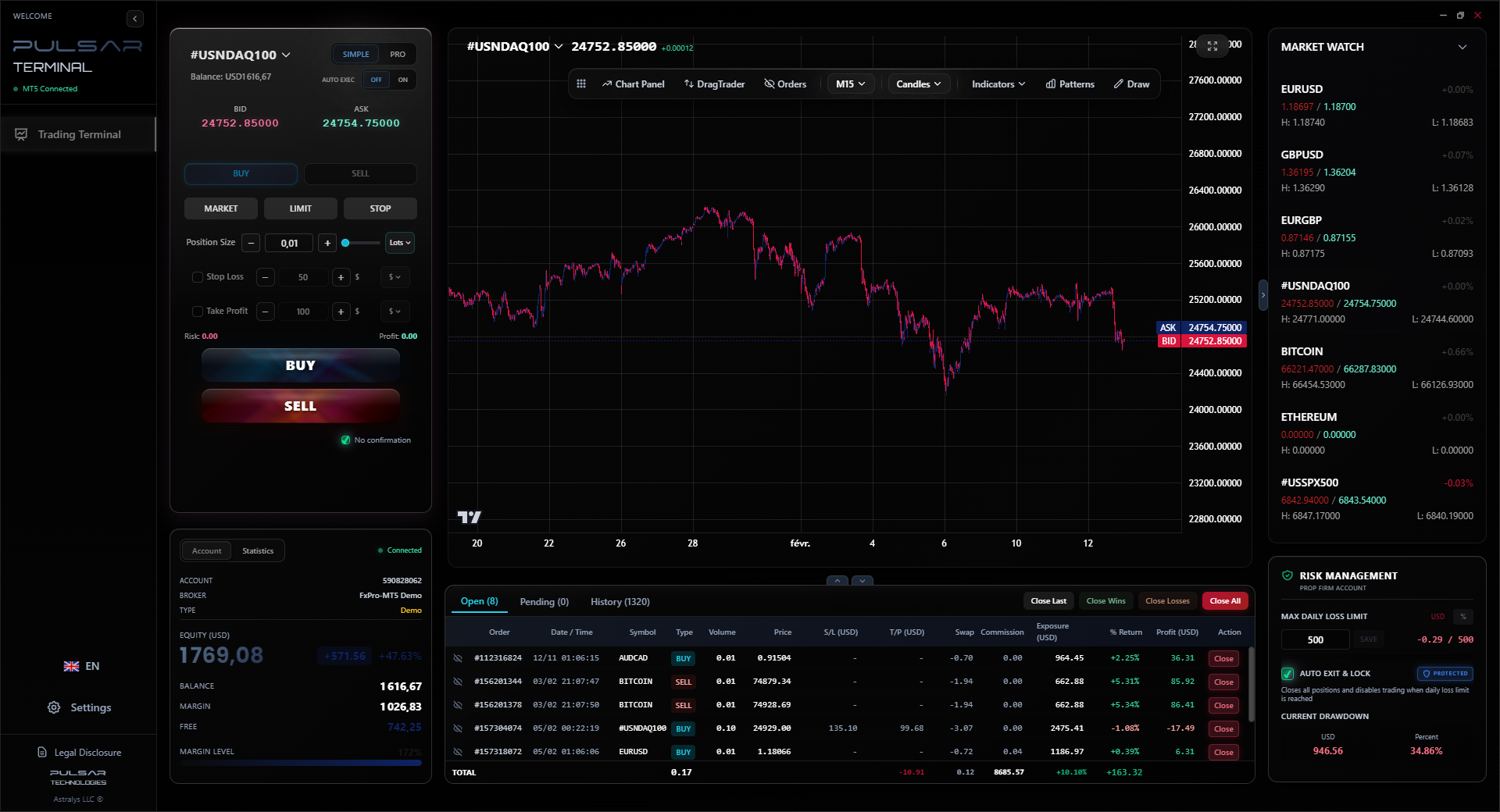
Managing trades on volatile ZAR pairs requires speed; Pulsar Terminal lets you set multi-level take profits and trailing stops with one click on your MT5 chart.
Pulsar Terminal
เครื่องมือ MT5 ครบวงจร: ลากวางคำสั่ง, multi-TP/SL, trailing stop, grid trading, Volume Profile และการป้องกัน prop firm ใช้งานโดยเทรดเดอร์กว่า 1,000 คนทุกวัน
“The advantage of STP isn't just speed; it's the trust that comes from transparent execution.”
The landscape is evolving fast. Here’s what’s on the horizon for South African traders.
Regulation Gets Tighter: The new Conduct of Financial Institutions (COFI) Bill is coming. It aims to create a more outcomes-based framework. For you, this means even stronger consumer protection and clearer rules on broker conduct. It’s a good thing.
Crypto is Now Part of the Game: As of 2026, the FSCA officially regulates crypto assets as financial products. Some STP brokers will start offering crypto CFDs under this regulated umbrella. This doesn’t change the STP meaning in forex, but it expands the asset universe you can trade with the same execution model.
Faster Tech, Lower Latency: Infrastructure in SA is improving. The move to faster, low-latency execution systems is becoming standard. This means the speed advantage of STP brokers will only increase.
The ZAR's Rollercoaster: With the SARB cutting rates and the Rand showing strength in early 2026, volatility in ZAR pairs will remain. A reliable STP broker becomes even more critical to navigate these swings without execution worries.
The bottom line? STP is becoming the baseline expectation, not a premium feature. As a trader, your focus should shift from finding an STP broker to choosing the best one for your specific needs in this maturing market.
FAQ
Q1Is STP trading better than Market Making for beginners in South Africa?
Generally, yes. While Market Makers might offer simpler fixed spreads, the potential conflict of interest and requotes can create bad habits and frustration. An STP broker teaches you real market conditions from the start. Just start with a micro account to get used to variable spreads.
Q2Do all FSCA-regulated brokers offer STP execution?
No. Regulation ensures safety of funds and fair conduct, but it doesn't dictate execution models. Many FSCA brokers offer STP, but some are primarily Market Makers. You must check the broker's execution policy specifically.
Q3Why is the spread on USD/ZAR so high with my STP broker?
It's not your broker, it's the market. USD/ZAR is an exotic currency pair with lower liquidity than majors like EUR/USD. The raw interbank spread is naturally wide (often 50-100 pips). Your STP broker adds a small markup on top of that. It's the cost of trading a less common pair.
Q4Can I get negative slippage with an STP broker?
Yes, it's possible. If the market moves in your favour between the moment you click and the moment your order is filled, you might get a better price than you asked for. This is more common with limit orders in fast-moving markets.
Q5What's the difference between an STP broker and an ECN broker?
Think of STP as a curated feed and ECN as a raw feed. An STP broker aggregates prices from its liquidity providers and gives you one quoted price (with a markup). An ECN broker shows you the raw order book from multiple participants; you see the raw spread and pay a commission. ECN is often preferred by high-volume traders.
Q6How do I know if my trade was executed via STP?
You won't see a stamp saying "STP fill." The evidence is in the absence of problems: no deliberate requotes, fast execution, and fills at or near the price you saw. Your broker's trade confirmation slip should also list the execution venue, which for STP would be an external liquidity provider's ID.
บทเรียนจาก Prof. Winston
สรุปสาระสำคัญ:
- ✓STP brokers route orders to external LPs, removing dealer conflict.
- ✓Verify FSCA license & execution policy before depositing any Rands.
- ✓Use a ZAR account to avoid 2-3% bank conversion fees.
- ✓Expect USD/ZAR spreads of 80-150 pips; plan trades accordingly.
บทความนี้มีประโยชน์แค่ไหน?
คลิกดาวเพื่อให้คะแนน
ข้อมูลเชิงลึกการเทรดรายสัปดาห์
การวิเคราะห์และกลยุทธ์รายสัปดาห์ฟรี ไม่มีสแปม
เกี่ยวกับผู้เขียน
David van der Merwe
เทรดเดอร์ตลาดเกิดใหม่
เทรดเดอร์ประจำโจฮันเนสเบิร์ก มีประสบการณ์ 11 ปีในสกุลเงินตลาดเกิดใหม่ เชี่ยวชาญคู่ ZAR การเทรดภายใต้กฎระเบียบ FSCA และการวิเคราะห์ตลาดแอฟริกาใต้
ความคิดเห็น
คำเตือนความเสี่ยง
การซื้อขายตราสารทางการเงินมีความเสี่ยงสูงและอาจไม่เหมาะสำหรับนักลงทุนทุกคน ผลการดำเนินงานในอดีตไม่ได้รับประกันผลลัพธ์ในอนาคต เนื้อหานี้มีวัตถุประสงค์เพื่อการศึกษาเท่านั้นและไม่ควรถือเป็นคำแนะนำในการลงทุน โปรดทำการวิจัยของคุณเองก่อนการซื้อขาย
คุณอาจชอบสิ่งนี้

Cara Trading Forex Sukses: 7 Prinsip dari Trader Profesional
Cara trading forex sukses dengan 7 prinsip trader pro: manajemen modal, disiplin, journal trading, backtest. Data nyata, bukan janji profit palsu.
Jam Trading Forex Terbaik untuk Trader Indonesia: Panduan Lengkap dengan Tabel Waktu
Panduan jam trading forex untuk trader Indonesia. Tabel 4 sesi dunia, jam emas 20:00-00:00, sesi mana yang harus dihindari. Data akurat + tips dari trader berpengalaman.
Top 5 Sàn Forex Uy Tín Nhất 2026: Review Jujur dari Trader Indonesia
Top 5 sàn forex uy tín 2026 untuk trader Indonesia. Review jujur: spread, deposit, withdraw, dukungan lokal. Exness, XM, IC Markets & lebih.
รับ Pulsar Terminal
เครื่องคำนวณทั้งหมดนี้ถูกสร้างไว้ใน Pulsar Terminal พร้อมข้อมูลเรียลไทม์จากบัญชี MT5 ของคุณ
รับ Pulsar Terminal