


Here's a number that should sober you up: the average pass rate for a prop firm challenge is between 5% and 10%.

James Mitchell
นักวิเคราะห์การเทรดอาวุโส
☕ 9 นาทีอ่าน
สิ่งที่คุณจะได้เรียนรู้:
Here's a number that should sober you up: the average pass rate for a prop firm challenge is between 5% and 10%. That means roughly 94 out of every 100 traders who pay the fee fail. I was one of them, twice, before I figured out the game. This isn't about getting rich quick. It's about understanding a business model where your failure is their primary revenue stream. Let's talk about what a take profit prop firm really is, how to navigate the US regulatory gray area, and the hard lessons I learned so you can be in that 6%.
Forget the flashy ads with Lamborghinis. At its core, a take profit prop firm is a simple deal with a brutal filter. You pay them a fee (say, $50 to $500) for the chance to prove yourself in a simulated trading challenge. If you pass their rules - usually hitting a profit target without violating daily or max loss limits - they give you access to a larger pool of their capital to trade with. You then split the profits you generate, often 70/80/90% in your favor.
It sounds like a golden ticket. But here's the catch most people miss: the firm makes money two ways. First, from the thousands of failed challenge fees. Second, from your future profits. Their entire model is built on finding the rare, consistently profitable trader. They're not your coach; they're a talent scout with a very expensive audition process.
I learned this the hard way. My first attempt was with a popular firm's $25,000 challenge. I paid a $299 fee. I was up 4% in three days, feeling invincible. Then I took one oversized trade on the NASDAQ, got stopped out, and blew through the daily loss limit. Game over. $299 gone. That fee wasn't an investment; it was the price of a very specific, very expensive lesson in position size calculator discipline.

Warning: The "funded" account you get is often still a simulated/demo environment. The firm just mirrors your trades on their live book. This is a key legal distinction that keeps them out of direct broker regulation, but it means you're not directly moving market prices.

💡 เคล็ดลับจาก Winston
Treat the challenge fee as a sunk cost the moment you pay it. Trade to follow your plan, not to 'get your money back.' That mindset leads to revenge trading.
“The prop firm model is built on finding the rare, consistently profitable trader. They're not your coach; they're a talent scout with a very expensive audition process.”
This is the part most prop firm reviews gloss over. In the US, these firms operate in a regulatory shadow. They're not brokers, so they don't need FINRA or SEC licenses in the traditional sense. They structure themselves as "evaluation service providers." You're paying for a test, not for them to manage your money.
The Regulatory Tightrope
This service-based model is their loophole. Since you're trading simulated capital during the challenge (and often after), they argue they're not handling client funds for trading purposes. This lets them sidestep the heavy oversight that a broker like IC Markets or Pepperstone faces.
But the winds are changing. The SEC has been poking around, and the CFTC is likely to start classifying these firms as Commodity Trading Advisors (CTAs) by 2026 or sooner. What does that mean for you? More legitimacy, but potentially stricter rules: lower use, formal risk disclosures, and maybe even proof of firm capital reserves. The wild west days are numbered.

Pro Tip: Always check where a prop firm is based and if it has any regulatory registration (even as a simple business). A US-based LLC is generally safer than a completely offshore entity with no transparency. Your payout depends on their solvency.
“Your target isn't to make 20% in a week. It's to hit their profit target without ever touching their loss limits. This is a defensive game.”
Let's get specific. The marketing says "up to 90% profit split!" The reality is a maze of tiers and conditions.
The Fee Structure:
- Challenge Fee: This is your ticket. It can range from a "special" at $17 for a $5k account to $500+ for a $200k account. This fee is often refundable on your first payout... if you make it that far.
- Monthly/Quarterly Fees: Some firms charge a small account fee after you're funded. Others don't. Read the fine print.
The Profit Split: This is where you need to sharpen your pencil. A "90% split" might only kick in after you've reached a certain profit milestone, or it might be part of a scaling plan. Most start at 80/20 in your favor. Here's a real example from my trading:

Example: I passed a challenge for a $50k account with an 80/20 split. In my first payout period, I made a $3,000 profit. My take was $2,400 (80%). The firm kept $600. Not bad for risking only my initial challenge fee. But to earn that $2,400, I had to first generate $3,000 in simulated profits without breaking their rules - a task with a 90%+ failure rate.
use: This is a big one. US-facing firms are already conservative. Don't expect the 1:500 you see offshore. Typical use looks like this:
| Instrument | Typical Prop Firm use (US) |
|---|---|
| Forex Majors (EUR/USD) | 1:30 to 1:50 |
| Indices (US30, SPX) | 1:10 to 1:20 |
| Commodities (XAU/USD) | 1:10 to 1:20 |
| Cryptocurrencies | 1:2 to 1:5 |
This lower use forces you to be a better trader. You can't rely on a 5-pip move on a huge position to save you. It demands patience, like the kind needed for swing trading setups.
💡 เคล็ดลับจาก Winston
The most important indicator during your challenge isn't the RSI or MACD. It's the 'Daily Loss Used' meter on your dashboard. Watch it like a hawk.

“The strategy that got you funded is the strategy that will keep you funded. Do nothing differently.”
This is the only part that matters. All the theory is useless if you blow the account in week one. I failed two challenges before I passed one. Here’s what changed.
1. The Goal is Survival, Not Glory. Your target isn't to make 20% in a week. It's to hit their profit target (often 8-10%) without ever touching their loss limits. This is a defensive game. I treated my third challenge like a military campaign. My daily goal was +0.5% to +1%. A green day, any green day, was a win. I used a position size calculator for every single entry, ensuring even a full stop-out loss would only be 0.5% of the account. Boring? Yes. Effective? Absolutely.
2. The Rules Are The Strategy. Every firm has different rules: a 5% max loss, a 2% daily loss, no weekend holding, etc. These aren't annoyances; they are your trading plan. I built my entire approach around the strictest rule. If the daily loss was 2%, my personal daily loss limit was 1%. This buffer saved me more than once.
3. Instrument Selection is Key. I failed my first challenge trading volatile gold (XAU/USD) and the NASDAQ. I passed by primarily trading a single, liquid forex pair - EUR/USD. The spreads were tighter, the moves were more predictable, and it was easier to manage risk. I wasn't there to chase excitement; I was there to pass.
4. Have a Take Profit Prop Firm Mindset. This means knowing exactly when you'll exit a winner. I used a strict 2:1 risk/reward ratio. If my stop loss was 10 pips, my take profit was 20 pips. I set it and walked away. No moving targets, no "letting it run" and watching it reverse. Consistent, small wins add up to the target. Greed is the #1 challenge killer.
Pro Tip: Use the challenge's own structure. Many have a "profit target" but no limit on how long you take. There's no bonus for finishing in 3 days. Take 3 months if you need to. One or two high-probability trades a week is all it takes.
“The strategy that got you funded is the strategy that will keep you funded. Do nothing differently.”
You passed. Congrats. Now the real psychological test begins.
Suddenly, the simulated number on your screen represents a real split of real money. The pressure amplifies. I immediately made my worst mistake: I increased my position size because "now it counts." I gave back 3% in two days by over-trading.
The key is to do nothing differently. The strategy that got you funded is the strategy that will keep you funded. The firm will have new rules, often more relaxed (higher daily loss, no max loss). Do not use this as an excuse to get sloppy.
Payouts are usually bi-weekly or monthly. You request a withdrawal, they process it. The first payout feels surreal. But remember, they can still take the account away if you breach their rules. You're always being evaluated.
This is where tools that enforce discipline are worth their weight in gold. Managing multiple trades with different take profit and stop-loss levels manually is a headache. Automating this process removes emotion. For example, setting a trailing stop to lock in profits on a runner is a crucial skill that prevents you from snatching at small gains.
Also, track everything. Your prop firm will have a dashboard, but keep your own journal. Note your emotional state on every trade. When you get a payout, set aside a big chunk for taxes. The IRS doesn't care that you traded with simulated capital; the profit split you receive is 100% real, taxable income.
💡 เคล็ดลับจาก Winston
Before you even look at a chart, calculate your maximum position size for the day based on your personal 1% risk limit. Write it on a sticky note and stick it to your monitor.

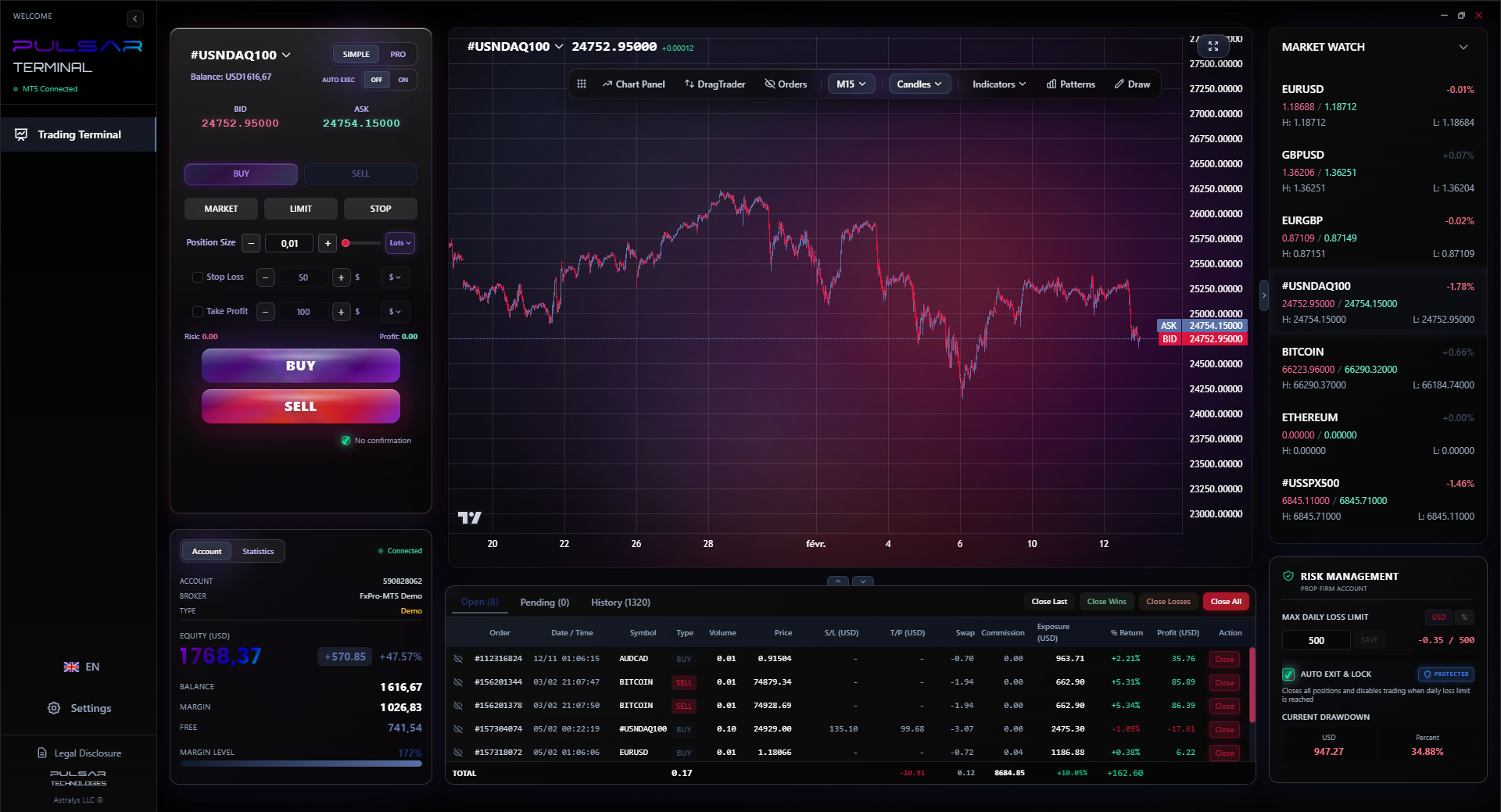
Managing the strict risk rules of a funded account is stressful; Pulsar Terminal lets you set automatic trailing stops and breakeven triggers on MT5, so your discipline is enforced by code, not willpower.
Pulsar Terminal
เครื่องมือ MT5 ครบวงจร: ลากวางคำสั่ง, multi-TP/SL, trailing stop, grid trading, Volume Profile และการป้องกัน prop firm ใช้งานโดยเทรดเดอร์กว่า 1,000 คนทุกวัน
“Losing $50 on a $5k challenge is a far cheaper lesson than losing $500 on a $100k dream.”
The landscape is shifting. With MetaQuotes cracking down on prop firms using MT4/MT5, many are moving to platforms like cTrader or DXtrade. This isn't necessarily bad - just be ready to adapt.
Green Lights (Good Signs):
- Clear, Consistent Rules: The rules are easy to find and don't change often.
- Realistic use: Offers use in line with US norms (see table above), not offshore extremes.
- Transparent Payout History: They show proof of payments to traders.
- Good Platform: Offers a professional platform you're comfortable with (MT5, cTrader, TradingView).
- Responsive Support: You can get answers to questions before you pay.
Red Flags (Run Away):
- "No Stop Loss Allowed": This is insane risk management and a giant red flag.
- Overly Complex or Hidden Rules: If you need a lawyer to understand the drawdown calculation, avoid it.
- Sky-High use Promises: Any firm offering 1:500 to US traders is playing fast and loose and likely not long for this new regulatory world.
- Constant "Discount" Sales: If the challenge is always 90% off, it tells you the real value they place on it.
- No Verifiable Company Address or Registration: You need to know who you're doing business with.
Do your homework. Read reviews on sites like The Trading Mentor, but look for detailed user experiences, not just affiliate hype. Join their Discord or Telegram before paying and lurk. See how they treat their traders.
My final, hard-won piece of advice: Start with the smallest, cheapest challenge you can find. Prove your strategy there. Losing $50 on a $5k challenge is a far cheaper lesson than losing $500 on a $100k dream. Scaling up is always an option after you've proven you can consistently navigate their system.
FAQ
Q1Is the profit from a prop firm taxable in the US?
Yes, 100%. When the firm sends you your profit split (e.g., $2,400), that is considered ordinary income by the IRS. You will receive a 1099-MISC or similar form, and you must report it on your tax return. Keep detailed records of all your payouts.
Q2What's the biggest mistake traders make in prop firm challenges?
Overtrading and incorrect position sizing. They treat the challenge like a casino, trying to hit the profit target in a few huge trades. This almost always triggers the daily or max loss limit. The winning approach is slow, conservative, and focused on risk management above all else.
Q3Can I use expert advisors (EAs) or robots in a challenge?
It depends entirely on the firm's rules. Some allow them, some ban them outright, and some only allow them on funded accounts. You must read the terms and conditions. Even if allowed, remember the EA must also adhere to all loss limits and trading rules.
Q4What happens if I have a losing trade that puts me below the daily loss limit?
The account is typically failed immediately and automatically. There's usually no warning or margin call. The platform will just close all positions and lock you out. This is why maintaining a buffer (e.g., trading as if your personal daily limit is half of theirs) is critical.
Q5Are prop firms a scam?
Not inherently, but the industry has scammy elements. The business model legitimately profits from failed challenges. A legitimate firm, however, will actually pay out consistent traders. A scam firm will use impossible rules, hidden clauses, or simply not pay. Due diligence is non-negotiable.
Q6How long does it take to get a payout once funded?
Typically 1-4 weeks after you request it. Most firms have a payout cycle (e.g., every two weeks). Your first payout might take longer for processing. Reputable firms are transparent about their payout schedule.
Q7Should I use a prop firm or just trade my own small account?
If you are not yet consistently profitable, trade your own small account. You'll lose less money learning. A prop firm is for traders who have a proven, disciplined edge and need capital to scale it. It is an accelerator, not a teacher.
บทเรียนจาก Prof. Winston
สรุปสาระสำคัญ:
- ✓Pass rates are 5-10%. You are the underdog.
- ✓Challenge fees fund the firm. Your failure is their business.
- ✓Trade 0.5% risk per trade, max. Survival first.
- ✓Choose one liquid instrument (like EUR/USD) for the challenge.
- ✓The funded account rules are your new trading plan. Obey them.
บทความนี้มีประโยชน์แค่ไหน?
คลิกดาวเพื่อให้คะแนน
ข้อมูลเชิงลึกการเทรดรายสัปดาห์
การวิเคราะห์และกลยุทธ์รายสัปดาห์ฟรี ไม่มีสแปม
เกี่ยวกับผู้เขียน
James Mitchell
นักวิเคราะห์การเทรดอาวุโส
ประจำอยู่ที่นิวยอร์ก มีประสบการณ์การเทรดมากกว่า 9 ปี เน้นคู่ USD หลัก ความท้าทายของ prop firm และกฎระเบียบการเงินของสหรัฐฯ
ความคิดเห็น
คำเตือนความเสี่ยง
การซื้อขายตราสารทางการเงินมีความเสี่ยงสูงและอาจไม่เหมาะสำหรับนักลงทุนทุกคน ผลการดำเนินงานในอดีตไม่ได้รับประกันผลลัพธ์ในอนาคต เนื้อหานี้มีวัตถุประสงค์เพื่อการศึกษาเท่านั้นและไม่ควรถือเป็นคำแนะนำในการลงทุน โปรดทำการวิจัยของคุณเองก่อนการซื้อขาย
คุณอาจชอบสิ่งนี้

Cara Trading Forex Sukses: 7 Prinsip dari Trader Profesional
Cara trading forex sukses dengan 7 prinsip trader pro: manajemen modal, disiplin, journal trading, backtest. Data nyata, bukan janji profit palsu.
Jam Trading Forex Terbaik untuk Trader Indonesia: Panduan Lengkap dengan Tabel Waktu
Panduan jam trading forex untuk trader Indonesia. Tabel 4 sesi dunia, jam emas 20:00-00:00, sesi mana yang harus dihindari. Data akurat + tips dari trader berpengalaman.
Top 5 Sàn Forex Uy Tín Nhất 2026: Review Jujur dari Trader Indonesia
Top 5 sàn forex uy tín 2026 untuk trader Indonesia. Review jujur: spread, deposit, withdraw, dukungan lokal. Exness, XM, IC Markets & lebih.
รับ Pulsar Terminal
เครื่องคำนวณทั้งหมดนี้ถูกสร้างไว้ใน Pulsar Terminal พร้อมข้อมูลเรียลไทม์จากบัญชี MT5 ของคุณ
รับ Pulsar Terminal