


Most forex courses in Nigeria are a waste of your money.

Olumide Adeyemi
ผู้บุกเบิกการเทรดในแอฟริกาตะวันตก ·  Nigeria
☕ 10 นาทีอ่าน
สิ่งที่คุณจะได้เรียนรู้:
Most forex courses in Nigeria are a waste of your money. They sell you a dream of Lamborghinis but skip the boring, crucial stuff like taxes, legal risks, and how to not blow up your first account in a week. I’ve seen it happen too many times. This isn’t another sales pitch. This is the complete foundation forex trading course you actually need, built for the realities of trading from Nigeria. I’ll show you the real numbers, the legal fine print everyone ignores, and the one simple strategy I used to turn $500 into $5,000 before I lost half of it learning a hard lesson about discipline.
Before you even think about a chart, you need to know the rules of the game. Getting this wrong can cost you more than a bad trade.
Forex trading itself is legal for you as an individual. The big change came with the Investments and Securities Act (ISA) 2025. This law now gives the Securities and Exchange Commission (SEC) the power to regulate the platforms and companies offering forex trading services. If a platform isn't registered with the SEC, it's operating illegally. This is good for you - it means there's a push for more oversight to protect traders from outright scams.
The Central Bank of Nigeria (CBN) has different concerns. They manage the Naira. While they don't stop you from trading, they do stop you from using the official CBN window to get dollars to fund your trading account. That's why you'll use domiciliary accounts, e-wallets like Skrill, or crypto. Also, forget about using your Naira debit card for large international broker deposits; the limits are too low.
Now, here’s the kicker that most ‘gurus’ won’t mention: taxes. The Federal Inland Revenue Service (FIRS) wants its share. Your forex trading profits are subject to a 10% capital gains tax on your gross profits. It doesn't matter if your broker is in Cyprus or your money is in a Binance wallet. If you make money, you owe tax. I learned this the hard way after a good quarter; setting aside 10% from every withdrawal is non-negotiable. Talk to a tax professional, please.

Warning: The ISA 2025 is new. Expect more regulations and possibly licensing requirements for educators and signal providers. Stick with brokers that are transparent about their international regulations (like FCA, CySEC) as a safety net.

💡 เคล็ดลับจาก Winston
Your first ₦100,000 in trading should be spent on losing. Consider it tuition. The goal isn't to double it, but to learn how to lose it slowly and controllably.
“The expensive mentorship isn't selling secret knowledge; it's selling community and hand-holding.”
Let's talk numbers, because the cost of entry is more than just a broker deposit. The ‘education’ industry around forex in Nigeria is, frankly, a minefield.
You can find basic online courses for as little as ₦10,000. They’ll teach you what a pip definition is and how to draw a trendline. Intermediate or in-person workshops can jump to ₦300,000. Then there are the ‘mentorship’ programs. I’ve seen them advertised from ₦50,000 to over ₦500,000. A popular one in Lagos, ‘Forexversity’, charges about ₦225,000 for a package.
Here’s my blunt opinion: You do not need to pay ₦500,000 to learn to trade. The core principles are free or cheap. The expensive stuff is often just community access and hand-holding, which has value, but isn't ‘secret knowledge’.
Your money is better spent on:
- A solid, cheap foundational course (under ₦50,000).
- Funding a live trading account you expect to lose (start small, like $100).
- Paying for a good charting tool or data feed later on.
- Saving for a prop firm challenge fee if you want to trade with larger capital. These evaluation fees are typically ₦50,000 to ₦150,000.
I paid ₦80,000 for a course in 2015. The best thing I got from it was the basic risk management section. The rest I unlearned through experience. The market is the real teacher, and it charges tuition in lost pips.
“A good loss is one where you followed your plan. It's a cost of business.”
This is where your Nigerian residency really matters. You need a broker that accepts you, lets you deposit easily, and doesn't vanish with your money.
Regulation is Your First Filter
Look for brokers regulated by reputable international bodies like the UK's FCA, Cyprus's CySEC, or Australia's ASIC. This is your primary safety net. Many brokers popular here, like Exness, IC Markets, and XM, hold such licenses.
Deposits and Withdrawals in Naira
This is the daily hassle. The best brokers offer local bank transfers or card deposits in Naira. It’s simpler and faster. For example, FXTM allows deposits from ₦100 via local transfer. Others, like HFM, offer NGN-denominated accounts. If you use international methods, e-wallets (Neteller, Skrill) or crypto (USDT) are the most reliable due to CBN restrictions on card use.
The Numbers That Actually Matter
Don't get dazzled by ‘1:3000 use’. It's a trap for new traders. Focus on these instead:
- Minimum Deposit: Can you start small? $10 with Exness, $5 with HFM, or even $1 with FBS lets you test the waters.
- Spreads: This is your transaction cost. On the EUR/USD, expect 0.8 to 1.5 pips on a standard account. For tighter spreads (0.0 pips + commission), you’d look at an ECN account from a broker like IC Markets or Pepperstone.
- Platform: You’ll likely use MetaTrader 4 or 5 (MT4/MT5). It’s the standard for a reason.

Pro Tip: Open demo accounts with 2-3 brokers. Test their deposit/withdrawal process for Nigeria before you fund a live account. Latency and fees can vary wildly.
“A good loss is one where you followed your plan. It's a cost of business.”
This is the meat of your foundation. Understand these, and you're ahead of 90% of beginners.
A Trade is a Bet on Price Movement: You buy (go long) if you think price will rise. You sell (go short) if you think it will fall. That’s it. All the analysis is just to make an educated guess on direction.
The Trinity: Pips, Lots, and use
- A Pip is the smallest price move. If EUR/USD moves from 1.1050 to 1.1051, that’s 1 pip. It’s how we measure profit and loss.
- A Lot is your trade size. A standard lot is 100,000 units of currency. A mini lot is 10,000, a micro lot is 1,000. This determines how much each pip is worth. Use a position size calculator every single time.
- use is a loan from your broker. 1:100 use means you control $10,000 with only $100 of your own money (your margin). It amplifies both gains AND losses. It’s not a magic wand; it’s a risk multiplier.
The Cost of Doing Business: Spreads and Swaps The spread is the difference between the buy and sell price. It’s how many brokers make money. A 1-pip spread on EUR/USD means the price has to move 1 pip in your favor just for you to break even. A swap is an overnight interest fee (or credit) for holding a position past the market close. It’s small but adds up.
Margin and the Margin Call Margin is the collateral you put up to open a leveraged trade. If your losses eat into your margin too much, you’ll get a margin call - a warning to add funds. If you don’t, the broker will close your trades to prevent further loss. This is how accounts get ‘blown’.
💡 เคล็ดลับจาก Winston
If you can't explain your trade setup in one sentence, you don't have a setup. Complexity is the enemy of execution.
“use isn't a magic wand; it's a risk multiplier for both gains and losses.”
I’m going to give you one strategy. Not five. One. Master this before you even look at anything else. It’s a swing trading approach based on support/resistance and a single indicator.
The 200 EMA & Horizontal Level Strategy
- Timeframe: Use the 4-hour chart (H4). This filters out market noise. The daily chart is for context.
- The Trend Filter: Plot a 200-period Exponential Moving Average (EMA) on your chart. If price is above the 200 EMA, we only look for buy setups. If price is below, we only look for sell setups. This keeps you on the right side of the broader trend.
- The Trigger: Identify clear horizontal support (for buys) or resistance (for sells) levels. These are prices where the market has bounced or reversed multiple times before.
- The Entry: Wait for price to come back to that key level and show rejection. For a buy at support, look for a bullish pin bar or a strong engulfing candle closing above the level. Place your buy order just above that candle. Do the opposite for a sell.
- Risk Management: Your stop-loss goes just below the support (for buys) or above the resistance (for sells). Your take-profit target should be at least 1.5 to 2 times the distance of your stop-loss.
Why This Works It’s simple, rule-based, and teaches you to read price action and respect key levels. It forces patience. I made my first consistent profits with a version of this on XAU/USD (gold). In June 2023, I bought at $1932 support (above the 200 EMA) with a stop at $1925. I took half profit at $1950 and let the rest run to $1968. A simple 7-pip risk turned into a 36-pip gain on the first target.

Example: You have $500. You risk 1% ($5) per trade. Your stop-loss on a EUR/USD trade is 25 pips. A micro lot (1,000 units) moves roughly $0.10 per pip. So, 25 pips x $0.10 = $2.50 risk per micro lot. To hit your $5 max risk, you can trade 2 micro lots ($2.50 x 2 = $5). Always calculate this.
“use isn't a magic wand; it's a risk multiplier for both gains and losses.”
This is the hardest part. Your strategy is a plan. Your psychology is whether you can follow it when real money is on the line. I couldn't, at first.
Fear and Greed are Your Enemies
- Fear makes you move your stop-loss wider, hoping a losing trade will come back. It never does. It also makes you take profit too early.
- Greed makes you risk too much on one trade (‘This is the sure thing!’). It makes you hold a winning trade too long until it turns into a loser.
I have a trade seared into my memory. On EUR/USD, I had a perfect sell setup. Price hit my take-profit. Instead of closing, greed whispered, ‘It’s going lower!’. I moved my target. Price reversed, hit my break-even stop, and I made nothing. I broke my own rule and got punished. That lesson was more valuable than the profit I gave back.
The Only Way to Build Discipline
- Write a Trading Plan: A physical document with your strategy, risk per trade (I recommend 1%), and rules. Refer to it before every trade.
- Journal Religiously: After every trade, win or lose, write it down. What was the setup? Did you follow your plan? How did you feel? This is how you find your personal weaknesses.
- Accept Losses: A good loss is one where you followed your plan. It’s a cost of business. A bad loss is where you broke your rules. Focus on eliminating the bad losses, and the profits will come.
Trading is a marathon of managing your own emotions. The chart is just a mirror.
💡 เคล็ดลับจาก Winston
The market doesn't know you exist. It doesn't care about your rent, your goals, or your 'sure thing'. Trade the price, not your life.
“Your strategy is a plan. Your psychology is whether you can follow it when real money is on the line.”
Once you’ve traded your simple strategy for 3-6 months and have a positive journal, you can explore. Don’t jump around before then.
Deepen Your Analysis
- Price Action: Learn to read candlestick patterns and market structure (higher highs, lower lows).
- Indicators: Add one at a time. The MACD indicator can help confirm momentum. The RSI indicator can show overbought/oversold conditions. Use them as confluence, not as holy grails.
Explore Other Styles
- Scalping Strategy: Fast, high-pressure trading on 1 or 5-minute charts. Requires intense focus and low spreads.
- Automated Trading: Using Expert Advisors (EAs) on MT4/MT5. Be skeptical; most sold EAs fail in live markets.
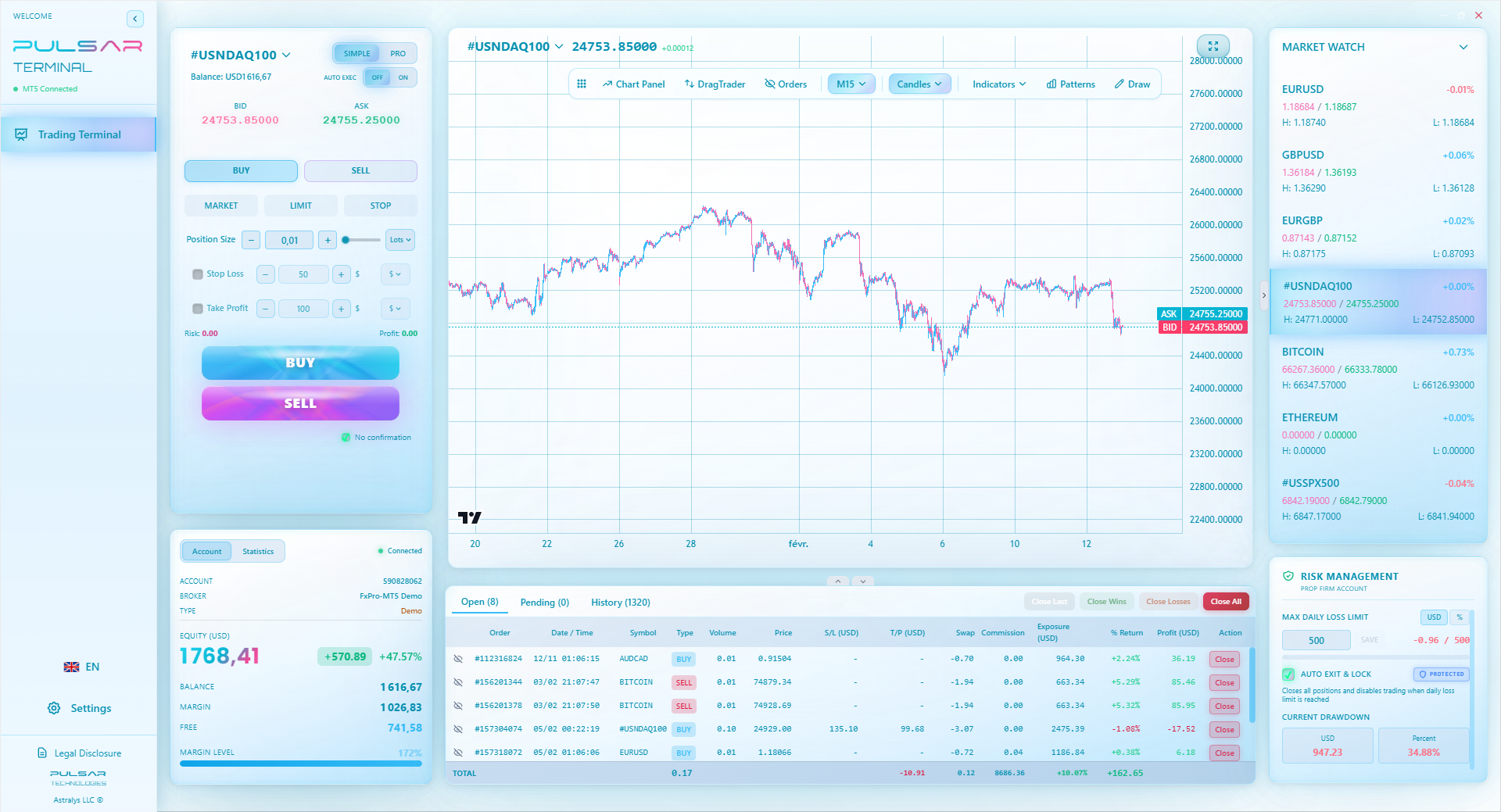
Upgrade Your Tools As you grow, basic MT4 might feel limited. This is where advanced trading terminals come in. They plug into your MT4/MT5 and give you superior tools for faster execution and more complex order types, which are essential for scaling your precision.
When you're ready to move beyond basic MT4 and need faster execution with advanced order types like multi-TP/SL and trailing stops, tools like Pulsar Terminal integrate directly to give you that professional edge.
Pulsar Terminal
เครื่องมือ MT5 ครบวงจร: ลากวางคำสั่ง, multi-TP/SL, trailing stop, grid trading, Volume Profile และการป้องกัน prop firm ใช้งานโดยเทรดเดอร์กว่า 1,000 คนทุกวัน
FAQ
Q1Is forex trading illegal in Nigeria?
No, it's legal for individuals to trade forex with their personal funds. The new Investments and Securities Act (ISA) 2025 regulates the platforms offering the services, not the individual trader. However, you cannot use official CBN forex windows to fund your account.
Q2How much money do I need to start forex trading in Nigeria?
You can start with a very small amount. Some brokers like FBS allow a $1 minimum deposit, while others like Exness or HFM start at $5-$10. In Naira, you can start with as little as ₦100 with some brokers. However, only trade with money you can afford to lose completely.
Q3Do I pay tax on my forex trading profits?
Yes. The FIRS imposes a 10% capital gains tax on your gross forex trading profits. It is your responsibility to declare and pay this tax. Consult a tax professional for guidance on your specific situation.
Q4What is the best trading platform for beginners in Nigeria?
MetaTrader 4 (MT4) is the most common and beginner-friendly. It's widely offered by brokers, has a simple interface, and there's a massive amount of free educational content on how to use it. Most Nigerian traders start on MT4 or MT5.
Q5How long does it take to become a profitable trader?
This is the hardest truth: expect to take at least 1-2 years of consistent study and practice. The first 6 months are often about learning how to not lose money. Profitable consistency comes after you've internalized risk management and mastered your own psychology. There are no shortcuts.
Q6Are prop firm challenges worth it for Nigerians?
They can be, but only after you have a proven, disciplined strategy. The evaluation fees (₦50k-₦150k) are an investment. The benefit is trading the firm's capital (e.g., $100k) for a share of the profits. It's a serious step, not a beginner's tool.
บทเรียนจาก Prof. Winston
สรุปสาระสำคัญ:
- ✓Taxes are 10% on gross profits. Plan for it.
- ✓Start with a broker that accepts Naira deposits.
- ✓Risk only 1% of your capital per trade.
- ✓Master one simple strategy on the 4-hour chart first.
- ✓A trading journal is non-negotiable for growth.
บทความนี้มีประโยชน์แค่ไหน?
คลิกดาวเพื่อให้คะแนน
ข้อมูลเชิงลึกการเทรดรายสัปดาห์
การวิเคราะห์และกลยุทธ์รายสัปดาห์ฟรี ไม่มีสแปม
เกี่ยวกับผู้เขียน
Olumide Adeyemi
ผู้บุกเบิกการเทรดในแอฟริกาตะวันตก
หนึ่งในนักการศึกษาฟอเร็กซ์ที่กระตือรือร้นที่สุดของไนจีเรีย 8 ปีประสบการณ์เทรดจากลากอส เชี่ยวชาญกลยุทธ์ทุนต่ำและความท้าทาย prop firm สำหรับเทรดเดอร์ในแอฟริกา
ความคิดเห็น
คำเตือนความเสี่ยง
การซื้อขายตราสารทางการเงินมีความเสี่ยงสูงและอาจไม่เหมาะสำหรับนักลงทุนทุกคน ผลการดำเนินงานในอดีตไม่ได้รับประกันผลลัพธ์ในอนาคต เนื้อหานี้มีวัตถุประสงค์เพื่อการศึกษาเท่านั้นและไม่ควรถือเป็นคำแนะนำในการลงทุน โปรดทำการวิจัยของคุณเองก่อนการซื้อขาย
คุณอาจชอบสิ่งนี้

Cara Trading Forex Sukses: 7 Prinsip dari Trader Profesional
Cara trading forex sukses dengan 7 prinsip trader pro: manajemen modal, disiplin, journal trading, backtest. Data nyata, bukan janji profit palsu.
Jam Trading Forex Terbaik untuk Trader Indonesia: Panduan Lengkap dengan Tabel Waktu
Panduan jam trading forex untuk trader Indonesia. Tabel 4 sesi dunia, jam emas 20:00-00:00, sesi mana yang harus dihindari. Data akurat + tips dari trader berpengalaman.
Top 5 Sàn Forex Uy Tín Nhất 2026: Review Jujur dari Trader Indonesia
Top 5 sàn forex uy tín 2026 untuk trader Indonesia. Review jujur: spread, deposit, withdraw, dukungan lokal. Exness, XM, IC Markets & lebih.
รับ Pulsar Terminal
เครื่องคำนวณทั้งหมดนี้ถูกสร้างไว้ใน Pulsar Terminal พร้อมข้อมูลเรียลไทม์จากบัญชี MT5 ของคุณ
รับ Pulsar Terminal