


If you think forex trading is a quick ticket to a mansion in Sandton, I need to stop you right there.

David van der Merwe
เทรดเดอร์ตลาดเกิดใหม่ ·  South Africa
☕ 8 นาทีอ่าน
สิ่งที่คุณจะได้เรียนรู้:
If you think forex trading is a quick ticket to a mansion in Sandton, I need to stop you right there. That's the biggest myth, and it's how most people lose their shirts. I've been there, chasing that dream and learning the hard way. This isn't about get-rich-quick schemes. It's about the real, gritty, regulated, and often frustrating world of trading currencies from South Africa. Let's set the record straight on the things you need to know about forex trading here, from the FSCA's rulebook to dealing with SARS.
The first and most critical thing you need to know is who's watching the shop. In South Africa, that's the Financial Sector Conduct Authority (FSCA). Trading with an unregulated broker is like leaving your car unlocked in Hillbrow at midnight. You're just asking for trouble.
The FSCA does a few key things for you. They force brokers to keep your money in segregated accounts, so it can't be used to pay the company's office rent. More importantly for new traders, they capped retail use at 30:1 back in 2021. That might sound restrictive compared to the 'unlimited use' some offshore sharks advertise, but trust me, it's a lifesaver. It stops you from blowing up your account in five minutes.
You can check any broker's license on the FSCA's public register. If they're not there, walk away. Yes, you can use international brokers, but if something goes wrong, good luck getting help from a regulator in Cyprus or the Seychelles. Your best protection is right here.

Warning: The FSCA has been cracking down. In 2024, they debarred a guy for 10 years and fined him over a million Rand for selling trading signals without a license. They're not playing games. Stick with the regulated players like Exness, IC Markets, or Pepperstone who hold local FSP licenses.

💡 เคล็ดลับจาก Winston
The market's job is to make you feel wrong. Your job is to have a plan so solid that your feelings don't matter. A stop-loss isn't an admission of failure; it's the price of a ticket to trade another day.
“Trading with an unregulated broker is like leaving your car unlocked in Hillbrow at midnight.”
Brokers love to advertise 'tight spreads' and 'zero commissions.' It's marketing. The real cost of trading is a combination of fees that quietly eats into your profits. You have to know them all.
The Obvious Cost: Spreads
This is the difference between the buy and sell price. For EUR/USD, you might get 0.6 pips on a good day. But for ZAR pairs, it's a different story. USD/ZAR can have a 5-pip spread, and EUR/ZAR can be 14 pips or more. That's the cost of trading a less liquid, emerging market currency. You need a much bigger price move just to break even.
The Hidden Costs
Commissions: Some brokers offer raw spreads but charge a commission per lot. That's often a better deal for active traders. Swap Rates: If you hold a trade overnight, you pay or receive interest. Going long on a high-interest rate currency like the ZAR against a low-yielder can earn you a small credit. Doing the opposite costs you. These rates change daily.
The Psychological Cost: This one doesn't show up on your statement, but it's real. I once overtraded USD/ZAR during a volatile political news period, chasing losses. The spread was wide, the moves were erratic, and I broke my own rules. That session cost me R4,200 in real money and a week of frustration. The market doesn't just take your money, it can take your confidence if you let it.

Example: Let's say you trade 1 standard lot (100,000 units) of USD/ZAR with a 5-pip spread. At a rate of R18.50/$, one pip is worth R100 (100,000 * 0.0001 * 18.50 ≈ R100). Your trade is down R500 the second you open it, just from the spread. You need the market to move 5 pips in your favor just to get back to zero. Always use a position size calculator to understand the rand value of your risk before you click.
“A realistic, professional target is a 10-20% return on your trading capital per year. Yes, per year.”
Trading USD/ZAR or EUR/ZAR is not like trading EUR/USD. It's the difference between surfing at Muizenberg and trying to navigate a stormy Cape Point. The liquidity is lower, which means wider spreads and sometimes sudden, gaping moves.
These pairs are hyper-sensitive to local news. A cabinet reshuffle, a budget speech, load-shedding forecasts, or a major mining strike can send the Rand reeling in minutes. I learned this the hard way during a SARB interest rate announcement. I was in a short USD/ZAR trade, expecting a hawkish tone to boost the Rand. The statement was dovish. The pair spiked 150 pips against me in under a minute. My stop-loss got filled at a terrible price due to slippage, turning a planned R500 loss into a R1,800 nightmare.
The lesson? If you're going to trade the Rand, you have to follow South African news as closely as the charts. And you need to give your trades more breathing room. A 20-pip stop-loss on USD/ZAR is often just noise. You might need 50, 80, or even 100 pips to avoid being stopped out by normal volatility. This changes your entire position sizing strategy.
“A realistic, professional target is a 10-20% return on your trading capital per year. Yes, per year.”
Here's a thing you really need to know: your forex profits are not a secret. SARS views frequent trading as income, not capital gains. That means your profits get added to your salary and taxed at your marginal rate (up to 45%).
As of March 2026, SARS has gotten much better at data sharing. They can, and do, get information from banks and even some brokers. Assuming they won't find out is a recipe for a nasty audit and penalties.
You need to keep impeccable records:
- A full trade history from your broker.
- Statements for all deposits and withdrawals.
- Records of your net profit/loss for the tax year.
- The ZAR conversion rate for every foreign currency transaction (this is crucial).
I made the mistake early on of not tracking my conversions properly. One year, I had to reconstruct six months of trades using historic rate data. It took a weekend and was a massive headache. Now, I use a simple spreadsheet updated weekly. When tax season comes, I know my exact taxable income. It's not fun, but it's non-negotiable.
💡 เคล็ดลับจาก Winston
If you wouldn't know what to do if the market closed for a week the moment after you entered a trade, you shouldn't be in that trade. Have an exit plan for every possible scenario before you enter.
“Taking a small, planned loss is a sign of strength, not weakness.”
Your trading platform is your office. In South Africa, MetaTrader 4 and 5 are the undisputed kings. Most local brokers support them, and they're reliable. But don't just accept the basic setup.
Platform Setup
I customize everything. I have templates for different strategies: one for scalping EUR/USD with tight charts, and another for swing trading USD/ZAR on a 4-hour view. I rely heavily on the RSI indicator for momentum and the MACD indicator for trend confirmation. The key is to keep it clean. Too many indicators just create confusion and conflict.
What to Trade
Start with the majors. EUR/USD, GBP/USD, USD/JPY. They have the tightest spreads and are less prone to random shocks than the ZAR. They're a better training ground. Once you're consistently managing risk there, you can cautiously explore the ZAR crosses. The best trading window for us is the London-New York overlap, from 3 PM to 7 PM SAST. That's when the volume and volatility are highest.

Pro Tip: Don't trade ZAR pairs around major South African news events unless you're specifically trading the news. The volatility is extreme and the spreads can widen dramatically, making rational trade management almost impossible.
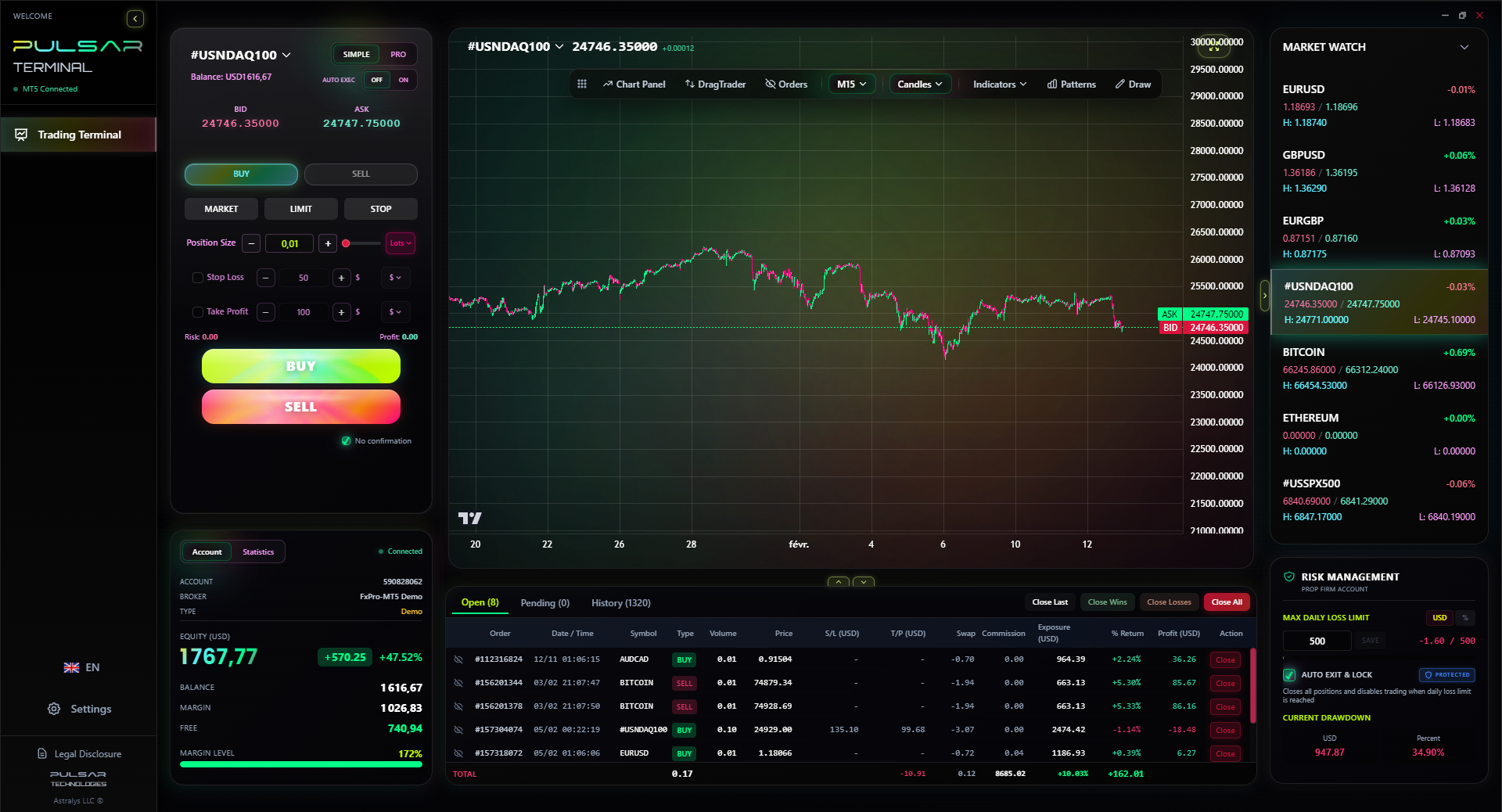
Managing multiple trades and setting precise stops on volatile pairs like USD/ZAR is critical, and Pulsar Terminal's drag-and-drop orders and multi-TP/SL tools on MT5 make executing your plan faster and less error-prone.
Pulsar Terminal
เครื่องมือ MT5 ครบวงจร: ลากวางคำสั่ง, multi-TP/SL, trailing stop, grid trading, Volume Profile และการป้องกัน prop firm ใช้งานโดยเทรดเดอร์กว่า 1,000 คนทุกวัน
“Taking a small, planned loss is a sign of strength, not weakness.”
You can have the best strategy in the world, but if you can't control your emotions, you'll lose. I've blown accounts. I've revenge traded. I've held losing positions hoping they'd come back, only to watch a margin call wipe me out. This is the unglamorous truth.
The single most important psychological skill is discipline. Discipline to follow your trading plan, discipline to use stop-losses every single time, and discipline to walk away after a losing streak. I have a rule: two consecutive losses, and I'm done for the day. No arguments. This rule alone has saved me thousands.
Fear and greed are your enemies. Fear makes you close winning trades too early. Greed makes you let losers run. You have to systematize everything to take the emotion out. Define your entry, your stop-loss, and your take-profit before you enter the trade. Then, let the system work. Sometimes you'll be stopped out and then the market will rocket in your original direction. It happens. Taking that small, planned loss is a sign of strength, not weakness.
💡 เคล็ดลับจาก Winston
Treat every trade like a business transaction, not a bet. You are the CEO of a one-person firm. Would you risk 20% of your company's capital on a single, emotional decision? No. So don't do it with your trading account.
“In this game, survival is the first step to success.”
Let's talk numbers. The stats say between 51% and 89% of retail traders lose money. Why? Unrealistic expectations. People think they can turn R5,000 into R50,000 in a month. That's gambling, not trading.
A realistic, professional target is a 10-20% return on your trading capital per year. Yes, per year. If you can consistently achieve that, you're in the top tier of traders. That means growing a R50,000 account by R5,000 to R10,000 over twelve months. It sounds boring, but sustainable wealth is built slowly.
This is a skill, like learning to be an electrician or a programmer. It takes time, practice, and you will pay for your education (through losses). Start with a demo account, then move to a live account with money you can absolutely afford to lose. I started with R2,000. I lost it in three months. That was my tuition fee. My second deposit was R2,000 again, and I made it last six months. Progress, not perfection.
Focus on protecting your capital first. Making money comes second. If you can end most months with a small gain or even a small loss, you're surviving. In this game, survival is the first step to success.
FAQ
Q1Is forex trading legal in South Africa?
Yes, it's completely legal, but it must be done through a broker licensed by the Financial Sector Conduct Authority (FSCA). Always check the broker's FSP number on the FSCA's public register before depositing any money.
Q2How much money do I need to start forex trading in South Africa?
You can start with very little. Some brokers like XM allow deposits as low as $5 (about R90). However, starting with such a small amount is more for learning the platform. A more practical starting amount to properly test a strategy with sensible position sizing is around R2,000 to R5,000.
Q3Do I pay tax on my forex trading profits?
Absolutely. SARS treats profits from frequent trading as ordinary income, taxed at your marginal tax rate. You must declare this income on your annual tax return. Keep detailed records of all trades, deposits, withdrawals, and currency conversions.
Q4What is the best time to trade forex in South Africa?
Q5Why are the spreads on USD/ZAR so wide?
USD/ZAR is an emerging market currency pair with lower liquidity than majors like EUR/USD. Fewer buyers and sellers at any given moment mean brokers quote a wider difference (spread) between the buy and sell price to manage their risk. It's normal to see spreads of 5 pips or more.
Q6Can I use international brokers like Exness or IC Markets?
Yes, many South Africans do. The key is to ensure that the international broker's local entity (e.g., Exness (SC) Ltd) is registered with the FSCA. This gives you the protection of local regulation. You can read our reviews of Exness and IC Markets for more details on their local offerings.
Q7What's the biggest mistake new South African traders make?
Two things: using too much use (ignoring the 30:1 FSCA limit by going offshore for 500:1), and jumping straight into trading volatile ZAR pairs without understanding the wider spreads and unique risks. They treat it like trading the majors and get burned quickly.
บทเรียนจาก Prof. Winston
สรุปสาระสำคัญ:
- ✓FSCA regulation is your primary safety net; never trade without it.
- ✓Account for all costs: spread, commission, swap, and the psychological toll.
- ✓Trade ZAR pairs with caution; they require wider stops and local news awareness.
- ✓SARS taxes trading profits as income; keep careful records from day one.
- ✓A 10-20% annual return is a stellar, professional achievement.
บทความนี้มีประโยชน์แค่ไหน?
คลิกดาวเพื่อให้คะแนน
ข้อมูลเชิงลึกการเทรดรายสัปดาห์
การวิเคราะห์และกลยุทธ์รายสัปดาห์ฟรี ไม่มีสแปม
เกี่ยวกับผู้เขียน
David van der Merwe
เทรดเดอร์ตลาดเกิดใหม่
เทรดเดอร์ประจำโจฮันเนสเบิร์ก มีประสบการณ์ 11 ปีในสกุลเงินตลาดเกิดใหม่ เชี่ยวชาญคู่ ZAR การเทรดภายใต้กฎระเบียบ FSCA และการวิเคราะห์ตลาดแอฟริกาใต้
ความคิดเห็น
คำเตือนความเสี่ยง
การซื้อขายตราสารทางการเงินมีความเสี่ยงสูงและอาจไม่เหมาะสำหรับนักลงทุนทุกคน ผลการดำเนินงานในอดีตไม่ได้รับประกันผลลัพธ์ในอนาคต เนื้อหานี้มีวัตถุประสงค์เพื่อการศึกษาเท่านั้นและไม่ควรถือเป็นคำแนะนำในการลงทุน โปรดทำการวิจัยของคุณเองก่อนการซื้อขาย
คุณอาจชอบสิ่งนี้

Cara Trading Forex Sukses: 7 Prinsip dari Trader Profesional
Cara trading forex sukses dengan 7 prinsip trader pro: manajemen modal, disiplin, journal trading, backtest. Data nyata, bukan janji profit palsu.
Jam Trading Forex Terbaik untuk Trader Indonesia: Panduan Lengkap dengan Tabel Waktu
Panduan jam trading forex untuk trader Indonesia. Tabel 4 sesi dunia, jam emas 20:00-00:00, sesi mana yang harus dihindari. Data akurat + tips dari trader berpengalaman.
Top 5 Sàn Forex Uy Tín Nhất 2026: Review Jujur dari Trader Indonesia
Top 5 sàn forex uy tín 2026 untuk trader Indonesia. Review jujur: spread, deposit, withdraw, dukungan lokal. Exness, XM, IC Markets & lebih.
รับ Pulsar Terminal
เครื่องคำนวณทั้งหมดนี้ถูกสร้างไว้ใน Pulsar Terminal พร้อมข้อมูลเรียลไทม์จากบัญชี MT5 ของคุณ
รับ Pulsar Terminal