


Here's a number that should make you pause: over 90% of traders who try a prop firm challenge fail it.

James Mitchell
นักวิเคราะห์การเทรดอาวุโส
☕ 11 นาทีอ่าน
สิ่งที่คุณจะได้เรียนรู้:
- 1What Exactly is Topstep?
- 2The Rules: Where Most Traders Fail
- 3The Real Costs: Fees, Payouts, and Fine Print
- 4The Brutal Honesty: Pros and Cons
- 5A Strategy to Actually Pass (From Someone Who Did)
- 6Life After the Challenge: The Funded Account
- 7How Topstep Stacks Up Against Other Prop Firms
- 8Final Verdict: Who Is This For?
Here's a number that should make you pause: over 90% of traders who try a prop firm challenge fail it. Topstep is one of the biggest names promising a slice of the other 10%. They've paid out over $100 million to traders, but that headline figure hides a brutal reality. I've traded their accounts, passed their evaluations, and watched students blow up trying. This isn't a sales pitch. It's a blunt look at whether this Topstep futures prop firm is a legitimate path to capital or just a very expensive lesson.
Topstep is a proprietary trading firm, or 'prop firm,' focused exclusively on futures. Their model is simple: you prove you can trade profitably and manage risk in a simulated account (their 'Evaluation'). If you pass, they give you a 'Funded Account' where you trade their capital and keep a large chunk of the profits. It's not a broker; you'll still need a separate brokerage account with NinjaTrader, Tradovate, or similar. Think of them as a risk manager and capital allocator. Their entire business is built on finding the minority of traders who won't lose them money. I respect that clarity. They're not pretending to be your friend. They're a filter.

Warning: Don't confuse 'simulated' with 'play money.' The rules in the Evaluation are brutally real. A single bad trade can reset your progress or fail you outright. The psychological pressure is identical to trading a real $50k or $100k account, because the reward for doing so is real.
The core of their offering is the Trading Combine®. You pick a starting account size (e.g., $50k, $100k), pay a monthly fee, and have to hit a profit target while staying within strict daily and total loss limits. It's a test, pure and simple.
This is the meat of it. Topstep's rules are designed to eliminate gamblers. You must demonstrate consistency, not just a lucky streak. Here’s the breakdown for a standard $50K account Evaluation.
Profit Target & Loss Limits
You need to hit a profit target of $3,000. Sounds easy, right? It's not. Your total loss limit is also $3,000. Your daily loss limit is even tighter at $1,500. Hit that daily max, and you're locked out for the day. Hit the total $3,000 drawdown, and you fail. The moment your account equity dips to $47,000, you're done. This forces a ridiculously low risk-per-trade. If you're risking more than $150 per trade, you're already flirting with disaster.
The Consistency Rule
This one catches everyone off guard. You can't just make the $3,000 profit in one trade. At least 50% of your total trading days must be profitable. If you trade for 10 days, at least 5 need to be green. This kills the 'one and done' scalping strategy where you hit a home run and stop. They want grinders.
Minimum Trading Days
You must trade for at least 10 days. No passing in two days. This combines with the consistency rule to test your process under various market conditions.
I failed my first Topstep attempt on the consistency rule. I made $2,800 in three days, got overconfident, took a few sloppy trades the next day, and ended with only 2 profitable days out of 6. Account reset. Lesson learned: patience isn't optional here.

💡 เคล็ดลับจาก Winston
During your eval, keep a physical sticky note on your monitor with three numbers: Daily Loss Limit, Total Loss Limit, and Profit Target. When in doubt, look at the note.
“The monthly fee isn't a cost; it's a motivational burn that forces you to respect the capital.”
Let's talk money, because the 'free capital' angle is misleading. There are real, recurring costs.
| Item | Typical Cost (50K Account) | What It Means For You |
|---|---|---|
| Evaluation Fee | $165/month | You pay this every month until you pass or quit. Fail, and you pay again to retry. |
| Profit Split | 80%/90% (First/After Scaling) | You keep 80% of profits initially. Hit scaling goals, and it goes to 90%. Topstep takes the rest. |
| Withdrawal Fee | None | A legit positive. They don't charge to pull your earnings. |
| Platform Data | ~$10-$30/month | You pay your broker (NinjaTrader, etc.) for real-time data feeds. |
So, if you pass in one month, your upfront cost is about $175. If it takes you three months, you're in for over $500 before you see a dime of profit. This is why I tell students to treat the Evaluation like a real business expense. That monthly fee is a motivational burn.
The profit split is fair for the industry. Keeping 80% of what you make with someone else's capital is a good deal. But remember, you have to make it past the gatekeepers first. The first payout is also delayed. You need to make a minimum of $500 in your Funded Account before you can request a withdrawal. Then, it's bi-weekly. It's not a get-rich-quick scheme; it's a slow-build profession.

Example: You pass the $50K challenge. In your first funded month, you make a net profit of $2,000. Your take-home is $1,600 (80%). Topstep keeps $400. Not bad, but you also spent $165+ on the challenge and pay for data. Your real net is closer to $1,400.
After working with them and coaching traders through it, here's my unfiltered take.
The Good Stuff (It's Not All Bad):
- Real Capital Access: The top funded account size goes up to $250k. That's serious buying power for futures, where contracts are leveraged.
- Discipline Forger: The rules will beat bad habits out of you. You will learn position sizing like your life depends on it. I still use my position size calculator religiously because of my Topstep days.
- No Liability: If you blow the funded account (it happens), you don't owe them the losses. You just lose the account. This is the biggest draw versus taking out a personal loan to trade.
- Platform Choice: You can use NinjaTrader, Tradovate, or others. You're not locked into some janky proprietary platform.
The Ugly Truths:
- The House Always Wins: Their revenue model is built on monthly fees from people who don't pass. It's a gym membership business. This creates a potential conflict of interest, though their payouts prove they do want successful traders.
- Psychological Gauntlet: The evaluation is a different beast. The pressure to not 'waste' the monthly fee can lead to overtrading or fear. I've seen good traders turn into nervous wrecks.
- Rule Rigidity: That daily loss limit is a double-edged sword. It saves you from a total meltdown, but it can also kill a legitimate mean-reversion play that would have worked by the close. You have to trade their system.
- You're a Contractor: You get a 1099 at year's end for your profits. You're responsible for the taxes, not them.
“Their revenue model is built on monthly fees from people who *don't* pass. It's a gym membership business.”
Forget your fancy strategies for a minute. Passing Topstep is about risk management, not prediction. Here's the blueprint.
1. Treat Every Trade as a $150 Risk. With a $1,500 daily loss limit, you can only afford about 10 max-loss trades per day. That's nothing. I risked no more than $75-$100 per trade during my successful pass. This meant tiny position sizes in the E-mini S&P 500 (ES). Use the margin call concept as a ghost over your shoulder. If you don't know your exact risk in dollars before entering, you've already failed.
2. Hunt for 2:1 Reward-to-Risk, Minimum. Aiming for small, high-probability wins is the only way to hit the profit target without blowing the drawdown. If you risk $75, your target should be at least $150. This directly impacts your position size calculator settings. This ratio slowly and steadily builds the account while giving you a buffer for losing trades.
3. Use the "One Trade a Day" Starter Method. For the first 5-6 days, just make one high-conviction trade per day. Aim for that 2:1 win. This almost guarantees you'll hit the minimum trading days and the profitability consistency rule without the noise of overtrading. It's boring. It works.
4. Ignore the Profit Target Until the Last Week. Your sole focus for the first two weeks should be: don't hit the daily loss limit. Protect the capital. Let profits accumulate slowly. Once you have a $1,000-$1,500 buffer, then you can think about strategically closing in on the $3,000 target.
5. Choose Your Instrument Wisely. The Micro E-mini S&P 500 (MES) is your best friend. One pip definition (well, tick) is $1.25, compared to $12.50 on the standard ES. It allows for precise, small risk management. The EUR/USD guide won't help you here. This is a futures game. Stick to the most liquid products: ES, NQ (Nasdaq), or CL (Crude Oil). Avoid the weird stuff.
My winning pass looked like this: 12 trading days, 7 profitable. My largest single win was $212. My largest loss was $89. It was excruciatingly dull. That's the secret.
💡 เคล็ดลับจาก Winston
The best trade you'll make in a Topstep challenge is often the one you don't take. If the setup isn't crystal clear, sit on your hands. Inactivity is a valid strategy.
Congratulations, you passed. Now the real work begins, and the rules... change slightly. The profit target is gone. The consistency rule is gone. The minimum trading days are gone. What remains are the drawdown limits, and they become trailing. This is critical.
In the Evaluation, your max loss was a fixed line in the sand ($47,000 account equity). In the Funded Account, your drawdown limit trails your peak account equity by the loss limit amount. Let's say you're in a $50K funded account (max loss $3,000). You start at $50,000. You make $1,000, so your account equity peaks at $51,000. Your new loss threshold is now $48,000 ($51,000 - $3,000). If you then lose $2,000, you're at $49,000 and still safe. But if you give back all $1,000 of profit plus another $2,000, dropping you to $48,000, you hit the trailing drawdown and lose the account.

Pro Tip: This trailing rule makes conservative trading even more important. The moment you make a new high in equity, your safety net rises. This encourages you to bank profits frequently. It's a brilliant, if ruthless, mechanism to protect their capital.
Your first goal is to trigger a 'profit split' by making $500. Then, you can request a withdrawal every two weeks. Your next goal is 'scaling.' Hit a profit target (e.g., $3,000 net), and they may increase your account size and boost your profit split to 90%. This is how you grow with them.
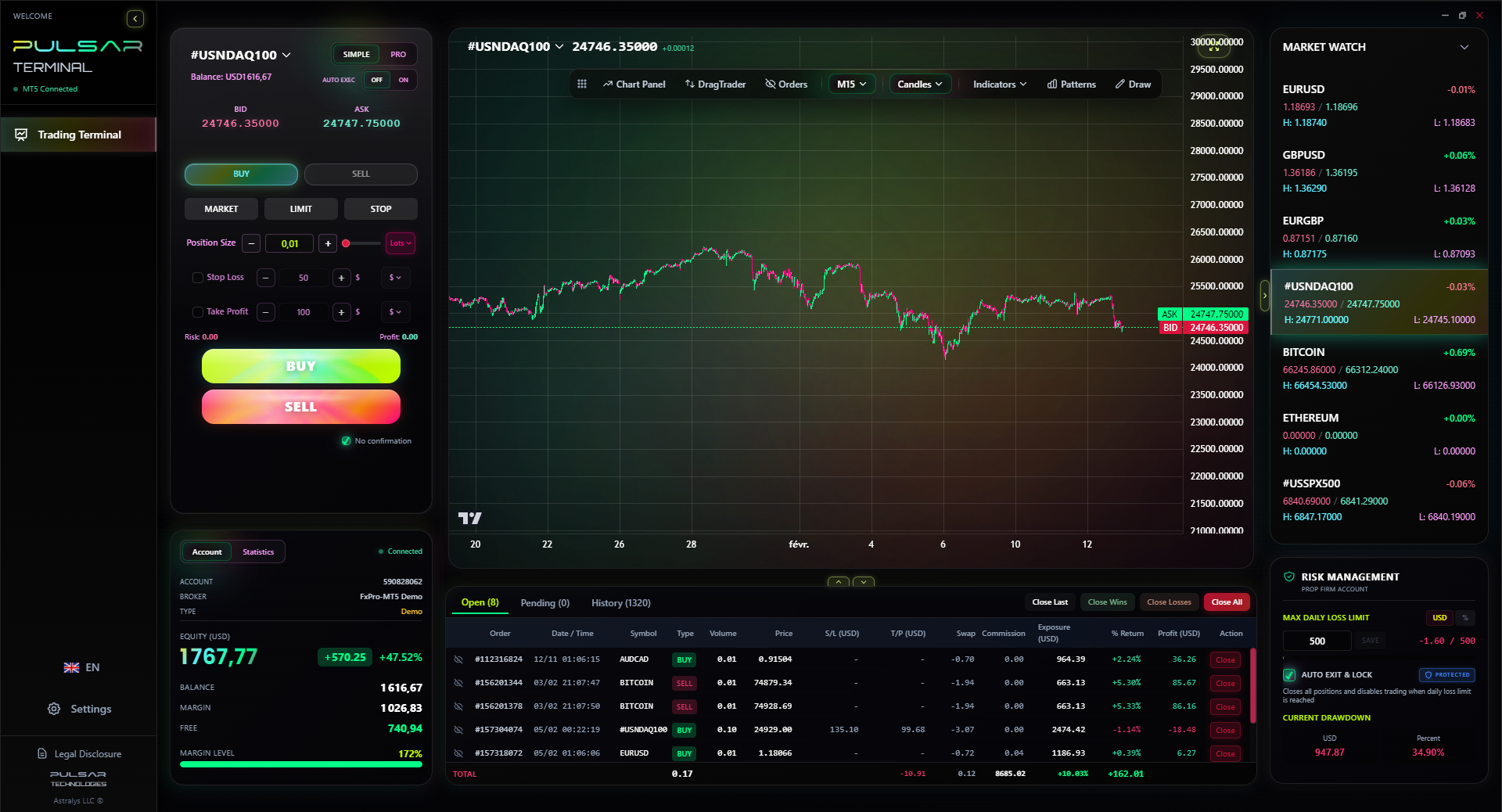
Managing a trailing drawdown manually is stressful; Pulsar Terminal automates trailing stops and breakeven triggers directly on your MT5 chart, so you can focus on the trade, not the calculator.
Pulsar Terminal
เครื่องมือ MT5 ครบวงจร: ลากวางคำสั่ง, multi-TP/SL, trailing stop, grid trading, Volume Profile และการป้องกัน prop firm ใช้งานโดยเทรดเดอร์กว่า 1,000 คนทุกวัน
“I failed my first attempt on the consistency rule. Overconfidence is a faster killer than a bad chart.”
Topstep is the OG for futures, but it's not the only option. Here’s a quick, opinionated comparison.
- Apex Trader Funding: Often cheaper monthly fees, and a key difference: they usually have a one-time reset fee instead of a recurring monthly fee if you fail. Their rules can be slightly more forgiving on the daily loss relative to account size. For a pure cost perspective, Apex can be better for those who think they might need multiple tries.
- FTMO / The Funded Trader: These giants are primarily focused on forex and CFDs, not futures. If you want to trade XAU/USD guide or major forex pairs, look here instead. Their challenge structure is similar but tailored to the spot forex market.
- Taking a Loan / Trading Your Own Cash: The real alternative. If you have $5,000, you could open an account with a broker like Pepperstone review or IC Markets review and keep 100% of your profits (and losses). You have no rules, but you also have no safety net and full liability.
Topstep's advantage is its singular focus on US futures and its established reputation. You know what you're getting. The disadvantage is the monthly fee model, which can become a money pit if you're stuck in the evaluation phase for too long.
The Topstep futures prop firm is not for beginners. Let me say that again. If you're new to trading, you are donating your monthly fee. It's a tuition payment for a lesson in humility.
Topstep is for you if:
- You have a proven, rule-based trading strategy with a positive expectancy over at least 100 trades.
- You have the discipline of a monk and can follow rules even when they feel stupid.
- You understand futures markets, spread definition, and use intimately.
- You have the spare cash to cover 3-6 months of evaluation fees without it hurting.
- You want structured, external discipline to force you to the next level.
Avoid Topstep if:
- You're still 'figuring out' your strategy.
- You have a gambling itch or can't take small losses gracefully.
- The thought of risking $75 to make $150 sounds painfully slow.
- You trade primarily on emotion or news headlines.
My bottom line: Topstep is a legitimate, professional operation. It provides a real service for a specific type of trader. For the disciplined, systematic futures trader who lacks significant capital, it can be a career accelerator. For everyone else, it's an expensive filter you will likely fail. I passed, and it made me a better trader by exposing every weakness in my risk management. But I watched far more talented chart readers fail because they couldn't obey the rules. The question isn't about Topstep. It's about you.
FAQ
Q1Can I trade stocks or forex with a Topstep account?
No. Topstep is exclusively for futures contracts traded on US exchanges (like the CME). You cannot trade individual stocks, ETFs, or spot forex pairs. Their platform connections and risk systems are built for futures only.
Q2What happens if I hit the daily loss limit?
Your trading is suspended for the rest of that trading day (5:00 PM CT to 4:00 PM CT next day). You can resume trading at the next session open. It does not automatically fail you, but it uses up a chunk of your total allowable drawdown, putting you dangerously close to failing the entire evaluation.
Q3How long does it take to get paid after a withdrawal request?
Topstep processes withdrawal requests on a bi-weekly schedule. Once you submit a request (minimum $500 profit), it's typically paid via ACH bank transfer within 3-5 business days after the next processing date. It's not instant, but it's reliable.
Q4Is the Topstep evaluation fee refundable?
No. The monthly fee for the Trading Combine® is non-refundable. However, if you purchase a "Retry" after failing, it is sometimes offered at a discounted rate. Consider the fee a sunk cost for the opportunity to try for their capital.
Q5Can I use automated trading or algorithms?
Yes, with restrictions. You can use automated strategies (Expert Advisors, algorithms) on your platform, but you are 100% responsible for their actions. If your algo goes haywire and breaches a loss limit, you fail. Topstep does not provide or endorse any specific automated systems.
Q6What's the biggest mistake traders make in the evaluation?
Overtrading after a loss. They lose $100, get emotional, and immediately jump into a larger position to 'make it back.' This violates the core rules of small, consistent risk and almost always leads to hitting the daily loss limit. One loss should not change your plan.
Q7Do I need a separate broker account?
Yes. Topstep is not a broker. You must have your own account with a supported futures broker like NinjaTrader, Tradovate, or AMP Global. You will pay for your own data feeds and platform fees (if any) to that broker.
บทเรียนจาก Prof. Winston
สรุปสาระสำคัญ:
- ✓Risk no more than 1% of your daily loss limit per trade.
- ✓The consistency rule is a bigger filter than the profit target.
- ✓Trailing drawdown in the funded account protects their capital ruthlessly.
- ✓Micro futures (MES) are the best tool for precise risk control.
บทความนี้มีประโยชน์แค่ไหน?
คลิกดาวเพื่อให้คะแนน
ข้อมูลเชิงลึกการเทรดรายสัปดาห์
การวิเคราะห์และกลยุทธ์รายสัปดาห์ฟรี ไม่มีสแปม
เกี่ยวกับผู้เขียน
James Mitchell
นักวิเคราะห์การเทรดอาวุโส
ประจำอยู่ที่นิวยอร์ก มีประสบการณ์การเทรดมากกว่า 9 ปี เน้นคู่ USD หลัก ความท้าทายของ prop firm และกฎระเบียบการเงินของสหรัฐฯ
ความคิดเห็น
คำเตือนความเสี่ยง
การซื้อขายตราสารทางการเงินมีความเสี่ยงสูงและอาจไม่เหมาะสำหรับนักลงทุนทุกคน ผลการดำเนินงานในอดีตไม่ได้รับประกันผลลัพธ์ในอนาคต เนื้อหานี้มีวัตถุประสงค์เพื่อการศึกษาเท่านั้นและไม่ควรถือเป็นคำแนะนำในการลงทุน โปรดทำการวิจัยของคุณเองก่อนการซื้อขาย
คุณอาจชอบสิ่งนี้

Cara Trading Forex Sukses: 7 Prinsip dari Trader Profesional
Cara trading forex sukses dengan 7 prinsip trader pro: manajemen modal, disiplin, journal trading, backtest. Data nyata, bukan janji profit palsu.
Jam Trading Forex Terbaik untuk Trader Indonesia: Panduan Lengkap dengan Tabel Waktu
Panduan jam trading forex untuk trader Indonesia. Tabel 4 sesi dunia, jam emas 20:00-00:00, sesi mana yang harus dihindari. Data akurat + tips dari trader berpengalaman.
Top 5 Sàn Forex Uy Tín Nhất 2026: Review Jujur dari Trader Indonesia
Top 5 sàn forex uy tín 2026 untuk trader Indonesia. Review jujur: spread, deposit, withdraw, dukungan lokal. Exness, XM, IC Markets & lebih.
รับ Pulsar Terminal
เครื่องคำนวณทั้งหมดนี้ถูกสร้างไว้ใน Pulsar Terminal พร้อมข้อมูลเรียลไทม์จากบัญชี MT5 ของคุณ
รับ Pulsar Terminal