


I watched my profit on a USD/NGN trade evaporate in 2023.

Olumide Adeyemi
ผู้บุกเบิกการเทรดในแอฟริกาตะวันตก ·  Nigeria
☕ 11 นาทีอ่าน
สิ่งที่คุณจะได้เรียนรู้:
- 1What Exactly Is a Trailing Stop? (It's Not Magic)
- 2Why Nigerian Traders Absolutely Need This Tool
- 3How to Set a Trailing Stop: MT4/MT5 Walkthrough
- 4Mistakes I've Made (So You Don't Have To)
- 5Beyond the Basics: Smarter Trailing Techniques
- 6Brokers & Platforms: Getting the Right Tools
- 7Your Action Plan: From Theory to Live Trading
I watched my profit on a USD/NGN trade evaporate in 2023. I was up ₦420,000 on a short position as the Naira weakened, got greedy, and didn't move my stop loss. Then the CBN announced new FX measures. The pair reversed violently, hit my static stop, and I walked away with just ₦85,000. A trailing stop would have banked most of that profit automatically. That's the painful lesson: in a market as volatile as ours, where news from Abuja can move prices 5% in minutes, a static stop-loss is often just a suggestion. Let's talk about how to make your stops work for you, not against you.
A trailing stop is a dynamic stop-loss order. Instead of sitting at a fixed price, it follows the market price at a set distance (in pips or a percentage). If the price moves in your favor, the stop moves up (for a long trade) or down (for a short trade). If the price reverses, the stop stays put, locking in your profit.
Think of it like a security guard who follows you as you walk deeper into a profitable trade, but stands his ground if you try to retreat. His job is to protect the furthest point you reached.
Here’s the crucial bit everyone misses: a trailing stop is an exit-only tool. It doesn't help you enter a trade. Its sole purpose is to manage an open position by automating the most emotionally difficult part of trading: letting profits run while cutting losses. In the Nigerian context, where internet connections can be unreliable and you might be trading from your phone during a meeting, this automation is a lifesaver.

Warning: A trailing stop is not a guarantee. It becomes a market order once triggered. In a fast-moving market (like when Binance news hits), the price you get filled at (slippage) can be significantly worse than your stop level. Don't assume it's a bulletproof shield.

💡 เคล็ดลับจาก Winston
Never set a trailing stop distance smaller than the average spread of the pair you're trading. You'll be paying the broker for the privilege of getting stopped out instantly.
Our market has a unique personality. It's thin on liquidity for exotic pairs, reacts hysterically to local news, and the Naira's own drama creates wild swings in pairs like USD/NGN or GBP/NGN. A static stop-loss here is like bringing a knife to a gunfight.
Volatility is Your Enemy and Your Friend. Remember when the CBN re-admitted BDCs in early 2026? USD/NGN spiked, then crashed within hours. A well-placed trailing stop on a short trade would have ridden that spike down and locked in gains before the inevitable retracement. Without it, you're either closing too early out of fear or watching paper profits vanish.
The Psychology Problem. We have a cultural tendency to turn trades into investments. "It will come back," we say, as a trade goes 50 pips against us. A trailing stop removes that emotional debate. It makes the decision for you, based on the rules you set when you were thinking clearly. I've saved myself from countless revenge-trading spirals by letting my trailing stop execute and walking away.
Practical Reality. You're not a full-time trader watching charts. You have a job, family, and unreliable electricity. A trailing stop works while you sleep, during load-shedding, or when you're stuck in Lagos traffic. It's your full-time trade manager. For strategies like swing trading, where you hold for days, it's non-negotiable.
“A trailing stop in a volatile market isn't a luxury; it's a seatbelt.”
Most of us use MetaTrader. The process is simple, but the settings are critical.
On MetaTrader 4 or 5
- Open the "Terminal" window (Ctrl+T).
- Find your open trade in the "Trade" tab.
- Right-click on the trade and select "Trailing Stop."
- Choose your distance. This is where most people mess up.
Choosing the Distance: The Goldilocks Zone
This isn't a random guess. Your trailing distance must be wider than the market's normal noise but tighter than a major swing.
- Too Tight (e.g., 10 pips on EUR/USD): You'll get stopped out by every tiny retracement. You'll pay spreads and commissions for no gain.
- Too Wide (e.g., 100 pips): It offers no protection. You give back all your profit before it triggers.
My Rule of Thumb: Start with 1.5 to 2 times the Average True Range (ATR) over 14 periods. If EUR/USD has an ATR of 15 pips, set a trailing stop of 23-30 pips. This allows the trade room to breathe. For more volatile pairs involving the Naira, you might need 2.5x ATR.

Example: I went long on GBP/USD at 1.2600. The 14-period ATR was 18 pips. I set a 27-pip trailing stop (1.5 x 18). Price rose to 1.2670 (70 pip profit). My stop trailed up to 1.2643 (1.2670 - 0.0027). A retracement to 1.2645 wouldn't stop me out, but a deeper pullback to 1.2643 would, locking in 43 pips. Without it, I might have watched it fall back to breakeven.
Always use a position size calculator first. Your trailing stop distance determines your risk per trade. A 30-pip stop on a standard lot risks $300. Make sure that's a percentage of your account you can stomach.
💡 เคล็ดลับจาก Winston
If you're trading a pair with the Naira, double your normal trailing stop distance. The liquidity is thinner and the spikes are sharper. Give your trade room to survive the noise.
I've paid my tuition to the market on this. Here's what not to do.
1. Setting It and Forgetting It (Completely). A trailing stop isn't a "fire and forget" missile. You must monitor the broader context. If a major news event is due (like CBN MPC meeting results), the initial spike can be insane. Your trailing stop might get hit in the volatility, only for the trend to resume immediately. Sometimes, before high-impact news, I convert my trailing stop to a manual stop farther away, or I just take partial profit and manage the rest manually.
2. Using it in Ranging Markets. This is a classic killer. In a choppy, sideways market, a trailing stop will get you whipsawed out of trades repeatedly for small losses. I bled my account dry doing this on EUR/NGN during a quiet period. Trailing stops work best in strong, clear trends. Use other tools like the RSI indicator or support/resistance to identify the market condition first.
3. Ignoring Broker Specifics. Not all brokers implement trailing stops the same way. Some handle it on their server, which is good (it works if your platform closes). Others only work if your MT4/MT5 platform is running. Always check your broker's FAQ. I learned this the hard way with an old XM review account years ago; I closed my laptop and my trailing stop vanished.
4. Chasing with a Tight Stop. You see a rocket ship taking off, FOMO kicks in, and you buy the top. Then you slap a tight 15-pip trailing stop on it to "manage risk." What happens? The inevitable pullback after the explosive move stops you out for a loss, and then the trend continues. Entry matters. A trailing stop protects a good trade; it rarely saves a bad one.
“The goal isn't to be right about the direction. The goal is to be profitable when you are right.”
Once you're comfortable, you can graduate from the fixed-distance trailing stop.
The Manual Trail (The Poor Man's Version). Don't have an automated tool? Manually move your stop-loss to breakeven once you're in profit by 1x your initial risk. Then, move it to lock in profit at key levels: recent swing highs/lows, or Fibonacci retracement levels. It's more work, but it teaches you discipline.
Using Moving Averages as a Dynamic Trail. Instead of a fixed pip distance, some traders place their stop-loss below a key moving average (like the 20-period EMA). As the average rises, so does your stop. This creates a dynamic, curved trailing stop that adapts to volatility. I've used this successfully on trending instruments like XAU/USD.
Partial Closure with Trailing Stops. This is a pro move. Close half your position at a predetermined profit target (taking risk off the table), then apply a trailing stop to the remaining half. This way, you bank some profit and give the rest unlimited runway. You need a platform that allows this easily, which is where advanced tools come in.

Pro Tip: Combine your trailing stop with a volatility filter. If the ATR expands dramatically, widen your trailing distance proportionally. This prevents you from being shaken out of a strong trend that's just getting more volatile. You can code this as an EA, or use a platform that offers dynamic trailing features.
The goal is to tailor the exit to the market's behavior, not just your hope. A one-size-fits-all trailing stop doesn't exist.
💡 เคล็ดลับจาก Winston
Your first move after a trade goes 1.5R in profit should be to move your stop to breakeven. *Then* think about activating a trailing stop. Never let a winning trade turn into a loser.
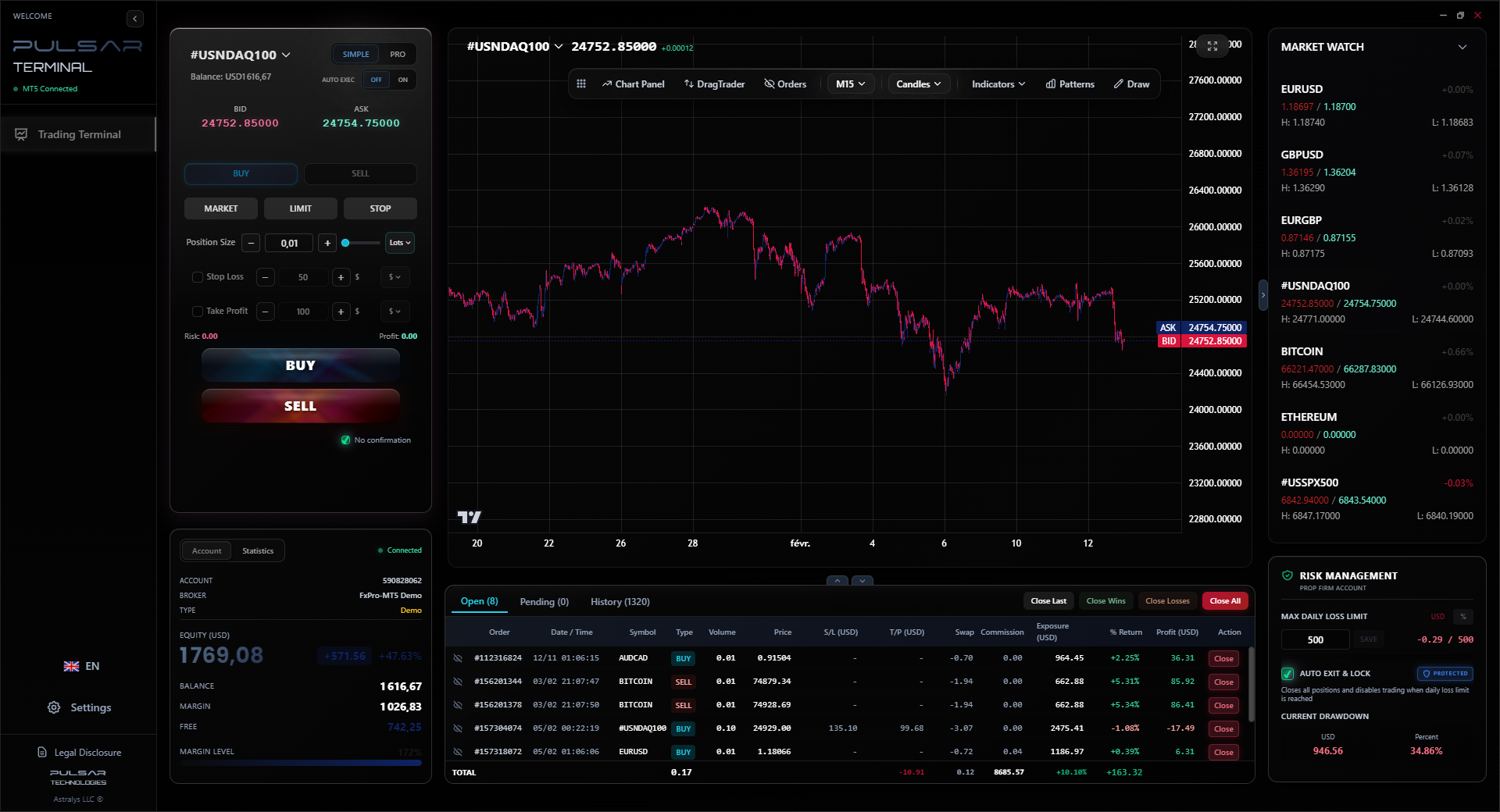
Manually moving stops and managing partial closures is a hassle, which is why tools like Pulsar Terminal automate advanced trailing stop logic and multi-TP/SL strategies directly on your MT5 charts.
Pulsar Terminal
เครื่องมือ MT5 ครบวงจร: ลากวางคำสั่ง, multi-TP/SL, trailing stop, grid trading, Volume Profile และการป้องกัน prop firm ใช้งานโดยเทรดเดอร์กว่า 1,000 คนทุกวัน
Your broker choice directly impacts how well your trailing stop works. Here’s the lowdown for Nigerian traders.
Key Considerations:
- Server-Side Trailing Stops: This is crucial. It means the stop runs on the broker's server, not your computer. If your power goes out or app crashes, your stop is still active. Brokers like IC Markets and Pepperstone offer this.
- Execution Speed & Slippage: A trailing stop becomes a market order. In a fast market, you want a broker with lightning-fast execution to minimize slippage. Check reviews for execution stats.
- Spreads: A tight spread definition is vital. If the EUR/USD spread is 3 pips, your trailing stop has to overcome that just to break even. Look for brokers known for low, stable spreads.
A Quick Comparison for Nigerian Traders:
| Broker | Good For Trailing Because... | Watch Out For... |
|---|---|---|
| IC Markets | Raw spreads (0.0 pips on majors), very fast execution, server-side stops. | $200 min deposit might be high for starters. |
| Exness | Very low minimum deposit, accepts local payments easily. | Unlimited use can be dangerous if you don't manage risk. |
| XM | Low minimum deposit ($5), good for beginners. | Spreads on commission-free accounts can be wider. |
| Pepperstone | Excellent execution, Razor account has tight spreads. | Their proprietary platform may have different trailing stop logic than MT4/5. |
Funding Your Account: Use methods that are cheap and fast. Bank transfers can be slow and attract CBN scrutiny. I've found funding in USD through a domiciliary account transfer, or using USDT (Tether) on brokers that accept crypto, to be the most efficient. Avoid funding in NGN if you're trading international pairs; the conversion fees will eat you alive.
Remember, no matter the broker, your number one job is to avoid a margin call. A trailing stop is a risk management tool, not a license to over-use.
“A static stop-loss in the Nigerian forex market is often just a suggestion waiting to be ignored.”
Knowledge is useless without action. Here's a step-by-step plan to implement trailing stops this week.
- Backtest First, Always. Don't use real money. Take a strategy you know (even a simple moving average crossover). On your MT4 platform, use the strategy tester or manually review old charts. Apply a trailing stop of 1.5x ATR and see how it affects your win rate, average profit, and average loss. Does it improve your results? I did this with a scalping strategy and found trailing stops were too slow; they worked better for my swing trades.
- Start Small on a Demo. Open a demo account with your preferred broker (like the ones in our Exness review or others). Trade for two weeks using ONLY trailing stops to exit profitable trades. Get used to the feeling of being stopped out while still in profit. It feels weird at first.
- Go Live with One Trade. In your live account, take your next high-conviction trade. Calculate your position size based on a 2% risk. Set your initial stop-loss. The moment you're in profit by 1.5x your risk (e.g., you risked 20 pips, now you're up 30), activate a trailing stop equal to your initial risk (20 pips). This is a conservative, disciplined approach.
- Review and Adapt. After 10-20 trades using trailing stops, analyze your journal. What was your average win vs. average loss? Did you leave too much on the table? Adjust your trailing distance or technique accordingly. Maybe you need to combine it with the MACD indicator to confirm trend strength before activating it.
The ultimate goal is to systematize your exits. Your emotions will always scream "take profit now!" or "it'll come back!" A trailing stop is the quiet, logical voice that follows the plan. In the chaotic Nigerian forex market, that voice might just be your most valuable asset.
FAQ
Q1Is using a trailing stop free?
Yes, the order type itself doesn't cost extra. However, you still pay the broker's spread when the stop is triggered and becomes a market order. Some brokers might have specific rules, so always check their terms.
Q2Can I use a trailing stop on my phone?
Yes, both the MT4 and MT5 mobile apps allow you to set and modify trailing stops on open positions. It's a bit more fiddly than on desktop, but it works. This is essential for managing trades on the go in Nigeria.
Q3What's better: a trailing stop in pips or a percentage?
For forex, pips are standard and more precise because spreads and volatility are measured in pips. A percentage (e.g., 1%) can be useful for stocks or cryptocurrencies. I always use pips for forex, as it relates directly to the instrument's pip definition and behavior.
Q4My trailing stop got hit, but then the price went back in my direction. What did I do wrong?
Probably nothing "wrong." This is called being "whipped out." It means your trailing distance was too tight for the current market volatility. Widen your trailing stop (use a larger ATR multiple) or accept that this happens sometimes. Protecting capital is priority one; catching every pip is impossible.
Q5Should I use a trailing stop for every single trade?
No. They are best for trending markets. In a clear, strong uptrend or downtrend, they're fantastic. In a choppy, sideways range (like markets often are before big news), they will get you stopped out repeatedly for small losses. Learn to identify the market condition first.
Q6How does a trailing stop work with use?
It works the same way, but use amplifies everything. A 30-pip trailing stop on a 1:100 leveraged position controls a much larger amount of capital than on a 1:10 position. The key is to use a position size calculator so your risk (in pips x value per pip) is a sane percentage of your account, regardless of use.
Q7Are trailing stops allowed by Nigerian regulators?
Yes. The CBN and SEC don't regulate specific order types. They regulate market conduct and institutions. Since most Nigerian traders use international brokers (regulated by CySEC, FCA, ASIC, etc.) that offer MetaTrader, using a trailing stop is perfectly legal and standard practice.
บทเรียนจาก Prof. Winston
สรุปสาระสำคัญ:
- ✓Use a trailing stop distance of 1.5x to 2x the 14-period ATR.
- ✓Always test if your broker's trailing stop runs server-side.
- ✓Never use a tight trailing stop in a ranging market.
- ✓Combine trailing stops with partial profit-taking for best results.
บทความนี้มีประโยชน์แค่ไหน?
คลิกดาวเพื่อให้คะแนน
ข้อมูลเชิงลึกการเทรดรายสัปดาห์
การวิเคราะห์และกลยุทธ์รายสัปดาห์ฟรี ไม่มีสแปม
เกี่ยวกับผู้เขียน
Olumide Adeyemi
ผู้บุกเบิกการเทรดในแอฟริกาตะวันตก
หนึ่งในนักการศึกษาฟอเร็กซ์ที่กระตือรือร้นที่สุดของไนจีเรีย 8 ปีประสบการณ์เทรดจากลากอส เชี่ยวชาญกลยุทธ์ทุนต่ำและความท้าทาย prop firm สำหรับเทรดเดอร์ในแอฟริกา
ความคิดเห็น
คำเตือนความเสี่ยง
การซื้อขายตราสารทางการเงินมีความเสี่ยงสูงและอาจไม่เหมาะสำหรับนักลงทุนทุกคน ผลการดำเนินงานในอดีตไม่ได้รับประกันผลลัพธ์ในอนาคต เนื้อหานี้มีวัตถุประสงค์เพื่อการศึกษาเท่านั้นและไม่ควรถือเป็นคำแนะนำในการลงทุน โปรดทำการวิจัยของคุณเองก่อนการซื้อขาย
คุณอาจชอบสิ่งนี้

Cara Trading Forex Sukses: 7 Prinsip dari Trader Profesional
Cara trading forex sukses dengan 7 prinsip trader pro: manajemen modal, disiplin, journal trading, backtest. Data nyata, bukan janji profit palsu.
Jam Trading Forex Terbaik untuk Trader Indonesia: Panduan Lengkap dengan Tabel Waktu
Panduan jam trading forex untuk trader Indonesia. Tabel 4 sesi dunia, jam emas 20:00-00:00, sesi mana yang harus dihindari. Data akurat + tips dari trader berpengalaman.
Top 5 Sàn Forex Uy Tín Nhất 2026: Review Jujur dari Trader Indonesia
Top 5 sàn forex uy tín 2026 untuk trader Indonesia. Review jujur: spread, deposit, withdraw, dukungan lokal. Exness, XM, IC Markets & lebih.
รับ Pulsar Terminal
เครื่องคำนวณทั้งหมดนี้ถูกสร้างไว้ใน Pulsar Terminal พร้อมข้อมูลเรียลไทม์จากบัญชี MT5 ของคุณ
รับ Pulsar Terminal