


Most traders in Nigeria are looking for the next big signal, the complex indicator, the holy grail.

Olumide Adeyemi
ผู้บุกเบิกการเทรดในแอฟริกาตะวันตก ·  Nigeria
☕ 12 นาทีอ่าน
สิ่งที่คุณจะได้เรียนรู้:
- 1What Exactly Is a Tweezer Top?
- 2How to Spot a Real Tweezer Top (And Avoid the Fakes)
- 3My Step-by-Step Plan for Trading a Tweezer Top
- 4Why This Pattern Works So Well for Nigerian Traders
- 5The Three Mistakes That Will Blow Up Your Tweezer Top Trade
- 6Supercharge Your Tweezer Tops: Add These Tools
- 7A Recent Trade: From Spotting to Cashing Out
Most traders in Nigeria are looking for the next big signal, the complex indicator, the holy grail. They're missing the simple stuff that actually works. I'm telling you, the humble tweezer top is one of the most reliable patterns you can find on a chart, especially when trading the volatile pairs that affect our Naira. It's not flashy, but it's saved my account more times than I can count. In this guide, I'll show you exactly how to spot it, trade it, and avoid the common mistakes that turn a good signal into a blown trade.
Let's cut through the jargon. A tweezer top is a bearish reversal pattern. You find it at the top of an uptrend, and it screams one thing: "The buyers are tired." It's made of two (or sometimes more) candlesticks that have identical, or nearly identical, highs.
Picture this: The market's been climbing. The first candle is bullish, pushing up to a new high and closing strong. Everyone's feeling good. Then the next candle opens, tries to push past that same high, and fails miserably. It closes lower, leaving a wick or a body that taps the exact same price level as the day before. That's your tweezer top. It's like the market hit an invisible ceiling and bounced off. That ceiling is your resistance level.
The psychology is simple. The first high shows where buyers finally met sellers strong enough to stop the rally. The second candle confirms that those sellers are still there, waiting, and now they're pushing price down. It's a classic sign of exhaustion. I've seen this play out perfectly on USD/NGN charts during periods of CBN intervention rumors. The pair will rally on speculation, form a clean tweezer top at a key psychological level (like 1500), and then reverse hard when the official news drops.

Warning: A tweezer top alone is just a suggestion. It's not a magic bullet. I learned this the hard way early on, taking every twin-high I saw as a sell signal. You need confirmation, which we'll get into next.
“A tweezer top alone is just a suggestion. It's not a magic bullet.”
Not every pair of candles with similar highs is a valid pattern. You need to be picky. Here’s my checklist, forged from years of getting it wrong before I got it right.
The Non-Negotiables
First, you need a clear uptrend. Don't go looking for reversal patterns in the middle of a messy, sideways market. Zoom out. The price should have been making higher highs and higher lows for a decent period. On a 4-hour or daily chart, this could be over several days or weeks.
Second, the highs must be virtually identical. I'm talking within a few pips. If you're squinting and saying "close enough," it's not close enough. The more precise the match, the stronger the signal. On major pairs like EUR/USD, I look for them to be within 2-3 pips. On more volatile pairs, you might allow a tiny bit more leeway.
Candle Types That Matter
The classic, strongest formation is a bullish candle (often a long green one) followed by a bearish candle (a red one). The bearish candle can be a doji, a shooting star, or a full-bodied red candle. The key is the rejection. A shooting star as the second candle is a particularly potent sign.
The Context is King
Where is this pattern forming? Is it at a major previous resistance level on the weekly chart? Is it sitting at a big, round number like 1.1000 on EUR/USD? A tweezer top at a known technical level is worth ten times more than one that appears in no-man's land. Always check your higher timeframes. I use the Volume Profile tool on my platform to see if the highs are aligning with a high-volume node, which acts as a natural barrier.

Pro Tip: Switch your chart to a line chart or use the bar chart setting temporarily. Sometimes the twin highs are easier to spot when you're just looking at the peaks without the candle bodies distracting you. Once you see the double top on the line, switch back to candles to confirm the structure.

💡 เคล็ดลับจาก Winston
The market's memory is at round numbers. A tweezer top at a price ending in .00 or .50 is shouting, not whispering. Listen.
“The psychology is simple: the first high shows where buyers finally met sellers strong enough to stop the rally.”
Okay, you've found a clean pattern in a solid uptrend. Now what? Jumping in immediately is a sure way to get stopped out. Here's the process I follow every single time.
Step 1: Wait for the Close. Never, ever enter a trade before the second candle of the pattern has fully closed. That's when the signal is confirmed. I've been burned trying to anticipate it.
Step 2: Look for Immediate Confirmation. The best entries come on the next candle after the pattern. You want to see that candle break below the low of the second (bearish) candle in the tweezer. This is your trigger. It confirms the sellers have taken control. You can place a sell order a few pips below that low.
Step 3: Set Your Stop Loss. This is non-negotiable. Your stop loss must be placed above the high of the tweezer top pattern. By definition, if price breaks above that high, the pattern is invalidated. The market is telling you it wants to go higher. Give it some room - place the stop 5-10 pips above the high to account for spreads and minor spikes.
Step 4: Set Your Take Profit. I use a risk-reward ratio of at least 1:2. Measure the height from the pattern's high to your entry point. Then, project that same distance down from your entry for your first profit target. For a more aggressive approach, you can look for the next major support level or use a trailing stop. A solid swing trading approach is to take partial profits at the 1:1 risk/reward level and let the rest run.
Real Trade Example: On February 15th, 2026, GBP/USD was in a strong uptrend. It formed a perfect tweezer top at 1.2850 on the 4-hour chart. I waited for the close below 1.2835 (the low of the second candle). I entered at 1.2832. Stop loss at 1.2865 (15 pips above the high). My first target was at 1.2802 (30 pips down, a 1:2 R/R). Price hit my target in under 12 hours. A clean 30-pip gain.
Managing the trade is key. If you're not comfortable with a single entry and exit, consider using a broker like IC Markets or a tool that allows for multiple take-profit levels, so you can bank some profit early and reduce risk.
“The psychology is simple: the first high shows where buyers finally met sellers strong enough to stop the rally.”
Our market has unique rhythms. The volatility in USD/NGN and other pairs correlated with commodity prices (like XAU/USD for gold) creates perfect conditions for clear rejection patterns like the tweezer top.
Naira-Related Pairs: When trading USD/NGN or crosses like GBP/NGN (through CFDs where offered), news from the CBN is everything. The market will often make a sharp, emotional move on a rumor - say, about new BDC allocations or an interest rate decision. That move frequently exhausts itself at a key level, forming these patterns. The tweezer top gives you a technical reason to fade that emotional spike before the official clarification comes out and reverses the move.
use and Risk: Many brokers popular here, like Exness or XM, offer high use. This is a double-edged sword. A well-timed tweezer top trade with high use can be very profitable. But get it wrong, and the stop loss above the pattern is your lifeline. It prevents a small loss from turning into a margin call disaster. Always, always use a position size calculator before entering. With use of 1:500, a 20-pip stop loss requires a much smaller position size than you think.
Payment and Psychology: We're used to swift mobile payments with Paga or Opay. We want things to happen fast. This pattern suits that mindset. It's not a long-term investment signal; it's a tactical setup that often plays out over the next few candles to a few days. It gives you a clear structure: here's the level, here's the entry, here's the exit. That clarity is gold in a chaotic market.
Remember, while the SEC is taking a closer look at platforms, you're likely using an internationally regulated broker. Their rules protect you, but your trading discipline - using patterns like this correctly - protects your capital.
💡 เคล็ดลับจาก Winston
Your first job isn't to make money. It's to protect your capital. A correct stop loss on a losing trade is a successful trade.
“Not every pair of candles with similar highs is a valid pattern. You need to be picky.”
I've made all of these. Consider this a shortcut from my losses to your success.
1. Ignoring the Trend. This is the #1 killer. You see two equal highs in a downtrend and think it's a reversal up? No. That's just a consolidation or a minor pullback. A tweezer top is a reversal pattern. It only has meaning at the top of an uptrend. In a downtrend, the same formation is meaningless for a bearish bet.
2. Placing the Stop Loss Too Tight. You put your stop loss just 1 pip above the high to "minimize risk." A little market noise, a tiny spread widening from your broker, and you're stopped out before the trade even has a chance. Then you watch price plummet without you. Always add a buffer. That buffer is the cost of doing business.
3. No Volume or Momentum Confirmation. A tweezer top with declining volume on the second candle is stronger. Even better is if a momentum indicator like the RSI indicator is showing bearish divergence (price makes a higher high, but RSI makes a lower high). I once took a tweezer top on EUR/USD without checking. The pattern was perfect, but the RSI was strong and not divergent. The "reversal" lasted one candle before the uptrend resumed and hit my stop. Now, I always glance at an oscillator for extra conviction.

Example: Let's say you're trading a standard lot (100,000 units). Your stop loss is 15 pips away. That's a $150 risk (15 pips x $10 per pip). If your account is $3,000, that's a 5% risk on one trade - way too high. You should be risking 1-2% max. That means your position size should be closer to a 0.2 or 0.3 lot. This is where discipline separates the pros from the hopefuls.
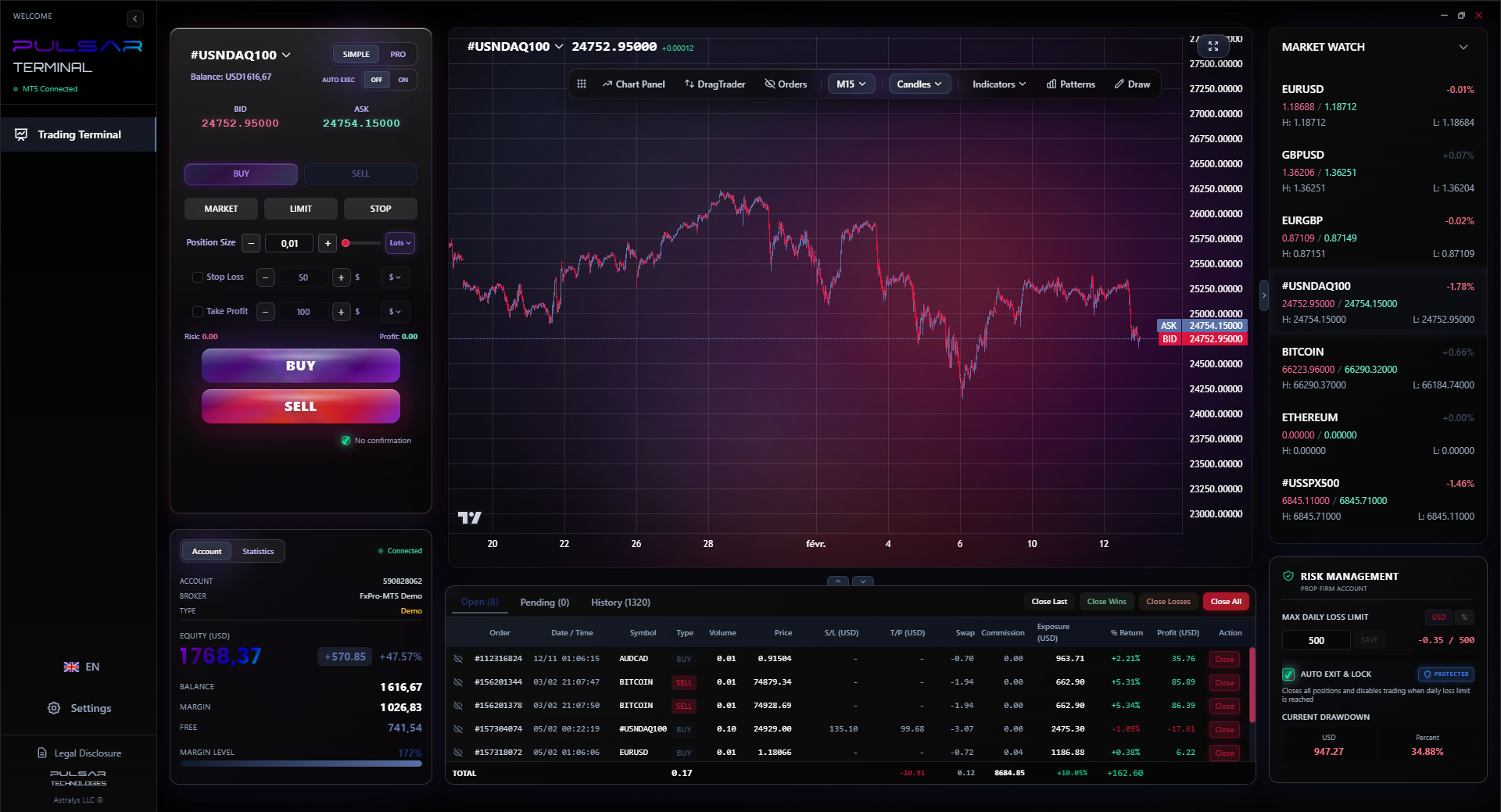
Managing multiple take-profit levels and moving stops to breakeven on a volatile tweezer top trade is much simpler when your platform automates it for you.
Pulsar Terminal
เครื่องมือ MT5 ครบวงจร: ลากวางคำสั่ง, multi-TP/SL, trailing stop, grid trading, Volume Profile และการป้องกัน prop firm ใช้งานโดยเทรดเดอร์กว่า 1,000 คนทุกวัน
“Not every pair of candles with similar highs is a valid pattern. You need to be picky.”
A lone tweezer top is good. A tweezer top supported by other tools is a high-probability setup. Don't use these to complicate things; use them to filter out the bad signals.
Trend Lines and Channels: Draw your trend lines. A tweezer top that forms right at the upper boundary of a rising trend channel? That's a premium signal. It's a double confirmation of resistance.
The MACD Indicator: I love using the MACD indicator here. Look for the MACD histogram to be losing momentum as price makes the tweezer highs. Even better, wait for the MACD line to cross below the signal line after the pattern completes. This adds a layer of momentum confirmation that has saved me from several fakeouts.
Support and Resistance Levels: This is the big one. Is the tweezer top forming at a level that has rejected price three times before on the daily chart? That's major. I keep a simple list of key weekly and daily levels on a notepad. A pattern at one of these levels gets my full attention and a larger (but still disciplined) position size.
For the Aggressive Traders: If you're into scalping strategy on the 5 or 15-minute charts, you can use smaller tweezer formations. The rules are the same, but everything is faster. Your stop loss is tighter, and your profit target is quicker. This requires a broker with razor-thin spreads, like Pepperstone on their Razor account, because every pip counts.
💡 เคล็ดลับจาก Winston
If you find yourself constantly adjusting your stop loss after entering, your initial analysis was flawed. Do the work upfront.
“A correct stop loss on a losing trade is a successful trade.”
Let's walk through a recent one from my own journal. This isn't a backtest; this is what happened.
The Setup (March 2026): XAU/USD (Gold) had been rallying for days on safe-haven demand. On the 4-hour chart, it approached the $2,180 level - a big round number and a previous area of congestion. The uptrend was clear.
The Pattern: A strong bullish candle closed at $2,179. The very next candle opened, shot up to $2,180.5, and then got slammed down to close at $2,176, forming a bearish engulfing candle. The highs? $2,180.5 and $2,180.3. A near-perfect tweezer top at a key level.
My Action: I waited. The candle closed. I drew a horizontal line at the low of that bearish candle: $2,175.8. I set a sell stop order at $2,175.5. My stop loss went at $2,182.5 (a generous buffer above $2,180.5). My risk was 70 pips (or $70 per mini lot).
The Trigger & Management: The next candle broke below $2,175.8, executing my order. I was in at $2,175.5. Price fell steadily. I used a 1:2 risk-reward initially, so my first take-profit was at $2,161.5. I moved my stop loss to breakeven when price had moved 30 pips in my favor. Price hit my first target. I then trailed a stop for the remainder of the position, which I eventually closed near $2,155 for an extra gain.
The Lesson: Patience for the close. Respect for the key level ($2,180). A sensible stop loss. And a plan to manage profits. This trade worked not because I'm a genius, but because the pattern gave me a clear framework and I followed it mechanically. The emotional urge to chase the initial rally or to panic when the bearish candle appeared was overridden by the rules of the setup.
FAQ
Q1Can a tweezer top be a bullish signal?
Almost never in the traditional sense. The 'tweezer top' is defined as a bearish reversal pattern. However, its opposite - the 'tweezer bottom' - is a bullish reversal pattern found at the end of a downtrend, with two candles sharing identical lows. Don't mix up the names; the 'top' and 'bottom' tell you the expected direction.
Q2What's the best timeframe to trade tweezer tops?
They work on all timeframes, but reliability generally increases with higher timeframes. A tweezer top on a 4-hour or daily chart carries more weight than one on a 1-minute chart because it represents a longer battle between buyers and sellers. I find the sweet spot for actionable signals is the 1-hour to 4-hour chart for swing trading.
Q3How many pips can I expect from a tweezer top trade?
There's no fixed number. The potential is determined by the market context. A good rule is to measure the height of the recent uptrend or look for the next major support level. I always aim for a minimum 1:2 risk-to-reward ratio. So if my stop loss is 20 pips away, my first target is at least 40 pips away. Sometimes you get 30 pips, sometimes 150. It depends on the pair's volatility.
Q4Is the pattern valid if the candles are not consecutive?
The classic, strongest pattern has two consecutive candles. However, you can sometimes see a variation where a small candle or two come between the two matching highs. This is weaker, as it shows the resistance was tested over time, not rejected immediately. I treat these with much more caution and require stronger confirmation from other indicators.
Q5Do I need to use Heikin-Ashi candles to see this pattern?
No, and I'd advise against it for spotting this specific pattern. Tweezer tops are based on the actual open, high, low, and close prices. Heikin-Ashi candles smooth the data, which can distort the precise highs and make the pattern harder to identify correctly. Stick with standard candlestick charts.
Q6As a Nigerian trader, should I pay tax on profits from these trades?
Yes. According to Nigerian tax law, profits from forex trading are generally considered capital gains. You are responsible for declaring this income and paying a 10% Capital Gains Tax to the Federal Inland Revenue Service (FIRS). Keep detailed records of your trades, including entries, exits, and profits/losses.
บทเรียนจาก Prof. Winston
สรุปสาระสำคัญ:
- ✓Trade tweezer tops only in clear uptrends.
- ✓Place your stop loss 5-10 pips above the pattern's high.
- ✓Aim for a minimum 1:2 risk-to-reward ratio.
- ✓Always wait for the candle to close for confirmation.
บทความนี้มีประโยชน์แค่ไหน?
คลิกดาวเพื่อให้คะแนน
ข้อมูลเชิงลึกการเทรดรายสัปดาห์
การวิเคราะห์และกลยุทธ์รายสัปดาห์ฟรี ไม่มีสแปม
เกี่ยวกับผู้เขียน
Olumide Adeyemi
ผู้บุกเบิกการเทรดในแอฟริกาตะวันตก
หนึ่งในนักการศึกษาฟอเร็กซ์ที่กระตือรือร้นที่สุดของไนจีเรีย 8 ปีประสบการณ์เทรดจากลากอส เชี่ยวชาญกลยุทธ์ทุนต่ำและความท้าทาย prop firm สำหรับเทรดเดอร์ในแอฟริกา
ความคิดเห็น
คำเตือนความเสี่ยง
การซื้อขายตราสารทางการเงินมีความเสี่ยงสูงและอาจไม่เหมาะสำหรับนักลงทุนทุกคน ผลการดำเนินงานในอดีตไม่ได้รับประกันผลลัพธ์ในอนาคต เนื้อหานี้มีวัตถุประสงค์เพื่อการศึกษาเท่านั้นและไม่ควรถือเป็นคำแนะนำในการลงทุน โปรดทำการวิจัยของคุณเองก่อนการซื้อขาย
คุณอาจชอบสิ่งนี้

Cara Trading Forex Sukses: 7 Prinsip dari Trader Profesional
Cara trading forex sukses dengan 7 prinsip trader pro: manajemen modal, disiplin, journal trading, backtest. Data nyata, bukan janji profit palsu.
Jam Trading Forex Terbaik untuk Trader Indonesia: Panduan Lengkap dengan Tabel Waktu
Panduan jam trading forex untuk trader Indonesia. Tabel 4 sesi dunia, jam emas 20:00-00:00, sesi mana yang harus dihindari. Data akurat + tips dari trader berpengalaman.
Top 5 Sàn Forex Uy Tín Nhất 2026: Review Jujur dari Trader Indonesia
Top 5 sàn forex uy tín 2026 untuk trader Indonesia. Review jujur: spread, deposit, withdraw, dukungan lokal. Exness, XM, IC Markets & lebih.
รับ Pulsar Terminal
เครื่องคำนวณทั้งหมดนี้ถูกสร้างไว้ใน Pulsar Terminal พร้อมข้อมูลเรียลไทม์จากบัญชี MT5 ของคุณ
รับ Pulsar Terminal