


Most new traders think pips are just a boring unit of measurement.

David van der Merwe
เทรดเดอร์ตลาดเกิดใหม่ ·  South Africa
☕ 10 นาทีอ่าน
สิ่งที่คุณจะได้เรียนรู้:
- 1Pips Defined: It's Not Just a Number
- 2Calculating Pip Value in South African Rands
- 3The Real Cost: Spreads, Commissions & ZAR Accounts
- 4Pips Are Your Risk Management Toolkit
- 5Trading Exotics: The USD/ZAR Reality Check
- 6Common Pip Mistakes (And How to Avoid Them)
- 7Putting It All Together: A South African Trading Plan
Most new traders think pips are just a boring unit of measurement. They're wrong. Understanding pips is the single most important skill for keeping your money safe and knowing exactly what you're risking on every trade. If you don't get pips, you're just gambling with numbers you don't understand. I'll show you, with real ZAR examples, how to master this fundamental concept and stop losing money to simple math errors.
Alright, let's cut through the jargon. A pip is simply the smallest price move a currency pair can make. It's how we measure profit and loss. For most pairs, like the EUR/USD, that's the fourth decimal place. If EUR/USD moves from 1.1050 to 1.1051, it's gone up by one pip.
Now, here's the first curveball for us trading the Rand. Pairs with the Japanese Yen (JPY) are different. They use the second decimal place. So if USD/JPY moves from 154.01 to 154.02, that's also one pip. You'll see this with USD/ZAR too, where the pip is typically the fourth decimal place (e.g., a move from 18.2500 to 18.2501).
Some brokers show an extra digit, called a pipette. That's just a tenth of a pip. It gives you more precision, but for all your core calculations - your risk, your reward - you're working in full pips. I made the mistake early on of confusing pipettes for pips on my platform and completely miscalculated my position size. That was a R500 lesson in paying attention.

Pro Tip: Always check your broker's specification sheet. Know if they quote USD/ZAR to four decimals (e.g., 18.2534) or five (18.25345). That fifth digit is the pipette.
This is where the magic (and the math) happens. Knowing a pip moved is useless unless you know what that move means for your wallet in Rands. The value depends on three things: the currency pair, your trade size (lot size), and the current exchange rate.
The Standard Formula
For a standard lot (100,000 units), the pip value formula is straightforward. Let's use EUR/USD trading at 1.1050 as an example: Pip Value = (0.0001 / 1.1050) x 100,000 = $9.05
But you're a South African trader. You need that in Rands. If USD/ZAR is at 18.50, then that $9.05 is worth about R167.43. That's the profit or loss per pip for one standard lot on EUR/USD.
Making it Practical with Mini and Micro Lots
You're probably not starting with R185,000 to buy a full standard lot (100,000 units of currency). That's where mini lots (10,000 units) and micro lots (1,000 units) come in. They're your best friends.
- Mini Lot (10k units): Pip value is roughly 1/10th of a standard lot. Using our example above, that's about R16.74 per pip.
- Micro Lot (1k units): Pip value is roughly 1/100th. That's about R1.67 per pip.
I started with micro lots. My first meaningful trade was on GBP/USD. I bought at 1.2750 with a micro lot, risking 20 pips (R33.40). It went my way for 50 pips, netting me R83.50. It wasn't life-changing money, but it proved the system worked. The position size calculator on our site will do this math for you instantly - use it until the calculation is second nature.

💡 เคล็ดลับจาก Winston
A pip is a unit of risk before it's a unit of reward. Always calculate what one pip costs you in ZAR before you enter the trade. If that number makes you uncomfortable, your position is too big.
“If you don't understand pips, you're just gambling with numbers you don't understand.”
Pips aren't just for measuring profit. They measure your first loss on every single trade: the spread. The spread is the difference between the buy (ask) and sell (bid) price, quoted in pips. You start every trade in a slight hole equal to the spread.
Here’s what spreads look like in the real South African market:
| Currency Pair | Typical Spread (in pips) | Notes for SA Traders |
|---|---|---|
| EUR/USD | 0.8 - 1.5 | The "majors" have the tightest spreads. Brokers like XM and AvaTrade often sit at the lower end. |
| USD/ZAR | 40 - 100+ | This is an exotic pair. Spreads are much wider due to lower liquidity. A 50-pip spread here is normal. |
| GBP/ZAR | 80 - 150+ | Even wider. You need a much bigger move just to break even. |

Warning: That USD/ZAR spread is a trap for new traders. You see the Rand moving and think you can catch it. But if the spread is 50 pips, the price needs to move 50 pips in your favor before you even start making money. I learned this the hard way, losing on a trade that was technically "right" on direction but got eaten alive by the cost of entry.
Commissions vs. Spread-Only
Some brokers, like IC Markets or Pepperstone, offer "raw spread" accounts. You might see a 0.0 pip spread on EUR/USD, but you pay a commission per lot (e.g., $7 per 100k). Other accounts have no commission but a wider spread (e.g., 1.3 pips). Which is cheaper? For smaller trade sizes, the spread-only account is often better. For larger volumes, the commission-based account can be cheaper. You have to do the math.
The ZAR Account Advantage
Many FSCA-regulated brokers now offer ZAR-denominated accounts. This is a game-saver. It means your deposits, withdrawals, and profit/loss are all shown in Rands. You avoid hidden currency conversion fees from your bank every time you fund your account. If you're trading from SA, this should be a top priority when choosing a broker.
This is the core of professional trading. Pips translate directly into risk. Here’s my non-negotiable rule: I never risk more than 1-2% of my account on a single trade. Pips make this rule executable.
Let's say you have a R10,000 trading account. You're willing to risk 1%, which is R100. You're looking at a USD/CAD trade. Your analysis says if price drops below 1.3600, it could fall to 1.3550. You decide to place a sell stop order at 1.3595, with a stop-loss at 1.3625. That's a 30-pip risk.
Now, the critical question: What lot size lets you risk only R100 on a 30-pip move? You need to work backwards. You know your risk (R100) and your risk in pips (30). You need to find the pip value that makes the math work: R100 / 30 pips = R3.33 per pip.
You then use a calculator or work the formula to find that a pip value of R3.33 on USD/CAD (at a specific rate) corresponds to roughly a 3,500 unit position (a micro-lot is 1,000 units). That's your position size. Not a standard lot, not a mini lot, but a precise 3,500 units. This discipline is what separates survivors from casualties.
I ignored this in 2018. I had a R20,000 account, got overconfident, and put on a trade that risked over 100 pips with a mini lot. That was a R1,600 risk (8% of my account!) on one idea. I was stopped out. The loss was devastating to my capital and my confidence. It took months to rebuild. Never let a trade have that much power over your account.
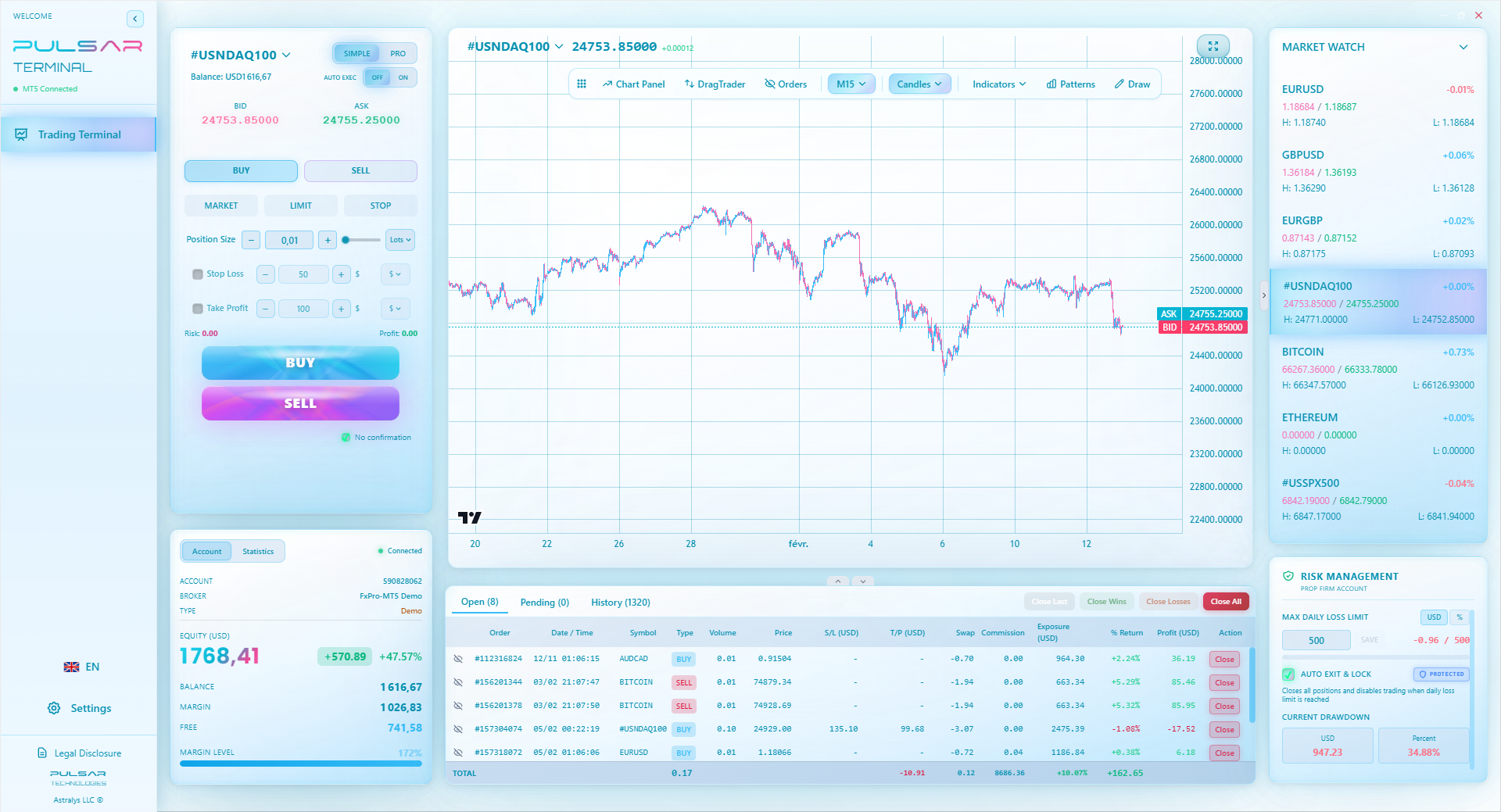
Managing risk with precise stop-losses and take-profits is fundamental, and Pulsar Terminal lets you set and adjust these levels with drag-and-drop ease directly on your MT5 charts.
Pulsar Terminal
เครื่องมือ MT5 ครบวงจร: ลากวางคำสั่ง, multi-TP/SL, trailing stop, grid trading, Volume Profile และการป้องกัน prop firm ใช้งานโดยเทรดเดอร์กว่า 1,000 คนทุกวัน
“That USD/ZAR spread is a trap for new traders. You need a much bigger move just to break even.”
We're South African. We watch the Rand every day. It's tempting to trade USD/ZAR because you feel you understand the news. But you have to respect it as an exotic pair. The rules are different.
- Wider Spreads: As we saw, a 50-pip spread means your trade needs to overcome a huge hurdle. This makes scalping strategies nearly impossible and very expensive. It's better suited for swing trading where you're aiming for moves of 200-500 pips.
- Higher Volatility: The Rand can gap significantly on local political news or SARB announcements. Your stop-loss might not get filled at the price you set if the market gaps over it. This is called slippage, and it can turn a small risk into a big loss.
- Swap Rates Matter: Holding USD/ZAR overnight incurs a swap fee or credit. Because of South Africa's interest rate differential with the US, you'll often pay to hold a long USD/ZAR position overnight. This can eat into profits on longer-term holds. You must check the swap rates on your platform before holding for days or weeks.
My most successful USD/ZAR trade was a swing short in late 2025. I sold at 18.85 with a stop at 19.10 (250 pips risk) and a target at 18.20 (650 pips reward). The wide spread was part of my calculation. I held for two weeks, paid some overnight fees, and caught a move down to 18.25. The key was giving it room to breathe and targeting a move big enough to justify the costs.
💡 เคล็ดลับจาก Winston
The wider the spread, the more the market is telling you to stay away. Treat a 50-pip spread on USD/ZAR as a warning sign, not an opportunity.
I've made most of these. Learn from my Rands.
- Mistake 1: Ignoring the Spread in Your Profit Target. You think, "I'll make 50 pips." But if the spread is 3 pips, you only net 47. Always add the spread to your required move when planning.
- Mistake 2: Not Calculating Pip Value for Each Pair. The pip value for EUR/USD is different from GBP/USD, which is different from USD/CHF. Assuming they're all the same will wreck your risk management. Always calculate or use a trusted calculator.
- Mistake 3: Trading Too Large for Your Account. This is the killer. You see a "sure thing" and throw on a position where each pip is worth R50. A 10-pip move against you costs R500. That kind of volatility will make you panic and close good trades early. Stick to a pip value that lets you sleep.
- Mistake 4: Forgetting About the Margin Call. If your losses mount, your broker will issue a margin call and close your positions. How do losses mount? Pip by pip. If you don't understand how many pips of adverse movement your account can withstand before a margin call, you're flying blind. Your trading platform should show you this "margin level" percentage. Watch it like a hawk.

Example: Account: R5,000. Trade: 1 mini lot (10k) on EUR/USD. Pip Value: ~R16.50. A 30-pip loss = R495 (9.9% of your account). A 100-pip loss = R1,650 (33%!). This is how accounts blow up. Use micro lots.
“I never risk more than 1-2% of my account on a single trade. Pips make this rule executable.”
Let's build a simple, pip-based plan for a R10,000 account.
- Max Risk Per Trade: 1% = R100.
- Choose Your Instrument: Let's pick a major pair with low spreads, like EUR/USD. Average spread: 1 pip.
- Find a Trade Setup: You identify support at 1.0750. You'll buy if price bounces, with a stop-loss 25 pips below at 1.0725. Your target is 75 pips above entry at 1.0825.
- Calculate Position Size: Risk = R100. Risk in pips = 25 (stop-loss distance). Required pip value = R100 / 25 = R4 per pip. For EUR/USD, a pip value of R4 corresponds to a position size of roughly 2,500 units (a quarter of a mini-lot). This is your exact trade size.
- Calculate Reality Check:
- Cost of Entry (Spread): 1 pip x R4 = R4. This is lost immediately.
- Potential Loss (Stop-Loss): 25 pips x R4 = R100.
- Potential Gain (Take-Profit): 75 pips x R4 = R300.
- Reward-to-Risk Ratio: R300 / R100 = 3:1. This is a good ratio.
This plan turns the abstract concept of pips into a concrete, executable strategy. It tells you exactly what to do, how much to risk, and what to expect. This is how you trade with clarity, not hope.
Finally, use your tools. Learn to use the RSI indicator or MACD indicator to help confirm your entry and exit points in terms of price (and therefore pips). But never let the indicator override your pre-calculated pip-based risk.
FAQ
Q1How much is a pip worth in South African Rands?
It's not a fixed amount. A pip's value in ZAR depends on the currency pair, your trade size, and the USD/ZAR exchange rate. For example, one pip on a standard lot (100,000 units) of EUR/USD might be worth about R185 if USD/ZAR is at 18.50. For a micro lot (1,000 units), it would be about R1.85. You must calculate it for each trade.
Q2Why is the spread on USD/ZAR so much wider than on EUR/USD?
USD/ZAR is an exotic currency pair. It has lower trading volume (liquidity) and higher volatility compared to major pairs like EUR/USD. To compensate for this higher risk and cost of facilitating the trade, brokers and the market itself charge a wider spread. It's the cost of trading a less common pair.
Q3What's the difference between a pip and a pipette?
A pip is the standard unit of movement (usually the 4th decimal for most pairs, 2nd for JPY pairs). A pipette is one-tenth of a pip. It's the 5th decimal place for most pairs. Brokers use pipettes to offer more precise pricing, but for calculating your profit, loss, and risk, you should primarily think in terms of full pips to keep things simple and consistent.
Q4As a beginner in South Africa, what lot size should I use?
Start with micro lots (1,000 units). This makes the pip value very small (often R1-R3), allowing you to practice real trading with minimal risk. It lets you focus on your strategy and psychology without the stress of large, account-blowing losses. You can find brokers like XM or Exness that easily accommodate micro-lot trading.
Q5How do pips relate to a margin call?
A margin call happens when your losses eat up your available margin. Losses are measured in pips. If you have a position that's too large, even a small adverse move of a few pips can cause a significant loss in Rands, quickly depleting your margin. Understanding your pip value tells you how many pips of movement your account can absorb before you're in danger of a margin call.
Q6Should I use a ZAR-denominated trading account?
Absolutely, yes. For South African traders, a ZAR account simplifies everything. Your deposits, withdrawals, and most importantly, your profit and loss are all displayed in Rands. This eliminates hidden currency conversion fees from your bank and gives you perfect clarity on exactly how much money you're making or losing in your local currency.
บทเรียนจาก Prof. Winston
สรุปสาระสำคัญ:
- ✓A pip's value in ZAR is not fixed; calculate it for every trade.
- ✓Never let a single trade risk more than 2% of your capital.
- ✓Exotic pairs like USD/ZAR have wide spreads; factor them in.
- ✓Start trading with micro lots to manage risk and learn.
บทความนี้มีประโยชน์แค่ไหน?
คลิกดาวเพื่อให้คะแนน
ข้อมูลเชิงลึกการเทรดรายสัปดาห์
การวิเคราะห์และกลยุทธ์รายสัปดาห์ฟรี ไม่มีสแปม
เกี่ยวกับผู้เขียน
David van der Merwe
เทรดเดอร์ตลาดเกิดใหม่
เทรดเดอร์ประจำโจฮันเนสเบิร์ก มีประสบการณ์ 11 ปีในสกุลเงินตลาดเกิดใหม่ เชี่ยวชาญคู่ ZAR การเทรดภายใต้กฎระเบียบ FSCA และการวิเคราะห์ตลาดแอฟริกาใต้
ความคิดเห็น
คำเตือนความเสี่ยง
การซื้อขายตราสารทางการเงินมีความเสี่ยงสูงและอาจไม่เหมาะสำหรับนักลงทุนทุกคน ผลการดำเนินงานในอดีตไม่ได้รับประกันผลลัพธ์ในอนาคต เนื้อหานี้มีวัตถุประสงค์เพื่อการศึกษาเท่านั้นและไม่ควรถือเป็นคำแนะนำในการลงทุน โปรดทำการวิจัยของคุณเองก่อนการซื้อขาย
คุณอาจชอบสิ่งนี้

Cara Trading Forex Sukses: 7 Prinsip dari Trader Profesional
Cara trading forex sukses dengan 7 prinsip trader pro: manajemen modal, disiplin, journal trading, backtest. Data nyata, bukan janji profit palsu.
Jam Trading Forex Terbaik untuk Trader Indonesia: Panduan Lengkap dengan Tabel Waktu
Panduan jam trading forex untuk trader Indonesia. Tabel 4 sesi dunia, jam emas 20:00-00:00, sesi mana yang harus dihindari. Data akurat + tips dari trader berpengalaman.
Top 5 Sàn Forex Uy Tín Nhất 2026: Review Jujur dari Trader Indonesia
Top 5 sàn forex uy tín 2026 untuk trader Indonesia. Review jujur: spread, deposit, withdraw, dukungan lokal. Exness, XM, IC Markets & lebih.
รับ Pulsar Terminal
เครื่องคำนวณทั้งหมดนี้ถูกสร้างไว้ใน Pulsar Terminal พร้อมข้อมูลเรียลไทม์จากบัญชี MT5 ของคุณ
รับ Pulsar Terminal