


I remember staring at the GBP/USD chart on my MT4 platform in late 2023, convinced I'd spotted the perfect downtrend.

Olumide Adeyemi
ผู้บุกเบิกการเทรดในแอฟริกาตะวันตก ·  Nigeria
☕ 10 นาทีอ่าน
สิ่งที่คุณจะได้เรียนรู้:
- 1The Simple Truth: What a Trendline Actually Is
- 2How to Draw a Valid Trendline (The Right Way)
- 3Trading the Lines: Uptrend Support vs. Downtrend Resistance
- 4Mistakes I See Every Day (And Made Myself)
- 5Making It Stronger: What to Use With Your Trendline
- 6Your Action Plan: From Theory to Naira Profit
- 7The Next Level: False Breakouts and Channel Trading
I remember staring at the GBP/USD chart on my MT4 platform in late 2023, convinced I'd spotted the perfect downtrend. I'd drawn a line connecting two lower highs and watched as price approached it for a third touch. My finger hovered over the sell button. The bounce was textbook... for about two hours. Then the price sliced straight through my line like it wasn't even there, rallying 150 pips and turning my confident short into a margin call warning. That painful loss, which cost me over ₦120,000, taught me more about what a trendline in forex truly is than any textbook ever could. It's not just a line, it's a story of market psychology, and drawing it wrong is an expensive lesson.
Forget the complex definitions. In practice, a trendline is a visual representation of a market's current bias. It's a straight line you draw on a chart that connects significant price points - either lows in an uptrend or highs in a downtrend. Its core job is to show you where buyers or sellers have consistently stepped in before.
Think of it like this: in an uptrend, buyers are aggressive. Each time the price dips, they see it as a discount and jump in, creating a series of higher lows. Your uptrend line connects these lows, forming a support level. The price tends to respect this line because that's where the collective memory of the market says "good value" is. A downtrend line is the opposite, connecting lower highs and acting as a dynamic resistance level where sellers consistently overwhelm buyers.

Warning: The biggest rookie mistake is forcing the line. If you're bending or angling it to make it touch more points, it's invalid. The market doesn't care about your pretty line. A real trendline should be obvious, not a work of art.
The power of this tool for us in Nigeria is context. With the Naira's volatility, trading without understanding the underlying trend is like driving in Lagos without checking your fuel gauge. A solid trendline on a higher timeframe, like the 4-hour or daily chart, gives you a fighting chance to align with the bigger flow, which is crucial when you're trying to earn in Dollars.

💡 เคล็ดลับจาก Winston
A trendline is a level of agreement. The more times price touches it without breaking, the more traders believe in it. When it finally breaks, the panic (or euphoria) is what creates the big moves.
“A trendline isn't just a line, it's a story of market psychology, and drawing it wrong is an expensive lesson.”
The Two-Point Minimum, Three-Point Confirmation Rule
You need at least two clear swing points to draw a line. But two points only give you a potential trendline. The magic, and the confirmation, happens on the third touch. When price approaches that line for a third time and reacts (bounces off support or rejects from resistance), you've got something traders are actually watching. I look for clean, obvious swings, not tiny wicks on a 1-minute chart.
Choosing Your Points: Close vs. Wick
This one caused me endless frustration early on. Do you connect the closing prices or the extreme wicks? For major support/resistance, I use the closes of the candles forming the swing point. It shows where the price actually settled, which reflects committed buying or selling pressure. However, for very dynamic, steep trends, sometimes connecting the extreme wicks can show you where panic buying or selling occurred. Be consistent. If you start a line using closes, stick with it.
Timeframe Matters
A trendline on a 5-minute chart might be valid for a few hours. A trendline on a daily chart can govern price action for months. For swing trading, which fits well with managing a job or business here, I start with the daily chart. I draw my primary trendlines there, then drop to the 4-hour or 1-hour to fine-tune entries. This top-down approach stopped me from trying to short a minor pullback in a massive daily uptrend - a classic mistake.

Example: Let's say you're trading USD/NGN (though often traded via CFDs with brokers like Exness or XM). On the daily chart, you spot two clear higher lows at ₦1,200 and ₦1,250. You draw a line connecting them. When price dips to ₦1,300 and bounces sharply, that's your third-touch confirmation. That line now represents a key support zone for the Naira's depreciation trend.
“The biggest rookie mistake is forcing the line. If you're bending or angling it to make it touch more points, it's invalid.”
Trading an Uptrend Line (Support): When price approaches your confirmed uptrend line, you look for buying opportunities. Don't just buy at the line. Wait for a bullish reversal candle pattern - a pin bar, a bullish engulfing, a double bottom - to form on or just above the line. That's your signal that buyers are defending it again. My entry is usually a few pips above that confirming candle's high. My stop loss goes just below the trendline. The risk? The trendline breaks. Your reward target is typically the previous swing high.
I learned this the hard way trading XAU/USD (Gold). I bought a bounce off a daily uptrend line at $1,820, but placed my stop too tight, just 5 pips below. A quick spike down took me out before price rallied $50. I should have given it room, placing the stop below a nearby consolidation zone. Tools like a position size calculator are non-negotiable here to keep your risk sane.
Trading a Downtrend Line (Resistance): This is the mirror image. Price rallies to your downtrend line, you watch for bearish rejection. A shooting star, a bearish engulfing, or a double top right at the line is your sell signal. Entry a few pips below the confirming candle's low, stop loss just above the trendline. Your profit target is the previous swing low.
The Breakout Trade: A clean break and close beyond a strong, multi-touch trendline is a major event. It often signals a trend reversal or a powerful acceleration. Don't jump in immediately. Wait for a retest. If price breaks below an uptrend line, then rallies back to touch it from underneath (now acting as resistance) and gets rejected, that's a high-probability short signal. This "break and retest" pattern saved my account during the EUR/USD plunge last year, giving me a clear entry after the initial chaos.
“The biggest rookie mistake is forcing the line. If you're bending or angling it to make it touch more points, it's invalid.”
- Drawing on Too Low a Timeframe: The 1-minute and 5-minute charts are noisy, especially with the high volatility pairs many Nigerians love. Trendlines drawn here are fragile and lead to overtrading. Start with H4 or Daily.
- Ignoring the Context of a Range: Not every market is trending. When price is chopping sideways, drawing diagonal trendlines is useless. You need horizontal support and resistance lines. Forcing a trendline in a range market will have you buying at resistance and selling at support.
- Not Adjusting the Line: A trendline isn't set in stone. Sometimes, after a strong move, price will accelerate and break your original line, only to establish a new, steeper trendline along newer swing points. It's okay to redraw. The goal is to track the current market structure, not be loyal to your first drawing.
- Forgetting Nigerian Reality – Spreads and Execution: You see a perfect bounce on your chart. You enter a market order. But with a wide spread on an exotic pair or during low liquidity, your fill price might be 3-5 pips past the trendline, ruining your risk/reward. Always use limit orders to enter at your exact price, especially with brokers where spreads can widen.
- Tax Amnesia: That perfect trendline trade nets you $500. Fantastic. Remember, Nigeria's 10% Capital Gains Tax applies to your gross profits. Factor that into your net profit calculation from the start. It's a real cost of doing business here.
💡 เคล็ดลับจาก Winston
Never risk more than 1% of your account on the integrity of a single line on a screen. The market has no memory, and your trendline is just a story we all agree to tell ourselves until we don't.
“One broken trendline shouldn't blow more than 1-2% of your account. I've had 6 losing trades in a row before. Proper risk management meant I was dented, not destroyed.”
A trendline alone is good. A trendline with confluence is powerful. Here’s what I pair it with:
- Horizontal Support/Resistance: When a diagonal trendline intersects with a major horizontal price level, that zone becomes a super-charged area of interest. The market often respects these confluence zones more than anything.
- The 200-period Moving Average: On daily charts, I watch where my trendline is relative to the 200 MA. A price bounce off an uptrend line that's also above a rising 200 MA is a much stronger signal than a bounce in a bear market.
- Basic Momentum Indicators: I don't overload the chart. But a simple RSI indicator can help. If price hits an uptrend line and the RSI is also dipping into oversold territory (below 30), it adds fuel to the bullish reversal case. Similarly, a MACD indicator showing bullish divergence at a trendline is a strong hint.
- Volume: On a breakout, I want to see volume spike. A breakout from a trendline on low volume is suspicious and more likely to fail (a false breakout).
My most reliable setup is this: a bounce off a major daily uptrend line that coincides with a previous horizontal support level, while the RSI is oversold. I enter on the first strong bullish daily close after that. It's not flashy, but it's kept me in the game.
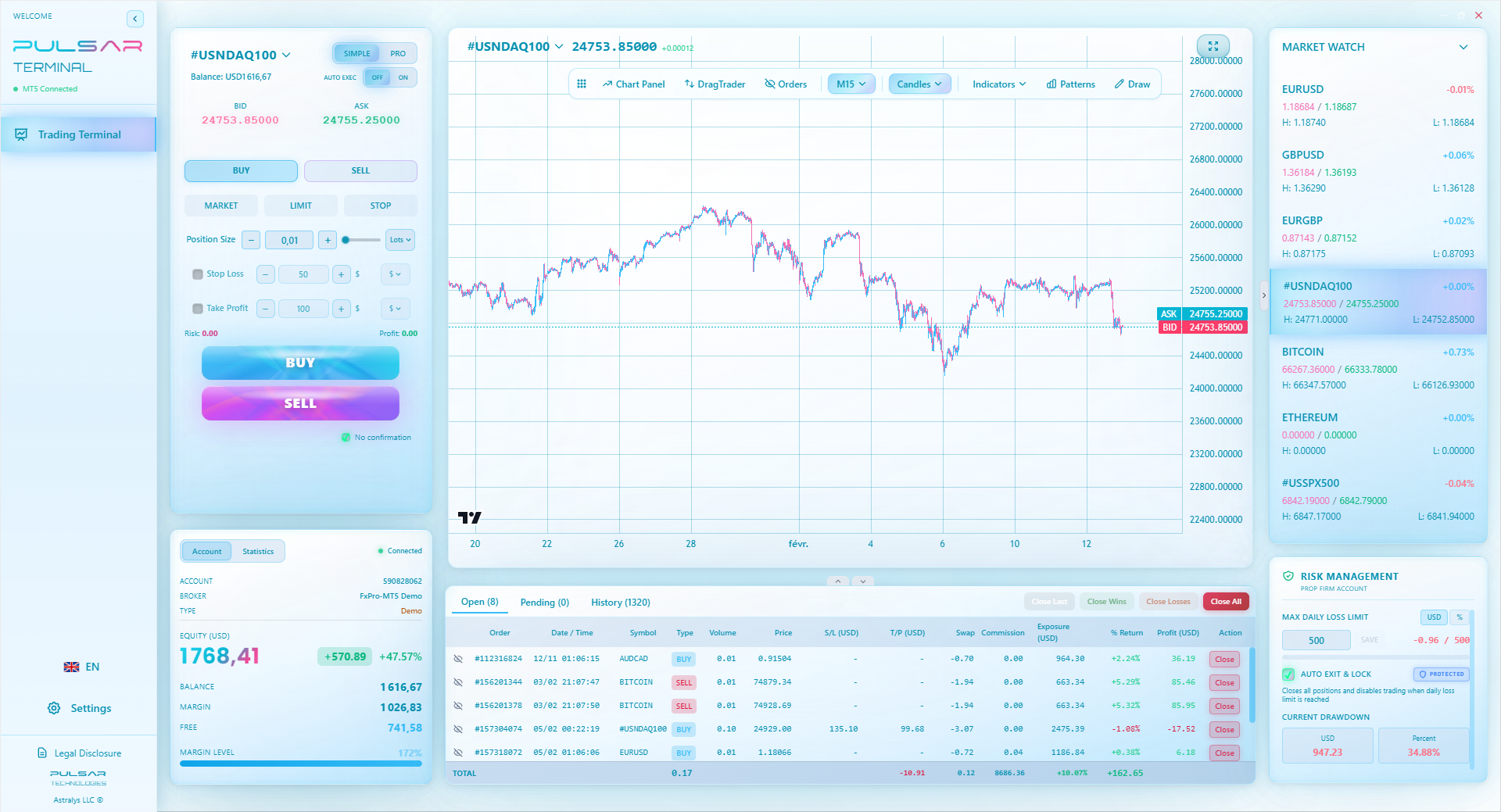
Drawing and adjusting multiple trendlines and channels across charts is faster when you have the right tools directly in your trading platform.
Pulsar Terminal
เครื่องมือ MT5 ครบวงจร: ลากวางคำสั่ง, multi-TP/SL, trailing stop, grid trading, Volume Profile และการป้องกัน prop firm ใช้งานโดยเทรดเดอร์กว่า 1,000 คนทุกวัน
“One broken trendline shouldn't blow more than 1-2% of your account. I've had 6 losing trades in a row before. Proper risk management meant I was dented, not destroyed.”
- Pick Your Broker & Platform: You need clean charts. Most of us use MT4/MT5. Brokers like IC Markets and Pepperstone offer raw spreads which are great for precise drawing. Ensure they support NGN deposits if that's easier for you.
- Start on Demo, But Not Forever: Draw trendlines on every major pair on the Daily chart for the past year. Mark the bounces and breaks. Do this for two weeks. Then switch to a live cent account with a small deposit (maybe $10). The psychological shift is real.
- Define Your Trade: See a setup? Write it down. "EUR/USD Daily. Testing 3rd touch uptrend line. Horizontal support at 1.0750. If bullish engulfing forms, enter long. SL below swing low at 1.0730. TP at previous high 1.0850." This discipline prevents emotional decisions.
- Manage Your Risk Religiously: That stop loss below the trendline is sacred. One broken trendline shouldn't blow more than 1-2% of your account. Use a calculator. I've had 6 losing trades in a row before. Proper risk management meant I was dented, not destroyed.
- Keep a Trading Journal: Note every trendline trade. The setup, the outcome, the screenshot. Review it weekly. You'll quickly see if you're better at trading bounces or breakouts, and which currency pairs respect your lines the most.

Pro Tip: For Nigerians, trading major pairs like EUR/USD or GBP/USD often offers better liquidity and tighter spreads than trying to trade Naira pairs directly through volatile and sometimes opaque channels. Focus on the global trend, earn in USD, and convert to Naira as needed.
“Mastering the false breakout alone will improve your win rate significantly.”
The False Break (My Favorite Trap): This is where the market fakes you out. Price will violently break through a strong trendline, get everyone to commit (you panic and close your trade or reverse), and then snap back to the original side of the line. It's a stop-hunting move. How do you spot it? Look for the break to happen on low volume or as a thin wick, not a solid candle body closing beyond the line. Often, the price will reclaim the line within 1-3 candles. If you're in a trade and this happens, don't panic exit. Wait for the candle to close. If you're looking to enter, wait for the reclaim.
Trend Channels: If you can draw one trendline, you can draw two. A channel is formed by drawing a parallel line to your main trendline that connects the opposite swing points. In an uptrend, you have a lower support trendline and an upper channel resistance line. This gives you a clear range within the trend. You can buy at the support line and take partial profits at the channel resistance. It's a fantastic way to capture more of a trend's movement. Trading within a channel requires even more discipline to take profits at the opposite side, as the temptation to let it run is huge.
These concepts separate the consistent traders from the gamblers. They require patience, but mastering the false breakout alone will improve your win rate significantly.
💡 เคล็ดลับจาก Winston
The most important trendline you'll ever draw is the one on your equity curve. If it's not sloping upwards over 6 months, your method is broken, no matter how pretty your chart lines are.
FAQ
Q1How many points do I need to draw a valid trendline in forex?
You need a minimum of two points to draw the line, but it's only considered valid and strong when price respects it a third time. Two points show a possibility, three points show a pattern the market is acknowledging.
Q2Should I connect the wicks or the bodies of the candles when drawing?
For most reliable support/resistance, connect the closing prices (the bodies) of the candles at the swing points. This reflects where the price actually settled. Connecting extreme wicks can be useful for very steep trends, but be consistent in your method.
Q3What is the best timeframe to draw trendlines for swing trading in Nigeria?
Start with the Daily chart to identify the primary trend. Then use the 4-hour (H4) chart to draw your main trading trendlines and the 1-hour chart for precise entry timing. This avoids the noise of lower timeframes.
Q4What should I do when a trendline breaks?
Don't act immediately. First, confirm the break by waiting for the candle to close decisively beyond the line. Then, watch for a "retest" where price returns to touch the broken trendline from the other side (now acting as resistance if it was support, or vice versa). A rejection from this retest is a high-probability entry signal for the new direction.
Q5Are there brokers in Nigeria that are good for practicing trendline trading?
Yes. Look for brokers that offer low minimum deposits on cent accounts (like XM or FBS) so you can practice with real money under low risk. For serious trading, brokers with tight spreads and reliable MT4/MT5 platforms, such as IC Markets or Pepperstone, are excellent choices for Nigerian traders.
Q6How does Nigeria's 10% capital gains tax affect my trendline trading profits?
You are required to pay 10% tax on your gross trading profits from forex. This is a direct cost. When calculating your potential profit from a trendline setup, you must factor this in. A ₦100,000 profit becomes ₦90,000 after tax. Always keep clear records for tax purposes.
Q7Can I use trendlines for scalping?
You can, but it's tricky. Trendlines on very low timeframes (like 1 or 5-minute) are less reliable and break easily. If you're scalping, use trendlines drawn on a higher timeframe (like 15-min or 1-hour) as a bias filter, then use price action on the lower timeframe for your actual entry.
บทเรียนจาก Prof. Winston
สรุปสาระสำคัญ:
- ✓Two points draw it, three points confirm it.
- ✓Trade the close, not the wick, for reliability.
- ✓Daily chart first, trade H4 confluence.
- ✓A break needs a close, then a retest.
- ✓Always factor in the 10% Nigerian tax.
บทความนี้มีประโยชน์แค่ไหน?
คลิกดาวเพื่อให้คะแนน
ข้อมูลเชิงลึกการเทรดรายสัปดาห์
การวิเคราะห์และกลยุทธ์รายสัปดาห์ฟรี ไม่มีสแปม
เกี่ยวกับผู้เขียน
Olumide Adeyemi
ผู้บุกเบิกการเทรดในแอฟริกาตะวันตก
หนึ่งในนักการศึกษาฟอเร็กซ์ที่กระตือรือร้นที่สุดของไนจีเรีย 8 ปีประสบการณ์เทรดจากลากอส เชี่ยวชาญกลยุทธ์ทุนต่ำและความท้าทาย prop firm สำหรับเทรดเดอร์ในแอฟริกา
ความคิดเห็น
คำเตือนความเสี่ยง
การซื้อขายตราสารทางการเงินมีความเสี่ยงสูงและอาจไม่เหมาะสำหรับนักลงทุนทุกคน ผลการดำเนินงานในอดีตไม่ได้รับประกันผลลัพธ์ในอนาคต เนื้อหานี้มีวัตถุประสงค์เพื่อการศึกษาเท่านั้นและไม่ควรถือเป็นคำแนะนำในการลงทุน โปรดทำการวิจัยของคุณเองก่อนการซื้อขาย
คุณอาจชอบสิ่งนี้

Cara Trading Forex Sukses: 7 Prinsip dari Trader Profesional
Cara trading forex sukses dengan 7 prinsip trader pro: manajemen modal, disiplin, journal trading, backtest. Data nyata, bukan janji profit palsu.
Jam Trading Forex Terbaik untuk Trader Indonesia: Panduan Lengkap dengan Tabel Waktu
Panduan jam trading forex untuk trader Indonesia. Tabel 4 sesi dunia, jam emas 20:00-00:00, sesi mana yang harus dihindari. Data akurat + tips dari trader berpengalaman.
Top 5 Sàn Forex Uy Tín Nhất 2026: Review Jujur dari Trader Indonesia
Top 5 sàn forex uy tín 2026 untuk trader Indonesia. Review jujur: spread, deposit, withdraw, dukungan lokal. Exness, XM, IC Markets & lebih.
รับ Pulsar Terminal
เครื่องคำนวณทั้งหมดนี้ถูกสร้างไว้ใน Pulsar Terminal พร้อมข้อมูลเรียลไทม์จากบัญชี MT5 ของคุณ
รับ Pulsar Terminal