


Let's cut through the hype.

David van der Merwe
เทรดเดอร์ตลาดเกิดใหม่ ·  South Africa
☕ 12 นาทีอ่าน
สิ่งที่คุณจะได้เรียนรู้:
- 1How It Actually Works: The Plumbing
- 2The FSCA Rules Everyone Pretends Don't Exist
- 3The Real Costs: Where Your Profit Disappears
- 4How to (Try to) Pick a Trader to Copy
- 5The Unspoken Risks & Drawbacks
- 6South African Brokers & Platforms
- 7A Better Alternative: Use It as a Learning Tool
- 8Final Verdict for South African Traders
Let's cut through the hype. What is copy trading in forex? It's a system that lets you automatically mirror the trades of someone else, and in South Africa, it's sold as a shortcut to easy money. Here's the truth most platforms won't tell you: it's the fastest way for a beginner to lose their capital with zero understanding of why. I've seen more accounts blown up by blindly following a 'guru' than by any bad trade I ever made myself. This guide isn't about selling you a dream. It's about showing you the mechanics, the brutal FSCA regulations everyone ignores, and the real numbers so you don't become another statistic.
You connect your trading account to a 'master' or 'strategy provider' account through a platform. When they open a trade, your account opens an identical one, scaled to your balance. If they buy 2 lots of EUR/USD, your R10,000 account might buy 0.1 lots. If they close, you close. You're a passenger.
There are two main setups. The first is the social trading network, like eToro's CopyTrader. You browse profiles, see a trader's past performance, risk score, and portfolio, then click 'Copy.' The second is signal-based, common on MetaTrader. You subscribe to a signal provider through services like Myfxbook AutoTrade or Signal Start, and the trades are executed on your MT4 or MT5 platform.
The critical thing most users miss is the latency. Your trade isn't executed at the master's exact price. There's a delay - sometimes a few seconds, sometimes longer - especially during volatile news events. I once copied a gold trade during an NFP announcement. The master got in at $1815. By the time my copy executed, price was at $1821. That 6-dollar difference per ounce turned a potential winner into an immediate loser. The platform shows you the master's glorious profit, but your reality is different.

Warning: Your entry and exit prices will NEVER be identical to the master trader's. Slippage and latency eat into your copy's performance, often turning their winning strategy into your losing one.

💡 เคล็ดลับจาก Winston
A master trader's 60% annual return looks great until you realize their worst drawdown was 55%. You will panic and quit at the bottom. Always look at the risk-adjusted return, not the headline number.
This is where it gets serious, and where most South Africans get caught out. The Financial Sector Conduct Authority (FSCA) isn't playing games.
The Broker Must Be Licensed
First, the platform or broker offering the copy trading service must be FSCA-regulated. This isn't optional. It ensures client funds are segregated and that the firm adheres to local laws. You can check a broker's status on the FSCA's website. Using an unregulated offshore platform strips you of all legal recourse if something goes wrong.
The Master Trader Needs a License Too
Here's the bomb the FSCA dropped in 2024 that changed everything. If you are a 'master trader' providing signals that are automatically copied by others, you are likely providing a discretionary financial service. That means you need a Financial Services Provider (FSP) license, typically Category I or II. Operating without one is a criminal offense.
Think about that. That 'guru' on a social platform with 10,000 followers? If they're South African and don't have an FSP number, they're breaking the law. The FSCA has said these unlicensed activities "usually end badly." This regulation exists to protect you from unqualified people gambling with your money.
Your Protections as a Copier
FSCA-regulated copy trading comes with crucial guards:
- Maximum use of 1:30 for retail clients. No more 1:500 insanity that wipes you out in minutes.
- 100% Negative Balance Protection. You can't lose more than you deposited.
- Transparency on Fees. All costs must be clearly disclosed.
Ignoring these rules because an international platform has slick marketing is a recipe for disaster. Your first question before copying anyone should be: "Is this broker, and is the trader I'm copying, compliant with FSCA regulations?" If the answer isn't a clear yes, walk away. For a list of brokers that take regulation seriously, you can read our Exness review and IC Markets review.
“Your entry and exit prices will NEVER be identical to the master trader's. Slippage eats their winning strategy.”
They'll show you a master trader's 80% yearly return. What they won't show you is how fees grind that down to 20% or less in your account. You pay on multiple levels.
- The Spread: This is the broker's cut. On a ZAR account, the spread on USD/ZAR can be 40-80 pips. If you're copying a strategy that trades this pair frequently, those costs add up fast. Even on major pairs like EUR/USD, a "low" spread of 1.0 pip is a cost you incur on every single trade opened and closed.
- The Commission: On raw spread accounts, you pay a commission per lot. This gets charged on your copied trades too. It might be R60-R70 per standard lot (round turn).
- The Performance Fee: This is the master trader's cut of your profits. It's usually 20-30%. If your copied portfolio makes R10,000 profit, R2,000-R3,000 goes to the trader. This is calculated monthly or quarterly.
- The Subscription Fee: Some signal services charge a monthly fee just for access, win or lose.
Let me give you a real example from my early days. I allocated $2,000 to copy a well-known trader. Over three months, the tracker showed his account was up 15%. My account? Up 4%. The difference was the performance fee (30%), the slightly wider spreads I got due to my smaller account type, and the latency on entries. I was taking all the risk for a fraction of the advertised gain. It was a brutal lesson in reading the fine print.

Example: A master trader makes 100 pips profit on a 1-lot EUR/USD trade (≈ $1000). You copy with 0.1 lots. Your gross profit is ≈ $100. Now deduct: Wider spread cost on your entry/exit ($5), possible commission ($1), and a 30% performance fee ($30). Your net profit is now $64. That's a 36% haircut before you even consider withdrawals.
Looking at just the percentage return is suicidal. You need to dig deeper. Here’s what I look at, in this order:
1. Risk Score & Drawdown: What is their maximum historical drawdown? If it's 50%, it means their account has been cut in half at some point. Are you prepared to sit through that? A steady 15% a year with a 10% drawdown is infinitely better than 80% a year with a 60% drawdown.
2. Consistency Over Time: Anyone can get lucky for a month. Look for a track record of at least 12-18 months. Check the monthly returns. Are they all green, or is there one monstrous month propping up nine mediocre ones? A smooth equity curve is what you want.
3. Average Trade Size & use: A trader using 1:100 use to make those returns is playing with fire. You want someone who uses sensible position sizes. This info is often buried but is critical for swing trading style strategies you might copy.
4. Strategy Description: Do they explain what they do? "Market feel" isn't a strategy. Look for mentions of specific setups, like using support/resistance or the RSI indicator. If they're vague, it's often because they don't have a repeatable process.
5. Copier Count & Assets Under Management: A trader with R50,000 of their own money and R5 million from copiers is a red flag. Their incentive shifts from performance to collecting your monthly fees. Their small personal stake means they feel less pain when you lose.
I made the mistake of copying a "forex prop firm challenge" passer. His stats were incredible for 6 months. What I didn't realize was his entire strategy was built on a specific, low-volatility market regime. When volatility returned, his system failed, and he hit a 40% drawdown in two weeks. I rode every bit of it down because I didn't understand what I was invested in.
💡 เคล็ดลับจาก Winston
If you can't explain the trader's strategy in one simple sentence after reading their profile, you're not copying a strategy. You're following a gambler. Don't risk your money on mystery.
“That 'guru' with 10,000 followers? If they're South African and lack an FSP number, they're breaking the law.”
Beyond costs and bad picks, copy trading has structural flaws.
The Lag Problem: As mentioned, you're always late. In fast scalping strategy copies, this lag can be fatal. The master might scalp 5 pips 10 times a day. You, with a 2-second lag, might only capture 2 pips, or even get stopped out on the same trades.
Strategy Drift: A trader might change their strategy without warning. The steady gold trader you started copying might suddenly decide to day-trade NASDAQ. Your risk profile changes instantly, and you might not notice until it's too late.
Overcrowding: If a popular master trader tries to exit a large position, and thousands of copiers exit simultaneously, it can cause slippage that hurts everyone, including the master. You become part of a herd that can move the market against itself.
Psychological Disconnect: This is the biggest one. You have no emotional connection to the trades. When a 20% drawdown hits, the master might understand his system and hold. You, seeing your hard-earned Rand evaporating, will panic and hit 'Stop Copy.' You'll crystalize the loss and miss the recovery. You're renting someone else's conviction, and it's very easy to evict yourself at the worst possible time.
The Withdrawal Trap: Remember, your profits are in the broker's environment. When you want to withdraw your Rands, you might face fees. Local EFTs are usually free, but if you used an international card, your bank might charge a 2.75% foreign transaction fee on top of a fixed fee. That final profit haircut stings.
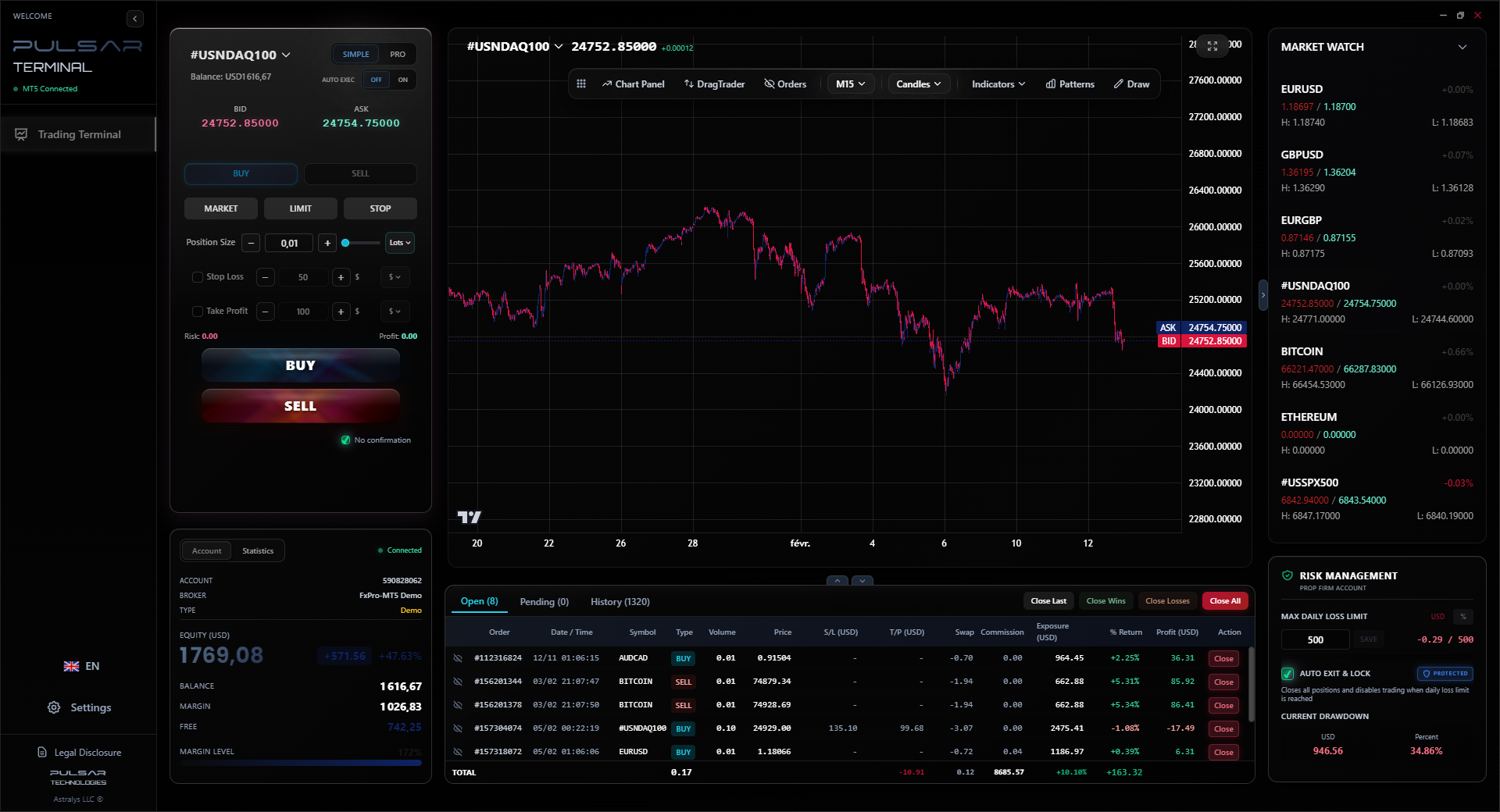
If you're using copy trading signals on MT5, Pulsar Terminal's drag-and-drop order management lets you quickly set multiple take-profits and stop-losses on those copied positions, giving you control the basic copy function lacks.
Pulsar Terminal
เครื่องมือ MT5 ครบวงจร: ลากวางคำสั่ง, multi-TP/SL, trailing stop, grid trading, Volume Profile และการป้องกัน prop firm ใช้งานโดยเทรดเดอร์กว่า 1,000 คนทุกวัน
You need a platform that offers ZAR accounts, local payment methods (EFT, Ozow, SID), and FSCA regulation. Here’s a quick comparison of a few major players:
| Broker/Platform | FSCA License | Min. Deposit (Copy) | Key Copy Feature | Local Focus |
|---|---|---|---|---|
| eToro | Yes | ~R3,500 | CopyTrader™ Social Feed | High, but international focus |
| AvaTrade | Yes (FSP 45984) | $100 (≈R1850) | AvaSocial, ZuluTrade | Strong, ZAR accounts |
| Khwezi Trade | Yes (SA ODP) | R500 | Proprietary & MT4/5 Signals | Purely South African |
| FP Markets | Yes | $100 (≈R1850) | Myfxbook, Signal Start | ECN spreads, good for active copiers |
| Vantage | Yes (FSP 51268) | $50 (≈R925) | Proprietary Social Trading | Low minimum entry |
A local note: Khwezi Trade is a fully South African broker. That means local support, instant Rands settlements, and deep understanding of SARB regulations. For trading ZAR pairs like USD/ZAR, which are incredibly popular here, a local broker's pricing and execution can be superior. However, their selection of international master traders might be smaller than on a global platform like eToro.
For MetaTrader users, platforms like XM and Pepperstone (both FSCA-regulated) integrate with external signal services, giving you a wider pool of traders to choose from, but you must do your own regulatory due diligence on the signal provider.
“Use copy trading as the most expensive tutoring service you'll ever buy, not a passive income scheme.”
If you're going to use copy trading, don't use it as a passive income scheme. Use it as the most expensive, but potentially valuable, tutoring service you'll ever buy.
Here's my method: Allocate a tiny amount of capital you're willing to lose entirely - say R1,000. Copy 2-3 traders with very different, well-explained strategies. One might trade XAU/USD breakouts, another might trade EUR/USD mean reversion using the MACD indicator.
Then, don't just watch your balance. Open the charts. When a trade is copied, mark the entry. Study the chart. Why did they enter here? What was the setup? Where did they place the stop loss and take profit? Try to reverse-engineer their rules.
This turns a passive, risky activity into active learning. You're paying them (via fees) to show you their playbook in real-time. Over 6 months, you might start to recognize patterns. You might then take a small portion of your main capital and try to execute similar setups yourself, with proper position size calculator use. Now you're building a skill, not just hoping a stranger doesn't blow up your account.
This is how I moved from copying to developing my own edge. I lost that R1,000 tuition fee, but the education was worth ten times that. It taught me more about real-world trade management than any book or course ever did.
💡 เคล็ดลับจาก Winston
Calculate the 'net return' after all fees. Take the master's profit, subtract 30% for their cut, subtract another 10% for wider spreads and commissions on your account. If what's left doesn't excite you, move on.
So, what is copy trading in forex? It's a tool. A very dangerous tool that's marketed as a safe elevator to the top floor.
For 95% of people, it's a bad idea. The fees are high, the risks are obscured, and it prevents you from learning the one thing that will actually make you money in the long run: understanding the markets.
If you insist on using it, follow these iron rules:
- Only use FSCA-regulated brokers. No exceptions.
- Allocate money you can afford to lose 100%. Treat it as tuition, not investment.
- Do deep due diligence on the master trader. Look beyond the shiny percentage.
- Understand every fee you will pay. Calculate the net return after all costs.
- Use it to learn, not to earn. Actively study every copied trade.
The dream of passive income from forex is a siren song. It lures in thousands of South Africans every year. The reality is that sustainable trading requires work, discipline, and a deep personal understanding of risk. Copy trading often provides the opposite: a comforting illusion of control while you hand the reins to a stranger. Don't let the convenience blind you to the very real chance of a margin call on money you needed. Start small, learn actively, and always, always know exactly what you're paying for.
FAQ
Q1Is copy trading legal in South Africa?
Yes, but with strict conditions. The broker/platform must be regulated by the FSCA, and crucially, as of 2024, the 'master trader' providing the signals must also hold a Financial Services Provider (FSP) license. Using unregulated platforms or copying unlicensed local traders is illegal and offers no consumer protection.
Q2What is the minimum deposit for copy trading in South Africa?
It varies by platform. Local broker Khwezi Trade allows you to start with R500. International platforms like eToro require around R3,500 to use their CopyTrader feature. Others like Vantage start at about $50 (roughly R925). Always check if the minimum is to open an account or to actually start copying.
Q3Can I lose more money than I deposit with copy trading?
Not with an FSCA-regulated broker. A key protection for retail clients is 100% Negative Balance Protection. This means you cannot lose more than the total amount you deposited into your account, shielding you from owing the broker money.
Q4What are the typical fees for copy trading?
You pay multiple layers: 1) The spread (e.g., 0.4-1.0 pips on majors), 2) Possible commissions (e.g., R60-R70 per lot), 3) A performance fee to the master trader (typically 20-30% of your profits), and sometimes 4) a monthly subscription fee. These can easily reduce a master's 80% return to under 30% in your account.
Q5How do I choose a good trader to copy?
Ignore the headline profit percentage. Look at: Maximum Historical Drawdown (lower is better), Consistency over 12+ months, Average Position Size & use used (avoid extreme use), and a Clear Strategy Description. A smooth equity curve is more important than a spiky, high-return one.
Q6Can I use copy trading on MetaTrader (MT4/MT5) in South Africa?
Yes. Many FSCA-regulated brokers offer MT4/MT5 and integrate with copy trading services like MetaTrader Signals, Myfxbook AutoTrade, or Signal Start. You subscribe to a signal provider within the platform, and trades are copied automatically. Ensure both your broker and the signal provider are compliant with FSCA rules.
Q7What is the difference between copy trading and a managed account?
In copy trading, you retain control of your account and can stop copying at any time. The trades are mirrored automatically. In a managed account, you hand over your login details or grant power of attorney to a fund manager who trades directly in your account. Managed accounts are higher risk, often require larger minimums, and are heavily regulated; the manager almost always requires a full Category II FSP license.
บทเรียนจาก Prof. Winston
สรุปสาระสำคัญ:
- ✓FSCA rules protect you. Use regulated brokers only.
- ✓Master traders need an FSP license. Verify it.
- ✓Fees can erase 50%+ of advertised profits.
- ✓Maximum drawdown matters more than total return.
- ✓Study the trades to learn, don't just watch the balance.
บทความนี้มีประโยชน์แค่ไหน?
คลิกดาวเพื่อให้คะแนน
ข้อมูลเชิงลึกการเทรดรายสัปดาห์
การวิเคราะห์และกลยุทธ์รายสัปดาห์ฟรี ไม่มีสแปม
เกี่ยวกับผู้เขียน
David van der Merwe
เทรดเดอร์ตลาดเกิดใหม่
เทรดเดอร์ประจำโจฮันเนสเบิร์ก มีประสบการณ์ 11 ปีในสกุลเงินตลาดเกิดใหม่ เชี่ยวชาญคู่ ZAR การเทรดภายใต้กฎระเบียบ FSCA และการวิเคราะห์ตลาดแอฟริกาใต้
ความคิดเห็น
คำเตือนความเสี่ยง
การซื้อขายตราสารทางการเงินมีความเสี่ยงสูงและอาจไม่เหมาะสำหรับนักลงทุนทุกคน ผลการดำเนินงานในอดีตไม่ได้รับประกันผลลัพธ์ในอนาคต เนื้อหานี้มีวัตถุประสงค์เพื่อการศึกษาเท่านั้นและไม่ควรถือเป็นคำแนะนำในการลงทุน โปรดทำการวิจัยของคุณเองก่อนการซื้อขาย
คุณอาจชอบสิ่งนี้

Cara Trading Forex Sukses: 7 Prinsip dari Trader Profesional
Cara trading forex sukses dengan 7 prinsip trader pro: manajemen modal, disiplin, journal trading, backtest. Data nyata, bukan janji profit palsu.
Jam Trading Forex Terbaik untuk Trader Indonesia: Panduan Lengkap dengan Tabel Waktu
Panduan jam trading forex untuk trader Indonesia. Tabel 4 sesi dunia, jam emas 20:00-00:00, sesi mana yang harus dihindari. Data akurat + tips dari trader berpengalaman.
Top 5 Sàn Forex Uy Tín Nhất 2026: Review Jujur dari Trader Indonesia
Top 5 sàn forex uy tín 2026 untuk trader Indonesia. Review jujur: spread, deposit, withdraw, dukungan lokal. Exness, XM, IC Markets & lebih.
รับ Pulsar Terminal
เครื่องคำนวณทั้งหมดนี้ถูกสร้างไว้ใน Pulsar Terminal พร้อมข้อมูลเรียลไทม์จากบัญชี MT5 ของคุณ
รับ Pulsar Terminal