


You're planning a trip abroad or need to pay for an online subscription, and someone mentions getting a 'forex card.' But what is a forex card, really? Is it just another bank card, a magic solution for currency problems, or a potential trap with hidden fees? In Nigeria's complex financial environment, the answer isn't simple.

Olumide Adeyemi
ผู้บุกเบิกการเทรดในแอฟริกาตะวันตก ·  Nigeria
☕ 10 นาทีอ่าน
สิ่งที่คุณจะได้เรียนรู้:
- 1What Exactly Is a Forex Card? (It's Not What You Think)
- 2How It Works: Loading, Spending, and the Hidden Gaps
- 3The Real Cost: Fees That Will Eat Your Money
- 4Regulations & Limits: What the CBN Says (2026 Update)
- 5Forex Card vs. Alternatives: Which Should You Choose?
- 6Common Pitfalls & How to Avoid Them
- 7Step-by-Step: How to Get & Use a Forex Card in Nigeria
- 8The Future: Virtual Cards, CBDCs, and More Control
You're planning a trip abroad or need to pay for an online subscription, and someone mentions getting a 'forex card.' But what is a forex card, really? Is it just another bank card, a magic solution for currency problems, or a potential trap with hidden fees? In Nigeria's complex financial environment, the answer isn't simple. I've used them, I've been burned by them, and I'll break down exactly how they work - not from a banker's perspective, but from a trader's view of risk, cost, and practical utility. Let's cut through the marketing and look at the real numbers.
A forex card, at its core, is a prepaid payment card you load with foreign currency before you travel. Think of it like buying foreign cash, but in plastic form. You lock in an exchange rate when you load it, which can protect you if the Naira weakens further while you're abroad.
But here's where it gets Nigerian-specific. The term 'forex card' has been stretched. It can mean:
- A dedicated multi-currency travel card from a bank (like FirstBank's Visa Multi-Currency Card).
- A Naira debit card that's been 'reactivated' for international use (like your GTBank or ALAT card).
- A virtual dollar card from a fintech app (like Chipper Cash or Grey).
They all aim to solve the same problem: letting you spend money internationally when your regular Naira card might fail. The key difference is in the fees, limits, and where the money actually sits.

Warning: Don't confuse a forex card with forex trading. They are completely different. A card is for spending. Trading is speculating on currency price movements, which you can learn about in our forex trading guides. Using a card to fund a trading account is often prohibited and a fast way to get your card blocked.
The Loading Process
You fund the card with Naira, which is converted to USD, EUR, or GBP at the bank's or fintech's rate. This is the first point where you can lose money. The rate you get is almost never the true market rate you'd see on a trading platform. There's always a spread - a hidden cost baked into the exchange.
I learned this the hard way in 2023. I loaded $1,000 onto a card before a trip. The advertised rate was 'competitive,' but when I did the math, I paid about ₦50 more per dollar than the official CBN rate at the time. That was a hidden cost of over ₦50,000 on that single load. A proper position size calculator mentality - knowing your exact costs - is crucial here.
Spending and Withdrawals
You use it like any other card: swipe at shops, pay online, or withdraw local cash from ATMs abroad. Each action triggers another layer of potential fees.
The Big Catch: Unloading
What happens to leftover money? Some cards let you transfer it back to your Naira account at a poor rate, others charge a fee to close the card, and some fintech cards might just keep it as a balance for next time. You must read the terms. This is where the 'convenience' can become a liquidity trap.

💡 เคล็ดลับจาก Winston
A forex card's exchange rate spread is its silent commission. If you don't know the exact rate you're getting versus the interbank rate, you're already losing.
“That $3.50 ATM fee isn't a charge; it's a 3.5% loss on a $100 withdrawal before you even leave the machine.”
This is the most important section. If you ignore the fees, you will lose money. It's as certain as a poorly planned trade hitting a margin call. Here’s a breakdown with 2025/2026 numbers:
| Fee Type | Traditional Bank Forex Card (e.g., GTBank) | Fintech Virtual Card (e.g., Chipper Cash) | Reactivated Naira Card |
|---|---|---|---|
| Issuance/Creation | ~₦1,000 or $10 equivalent | $3 - $5 (some are free) | Usually Free (card already exists) |
| Annual/Monthly Maintenance | $10 - $20 per year | $0 - $1 per month | Often free |
| ATM Withdrawal Abroad | $3.50 per withdrawal (This adds up fast) | Varies; often a % + fee | Your bank's int'l ATM fee + forex spread |
| Foreign Transaction Fee | Sometimes 0%, but check | Often 0% 'forex markup' | Typically 1-4% on top of the spread |
| Exchange Rate Spread | The main hidden cost. Can be 2-5% worse than market. | Usually better than banks, but not perfect. | Built into the Mastercard/Visa rate, which has a margin. |
| Reload/Inactivity Fees | May apply | May apply | N/A |

Example: Withdraw $200 four times on a trip with a GTBank Dollar Card. That's $200 * 4 = $800. Fees: 4 withdrawals * $3.50 = $14 in pure fee loss. That's over ₦21,000 (at ~₦1,500/$) gone before you've even spent the cash.
Fintechs often win on the 'forex markup' but can get you with subscription or transaction fees. The reactivated Naira cards (like those from Providus Bank or Wema ALAT) are convenient but watch their low monthly limits ($500-$3000) and the fact you're taking a hit on the exchange rate twice - once by the card network and once by your bank.
The rules changed significantly in late 2025. The CBN wants smoother international card usage but with tight controls.
Key CBN Directives (Dec 2025):
- Multi-factor Authentication is mandatory for larger withdrawals/online payments (over $200/day, $500/week). This is for security, but it can be a hassle if you're somewhere with poor data.
- Banks must show you the exchange rate and fees upfront before the transaction completes. You have to accept it. This is a big win for transparency - use it! Don't just click 'OK.'
- All settlements to Nigerian merchants must be in Naira. This is more about the backend.
- Banks must keep ATMs/POS working for international cards. In theory, this should reduce 'Declined' messages abroad.
Spending Limits (The Reality): Your ability to spend is capped, hard. Don't expect to fund a large overseas expense with your card.
- Wema Bank ALAT: ~$500 per month.
- GTBank Naira Card: $1,000 per quarter for POS/online, $500 per quarter for ATM abroad.
- Providus Bank: Up to $3,000/month (one of the highest).
- Fintechs: Vary wildly. Vesti offers $10,000/month, while Gomoney is only $100.
These limits make forex cards tools for travel spending or online subscriptions, not for major business transactions. It's like trying to run a scalping strategy with a $10 account - the structure limits your scope.
💡 เคล็ดลับจาก Winston
Treat ATM withdrawal fees like slippage on a market order. A $3.50 fee on a $100 withdrawal is a 3.5% loss before you even spend the cash. Size your withdrawals accordingly.
“Fintech virtual cards are winning because they attack the banks' biggest weakness: the hidden forex spread.”
Option 1: Dedicated Bank Forex Card (e.g., FirstBank, GTBank)
Good for: Frequent travelers who want a physical card linked directly to their domiciliary account. It feels secure. Bad for: Cost-conscious users. The fees (issuance, annual, ATM) are high, and the exchange rate is rarely the best.
Option 2: Reactivated Naira Debit Card
Good for: Occasional online payments or infrequent travel. It's the card you already have. Convenience is king. Bad for: Getting good value. You'll pay the highest forex spread (that 2-4% fee) and are subject to low limits. It's the 'easy' option that costs you the most per transaction.
Option 3: Fintech Virtual Dollar Card (Chipper, Grey, Eversend)
Good for: Online subscriptions (Netflix, Spotify), SaaS payments, and small-to-medium online shopping. They often have the best exchange rates (low or zero forex markup) and are quick to set up. Bad for: Physical travel (though some offer physical card delivery). Some have tricky fee structures (monthly fees, per-transaction fees). You must read the fine print.
Option 4: International Travel Cards (Wise, Revolut)
Good for: Serious international travelers or digital nomads. They offer excellent multi-currency features and top-tier exchange rates. Bad for: Funding from Nigeria can be a challenge (often requiring a domiciliary account transfer). Not always designed with Nigerian regulatory hurdles in mind.

Pro Tip: For most Nigerians doing online shopping or paying for subscriptions, a fintech virtual dollar card is the most cost-effective starting point. For extended physical travel, compare the total cost of a dedicated forex card (including all fees) against simply using your reactivated Naira card for the trip. Do the math for your specific spending pattern.
I've made these mistakes so you don't have to.
- Not Checking the Residual Balance Policy: I left about $80 on a card after a trip. A year later, 'inactivity fees' had chipped it down to almost zero. Always empty or close the card after your trip.
- Assuming ATM Fees Are Standard: That $3.50 fee is per withdrawal, not per day. If you take out small amounts frequently, you're bleeding money. Withdraw larger sums less often, if safe to do so.
- Ignoring the Load Rate: The moment you convert your Naira is the moment you lock in a loss versus the real market. Shop around. Sometimes the fintech rate is significantly better than your bank's. Check the rate on the day you load.
- Forgetting About Limits: Trying to pay for a $600 hotel stay with a card that has a $500 monthly limit will lead to a declined transaction and embarrassment. Know your limits like you know your stop-loss levels.
- Using It for Forex Trading Funding: This is a major red flag for banks and a violation of CBN guidelines for accessing official FX. Use the P2P or local transfer methods offered by your forex broker instead.
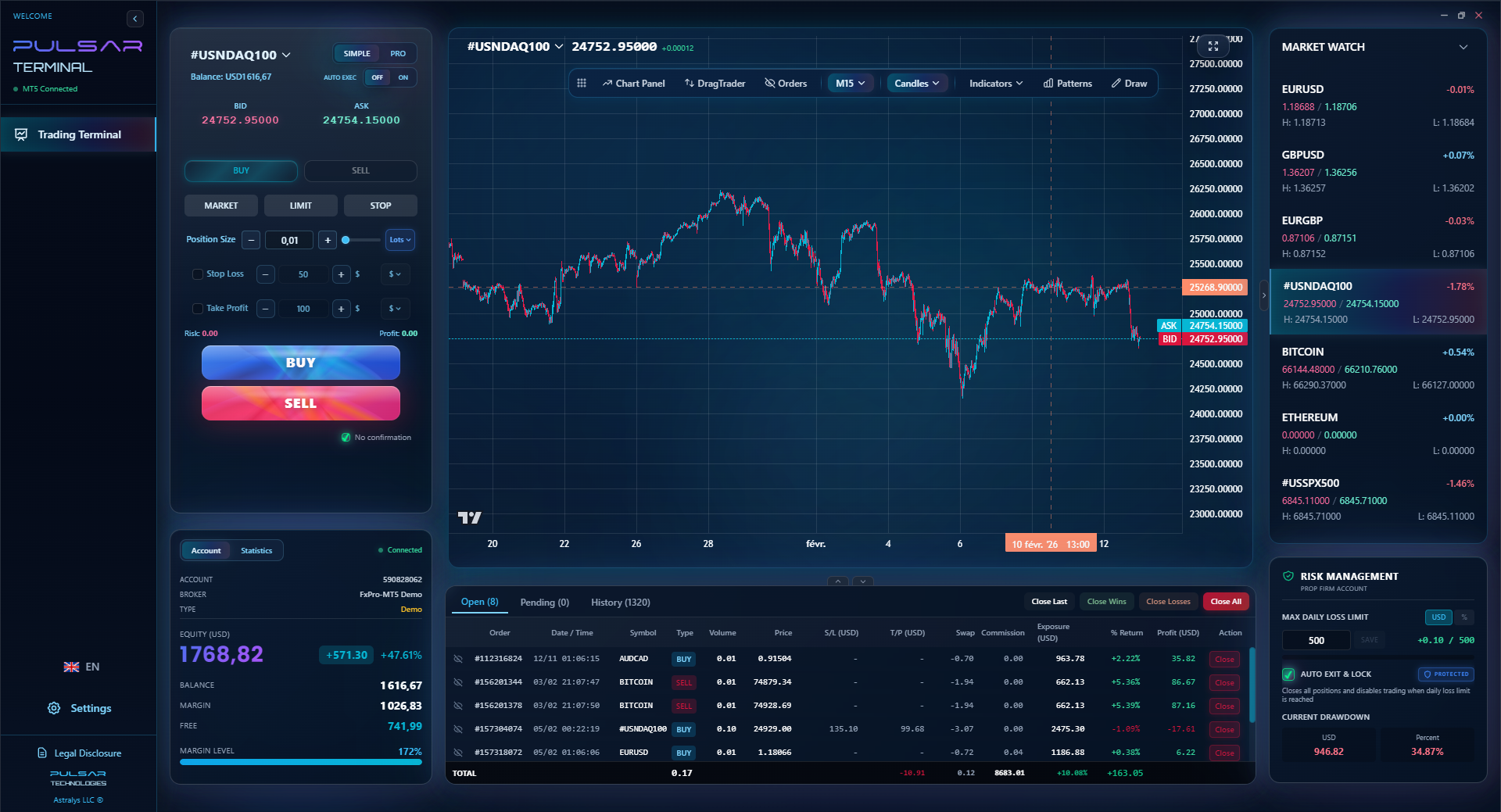
Just as managing a forex card requires tracking multiple fees and balances, managing complex trades requires a tool that can handle multiple take-profit and stop-loss orders with precision, which is where Pulsar Terminal excels on MT5.
Pulsar Terminal
เครื่องมือ MT5 ครบวงจร: ลากวางคำสั่ง, multi-TP/SL, trailing stop, grid trading, Volume Profile และการป้องกัน prop firm ใช้งานโดยเทรดเดอร์กว่า 1,000 คนทุกวัน
“A forex card is a tool for spending, not an investment. Any money left on it is decaying value.”
For a Fintech Virtual Card (Fastest Route):
- Download an app like Chipper Cash, Grey, or Eversend.
- Complete KYC (usually your BVN, NIN, and a selfie).
- Fund your Naira wallet in the app via bank transfer.
- Use the 'Create Card' feature. It generates virtual card details (number, expiry, CVV) instantly.
- Use these details for online payments. For a physical card, some apps offer delivery for an extra fee.
For a Bank Multi-Currency Card:
- Visit your bank (FirstBank, GTBank, etc.). Have a domiciliary account or be ready to open one.
- Apply for the specific forex/travel card. Pay the issuance fee.
- Load the card by transferring foreign currency from your domiciliary account or buying FX from the bank.
- Activate it for international use (this step is critical).
- Travel and spend. Keep all receipts and monitor your balance via the bank's app.
For Your Reactivated Naira Card:
- Confirm with your bank (GTBank, ALAT, Opay, etc.) that your specific card tier is eligible for international transactions.
- Ensure your transaction limits are set high enough for your needs.
- Just use it abroad or online. The conversion happens automatically.
Remember, the final step for all of them is the same: review the statement and calculate what the transaction actually cost you in Naira. That's your true performance metric.
💡 เคล็ดลับจาก Winston
Your best defense against bad financial products is a spreadsheet. List all fees - issuance, annual, ATM, reload, inactivity. The total cost per year tells the real story.
The trend is clear: physical forex cards are becoming legacy products. The future is digital, app-based, and integrated.
- Virtual Cards Will Dominate: For online payments, they're simply more secure (you can freeze them instantly, generate new details) and cheaper to issue. Every major fintech will offer one.
- CBN's eNaira & Integration: While slow, the potential exists for the eNaira to simplify cross-border payments and reduce the need for intermediary forex cards. Don't hold your breath, but the architecture is being built.
- Tighter, Smarter Regulation: The CBN's 2025 rules show a move towards transparency (showing fees) and security (MFA). Expect more of this, making hidden fees harder to hide.
- Blurring Lines: The distinction between a 'forex card,' a 'bank card,' and a 'fintech wallet' will keep fading. The best product will be the one that gives you the real market exchange rate with the fewest fixed fees.
As a trader, I see this as a market becoming more efficient. Inefficient products (high-fee bank forex cards) will lose out to efficient ones (low-margin fintech apps). Your job is to be on the right side of that trade.
FAQ
Q1Is a forex card the same as a domiciliary account debit card?
Not exactly, but they're closely related. A dedicated forex card is often a separate prepaid card you load from your domiciliary account. However, the debit card linked directly to your USD domiciliary account functions almost identically for spending abroad. The key difference may be in the specific fees attached to the 'forex card' product itself.
Q2Can I use a forex card to fund my forex trading account?
No, and you shouldn't try. The CBN explicitly prohibits using official foreign exchange channels (which includes bank-issued forex cards) to fund trading accounts. Brokers serving Nigerian clients offer alternative funding methods like local bank transfers or P2P. Using a card risks it being blocked and violates terms of service.
Q3Which is better for travel: a forex card or just my Naira card?
You need to do the math. For short trips with small spending, your reactivated Naira card might be simpler despite the higher forex spread. For longer trips, a dedicated forex card might save money on the exchange rate but watch the ATM fees. For the best rates, an international service like Wise often beats both, but funding it from Nigeria can be a hurdle.
Q4What happens to the money left on my forex card after my trip?
It depends on the provider. Some allow you to transfer it back to your Naira account at a poor rate. Some let you keep it for future use. Others charge monthly 'inactivity fees' that slowly drain the balance. You must read the terms and conditions before you get the card to know the exit strategy.
Q5Are fintech virtual dollar cards safe?
They are generally safe for transactions, using similar security (CVV, freeze functions) as physical cards. The risk is more about the fintech company's stability and their adherence to CBN regulations. Use established, licensed platforms. Never store large, long-term balances on them - treat them as a spending tool, not a savings account.
Q6What's the difference between a forex markup and an ATM fee?
The forex markup (or spread) is the hidden cost in the exchange rate. If the market rate is ₦1,500/$, you might get ₦1,530/$ - that ₦30 difference is the markup, a percentage loss. An ATM fee is a flat, explicit charge (e.g., $3.50) just for using the machine. You pay both on most transactions, and they destroy your budget.
Q7Do I need a BVN to get a forex card?
Yes, absolutely. For any card issued by a Nigerian bank or fintech, full Know-Your-Customer (KYC) including your BVN (and usually your NIN) is mandatory. International providers like Wise or Revolut have their own, often more stringent, identity verification processes.
บทเรียนจาก Prof. Winston
สรุปสาระสำคัญ:
- ✓The forex spread is your biggest, hidden cost.
- ✓ATM fees are fixed losses; withdraw larger amounts less often.
- ✓Always know the exit strategy for your leftover balance.
- ✓Virtual fintech cards often beat traditional banks on rate.
- ✓Never use a forex card to fund a trading account.
บทความนี้มีประโยชน์แค่ไหน?
คลิกดาวเพื่อให้คะแนน
ข้อมูลเชิงลึกการเทรดรายสัปดาห์
การวิเคราะห์และกลยุทธ์รายสัปดาห์ฟรี ไม่มีสแปม
เกี่ยวกับผู้เขียน
Olumide Adeyemi
ผู้บุกเบิกการเทรดในแอฟริกาตะวันตก
หนึ่งในนักการศึกษาฟอเร็กซ์ที่กระตือรือร้นที่สุดของไนจีเรีย 8 ปีประสบการณ์เทรดจากลากอส เชี่ยวชาญกลยุทธ์ทุนต่ำและความท้าทาย prop firm สำหรับเทรดเดอร์ในแอฟริกา
ความคิดเห็น
คำเตือนความเสี่ยง
การซื้อขายตราสารทางการเงินมีความเสี่ยงสูงและอาจไม่เหมาะสำหรับนักลงทุนทุกคน ผลการดำเนินงานในอดีตไม่ได้รับประกันผลลัพธ์ในอนาคต เนื้อหานี้มีวัตถุประสงค์เพื่อการศึกษาเท่านั้นและไม่ควรถือเป็นคำแนะนำในการลงทุน โปรดทำการวิจัยของคุณเองก่อนการซื้อขาย
คุณอาจชอบสิ่งนี้

Cara Trading Forex Sukses: 7 Prinsip dari Trader Profesional
Cara trading forex sukses dengan 7 prinsip trader pro: manajemen modal, disiplin, journal trading, backtest. Data nyata, bukan janji profit palsu.
Jam Trading Forex Terbaik untuk Trader Indonesia: Panduan Lengkap dengan Tabel Waktu
Panduan jam trading forex untuk trader Indonesia. Tabel 4 sesi dunia, jam emas 20:00-00:00, sesi mana yang harus dihindari. Data akurat + tips dari trader berpengalaman.
Top 5 Sàn Forex Uy Tín Nhất 2026: Review Jujur dari Trader Indonesia
Top 5 sàn forex uy tín 2026 untuk trader Indonesia. Review jujur: spread, deposit, withdraw, dukungan lokal. Exness, XM, IC Markets & lebih.
รับ Pulsar Terminal
เครื่องคำนวณทั้งหมดนี้ถูกสร้างไว้ใน Pulsar Terminal พร้อมข้อมูลเรียลไทม์จากบัญชี MT5 ของคุณ
รับ Pulsar Terminal