


Here's a fact that might surprise you: while the global forex market turns over $7.5 trillion daily, the legal market for Indian retail traders is restricted to just a handful of currency pairs.

Rajesh Sharma
นักวิเคราะห์ฟอเร็กซ์อาวุโส ·  India
India
☕ 10 นาทีอ่าน
สิ่งที่คุณจะได้เรียนรู้:
- 1Forex Trading Basics: What Does 'Forex Trading' Actually Mean in Hindi?
- 2The Legal Framework in India: SEBI, RBI, and What You Can Actually Trade
- 3Real Costs, Fees, and Choosing a Broker in India
- 4A Step-by-Step Guide to Start Trading Forex Legally in India
- 5Common Mistakes and Risks Every Indian Trader Must Avoid
- 6Analysis and Trading Strategies for INR Currency Pairs
- 7FAQs: Your Questions Answered
- 8Final Thoughts: Getting Started the Right Way
Here's a fact that might surprise you: while the global forex market turns over $7.5 trillion daily, the legal market for Indian retail traders is restricted to just a handful of currency pairs. If you've searched for 'what is forex trading in Hindi,' you've likely found a mix of hype and confusion. Let's clear that up. I've been trading for over a decade, and I'll walk you through exactly what forex trading means for you in India - the legal framework, the real costs, the common pitfalls, and how you can actually get started without breaking the law.
First things first, let's demystify the term. 'Forex' is short for Foreign Exchange. In Hindi, you'll hear it called विदेशी मुद्रा व्यापार (Videshi Mudra Vyapar). At its core, it's the simultaneous buying of one currency and selling of another.
Think of it like this: you're not buying a physical thing; you're betting on the value of one currency relative to another. The most common example globally is EUR/USD. For you in India, the most relevant pair is USD/INR. You're speculating on whether the US Dollar will strengthen or weaken against the Indian Rupee.
It's a 24-hour market (except weekends), moving on news, economic data, and global events. The sheer size makes it liquid, meaning you can usually enter and exit trades quickly. But that liquidity is a double-edged sword - it can amplify losses just as fast as gains.

Warning: A huge misconception is that 'forex trading' means trading pairs like EUR/USD or GBP/JPY from India. For a resident Indian, trading those major pairs on a spot basis with an international broker is illegal under FEMA. The legal route is through INR-based pairs on SEBI-regulated platforms.

💡 เคล็ดลับจาก Winston
The market's job is to take your money. Your job is to not let it. A 1% maximum risk rule isn't a suggestion; it's your armor.
This is the most critical section. Getting this wrong can lead to serious legal and financial trouble. India's forex market is governed by the Foreign Exchange Management Act (FEMA), 1999, with the Reserve Bank of India (RBI) and the Securities and Exchange Board of India (SEBI) calling the shots.
What is LEGAL for Indian Retail Traders?
You are allowed to trade currency derivatives on recognized Indian stock exchanges like the NSE and BSE. This means:
- Currency Futures: Contracts for USD/INR, EUR/INR, GBP/INR, JPY/INR.
- Currency Options: Options on the above futures contracts.
These are exchange-traded, standardized contracts with set expiry dates. You must do this through a SEBI-registered broker (like Zerodha, ICICI Direct, or Angel One).
What is ILLEGAL for Indian Retail Traders?
- Trading spot forex on international/offshore platforms (like Exness, IC Markets, or XM) as a resident Indian.
- Trading non-INR pairs (like EUR/USD, GBP/JPY) on any platform.
- Using use from an international broker to trade forex.
I made this mistake early on. Back in 2015, I funded an account with an offshore broker to trade EUR/USD. I made a quick 15% in two weeks and felt like a genius. Then RBI clarification news hit, I got nervous, pulled my money out, and spent months worried about a penalty notice. The stress wasn't worth the potential gain.
The market is growing within these rules. It was around $32 billion in 2020 and is estimated to hit nearly $70 billion by 2034. The opportunity is here, but it's inside the fence.
“For a resident Indian, trading major forex pairs on a spot basis with an international broker is illegal under FEMA.”
Let's talk numbers, because what you keep is more important than what you make.
Brokerage and Transaction Costs
Indian brokers charge differently than offshore CFD brokers. You won't see typical 'spreads' in the same way. Instead, you pay brokerage fees. For example, a major discount broker charges:
- ₹20 per executed order for intraday trades in currency derivatives, OR 0.03% of the turnover, whichever is lower.
- For currency futures, it's around ₹0.05 per lakh of turnover, plus GST.
Compare this to the global average spread for something like EUR/USD, which can be under 1 pip. The cost structure is just different.
The Offshore Broker Trap
You'll see ads for brokers offering 'zero spread' accounts with $100 minimum deposits. Their spreads on major pairs can be very tight, sometimes 0.0 pips plus commission. But remember, if you're an Indian resident using them to trade, you're likely violating FEMA. The low cost isn't worth the regulatory risk.
use: The Double-Edged Sword
On Indian exchanges, use for currency futures is effectively provided by the margin system. It's lower than what offshore brokers advertise. I've seen brokers overseas offer 500:1 - an insane amount that can wipe out an account in minutes. The Indian structure is more conservative, which, honestly, protects new traders from themselves. Always use a position size calculator to keep your risk in check, no matter what use is available.
Here’s your practical roadmap. I wish I had this when I started.
- Open a Trading & Demat Account: Choose a SEBI-registered broker that offers currency derivatives. Complete your KYC. This is straightforward and similar to opening an equity trading account.
- Learn the Platform: Spend time on the broker's platform or trading terminal. Understand how to place orders for currency futures and options. Paper trade if possible.
- Start with USD/INR Futures: This is the most liquid contract. One contract is usually for $1000. So, if the USD/INR rate is 83.50, the contract value is ₹83,500. The margin required might be a small percentage of this.
- Develop a Simple Strategy: Don't overcomplicate it. Start with price action or one indicator like the RSI indicator to identify overbought/oversold conditions in the context of a trend. This is more suited to swing trading these contracts rather than scalping due to the fee structure.
- Risk Management First: Decide your risk per trade before you enter. I risk no more than 1% of my trading capital on any single idea. If my capital is ₹1,00,000, my max loss on a trade is ₹1,000. This single rule has saved me more times than I can count.

Pro Tip: Your first 20 trades should be about following your process, not making money. Log every trade: entry reason, exit reason, P&L, and most importantly, your emotional state. This log is your best teacher.
💡 เคล็ดลับจาก Winston
If you don't know where you're getting out before you get in, you're not trading. You're gambling. Always have your stop-loss and take-profit levels defined.
“I once lost ₹50,000 in a single morning on a leveraged trade that gap-opened against me. That was my brutal lesson on stop losses.”
I've made plenty of these, so learn from my losses.
Chasing Illegal 'Opportunities': The biggest risk isn't market risk; it's regulatory risk. Using VPNs to sign up with Pepperstone or other offshore brokers might seem clever until you face issues withdrawing funds or, worse, legal repercussions. The broker can freeze your account if they ascertain your residency.
Misunderstanding use: use amplifies everything. A 2% move against you on a highly leveraged trade can be a 100% loss. I once lost ₹50,000 in a single morning on a leveraged silver trade that gap-opened against me. I didn't have a stop loss. That was my brutal lesson on the necessity of a hard stop on every position.
Ignoring the Macro for INR Pairs: Trading USD/INR isn't just technical analysis. You must watch RBI policy, crude oil prices (India's big import), and dollar inflows/outflows. A surprise RBI intervention can move the pair 50 paisa (500 pips) in minutes.
No Clear Exit Plan: Entering a trade without knowing where you'll exit if it goes wrong is like driving blindfolded. Always know your stop-loss and take-profit levels before you click 'buy' or 'sell'. Tools that help you set multi-level exits and trailing stops can remove emotion. For instance, managing a partial closure strategy manually is tough, but some advanced terminals can automate it.

Example: Let's say you buy 1 USD/INR futures contract at 83.00, expecting a rise. You decide your risk is 20 paisa (0.20). So your stop loss is at 82.80. If the contract size is $1000, your potential loss is 0.20 * 1000 = ₹200. Is that within your 1% risk rule? If not, don't take the trade.
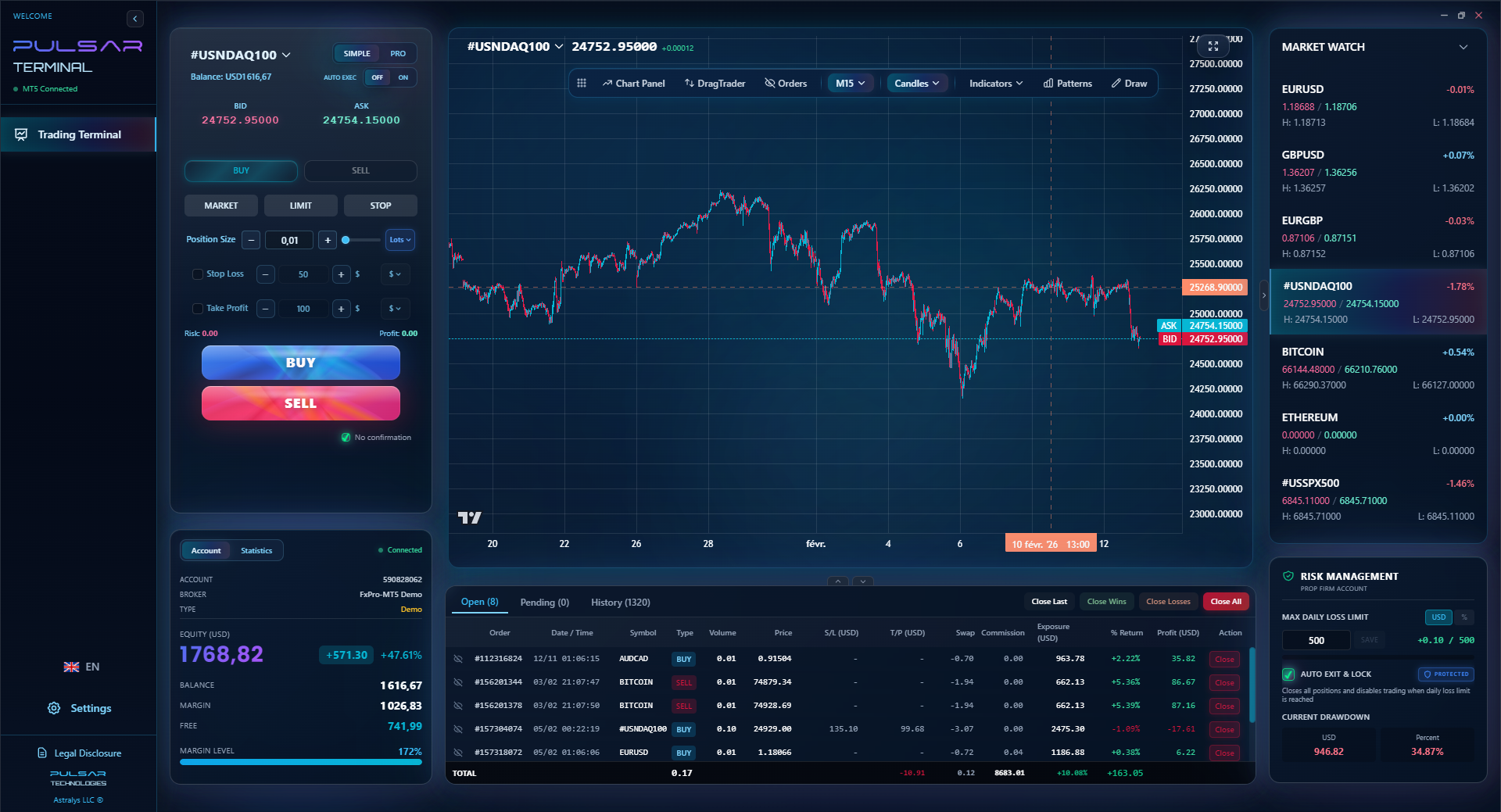
Managing complex exit strategies for currency futures, like partial closures and trailing stops, is much simpler with a tool that automates these rules directly on your trading terminal.
Pulsar Terminal
เครื่องมือ MT5 ครบวงจร: ลากวางคำสั่ง, multi-TP/SL, trailing stop, grid trading, Volume Profile และการป้องกัน prop firm ใช้งานโดยเทรดเดอร์กว่า 1,000 คนทุกวัน
Trading USD/INR futures is a different beast than trading EUR/USD. Here’s how I approach it.
Fundamental Drivers
- RBI Monetary Policy: Interest rate decisions are huge. A hawkish RBI (hinting at rate hikes) can strengthen the INR.
- Crude Oil Prices: India imports over 80% of its oil. Higher crude prices widen the trade deficit, putting downward pressure on the INR. I always have a Brent crude chart open when trading INR.
- Dollar Index (DXY): A strong broad dollar usually means a stronger USD/INR.
- FII Flows: Sustained foreign institutional investment into Indian equities supports the INR.
Technical Approach
Because of the fundamental weight, I use technicals more for timing than for direction. I look for confluences:
- Key Support/Resistance: Historical levels on the chart where the price has reversed before.
- Moving Average Confluence: The 50 and 200-day moving averages often act as dynamic support/resistance.
- Divergence: Using the MACD indicator to spot when price is making a new high but momentum is fading. This helped me exit a long USD/INR position at 82.90 in late 2023 before a sharp 60-paisa drop.
A simple strategy that worked for me was waiting for USD/INR to approach a strong resistance level (say, 83.50) after a rally, combined with overbought readings on the RSI and a bearish divergence on the 4-hour MACD. That was my signal to look for short opportunities with a tight stop above the resistance. It's not foolproof, but it stacks probabilities in your favor.
“Your goal in the first year should be to preserve capital and learn, not to get rich.”
Q: क्या भारत में Forex trading legal है? (Is forex trading legal in India?) A: Yes, but with strict conditions. Trading INR-based currency futures and options on SEBI-recognized exchanges like NSE is legal. Trading spot forex or non-INR pairs with international brokers is not legal for Indian residents.
Q: What is the minimum amount required to start? A: With Indian brokers, you can start with the margin required for one mini contract. For USD/INR, this can be as low as a few thousand rupees. It's more about the margin than a 'minimum deposit'.
Q: Can I trade in gold (XAU/USD) from India? A: Spot trading of international gold (XAU/USD) is not permitted. However, you can trade gold futures and options in rupees (e.g., GOLD MIC) on Indian commodity exchanges like MCX. For learning, you can read our XAU/USD guide to understand the global drivers, which also affect domestic prices.
Q: How are profits taxed? A: Profits from trading currency futures are treated as speculative business income. They are added to your total income and taxed according to your income tax slab. You must file ITR-3. Always consult a CA for your specific situation.
Q: What happens if I get a margin call? A: If your losses erode your margin below the maintenance level, your broker will issue a margin call to deposit more funds. If you don't, they will square off your positions, often at the worst possible price. Avoid this by never using all your capital as margin.
💡 เคล็ดลับจาก Winston
The first profit you should aim for is the profit of experience. Keep a detailed journal. Your past trades are a map to your future success.
Understanding 'what is forex trading in Hindi' is really about understanding what's possible and legal for you in India. The path is narrower than the global market, but it's well-defined and growing.
Start with education. Understand the economic factors that move the rupee. Paper trade currency futures on your broker's platform for at least a month. Get a feel for the volatility without risking real money.
Then, start small. Your goal in the first year should be to preserve capital and learn, not to get rich. The traders who blow up are the ones who go all-in on a 'sure thing.' The market has no sure things.
Finally, embrace the rules. Trading legally through Indian exchanges might seem limiting, but those limits protect you from the wild west of unregulated offshore trading. Build your skill, manage your risk, and view trading as a marathon, not a sprint. The market will be here tomorrow. Make sure your capital is too.
FAQ
Q1What does 'forex trading' mean in simple Hindi terms?
In simple Hindi, forex trading (विदेशी मुद्रा व्यापार) means buying and selling different countries' currencies to make a profit from the change in their exchange rates. For example, buying US Dollars when you think they will become more valuable compared to the Indian Rupee.
Q2Which currency pairs can I legally trade as an Indian?
As an Indian resident, you can legally trade currency pairs that include the Indian Rupee (INR) on SEBI-regulated platforms. The main pairs are USD/INR, EUR/INR, GBP/INR, and JPY/INR. These are traded as futures or options contracts on exchanges like the NSE.
Q3Is trading with international forex brokers like Exness or XM legal in India?
No. For a resident Indian, opening an account with an international broker to trade forex (including major pairs like EUR/USD) is illegal under FEMA laws. It is considered a violation of foreign exchange regulations, even if the broker accepts you.
Q4How much money do I need to start forex trading in India?
You don't need a large lump sum. You need enough to cover the initial margin for a contract. For a single USD/INR futures contract, the margin can start from a few thousand rupees. The key is to only use risk capital - money you can afford to lose completely.
Q5What is the biggest risk for a new forex trader in India?
The biggest risk is twofold: 1) Legal risk from trading illegally on offshore platforms, and 2) Financial risk from using excessive use without proper risk management. A small move in the wrong direction can wipe out your account if you're over-leveraged.
Q6Where can I learn technical analysis for trading USD/INR?
Start with the free educational resources provided by NSE and SEBI-registered brokers. The concepts of support/resistance, trend lines, and basic indicators like RSI and MACD are universal. Practice reading charts every day. Our guides on the RSI indicator and MACD indicator are a good starting point for the theory.
บทเรียนจาก Prof. Winston
สรุปสาระสำคัญ:
- ✓Trade only INR pairs (USD/INR, EUR/INR) on SEBI platforms.
- ✓Risk a maximum of 1% of capital per trade.
- ✓Crude oil price is a key driver for USD/INR.
- ✓Illegal offshore trading carries severe regulatory risk.
บทความนี้มีประโยชน์แค่ไหน?
คลิกดาวเพื่อให้คะแนน
ข้อมูลเชิงลึกการเทรดรายสัปดาห์
การวิเคราะห์และกลยุทธ์รายสัปดาห์ฟรี ไม่มีสแปม
เกี่ยวกับผู้เขียน
Rajesh Sharma
นักวิเคราะห์ฟอเร็กซ์อาวุโส
ซื้อขายในตลาดอินเดียและเอเชียใต้มากกว่า 10 ปี เริ่มต้นจากอนุพันธ์สกุลเงินของ NSE ก่อนเข้าสู่ตลาดฟอเร็กซ์สากล เชี่ยวชาญคู่ USD/INR และคู่สกุลเงินตลาดเกิดใหม่
ความคิดเห็น
คำเตือนความเสี่ยง
การซื้อขายตราสารทางการเงินมีความเสี่ยงสูงและอาจไม่เหมาะสำหรับนักลงทุนทุกคน ผลการดำเนินงานในอดีตไม่ได้รับประกันผลลัพธ์ในอนาคต เนื้อหานี้มีวัตถุประสงค์เพื่อการศึกษาเท่านั้นและไม่ควรถือเป็นคำแนะนำในการลงทุน โปรดทำการวิจัยของคุณเองก่อนการซื้อขาย
คุณอาจชอบสิ่งนี้

Cara Trading Forex Sukses: 7 Prinsip dari Trader Profesional
Cara trading forex sukses dengan 7 prinsip trader pro: manajemen modal, disiplin, journal trading, backtest. Data nyata, bukan janji profit palsu.
Jam Trading Forex Terbaik untuk Trader Indonesia: Panduan Lengkap dengan Tabel Waktu
Panduan jam trading forex untuk trader Indonesia. Tabel 4 sesi dunia, jam emas 20:00-00:00, sesi mana yang harus dihindari. Data akurat + tips dari trader berpengalaman.
Top 5 Sàn Forex Uy Tín Nhất 2026: Review Jujur dari Trader Indonesia
Top 5 sàn forex uy tín 2026 untuk trader Indonesia. Review jujur: spread, deposit, withdraw, dukungan lokal. Exness, XM, IC Markets & lebih.
รับ Pulsar Terminal
เครื่องคำนวณทั้งหมดนี้ถูกสร้างไว้ใน Pulsar Terminal พร้อมข้อมูลเรียลไทม์จากบัญชี MT5 ของคุณ
รับ Pulsar Terminal