


Most traders think they understand GDP.

Olumide Adeyemi
ผู้บุกเบิกการเทรดในแอฟริกาตะวันตก ·  Nigeria
☕ 12 นาทีอ่าน
สิ่งที่คุณจะได้เรียนรู้:
- 1GDP 101: It's Not Just a Number, It's a Signal
- 2How Nigerian GDP Specifically Moves the Naira
- 3How to Actually Trade a GDP Release (Without Losing Your Shirt)
- 4The Nigerian Trader's Reality: Costs, Taxes, and Platforms
- 5What the Headline GDP Hides: The Details That Matter
- 6Mistakes I've Made (So You Don't Have To)
- 7GDP is Lagging: Use These Leading Indicators Too
- 8Putting It All Together: Your GDP Trading Strategy
Most traders think they understand GDP. They see a headline number, buy or sell the currency, and then wonder why they got stopped out. The truth is, GDP is a lagging, revised, and often political piece of data. In Nigeria, with our unique economic pressures and the CBN's recent reforms, reading GDP the wrong way is a fast track to a blown account. I've made that mistake, chasing a Naira rally after a 'strong' GDP print only to watch it reverse when the details showed it was all oil revenue with zero trickle-down. Let's set the record straight on what GDP really means for your forex trades.
Gross Domestic Product (GDP) is the total value of everything produced within Nigeria's borders in a given period. Think of it as the country's financial report card. For forex traders, it's a primary signal for the Naira's future strength or weakness.
The core relationship is simple: strong, sustainable GDP growth should, in theory, strengthen the Naira (NGN). It suggests a healthy economy attracting foreign investment. Investors need Naira to buy Nigerian assets, pushing up demand. Weak GDP growth does the opposite, scaring off capital and weakening the currency.
But here's where new traders get it wrong. They trade the headline versus expectation. A beat is buy, a miss is sell. It's not that simple. You have to look inside the number. Was growth driven by consumer spending and business investment (good), or just by a temporary spike in government spending or crude oil prices (less reliable)? The CBN watches this closely, as it influences their interest rate decisions, which are the real engine for currency moves.

Example: Let's say Nigeria's Q1 GDP comes in at 3.5% year-on-year, beating forecasts of 2.8%. The initial knee-jerk reaction might be Naira strength. But if you dig into the report and see that the non-oil sector actually shrank while the entire growth came from a single, massive oil field coming back online, that 'strength' is built on shaky ground. A smart trader might fade that initial rally.

💡 เคล็ดลับจาก Winston
GDP is history. The market prices the future. Trade the *revision* of the past, or the *implication* for the future, not the headline from the past.
Trading USD/NGN or any Naira pair? You need a Nigerian lens on GDP. Our economy has specific pressure points that make the standard textbook rules only half the story.
The Oil Factor (The Double-Edged Sword)
A significant portion of Nigeria's GDP and over 90% of our foreign exchange earnings come from oil. So, a GDP beat driven by high oil production and prices should be Naira-positive, right? Usually, yes. It boosts foreign reserves and improves the nation's dollar inflow. But the market is forward-looking. If traders believe the high prices are unsustainable, or that the revenue isn't being used to stabilize the economy, the Naira rally can be short-lived. I learned this the hard way in 2022. Oil was high, GDP prints were strong, but the Naira kept sinking. Why? Because the market was pricing in rampant dollar demand, fuel subsidy costs, and a lack of confidence in FX management. The GDP was a rear-view mirror; the market was looking through the windshield at a pothole-filled road.
The CBN's Reaction Function
This is critical. The Central Bank of Nigeria's primary mandate is price stability. A very strong GDP report, especially if driven by consumer demand, can signal rising inflation. The CBN's likely response? Interest rate hikes. Higher interest rates can attract 'hot money' from foreign investors seeking yield, increasing demand for Naira. Therefore, a strong GDP can lead to Naira strength in anticipation of tighter monetary policy. You need to follow CBN governor speeches and MPC meeting minutes like a hawk. Their tone around GDP data tells you what they're likely to do next. A good broker with fast execution is key here, as these moves can be violent. I've had my best results using platforms from brokers like Exness or IC Markets during these high-volatility news events.
The Sentiment Override
Sometimes, the raw number doesn't matter as much as what it says about reform progress. Since 2023, with the FX unification and the new NFEM guidelines, international investors are looking for signs of structural economic improvement. A GDP report showing growth in agriculture, manufacturing, or tech (the non-oil sectors) is a massive sentiment booster. It suggests the economy is diversifying and reforms are working. This can strengthen the Naira more than a pure oil-driven number, even if the latter is bigger. It's about quality, not just quantity.
“Trading the first GDP print is gambling with slightly better odds.”
Trading news like GDP is a specialist's game. It's high-risk, high-reward, and most retail traders lose. If you're going to do it, you need a plan stricter than a prop firm's rules.
1. The Setup (Days Before): Don't just wait for the day. Know the schedule (Nigeria's National Bureau of Statistics releases quarterly data). Check the consensus forecast from Bloomberg or Reuters. Have a clear view on the state of the economy. Is the trend improving or worsening? This is where swing trading analysis of the longer-term USD/NGN trend helps frame the news trade.
2. The Execution (Minutes Before):
- Use a position size calculator. I'm serious. Volatility will be insane. Reduce your normal position size by at least 50%. A 100-pip spike in a major pair is common; in USD/NGN, it can be wilder.
- Have orders in place. Decide your direction based on the deviation from forecast. Place a buy stop above the current market and a sell stop below it. This is a 'straddle' setup. Whichever way it breaks, you're in. Cancel the other order immediately.
- Set tight stops. Your stop-loss should be just on the other side of the initial spike's rejection point. This isn't a 'set and forget' trade.
3. The Reality Check (After the Spike): The initial move lasts seconds, maybe minutes. The market often reverses as profit-takers come in and smarter money analyzes the details. Your job is to take partial profits quickly and trail a stop on the remainder. I once caught a 150-pip move on a UK GDP miss on GBP/USD, took 70 pips profit immediately, and trailed the rest. The trade eventually reversed and hit my breakeven stop. That's a win. Greed would have turned it into a loss.

Warning: Do NOT trade GDP releases if you have a slow internet connection, are using a broker with terrible slippage, or don't understand how your platform's execution works in volatile conditions. You will be slaughtered. Practice in a demo account during major US or EU GDP releases first to see the chaos.
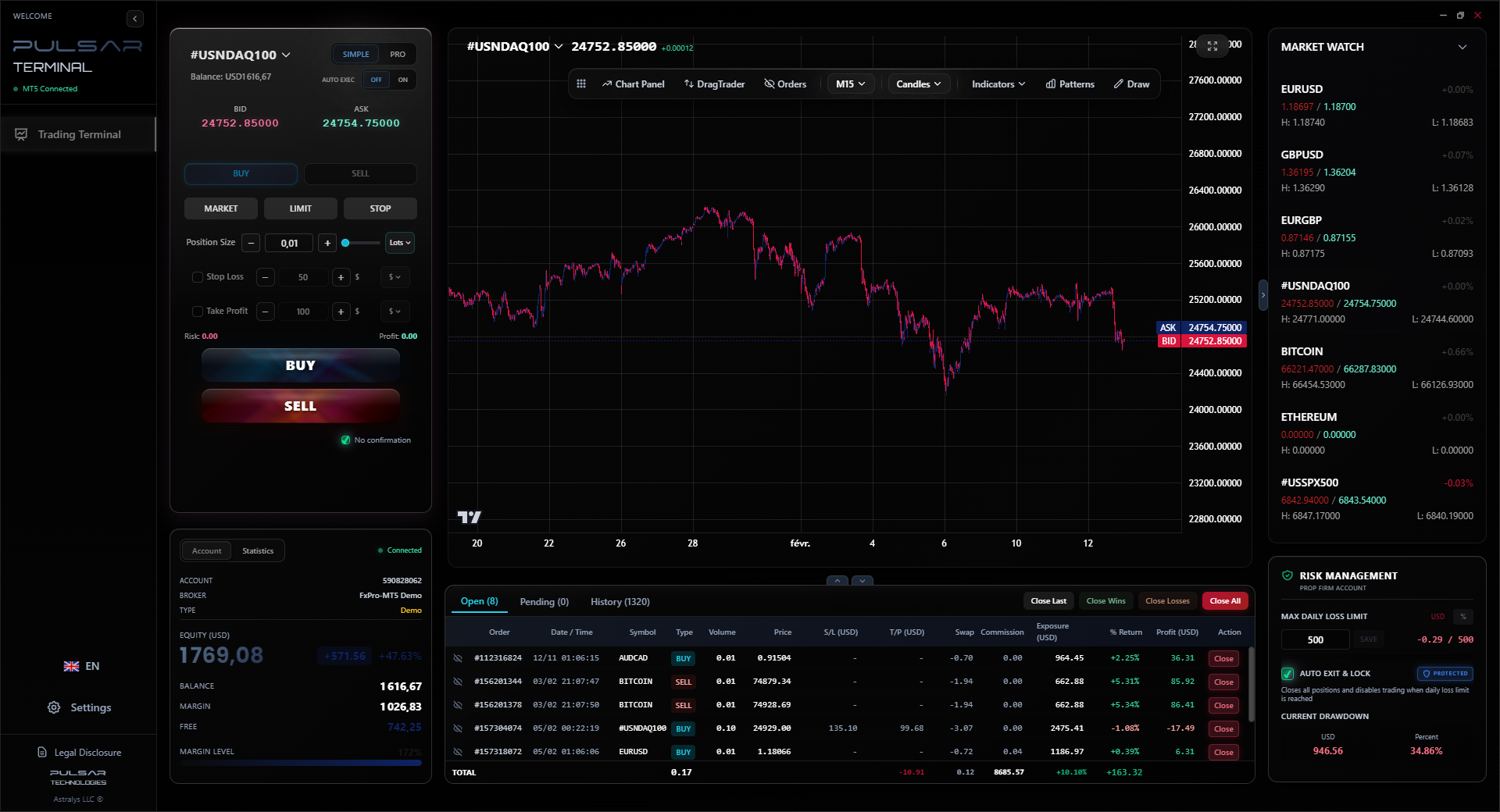
Managing the insane volatility of a GDP news trade requires precision tools; Pulsar Terminal's drag-and-drop orders and one-click partial closures let you secure profits and adjust stops faster than the market can reverse.
Pulsar Terminal
เครื่องมือ MT5 ครบวงจร: ลากวางคำสั่ง, multi-TP/SL, trailing stop, grid trading, Volume Profile และการป้องกัน prop firm ใช้งานโดยเทรดเดอร์กว่า 1,000 คนทุกวัน
Understanding what is GDP in forex is useless if you don't understand the local costs of trading it. Let's talk Naira and Kobo.
Taxes: The FIRS wants its share. You're liable for a 10% Capital Gains Tax on your gross trading profits. This is on you to declare. Most international brokers won't withhold it. Keep careful records. A N1,000,000 profit means a N100,000 tax bill. Factor this into your risk-reward calculations.
Costs: Your main cost is the spread. For majors like EUR/USD, expect 0.8 to 1.5 pips on a standard account. For exotic pairs involving NGN, spreads can be much wider - 10 pips or more. That's a huge hurdle. Always check the live spread before entering a trade. Commissions on ECN accounts are usually around $3.50 per 100k lot round turn. Use a broker with transparent pricing. I've found the raw spreads from Pepperstone or XM to be consistently among the best for active trading.
Platforms & Payments: MT4 and MT5 are kings here. They're familiar, stable, and supported by almost every broker. For funding, the landscape is good: bank transfers, cards, and e-wallets like Skrill and Neteller work. Some brokers even offer direct NGN accounts, which can simplify things but always check the conversion rates they use. Withdrawal fees vary; e-wallets are usually cheapest and fastest.
use: It's a trap dressed as an opportunity. Offshore brokers might offer you 1:500 or even 1:1000. Just because you can, doesn't mean you should. Trading a volatile news event like GDP with high use is a guaranteed margin call. I never use more than 1:50 for news trades, and even that feels risky.
💡 เคล็ดลับจาก Winston
In Nigeria, the difference between the GDP number and the parallel market exchange rate is the market's report card on the data's credibility. Watch that gap.
“In Nigeria, a GDP beat driven only by oil is like a salary boost that goes straight to debt repayment - it looks good on paper but doesn't change your life.”
The first release is the 'advance' estimate. It's often based on incomplete data and gets revised - sometimes massively. Trading the first print is gambling. The 'final' GDP reading, released a quarter later, is more accurate but by then the market has moved on.
You must dissect the components:
- Consumer Spending: Are Nigerians confident and spending? This is a key growth driver.
- Business Investment: Are companies expanding? This signals future productivity.
- Government Spending: Often less sustainable. A GDP boost from election-year spending is a red flag.
- Net Exports: (Exports - Imports). Crucial for Nigeria. A positive contribution here (surplus) is great for Naira demand.
Also, watch the GDP deflator. It's a measure of inflation within the GDP report. A high deflator means growth is nominal (just higher prices), not real (more goods produced). The CBN hates that. It could signal more aggressive rate hikes than the headline GDP growth suggests.
Technical analysis can help time your entry around these fundamentals. Using the MACD indicator on a 4-hour chart to gauge momentum before a release can help you avoid fading a strong underlying trend.
Let me be vulnerable. I've blown up parts of my account trading economic data. Here's my hall of shame:
-
Trading the Rumor, Then the News: Ahead of a big GDP, there's always chatter. I once went long USD/NGN on 'whispers' of a terrible number. The actual number was bad, but not catastrophic. The market had already priced it in. It was a classic 'buy the rumor, sell the news' event. I bought the rumor and the news, and got caught in the sell-off. Lost 2% of the account in 3 minutes.
-
Ignoring Revisions: I took a nice profit on a short EUR/USD trade after a weak German GDP print. Two months later, that figure was revised significantly higher. I didn't notice. The underlying trend had shifted, but I was still biased short from the old, wrong data. Missed a whole bullish trend.
-
Forgetting the Big Picture: In early 2024, a decent Nigerian GDP print came out. I went long Naira. But I ignored the fact that the Federal Reserve was in a massively hawkish cycle, sucking dollars back to the US. The global dollar strength overwhelmed the local positive data. My stop-loss got taken out. Lesson: Never trade local data in a vacuum. Always overlay the global macro picture, especially the US dollar trend.

Pro Tip: Create a simple checklist for every major data trade: 1) What is the consensus? 2) What is the recent trend of this data? 3) What is the broader market sentiment (risk-on/off)? 4) What is my max risk (in Naira)? 5) Where are my profit targets and stop-loss? No checklist, no trade.
“The best trade around a GDP release is sometimes the one you don't take.”
GDP tells you what already happened. To anticipate what GDP will be, you need leading indicators. These often move markets more subtly in the weeks before the GDP release.
| Indicator | What It Measures | Why It Matters for Naira |
|---|---|---|
| Purchasing Managers' Index (PMI) | Business activity in manufacturing/services. A reading above 50 = expansion. | Shows real-time economic health. A rising PMI hints at strong future GDP, can boost Naira sentiment. |
| Consumer & Business Confidence Surveys | How optimistic people/companies are. | Confidence leads to spending and investment, which drives future GDP. |
| Monthly Crude Oil Production & Price | Nigeria's lifeblood. | Directly forecasts the export component of GDP. Track this like your bank balance. |
| Inflation Rate (CPI) | Pace of rising prices. | The CBN's main enemy. High CPI forces rate hikes, which can support Naira even if growth is slowing. |
Combine these. If PMIs are falling, oil production is down, but GDP comes in strong, be deeply suspicious. The data is conflicting. The safest trade might be no trade at all. Sometimes, the best edge is knowing when to sit on your hands. I use the RSI indicator to identify overbought/oversold conditions in the pairs I track, which helps me avoid entering on a potential GDP move when the price is already exhausted.
💡 เคล็ดลับจาก Winston
If you wouldn't explain the components of the GDP report to a friend, you have no business trading it. Blind trading is gambling.
So, should you trade GDP? My honest advice for most Nigerian traders: don't make it your core strategy. It's a high-difficulty, low-frequency event. The pros have faster data, better analysis, and co-located servers. You're at a disadvantage.
A Better Approach:
- Use GDP for Context, Not Entries. Let the GDP report tell you the story of the economy. Is it strengthening or weakening? Use that to determine your medium-term bias for the Naira. Then, use technical analysis on lower timeframes to find better, less chaotic entry points.
- Trade the Aftermath, Not the Chaos. The market often overreacts. Wait 30-60 minutes after the release. Let the initial spike and reversal settle. Look for a clear technical pattern (like a support/resistance hold or a breakout retest) before entering. The risk is lower, and the move can be more sustainable.
- Focus on the Trend GDP Creates. A series of strong or weak GDP reports changes the central bank's narrative. If two quarters of strong, diversified GDP growth pile up, the CBN's path is clearer. That establishes a multi-week or multi-month trend you can trade with less stress using classic swing trading techniques.
, understanding what is GDP in forex is about understanding a story. It's one chapter in the long book of a currency's value. Read it carefully, but don't bet your entire account on a single sentence. Manage your risk, know your costs, and always, always respect the volatility. The market will be there tomorrow. Make sure your account is too.
FAQ
Q1When is Nigeria's GDP data released?
Nigeria's National Bureau of Statistics (NBS) typically releases quarterly GDP figures about two months after the end of the quarter. For example, Q1 (Jan-Mar) data is usually published in mid-to-late May. Always check an economic calendar for the exact date and time.
Q2Does a high GDP always mean a stronger Naira?
Not always. It depends on the source of growth. If GDP is high solely due to high oil prices, but domestic inflation is raging and dollar demand remains unmet, the Naira can still weaken. The market looks at the quality and sustainability of growth, not just the headline number.
Q3What's more important for the Naira, GDP or interest rates?
In the short term, interest rate decisions (and expectations of them) are almost always more important. GDP is a key input that influences the Central Bank's interest rate decisions. So, trade GDP based on what it means for future interest rate policy.
Q4Can I trade GDP with a small account?
It's extremely risky. The volatility can easily hit your stop-loss or cause significant slippage. If you must, use a micro lot (0.01) and reduce your position size drastically. It's better to use a demo account to practice first.
Q5What is the difference between real GDP and nominal GDP?
Nominal GDP measures the value of output using current prices. Real GDP adjusts for inflation, using the prices from a base year. Real GDP is the true measure of economic growth. Always look at the real GDP figure when trading.
Q6How do I manage risk trading GDP news?
Use a smaller position size, set tight stop-losses, and consider using a guaranteed stop-loss if your broker offers it (it costs extra but prevents slippage). The best risk management is often to wait for the initial volatility to settle before entering.
บทเรียนจาก Prof. Winston
สรุปสาระสำคัญ:
- ✓GDP is a lagging indicator, often revised.
- ✓Trade the market's reaction, not your interpretation.
- ✓Always reduce position size for high-volatility news.
- ✓The CBN's next move is more important than the last GDP print.
บทความนี้มีประโยชน์แค่ไหน?
คลิกดาวเพื่อให้คะแนน
ข้อมูลเชิงลึกการเทรดรายสัปดาห์
การวิเคราะห์และกลยุทธ์รายสัปดาห์ฟรี ไม่มีสแปม
เกี่ยวกับผู้เขียน
Olumide Adeyemi
ผู้บุกเบิกการเทรดในแอฟริกาตะวันตก
หนึ่งในนักการศึกษาฟอเร็กซ์ที่กระตือรือร้นที่สุดของไนจีเรีย 8 ปีประสบการณ์เทรดจากลากอส เชี่ยวชาญกลยุทธ์ทุนต่ำและความท้าทาย prop firm สำหรับเทรดเดอร์ในแอฟริกา
ความคิดเห็น
คำเตือนความเสี่ยง
การซื้อขายตราสารทางการเงินมีความเสี่ยงสูงและอาจไม่เหมาะสำหรับนักลงทุนทุกคน ผลการดำเนินงานในอดีตไม่ได้รับประกันผลลัพธ์ในอนาคต เนื้อหานี้มีวัตถุประสงค์เพื่อการศึกษาเท่านั้นและไม่ควรถือเป็นคำแนะนำในการลงทุน โปรดทำการวิจัยของคุณเองก่อนการซื้อขาย
คุณอาจชอบสิ่งนี้

Cara Trading Forex Sukses: 7 Prinsip dari Trader Profesional
Cara trading forex sukses dengan 7 prinsip trader pro: manajemen modal, disiplin, journal trading, backtest. Data nyata, bukan janji profit palsu.
Jam Trading Forex Terbaik untuk Trader Indonesia: Panduan Lengkap dengan Tabel Waktu
Panduan jam trading forex untuk trader Indonesia. Tabel 4 sesi dunia, jam emas 20:00-00:00, sesi mana yang harus dihindari. Data akurat + tips dari trader berpengalaman.
Top 5 Sàn Forex Uy Tín Nhất 2026: Review Jujur dari Trader Indonesia
Top 5 sàn forex uy tín 2026 untuk trader Indonesia. Review jujur: spread, deposit, withdraw, dukungan lokal. Exness, XM, IC Markets & lebih.
รับ Pulsar Terminal
เครื่องคำนวณทั้งหมดนี้ถูกสร้างไว้ใน Pulsar Terminal พร้อมข้อมูลเรียลไทม์จากบัญชี MT5 ของคุณ
รับ Pulsar Terminal