


Most trading guides get it wrong.

David van der Merwe
เทรดเดอร์ตลาดเกิดใหม่ ·  South Africa
☕ 11 นาทีอ่าน
สิ่งที่คุณจะได้เรียนรู้:
Most trading guides get it wrong. They'll tell you what moves the forex market is economic data and central banks. That's only half the story, and for a South African trading the Rand, it's the less important half. The real engine is a brutal, emotional tug-of-war between fear and greed, amplified tenfold for an emerging market currency like ours. If you think trading USD/ZAR is just about watching the Fed, you're going to lose money. I'll show you the real forces at play, how they hit your trades, and why understanding this is the only way to survive.
Forget the textbook answers. When we ask what moves the forex market on a global scale, three forces dominate everything else. They're the background noise that sets the stage for every pair, especially volatile ones like ZAR crosses.
The Dollar's Shadow
The US Dollar is the sun in our solar system. Everything else orbits it. When the USD strengthens, it sucks capital out of riskier assets and currencies. For the Rand, a strong dollar is like a vacuum cleaner on our reserves. I learned this the hard way in 2022. I was long on EUR/ZAR, thinking European strength would carry it. I ignored the sheer, relentless power of a Fed hiking cycle. The Dollar Index (DXY) ripped higher, and my trade got obliterated, losing 4.2% of my account in a week. The lesson? Always check the dollar's pulse first. A simple tool like the MACD indicator on the DXY chart can tell you more about market direction than a dozen ZAR-specific news reports.
The World's Mood (Risk-On vs. Risk-Off)
This is the emotional layer. Is the world feeling greedy or scared? You can see it in the stock market (S&P 500), bond yields, and the VIX 'fear index'. When fear takes over - think banking crises, wars, or recessions - investors flee to safe havens like the USD, JPY, and Swiss Franc. They sell everything else. The ZAR, as an emerging market currency, gets sold hard. I don't trade this with complex analysis. I keep a simple chart of the S&P 500 next to my USD/ZAR chart. If the S&P is making lower lows and looking sick, I'm not touching a long ZAR trade with a ten-foot pole. It's that simple.
The Commodity Connection
This is where South Africa gets personal. Our economy lives and dies by what comes out of the ground. Gold, platinum, palladium, coal. When commodity prices rally, the countries that dig them up see their currencies benefit. There's a direct, if sometimes laggy, correlation. But here's the catch: most commodities are priced in Dollars. So if gold goes up because the dollar is weak, ZAR might get a double boost. If gold goes up due to panic buying, the dollar might also be strong, and the effects cancel out. You have to untangle the cause.

Example: Let's say Platinum jumps 5% in a day. Historically, this could translate to a 1-2% appreciation in ZAR against a basket of currencies, all else being equal. But if that same day the Fed hints at rate hikes, the dollar strength might completely override the platinum move. Trading requires weighing these competing forces.
This is our home game. Understanding what moves the forex market here is about local ingredients that can make global trends scream or whisper.
Politics & Policy: The Ever-Present Noise
Eskom. Load shedding. Cabinet reshuffles. Coalition drama. For international money managers, South African politics is a source of constant background risk. A major political shock (and we have them) can cause a sudden 3-5% drop in ZAR faster than you can say 'state capture'. This isn't about your analysis being right or wrong; it's about unpredictable events. I got caught in the 2021 July unrest. I was in a profitable swing trading position on USD/ZAR short. Overnight, riots erupted. The pair gapped up 400 pips at the Sunday open, blowing through my stop loss and then some. The trade was technically sound, but locally unhinged. You must always factor in a 'political risk premium' on your ZAR trades.
SARB vs. The World
The South African Reserve Bank is our last line of defence. When they hike rates to fight inflation, it can support the Rand by offering better yields. But it's a relative game. If the SARB hikes by 0.5% but the Fed hikes by 0.75%, we're still losing the yield differential battle. Watch the real interest rate (interest rate minus inflation). If ours is deeply negative and the US's turns positive, money has a mathematical reason to leave. The SARB's tone is also key. A hawkish governor can provide temporary support, but they're often paddling against a global tide.
The Hard Data: GDP, Inflation, Trade
These are the report cards. A terrible GDP print or soaring CPI will hurt confidence. But here's a secret: the market often prices in the expectation before the number drops. The real volatility comes from the miss or beat versus consensus. I remember trading the USD/ZAR around a CPI print a few years back. The expectation was 5.6%. The actual came in at 6.2%. The pair spiked 150 pips in 90 seconds. I was on the right side because I'd placed a strategic buy order just above the range in anticipation of a miss. The number itself was less important than the market's surprise.

💡 เคล็ดลับจาก Winston
The market doesn't care about your opinion on politics. It only cares about capital flows. Trade the flow, not the flaw.
“If you think trading USD/ZAR is just about watching the Fed, you're going to lose money.”
What moves the forex market isn't just news; it's the literal plumbing of the market itself. For a South African, this matters more because our main pairs are often less liquid.
The ZAR Spread Trap
Trading EUR/USD? You might get a 0.8 pip spread. Trading EUR/ZAR? Buckle up. Spreads of 14-20 pips are common during active hours. They can balloon to 40+ pips overnight or during low liquidity. This means your trade is down 14 pips the second you enter. You need a move just to break even. I've seen new traders use a scalping strategy on USD/ZAR, trying to grab 10 pips. With a 5-pip spread and commission, they need a 7-pip move just to make a pathetic 3-pip profit. The math murders you. Always, always factor the spread into your potential profit. If your target is only 20 pips away on USD/ZAR, the spread eats 25% of your potential reward before you start. It's a terrible trade.
Liquidity Dry-Ups
When major banks in London or New York are closed, liquidity for ZAR pairs evaporates. This often happens between 10 PM and 7 AM SA time. During these windows, a moderately sized order can move the price disproportionately. I once had a stop loss hunted so obviously it was painful. The price spiked 25 pips on no news, took out a cluster of stops (including mine), and immediately reversed. It was a classic low-liquidity move. The solution? Don't leave tight stops on ZAR pairs overnight unless you're willing to pay the 'night guard' fee.

Warning: Never, ever trade ZAR pairs around local public holidays like Heritage Day or around major bank holidays in the US/UK. The liquidity is so thin that the spread is a robbery fee. Just walk away.
Knowing what moves the forex market is useless if you don't change your behaviour. Here’s how I apply this knowledge.
Filter Your Trades with a Macro Checklist
Before I even look at a chart for a ZAR trade, I run a mental checklist:
- DXY Trend: Is the dollar in a clear uptrend on the daily chart? If yes, be very cautious with shorting USD/ZAR.
- Global Sentiment: Are global stocks selling off? If it's a sea of red, long ZAR trades are fighting the current.
- Commodity Watch: Are our key export prices (gold/platinum) trending with or against the ZAR move I'm considering?
- Local Event Calendar: Is there a SARB meeting, budget speech, or high-impact data due in the next 24 hours?
If two or more of these are against my intended direction, I scrap the trade. No matter how pretty the chart looks.
Position Sizing for Volatility
ZAR pairs are 3-5 times more volatile than EUR/USD on a normal day. Your position size calculator inputs must reflect that. If you usually risk 1% on a major pair, for USD/ZAR, consider risking 0.5% or even 0.25% for the same stop distance. The swings will test your psychology. A R10,000 account shouldn't be trading more than a micro lot (0.01) on USD/ZAR unless you have a very wide stop. I learned this after a single USD/ZAR trade swung 2% against me (unrealized) and I panicked, closing for a loss right before it reversed to my target. My size was too big for my nerves.
Timeframe Selection
Trying to day trade ZAR pairs off 1-minute charts is a special kind of torture. The spreads and erratic moves will chew you up. I've had the most consistent results using 4-hour and daily charts for direction, and then using 1-hour or 30-minute charts for finer entry timing. This lets you ride the bigger trends driven by the macro forces we discussed, rather than getting whipsawed by every minor liquidity blip.
💡 เคล็ดลับจาก Winston
A wide stop loss isn't a sign of a bad trade. On volatile pairs, it's often the sign of a smart trader who understands the [landscape](/en/glossary/spread).
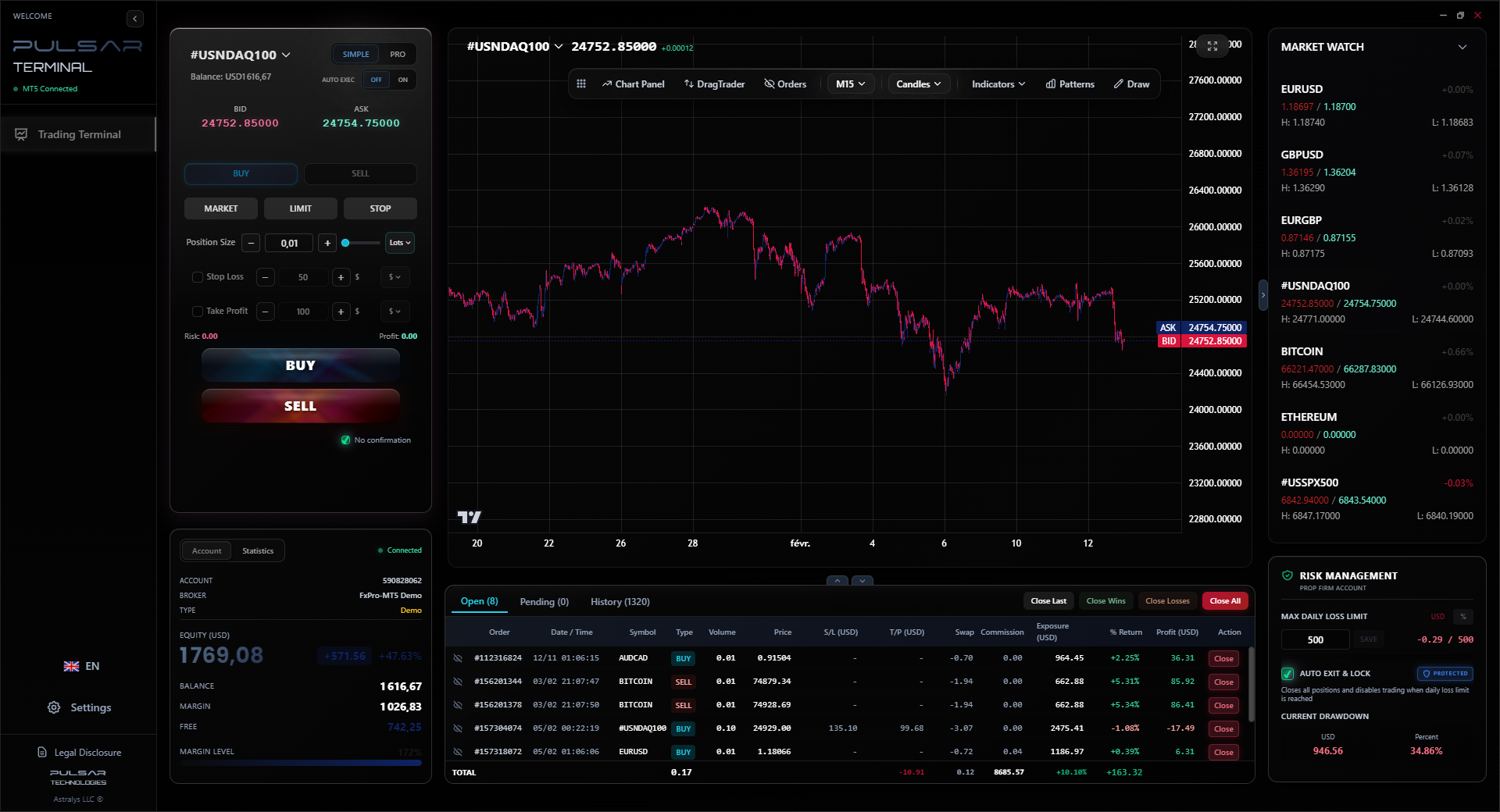
Managing multiple trades on volatile pairs like USD/ZAR is stressful, but tools like Pulsar Terminal let you set multi-level take-profits and trailing stops directly on your MT5 chart, so you can lock in gains as the market swings.
Pulsar Terminal
เครื่องมือ MT5 ครบวงจร: ลากวางคำสั่ง, multi-TP/SL, trailing stop, grid trading, Volume Profile และการป้องกัน prop firm ใช้งานโดยเทรดเดอร์กว่า 1,000 คนทุกวัน
“Local news is a ripple. Global macro is the tsunami. Bet on the tsunami.”
You can't talk about trading here without understanding the rules. They directly impact what you can do and with whom.
The FSCA is your friend. They're the main regulator, and using an FSCA-licensed broker is non-negotiable. This ensures client money segregation and a recourse if things go south. The big change was the 2021 use cap of 30:1 for retail clients. Some global brokers with FSCA licenses, like Exness or XM, still offer higher use to South African clients under different licensing, but the trend is towards lower use. This is a good thing. High use on volatile ZAR pairs is a guaranteed account destroyer.
Then there's exchange control. You have a R1 million Single Discretionary Allowance and a R10 million Foreign Investment Allowance (with tax clearance). For most traders starting out, this is plenty. But you must declare your trading as investment activity. Moving profits back to SA is straightforward through your authorized dealer. The key is paperwork. Keep every deposit, withdrawal, and statement. SARS will want to see it.
Choosing a broker? Look beyond the flashy ads. For ZAR trading, you need a broker with reliable execution during our volatility spikes and fair spreads. I've found brokers like IC Markets and Pepperstone to have strong systems. Crucially, check their specific ZAR pair spreads and whether they offer ZAR-based accounts to avoid conversion fees. A 1.2% conversion fee on every deposit and withdrawal is a silent killer of returns.
Let's get blunt. Here are the mistakes that cost me real money, all tied to misunderstanding what moves our market.
Pitfall 1: Trading ZAR Like a Major Pair. My first big loss was treating USD/ZAR like EUR/USD. I used a 20-pip stop loss. It was taken out by a routine wiggle before the price sailed to my original target. Volatility requires wider stops, which means smaller position sizes. It's a fundamental adjustment.
Pitfall 2: Ignoring the Global Clock. I entered a trade just before the London close. A piece of US news hit, liquidity vanished, and the spread on my EUR/ZAR trade widened from 16 pips to 45 pips in seconds. I was instantly in a huge hole. Now I only trade ZAR pairs during overlapping London and SA hours (9 AM - 5 PM SA time) for the best liquidity.
Pitfall 3: Over-Indexing on Local News. I once went all-in shorting USD/ZAR because a local political figure gave a great speech. The Rand strengthened for two hours. Then a US inflation number came out hot, and the global dollar wave crushed my trade. Local news is a ripple. Global macro is the tsunami. Bet on the tsunami.
Pitfall 4: Chasing Illiquidity. Trying to trade exotic crosses like GBP/ZAR or AUD/ZAR is a nightmare. The spreads are criminal, and the moves can be irrational. Stick to USD/ZAR and EUR/ZAR. They have the deepest liquidity and the most predictable (relatively) behaviour.

Pro Tip: Keep a trading journal. Note down not just your entry and exit, but the global context: 'DXY was falling, risk-on mood, but ahead of SARB meeting.' Over time, you'll see patterns in what market conditions lead to your wins and losses. This is more valuable than any indicator.
💡 เคล็ดลับจาก Winston
Your first job is to protect your capital. Your second job is to grow it. Most traders get this order backwards and wonder why they're broke.
FAQ
Q1What is the most important factor moving the ZAR right now?
It's almost always a combination, but in 2024, the single largest factor is the interest rate differential between South Africa and the United States. If the Fed keeps rates 'higher for longer' while SA growth struggles, the yield advantage attracts capital away from the Rand. Global risk appetite is a very close second.
Q2Is it illegal to use an international broker not regulated by the FSCA?
It's not illegal for you as a South African resident to use a broker regulated overseas (like ASIC or CySEC). However, you lose the direct protection of the FSCA and may face complications with depositing and withdrawing Rands. It also may be against that broker's terms of service. Using an FSCA-licensed broker is strongly recommended for simplicity and safety.
Q3Why does the USD/ZAR move so much when there's no news?
There's almost always 'news' in the form of large institutional order flow, shifts in global bond markets, or options-related hedging. For retail traders, it looks like random noise. Often, big moves happen when London or New York traders react to flows in other emerging markets, which then spill over into the ZAR. Low liquidity periods also exaggerate any move.
Q4How much money do I need to start trading forex in South Africa?
You can start with as little as R500 or R1000 with some brokers on a micro account. But realistically, with ZAR pair spreads being wide, you need enough capital so that your position size is sensible. I'd suggest a minimum of R5,000 to have any room for proper risk management without being wiped out by a few bad trades.
Q5What's a swap/rollover fee, and how does it affect my ZAR trades?
A swap is the interest you pay or earn for holding a position overnight. It's based on the interest rate difference between the two currencies. If you're long USD/ZAR (buying USD, selling ZAR), you are borrowing ZAR (at the SARB rate) to buy USD (earning the Fed rate). If US rates are higher than SA rates, you might earn a small daily credit. If SA rates are higher, you pay. Over long-term holds, this can add up or eat into profits.
Q6Can I make a living trading forex in South Africa?
The vast majority of people lose money. The ones who succeed treat it like a professional business, not a gamble. They have significant starting capital (R200,000+), rigorous risk management (risking 0.5-1% per trade), and a proven, disciplined strategy. They also have years of experience losing money first. It's an extremely tough path and not a reliable get-rich-quick scheme.
บทเรียนจาก Prof. Winston
สรุปสาระสำคัญ:
- ✓Always check the Dollar Index (DXY) trend first.
- ✓ZAR pairs need 3-5x wider stops than majors.
- ✓Trade ZAR during London/SA overlap for liquidity.
- ✓Factor the wide spread into your profit target.
บทความนี้มีประโยชน์แค่ไหน?
คลิกดาวเพื่อให้คะแนน
ข้อมูลเชิงลึกการเทรดรายสัปดาห์
การวิเคราะห์และกลยุทธ์รายสัปดาห์ฟรี ไม่มีสแปม
เกี่ยวกับผู้เขียน
David van der Merwe
เทรดเดอร์ตลาดเกิดใหม่
เทรดเดอร์ประจำโจฮันเนสเบิร์ก มีประสบการณ์ 11 ปีในสกุลเงินตลาดเกิดใหม่ เชี่ยวชาญคู่ ZAR การเทรดภายใต้กฎระเบียบ FSCA และการวิเคราะห์ตลาดแอฟริกาใต้
ความคิดเห็น
คำเตือนความเสี่ยง
การซื้อขายตราสารทางการเงินมีความเสี่ยงสูงและอาจไม่เหมาะสำหรับนักลงทุนทุกคน ผลการดำเนินงานในอดีตไม่ได้รับประกันผลลัพธ์ในอนาคต เนื้อหานี้มีวัตถุประสงค์เพื่อการศึกษาเท่านั้นและไม่ควรถือเป็นคำแนะนำในการลงทุน โปรดทำการวิจัยของคุณเองก่อนการซื้อขาย
คุณอาจชอบสิ่งนี้

Cara Trading Forex Sukses: 7 Prinsip dari Trader Profesional
Cara trading forex sukses dengan 7 prinsip trader pro: manajemen modal, disiplin, journal trading, backtest. Data nyata, bukan janji profit palsu.
Jam Trading Forex Terbaik untuk Trader Indonesia: Panduan Lengkap dengan Tabel Waktu
Panduan jam trading forex untuk trader Indonesia. Tabel 4 sesi dunia, jam emas 20:00-00:00, sesi mana yang harus dihindari. Data akurat + tips dari trader berpengalaman.
Top 5 Sàn Forex Uy Tín Nhất 2026: Review Jujur dari Trader Indonesia
Top 5 sàn forex uy tín 2026 untuk trader Indonesia. Review jujur: spread, deposit, withdraw, dukungan lokal. Exness, XM, IC Markets & lebih.
รับ Pulsar Terminal
เครื่องคำนวณทั้งหมดนี้ถูกสร้างไว้ใน Pulsar Terminal พร้อมข้อมูลเรียลไทม์จากบัญชี MT5 ของคุณ
รับ Pulsar Terminal