


Most new traders in Nigeria think the forex market 'opens' at 8 AM Lagos time.

Olumide Adeyemi
ผู้บุกเบิกการเทรดในแอฟริกาตะวันตก ·  Nigeria
☕ 9 นาทีอ่าน
สิ่งที่คุณจะได้เรียนรู้:
- 1The Market Never Closes (But Your Brain Should)
- 2The Four Sessions: Your WAT Cheat Sheet
- 3The Best (and Worst) Time to Place a Trade in Nigeria
- 4The Friday Shutdown & Weekend Gap Danger
- 5Matching the Economic Calendar to the Sessions
- 6Building a Nigerian Trader's Daily Schedule
- 7How Trading at the Wrong Time Blows Accounts

Most new traders in Nigeria think the forex market 'opens' at 8 AM Lagos time. They're wrong, and that misunderstanding costs them money. The truth is, the market never closes, but your chances of success do. If you're trading at the wrong time, you're basically fighting with one hand tied behind your back. I'll show you the real schedule, the hidden overlaps where the big moves happen, and the quiet hours where you should just walk away.
Let's get this straight first. The global forex market is a 24-hour beast from Sunday night to Friday night. There's no opening bell like the stock exchange. Instead, it's a relay race where one major financial center hands off to the next. For us in Nigeria on West Africa Time (WAT), this means the action is always happening somewhere, day or night.
The problem? Just because you can trade at 2 AM doesn't mean you should. I learned this the hard way. Back in 2018, I was obsessed with catching the Sydney session open. I'd set my alarm for 10 PM Sunday, bleary-eyed, trying to scalp the AUD/USD. After three months of this, my account was down 15%, and my sleep schedule was ruined. The spreads were wide, the moves were erratic, and my decision-making was terrible. I was trading a ghost market.

Warning: Trading outside your natural waking hours is a guaranteed path to poor decisions. Fatigue is a silent account killer.
The real skill isn't knowing the clock times, it's knowing which hours contain real opportunity versus which are just noise. Your first job is to match the market's rhythm to your own life, not the other way around.
Here’s the breakdown in our time zone. Bookmark this.
| Session | Major Center | WAT (West Africa Time) | Key Pairs | Typical Character |
|---|---|---|---|---|
| Sydney | Australia | 10:00 PM – 7:00 AM | AUD, NZD | Quiet, low liquidity. Often just range-bound. |
| Tokyo | Japan | 12:00 AM – 9:00 AM | JPY pairs (USD/JPY) | Can see volatility. Good for Asian session strategies. |
| London | UK/Europe | 8:00 AM – 5:00 PM | EUR, GBP, CHF | The main event. Highest volume. Strong trends. |
| New York | USA | 1:00 PM – 10:00 PM | USD, CAD, (all majors) | High volume, reacts to US data. Drives afternoon moves. |
Notice something perfect for Nigerian traders? The London session kicks off right at 8 AM, a normal start to the workday. The New York session joins in at 1 PM. That overlap from 1 PM to 5 PM WAT is the golden window. It's when over 70% of all daily forex transactions happen. The spread on majors like the EUR/USD is at its tightest, and momentum is real.
If you only have one hour to trade, make it during that London-New York overlap. Everything else is secondary. The Tokyo session can be useful if you're a night owl, but for most, it's not worth restructuring your life around.

💡 เคล็ดลับจาก Winston
Your edge isn't a secret indicator. It's the discipline to only trade when the London and New York desks are at their desks. Everything else is noise you're paying to listen to.
“The single biggest edge you have as a retail trader is choosing when to play the game.”
The Sweet Spot: 8 AM - 5 PM WAT
This is your bread and butter. Your entire trading plan should be built around this window. Economic data from Europe and the UK drops in the morning (8-10 AM WAT). US data hits between 1:30 PM and 3 PM WAT. This is when markets actually move on fundamentals, not just whipsaw on thin liquidity.
I built my first six-figure account strictly trading between 9 AM and 4 PM. I treated it like a job. In by 8:30 to analyze, ready for the European open. The consistency of being sharp during high-probability hours cannot be overstated.
The Dead Zone: 5 PM - 10 PM WAT (Late New York)
After London closes at 5 PM, volume drops sharply. The New York afternoon is often directionless. It's when markets consolidate or make fake breakouts. I've been chopped up more times than I can count trying to trade the "last move" of the day. Now, I flat all my positions by 5:30 PM. The risk/reward just isn't there.
The Trap: 10 PM - 7 AM WAT (Sydney/Tokyo Overlap)
This is the siren song for new traders. "I'll trade after my day job!" The spread on EUR/USD might be 3 pips instead of 0.8. A news spike from New Zealand can rock the boat with no follow-through. It's like trading in shallow water; you can get stuck on the bottom easily.

Pro Tip: Use off-hours for analysis, not execution. Plan your next day's trades between 10 PM and 12 AM. Your future self will thank you.
The single biggest edge you have as a retail trader is choosing when to play the game. The pros have to be in the market. You don't. Use that freedom.

The market 'closes' for us around 10 PM WAT on Friday when New York wraps up. It reopens at 10 PM WAT on Sunday with Sydney. That 48-hour gap is where risk lurks.
Geopolitical events, central bank announcements, or unexpected economic data can happen over the weekend. When the market reopens Sunday night, the price can literally jump to a new level, skipping over your stop loss. This is a gap.
I learned about gaps in the most expensive way possible. In early 2020, I was long GBP/USD over a weekend. Some Brexit headline hit the wires on a Saturday. Sunday night, the pair opened 80 pips below my stop loss. My broker executed the stop at the first available price, which was already past it. I lost 30% more than I had planned on that single trade. It was a brutal lesson in event risk.
Warning: Holding positions over the weekend is a speculative gamble, not a trade. Unless you have a very specific, high-conviction swing trading thesis, close out by Friday afternoon.
Most serious traders I know are flat by 5 PM WAT on Friday. They protect their capital and sleep easy. The few pips of potential gain are never worth the catastrophic risk of a weekend gap. This is non-negotiable for capital preservation.
💡 เคล็ดลับจาก Winston
If you wouldn't schedule an important business meeting for 3 AM, don't schedule a trade then. Price action needs an audience, and the audience is asleep.
“Holding positions over the weekend is a speculative gamble, not a trade.”
Knowing the time is useless if you don't know what's scheduled. High-impact news creates the volatility that makes or breaks trades.
London Session (8 AM - 1 PM WAT): This is for Euro and Pound news. Key releases:
- 8 AM WAT: German/European data (CPI, GDP, ZEW Survey)
- 9:30 AM WAT: UK Inflation, Retail Sales, GDP
London-New York Overlap (1 PM - 5 PM WAT): The volatility peak. US data dominates:
- 1:30 PM WAT: US CPI, Retail Sales, NFP (first Friday of month)
- 3 PM WAT: US Consumer Confidence, Existing Home Sales
- Any FOMC Rate Decision: Usually 7 PM WAT, creates massive moves.
Here's a concrete example. On a typical NFP day, I won't place a new trade after 12:30 PM WAT. I'll either be in a position already, waiting for the news to hit my target, or I'll be flat, waiting for the initial spike to settle. Trying to jump in as the number prints is a recipe for getting stopped out by the whipsaw. I use a position size calculator to ensure my risk is tiny during these events, usually 0.5% of my account or less.
The calendar dictates the market's energy. Trading the London session without knowing German data is coming out is like driving blindfolded.

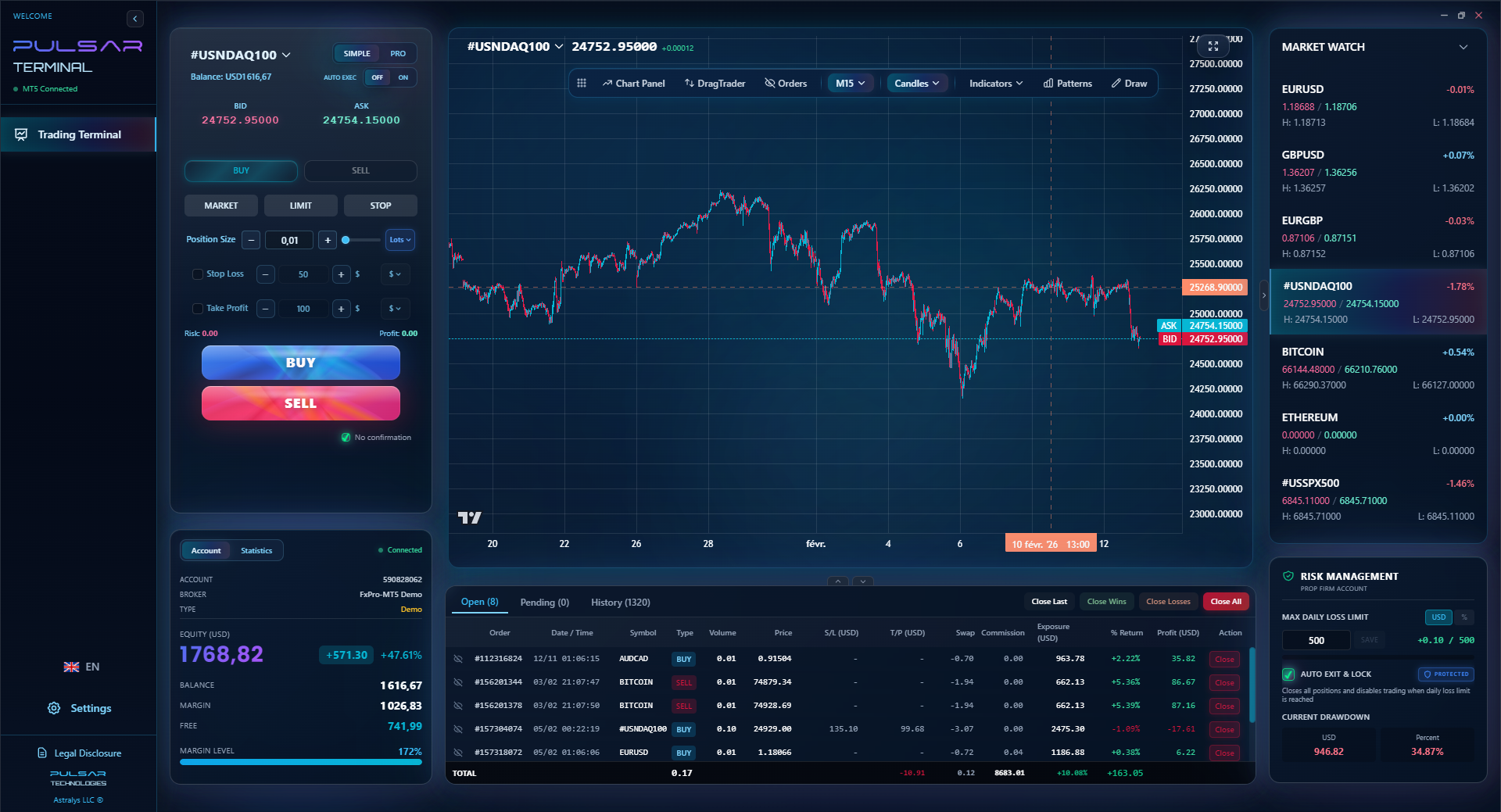
When high-impact news hits at 1:30 PM WAT, you need tools to manage risk instantly, like Pulsar Terminal's one-click breakeven and trailing stop features on MT5.
Pulsar Terminal
เครื่องมือ MT5 ครบวงจร: ลากวางคำสั่ง, multi-TP/SL, trailing stop, grid trading, Volume Profile และการป้องกัน prop firm ใช้งานโดยเทรดเดอร์กว่า 1,000 คนทุกวัน
Let's build a realistic day around a 9-5 job in Lagos.
6:30 AM - 8:00 AM: Preparation Hour. Coffee. Review the overnight price action (did Sydney/Tokyo do anything meaningful?). Scan the economic calendar for the day. Check your watchlist. No trading yet.
8:00 AM - 1:00 PM: London Session Focus. The market is now alive. Execute pre-planned setups. Monitor open positions. This is your primary trading window if you have a day job - try to focus during lunch breaks. A solid scalping strategy can work well here.
1:00 PM - 5:00 PM: Overlap & US Data. High alert. If you're in a trade, manage it. If not, be extremely selective about new entries, especially around 1:30 PM data. This is a great time to trail stops or take partial profits.
After 5:00 PM: Shutdown. Review the day's trades in a journal. Plan for tomorrow. Stop looking at the charts. The New York afternoon is a distraction.
This schedule respects the market's power hours and protects your capital during the weak ones. It turns the 24-hour market from an overwhelming monster into a manageable tool. A broker with reliable execution during these busy times is key, which is why I lean towards ones like IC Markets or Pepperstone for their liquidity.
💡 เคล็ดลับจาก Winston
The market gives you 6-8 good hours a day. Your job is to find 2-3 great setups within them. Trying to manufacture opportunity in the dead zones is how accounts get drained.

“Trading the London session without knowing German data is coming out is like driving blindfolded.”
Let's connect the dots. Why does timing cause blow-ups?
- Low Liquidity = Wider Spreads = Immediate Loss. Trading the Sydney session often means you're down 2-3 pips the second you enter from the spread. You're fighting an uphill battle before the price even moves.
- False Breakouts. In thin markets (evenings, nights), a moderate buy order can push price through a technical level. You buy the breakout, only for it to reverse instantly when London comes in and sees no real reason for the move. I've been caught in this trap dozens of times.
- Emotional Trading from FOMO. You wake up at 7 AM, see the EUR/USD has already moved 60 pips from the Tokyo session, and jump in late. You're chasing, entering at the worst possible price, just in time for the London traders to take profits. This is a classic margin call origin story.
- Fatigue-Induced Errors. Analyzing the MACD indicator or RSI indicator at 2 AM leads to misreads. You ignore your rules. You double down on a loser to "get back to even."
The data is clear. Over 80% of retail traders lose money. I'd bet a significant portion of those losses occur outside the London and overlap sessions. They're losing in the minor leagues, wondering why they can't compete. The market's schedule isn't a minor detail; it's the framework for your entire survival strategy.

FAQ
Q1What is the exact forex market open time on Sunday in Nigeria?
The forex market reopens for the new week at 10:00 PM West Africa Time (WAT) on Sunday with the Sydney session. However, liquidity is very low at this time, and it's not considered a good time to trade for most strategies.
Q2Can I trade forex at night in Nigeria?
Technically, yes. The Tokyo session runs from 12:00 AM to 9:00 AM WAT. But I strongly advise against it for most traders. The spreads are wider, moves can be erratic, and trading while tired leads to costly mistakes. It's better to use that time for analysis and sleep.
Q3What is the most volatile trading session for Nigerian traders?
The London-New York overlap, from 1:00 PM to 5:00 PM WAT, is the most volatile and liquid period. This is when the majority of global forex volume trades, leading to the cleanest trends and tightest spreads on major pairs.
Q4Should I close all my trades before Friday closes in Nigeria?
Absolutely. The market closes for the weekend around 10 PM WAT Friday. Holding trades over the weekend exposes you to gap risk, where the price can open significantly different on Sunday, blowing past your stop loss. Protect your capital and close out by late Friday afternoon.
Q5Is the forex market open on Saturdays in Nigeria?
No. The global interbank forex market is closed on Saturdays and Sundays. Any platform showing prices on Saturday is likely from a specific broker offering very limited CFD trading, not the real forex market. Do not trade then.
Q6What time do major US news releases come out in WAT?
Most high-impact US economic data (like CPI, NFP, Retail Sales) is released at 1:30 PM WAT. Fed announcements (FOMC) are usually at 7:00 PM WAT. Always check an economic calendar, as daylight saving time changes can shift these by an hour.
บทเรียนจาก Prof. Winston
สรุปสาระสำคัญ:
- ✓The 1 PM - 5 PM WAT overlap is where 70% of real volume trades.
- ✓Weekend gaps can blow through stops, risking 30%+ more than planned.
- ✓Spreads can triple in off-hours, putting you at an instant loss.
- ✓Schedule your trading like a job: 8 AM - 5 PM WAT is your office.
บทความนี้มีประโยชน์แค่ไหน?
คลิกดาวเพื่อให้คะแนน
ข้อมูลเชิงลึกการเทรดรายสัปดาห์
การวิเคราะห์และกลยุทธ์รายสัปดาห์ฟรี ไม่มีสแปม
เกี่ยวกับผู้เขียน
Olumide Adeyemi
ผู้บุกเบิกการเทรดในแอฟริกาตะวันตก
หนึ่งในนักการศึกษาฟอเร็กซ์ที่กระตือรือร้นที่สุดของไนจีเรีย 8 ปีประสบการณ์เทรดจากลากอส เชี่ยวชาญกลยุทธ์ทุนต่ำและความท้าทาย prop firm สำหรับเทรดเดอร์ในแอฟริกา
ความคิดเห็น
คำเตือนความเสี่ยง
การซื้อขายตราสารทางการเงินมีความเสี่ยงสูงและอาจไม่เหมาะสำหรับนักลงทุนทุกคน ผลการดำเนินงานในอดีตไม่ได้รับประกันผลลัพธ์ในอนาคต เนื้อหานี้มีวัตถุประสงค์เพื่อการศึกษาเท่านั้นและไม่ควรถือเป็นคำแนะนำในการลงทุน โปรดทำการวิจัยของคุณเองก่อนการซื้อขาย
คุณอาจชอบสิ่งนี้

Cara Trading Forex Sukses: 7 Prinsip dari Trader Profesional
Cara trading forex sukses dengan 7 prinsip trader pro: manajemen modal, disiplin, journal trading, backtest. Data nyata, bukan janji profit palsu.
Jam Trading Forex Terbaik untuk Trader Indonesia: Panduan Lengkap dengan Tabel Waktu
Panduan jam trading forex untuk trader Indonesia. Tabel 4 sesi dunia, jam emas 20:00-00:00, sesi mana yang harus dihindari. Data akurat + tips dari trader berpengalaman.
Top 5 Sàn Forex Uy Tín Nhất 2026: Review Jujur dari Trader Indonesia
Top 5 sàn forex uy tín 2026 untuk trader Indonesia. Review jujur: spread, deposit, withdraw, dukungan lokal. Exness, XM, IC Markets & lebih.
รับ Pulsar Terminal
เครื่องคำนวณทั้งหมดนี้ถูกสร้างไว้ใน Pulsar Terminal พร้อมข้อมูลเรียลไทม์จากบัญชี MT5 ของคุณ
รับ Pulsar Terminal