


I lost ₹1.2 lakh in about 20 minutes back in 2018.

Rajesh Sharma
นักวิเคราะห์ฟอเร็กซ์อาวุโส ·  India
India
☕ 9 นาทีอ่าน
สิ่งที่คุณจะได้เรียนรู้:
- 1The Big Misconception: It's Not *All* Illegal
- 2The Real "Why": Protecting the Rupee and You
- 3What Happens If You Get Caught? The Real Penalties
- 4Legal Alternatives: Trading INR Pairs Isn't So Bad
- 5Brokers: The Only Safe Choices
- 6The Noose is Tightening: Recent Crackdowns (2025-2026)
- 7Final Verdict: Should You Do It?

I lost ₹1.2 lakh in about 20 minutes back in 2018. It wasn't on the NSE. I'd funded an offshore broker with my credit card, chasing the 500:1 use they offered on EUR/USD. The trade went south, my margin got wiped, and the real headache started a month later. I got a letter from my bank asking me to explain the 'forex remittance for speculative purposes.' That's when I learned the hard way that the question isn't really 'why is forex trading illegal in India,' but 'when is it illegal, and what happens if you get caught?' Let me save you that trouble.
Most guys think it's a blanket ban. It's not. The government isn't against you making money; they're obsessed with controlling the flow of the Indian Rupee (INR) out of the country. That's the heart of it.
The legal framework is the Foreign Exchange Management Act (FEMA), 1999. Think of FEMA as a giant bouncer at the door of India's financial system. Its job is to manage foreign exchange, help real trade and payments, and stop speculative capital from fleeing. Trading through channels they don't control? That's a direct threat.
So, what's actually legal? You can trade currency derivatives - futures and options - on recognized Indian exchanges like the NSE, BSE, or MSE. But there's a huge catch: you're mostly limited to pairs where the INR is one side. We're talking USD/INR, EUR/INR, GBP/INR, JPY/INR. That's your playground.

Warning: A common trap is hearing that cross-currency pairs like EUR/USD are traded on Indian exchanges. While some derivatives exist, they are complex, often illiquid, and not meant for the average retail trader. Your primary, legal focus must be INR pairs.
The brokers for this are the usual SEBI-registered suspects: Zerodha, Upstox, Angel One. You fund in rupees, trade in rupees, and your profit is in rupees. Everything stays within the system. The moment you try to step outside that system to trade GBP/JPY on a platform like Exness or IC Markets, you've crossed into illegal territory under FEMA.

💡 เคล็ดลับจาก Winston
The first rule of trading in a regulated market is to know the regulator's rulebook better than your own strategy. Ignorance isn't a defense when the penalty notice arrives.

Let's cut through the jargon. The RBI has two main nightmares, and your forex account is at the center of both.
Nightmare 1: Capital Flight
India needs foreign exchange reserves (which hit a record $725+ billion in early 2026) to pay for imports, service foreign debt, and stabilize the rupee. When you send $1,000 to an offshore broker, that's $1,000 less in the country's kitty. If a million people do it, that's a billion dollars gone. The RBI can't have uncontrolled rupees being converted to dollars for pure speculation. It undermines their entire monetary policy.
Nightmare 2: The Unprotected Retail Trader
Let's be honest, most of us blow up our first account. The RBI and SEBI see the insane use (like 500:1 or 1000:1) offered by unregulated offshore brokers as predatory. In India, use for currency derivatives is capped at a conservative 1:50. It's for your own good, even if it feels restrictive. They've seen the stories of life-ruining losses and want to limit the damage.
I learned this after my loss. The offshore platform had no physical presence in India. If they'd just disappeared with my deposit, who would I complain to? The RBI's 'Alert List' of unauthorized platforms, which had 95 names as of late 2025, is their way of saying, 'We told you so.'

Pro Tip: Your trading psychology changes when you know the trade itself is illegal. The stress of a losing position is compounded by the fear of legal repercussions. It's not worth it. Stick to the legal scalping strategy or swing trading setups on USD/INR, where your only worry is the market.
“The government isn't against you making money; they're obsessed with controlling the flow of the Indian Rupee out of the country.”
This isn't a slap on the wrist. FEMA penalties are designed to hurt. Ignoring this is the biggest mistake you can make.
Let's say you make a $5,000 profit trading EUR/USD illegally. If caught, the penalties can be:
- A fine up to three times the amount involved. That's a $15,000 fine on your $5,000 profit.
- If they can't quantify the amount, a penalty up to ₹2 lakh, plus ₹10,000 for every day the violation continues.
- Potential imprisonment for up to five years under Section 13(1C).
How do you get caught? The RBI has directed banks to monitor and report transactions for unauthorized forex trading. That credit card payment or international bank transfer to 'XYZ Markets Ltd.' is a red flag. The Enforcement Directorate (ED) gets involved. They can freeze your bank accounts and blacklist you from future foreign transactions.
I know a guy who used his friend's corporate forex account for personal trading. The bank audit flagged it, and he spent months providing statements and explanations. He didn't go to jail, but the mental toll and professional embarrassment were massive. His account was frozen for weeks.

Example: You trade for 30 days on an illegal platform. The penalty could be ₹2 lakh + (30 days x ₹10,000) = ₹5 lakh total. That's before any fine on the trading amount itself. A few bad trades could bankrupt you twice over.
Okay, so you can't trade the majors. Big deal. The USD/INR futures market is one of the most liquid in the world. There's plenty of opportunity if you know how to look.
Understanding the USD/INR Market
It's driven by a mix of macro factors: dollar strength, oil prices (India imports a lot), foreign investment flows (FII), and RBI intervention. The daily range can be 20-40 pips, which is perfect for day trading. I've had consistent success trading breakouts after RBI policy announcements or major US economic data releases.
A Trade Example from My Journal
On April 5, 2026, after strong US jobs data, I took a short on USD/INR futures (April contract).
- Entry: 83.4150
- Stop Loss: 83.4550 (4 paise risk)
- Target: 83.3500 I used a simple premise: a strong dollar index (DXY) should lift USD/INR. The contract moved to 83.3520 within the hour, and I closed half. I let the rest run with a trailing stop, eventually getting stopped out at 83.3620. Net gain: about ₹4,800 per lot after brokerage. Not life-changing, but clean, legal, and repeatable.
The tools are the same. I use the RSI indicator for overbought/oversold levels on the 15-minute chart and watch for divergence. The MACD indicator on the hourly helps with trend confirmation. The key is adjusting your position size calculator for the lower volatility compared to something like XAU/USD.
The main drawback? The spread can be wider than on international majors, and you're trading futures/options, not spot. You need to roll over contracts monthly. But it's a small price to pay for peace of mind.
💡 เคล็ดลับจาก Winston
If you find yourself trying to 'work around' a financial law, you're not being clever. You're identifying the exact point where your risk management has failed catastrophically.
“Your trading psychology changes when you know the trade itself is illegal. The stress is compounded by the fear of legal repercussions.”
This is non-negotiable. Your broker must be registered with SEBI and a member of the NSE, BSE, or MSE. Full stop.
Legal Brokers (Examples): Zerodha, Upstox, Angel One, ICICI Direct, HDFC Securities, Kotak Securities. These platforms are built for Indian markets. You'll see USD/INR, EUR/INR futures right there next to Nifty stocks.
Illegal Brokers (The Trap): Any broker not on the above list, especially those marketing 'international forex' to Indians. The RBI's Alert List includes names like Fusion Markets, Nord FX, and others. Even massive global brands like Pepperstone or XM are not authorized to offer forex trading to Indian residents for non-INR pairs.
A sneaky trick some use: opening an account with a foreign broker using a relative's overseas address or passport. This is still a FEMA violation because you, the resident Indian, are the beneficial owner. If you fund it from your Indian bank account, you're leaving a clear trail for the ED.
The Liberalised Remittance Scheme (LRS) allowance of $250,000 per year? Many think it's a loophole. It's not. The RBI explicitly states LRS cannot be used for speculative forex trading or for investing in offshore forex platforms. Using it for that purpose is a direct violation.

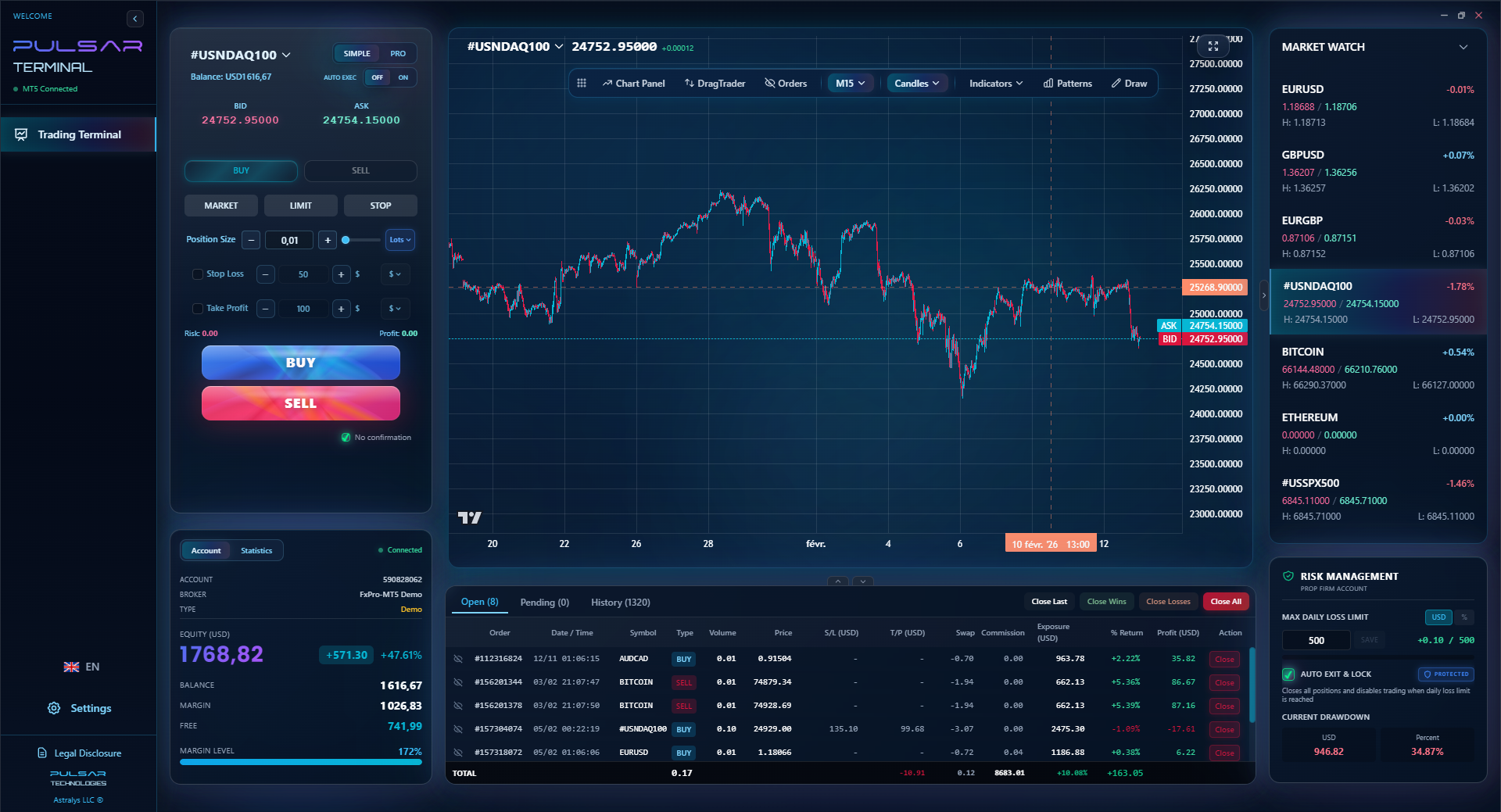
When trading fast-moving pairs like USD/INR, having precise order management tools that work directly on your MT5 platform is a huge advantage for staying within your legal risk limits.
Pulsar Terminal
เครื่องมือ MT5 ครบวงจร: ลากวางคำสั่ง, multi-TP/SL, trailing stop, grid trading, Volume Profile และการป้องกัน prop firm ใช้งานโดยเทรดเดอร์กว่า 1,000 คนทุกวัน
If you think this is old news, look at what's happened recently. The regulators are getting more aggressive, not less.
- April 2026: The RBI dropped a bombshell. They prohibited banks from offering non-deliverable derivative contracts involving the rupee to anyone, resident or non-resident. This was a direct move to kill offshore speculative betting on the INR. They also capped banks' net open exposure to $100 million. The message: we will control all rupee price discovery.
- November 2025: The RBI added 7 more names (like Starnet FX, CapPlace) to its Alert List, bringing the total to 95 unauthorized entities. They're publicly shaming these platforms.
- June 2025: The RBI issued a Master Direction saying no one can run an Electronic Trading Platform (ETP) for forex in India without RBI authorization. This is a legal net cast wide.
The trend is crystal clear. The regulatory walls are getting higher. The fantasy of easily accessing global forex markets from India is dying. Your energy is better spent mastering the legal market that exists.
“A margin call from your broker is one thing. A notice from the Enforcement Directorate is something else entirely.”
Here's my blunt take, after 12 years and that costly lesson.
Trading non-INR pairs on offshore platforms is a terrible idea. The risk-reward is broken. You're risking not just your capital, but legal penalties, frozen assets, and immense stress. The odds are stacked against you in every way.
The smart path is to embrace the legal market. Become a specialist in USD/INR. Understand its rhythms. Use the tools at your disposal. The market is growing (projected to hit $65+ billion by 2033), and liquidity is improving. There's money to be made here without looking over your shoulder.
If you absolutely crave exposure to gold or the Euro, look at other SEBI-regulated instruments. There are commodity derivatives, international equity ETFs, and more. Don't break FEMA for a few pips on EUR/USD.
Remember, a margin call from your broker is one thing. A notice from the Enforcement Directorate is something else entirely. Trade safe, trade legal, and build your skills within the rules of the game. That's the only way to last in this business.
FAQ
Q1Can I trade Forex with INR 10,000 in India?
Yes, but only legally. You can open an account with a SEBI-registered broker like Zerodha or Upstox and trade USD/INR or other INR-based currency futures. The minimum capital required can be as low as a few thousand rupees for one mini or micro lot, depending on the broker's requirements and margin. You cannot use that ₹10,000 to fund an offshore forex account.
Q2Is Forex trading tax-free in India?
No, it is not tax-free. Profits from trading currency derivatives on Indian exchanges are treated as 'Business Income' or 'Speculative Business Income' for tax purposes. You must file it under the appropriate head (typically P&L from business) and pay tax according to your income slab. Illegal forex trading profits, if discovered, would also be taxable and likely lead to penalties for tax evasion.
Q3What is the best legal Forex trading app in India?
The 'best' apps are those provided by SEBI-registered brokers for trading on Indian exchanges. Zerodha's Kite, Upstox Pro, and Angel One's platforms are popular, reliable, and built specifically for the Indian market. They allow you to trade USD/INR futures seamlessly. Avoid any app that promotes trading global forex pairs like EUR/USD to Indian residents.
Q4Can I use MetaTrader 5 (MT5) legally in India?
You can use the MT5 software, but the critical factor is who you connect it to. Using MT5 to connect to a broker like Exness or IC Markets to trade forex is illegal. However, some Indian brokers may offer MT5 for trading other asset classes like commodities. For legal currency trading, you'll likely use the broker's proprietary web or mobile platform, not MT5 connected to international servers.
Q5What happens if my overseas Forex broker shuts down?
If you're trading illegally with an offshore broker and they shut down or refuse withdrawal, you have virtually no recourse in India. The RBI and Indian courts will not help you recover funds sent abroad in violation of FEMA. You would have to pursue legal action in the broker's home country, which is complex and expensive. This is a major risk of using unregulated platforms.
Q6Are demo accounts on foreign Forex sites illegal?
Using a demo/virtual account for practice is not illegal in itself, as no real money is transferred out of India. However, it often serves as a gateway. The platform's goal is to convert you to a live account, which would involve an illegal transaction. It's safer to use demo features on legal Indian trading platforms to practice trading USD/INR.
Q7Can NRI (Non-Resident Indian) trade Forex freely?
NRIs have more flexibility but are still subject to rules. They can often trade on international platforms from their country of residence using their local bank account. However, if an NRI tries to use their Indian bank account or residency details to trade on these platforms, it may violate FEMA rules pertaining to their NRI status. They should seek specific advice based on their residential status.
บทเรียนจาก Prof. Winston
สรุปสาระสำคัญ:
- ✓Only trade INR-based pairs (USD/INR, EUR/INR) on SEBI brokers.
- ✓Penalties can be 3x the profit + ₹10k daily fines.
- ✓use is capped at 1:50 for legal trading.
- ✓Using the LRS scheme for forex is a direct violation.
- ✓The 2026 RBI rules killed offshore INR speculation.
บทความนี้มีประโยชน์แค่ไหน?
คลิกดาวเพื่อให้คะแนน
ข้อมูลเชิงลึกการเทรดรายสัปดาห์
การวิเคราะห์และกลยุทธ์รายสัปดาห์ฟรี ไม่มีสแปม
เกี่ยวกับผู้เขียน
Rajesh Sharma
นักวิเคราะห์ฟอเร็กซ์อาวุโส
ซื้อขายในตลาดอินเดียและเอเชียใต้มากกว่า 10 ปี เริ่มต้นจากอนุพันธ์สกุลเงินของ NSE ก่อนเข้าสู่ตลาดฟอเร็กซ์สากล เชี่ยวชาญคู่ USD/INR และคู่สกุลเงินตลาดเกิดใหม่
ความคิดเห็น
คำเตือนความเสี่ยง
การซื้อขายตราสารทางการเงินมีความเสี่ยงสูงและอาจไม่เหมาะสำหรับนักลงทุนทุกคน ผลการดำเนินงานในอดีตไม่ได้รับประกันผลลัพธ์ในอนาคต เนื้อหานี้มีวัตถุประสงค์เพื่อการศึกษาเท่านั้นและไม่ควรถือเป็นคำแนะนำในการลงทุน โปรดทำการวิจัยของคุณเองก่อนการซื้อขาย
คุณอาจชอบสิ่งนี้

Cara Trading Forex Sukses: 7 Prinsip dari Trader Profesional
Cara trading forex sukses dengan 7 prinsip trader pro: manajemen modal, disiplin, journal trading, backtest. Data nyata, bukan janji profit palsu.
Jam Trading Forex Terbaik untuk Trader Indonesia: Panduan Lengkap dengan Tabel Waktu
Panduan jam trading forex untuk trader Indonesia. Tabel 4 sesi dunia, jam emas 20:00-00:00, sesi mana yang harus dihindari. Data akurat + tips dari trader berpengalaman.
Top 5 Sàn Forex Uy Tín Nhất 2026: Review Jujur dari Trader Indonesia
Top 5 sàn forex uy tín 2026 untuk trader Indonesia. Review jujur: spread, deposit, withdraw, dukungan lokal. Exness, XM, IC Markets & lebih.
รับ Pulsar Terminal
เครื่องคำนวณทั้งหมดนี้ถูกสร้างไว้ใน Pulsar Terminal พร้อมข้อมูลเรียลไทม์จากบัญชี MT5 ของคุณ
รับ Pulsar Terminal