


Ever wondered how you, sitting in Lagos or Port Harcourt, can trade the same markets as someone in London or New York? The truth is, you already can.

Olumide Adeyemi
ผู้บุกเบิกการเทรดในแอฟริกาตะวันตก ·  Nigeria
☕ 12 นาทีอ่าน
สิ่งที่คุณจะได้เรียนรู้:
- 1What Does 'World Forex Trader' Even Mean?
- 2The Nigerian Regulatory Reality Check
- 3Funding Your Global Account: The Naira Dilemma
- 4Strategies That Travel Well
- 5The Unique Psychology of Trading from Nigeria
- 6Non-Negotiable Tools and Tech
- 7Pitfalls I Fell Into (So You Don't Have To)
- 8Building a Sustainable Career, Not a Hustle
Ever wondered how you, sitting in Lagos or Port Harcourt, can trade the same markets as someone in London or New York? The truth is, you already can. Being a world forex trader isn't about your location, it's about your mindset and your access. But for us in Nigeria, the path to the global stage has a few extra hurdles - some obvious, some hidden. I've traded through bull markets, crashes, and every regulatory twist since 2012. Let me walk you through what it really takes to compete on the world stage from right here.
It sounds fancy, right? Like you're part of some elite club. In reality, a world forex trader is simply someone who participates in the global foreign exchange market, regardless of where they log in from. The market doesn't care if you're in Ikoyi or Indiana. What separates the successful ones isn't geography, it's preparation.
For us in Nigeria, it means understanding we're playing in a market designed by and for institutions in financial hubs. Our internet might cut out during load-shedding. Our funding options are limited. Our regulatory protection is... let's call it 'developing'. But our edge? We're resilient, we're hungry, and we learn fast. I used to think I was at a disadvantage trading from Abuja. Then I realized my 3 AM is London's 3 AM. My market open is their market open. The charts are the same.
The real shift happens when you stop seeing yourself as a 'Nigerian trader' and start seeing yourself as a 'trader who happens to be in Nigeria'. Your analysis, your risk management, your psychology - these are universal. The local part is just logistics.

Warning: Don't get sucked into online gurus selling the 'world trader' lifestyle as Lamborghinis and private jets. That's marketing. The reality is screens, spreadsheets, and managing your emotions when a trade goes against you. The glamour is a myth; the work is real.

💡 เคล็ดลับจาก Winston
Your greatest asset isn't a secret indicator; it's your trading journal. The market tells you who you are every day. Are you listening?
This is where theory meets the road, and the road has potholes. Let's be brutally honest: the local regulatory framework for retail forex trading isn't built for us. The CBN's main job is monetary stability for Nigeria, not protecting you from a bad EUR/USD trade. The SEC is stepping in, which is good, but their primary domain is stocks and bonds.
What does this mean for you? It means you have to be your own first line of defense. When you sign up with a broker, you're often agreeing to terms under the jurisdiction of a foreign regulator. I learned this the hard way in 2015. I had a dispute with a platform over a slippage issue on GBP/JPY. My first instinct was to complain to a Nigerian authority. I quickly found there was no clear channel for that. The broker's terms pointed to resolution in Cyprus. It was a wake-up call.
Your Broker is Your De Facto Regulator
This is why your choice of broker is the most important financial decision you'll make. You need a broker that is regulated by a top-tier authority like the UK's FCA or Australia's ASIC. These bodies have investor compensation schemes and strict conduct rules. I personally verify any broker through the official register of their regulator. Don't just trust the 'regulated' badge on their website. Check it.
Many Nigerian traders use international brokers like Exness or IC Markets because they offer the stability and oversight we lack locally. They also understand our funding challenges. The SEC's CMOS tool is useful for checking if a broker has a local license, but remember, a global broker with an FCA license is often a safer bet than a local entity with minimal oversight.
The bottom line: In the world of forex, you are only as safe as your broker's regulator. Build your foundation on that rock, not on sand.
“The real shift happens when you stop seeing yourself as a 'Nigerian trader' and start seeing yourself as a 'trader who happens to be in Nigeria'.”
Ah, funding. The eternal struggle. You've found a great broker, you're ready to trade, and then you hit the deposit page. Your Nigerian card gets declined. I've been there, staring at the 'transaction failed' message more times than I can count.
The CBN's restrictions are a fact of life. They're not about stopping you from trading; they're about managing the country's foreign exchange reserves. Fighting the system is pointless. You have to work within it.
Here’s what actually works in 2026:
- Domiciliary Account: This is the classic, most straightforward method. Fund it through legitimate channels (export proceeds, transfers from abroad). Then, you can wire USD or EUR directly to your broker. The fees are high and it's slow, but it's reliable. I use this for larger, long-term capital injections.
- Cryptocurrency Transfers: This has become the lifeline for many traders. You buy USDT or another stablecoin with Naira on a local P2P platform, then send it to your broker's crypto wallet (if they offer it). The speed is minutes, and the costs are relatively low. Crucially, this bypasses traditional banking channels. I fund 90% of my active trading accounts this way now. But you must understand crypto wallets and confirm the broker's receiving address carefully.
- E-Wallets (Skrill, Neteller, etc.): Some brokers accept these. You can sometimes fund them with local cards, or through transfers from your domiciliary account. They act as a middleman.

Pro Tip: Never try to trick the system with multiple small card payments to avoid limits. Banks' fraud algorithms will flag and block your card. Be transparent with your bank about what you're doing if you're using official channels. For day-to-day funding, crypto has been a game-saver.
Withdrawals follow the same path in reverse. Plan for it to take 1-5 business days for e-wallets/bank wires, or minutes for crypto. Always factor these costs and delays into your position size calculator. A 2% fee on deposit and withdrawal means you're down 4% before you even place a trade.
A strategy that works on the Nigerian Stock Exchange might not work on the EUR/USD. Global forex requires adapting to different market personalities. Here’s what I’ve found works consistently from this side of the world.
Time Zone Trading
Your location is an advantage if you use it. The European session (7 AM - 4 PM WAT) is your bread and butter. It has the highest liquidity and clear trends. The London/New York overlap (1 PM - 4 PM WAT) is pure volatility - great for scalping if that's your style, but dangerous if you're not disciplined. I avoid trading the Asian session (11 PM - 8 AM WAT) from Nigeria. The spreads are wider, and the moves are often erratic, just chopping up retail traders.
Instrument Selection
Stick to the major and minor pairs. EUR/USD, GBP/USD, USD/JPY, AUD/USD. They have the tightest spreads and most predictable liquidity. I made the mistake early on of trading exotic pairs like USD/NGN or USD/ZAR because I thought I understood the economies. The spreads were massive (50-100 pips!), and the moves were driven by political news I couldn't possibly get first. It was a sure way to lose money to the broker's spread. Gold (XAU/USD) is another good one - it often moves inversely to the dollar and is a great hedge.
Analysis That Works
Price action and support/resistance are universal languages. A pin bar at a key level means the same thing in Tokyo as it does in Lagos. I combine this with a few key indicators. The RSI indicator for spotting overbought/oversold conditions, and the MACD indicator for trend confirmation and momentum shifts. Keep it simple. I used to have charts cluttered with 10 indicators. All they did was give me conflicting signals and paralysis.
For longer-term moves, I practice swing trading, holding positions for days or weeks. This fits the Nigerian reality better than frantic day trading, especially with our occasional power and internet issues. You set your trade, set your stop loss and take profit, and walk away. No need to babysit the screen every second.
💡 เคล็ดลับจาก Winston
A narrow spread is a trader's best friend. A wide spread is a tax you pay for being in the wrong place at the wrong time. Know your market hours.
“In the world of forex, you are only as safe as your broker's regulator. Build your foundation on that rock, not on sand.”
This might be the most important section. Trading psychology is hard everywhere, but we have unique pressures.
The 'Get-Rich-Quick' Pressure: The economic climate in Nigeria creates a desperate urgency. You might be trading to escape a tough situation. This is the most dangerous mindset. When you need the money, you'll overtrade, ignore your stop loss, and blow your account. I did this in 2018. I needed to pay a bill, so I tripled my usual position size on a 'sure thing'. It wasn't a sure thing. I lost three months' profits in an afternoon. Trade to grow capital, not to pay tomorrow's rent.
Infrastructure Stress: Your generator kicks off. Your data subscription runs out mid-trade. These aren't excuses, they are operational risks you must plan for. Have a backup internet source (your phone's hotspot). Use brokers with reliable mobile apps. Set stop losses on EVERY trade, so a power outage doesn't become a margin call.
Isolation: You might be the only trader you know. You have no one to talk to about a tough loss or a confusing chart pattern. This leads to doubting your system. Find a community - a serious online forum or Telegram group focused on analysis, not signal peddling. It makes a world of difference.
The key is to build a routine that insulates your trading from local chaos. My trading desk has a UPS, a dedicated LTE router, and a checklist I follow before every session. It creates a bubble of professionalism around the activity.
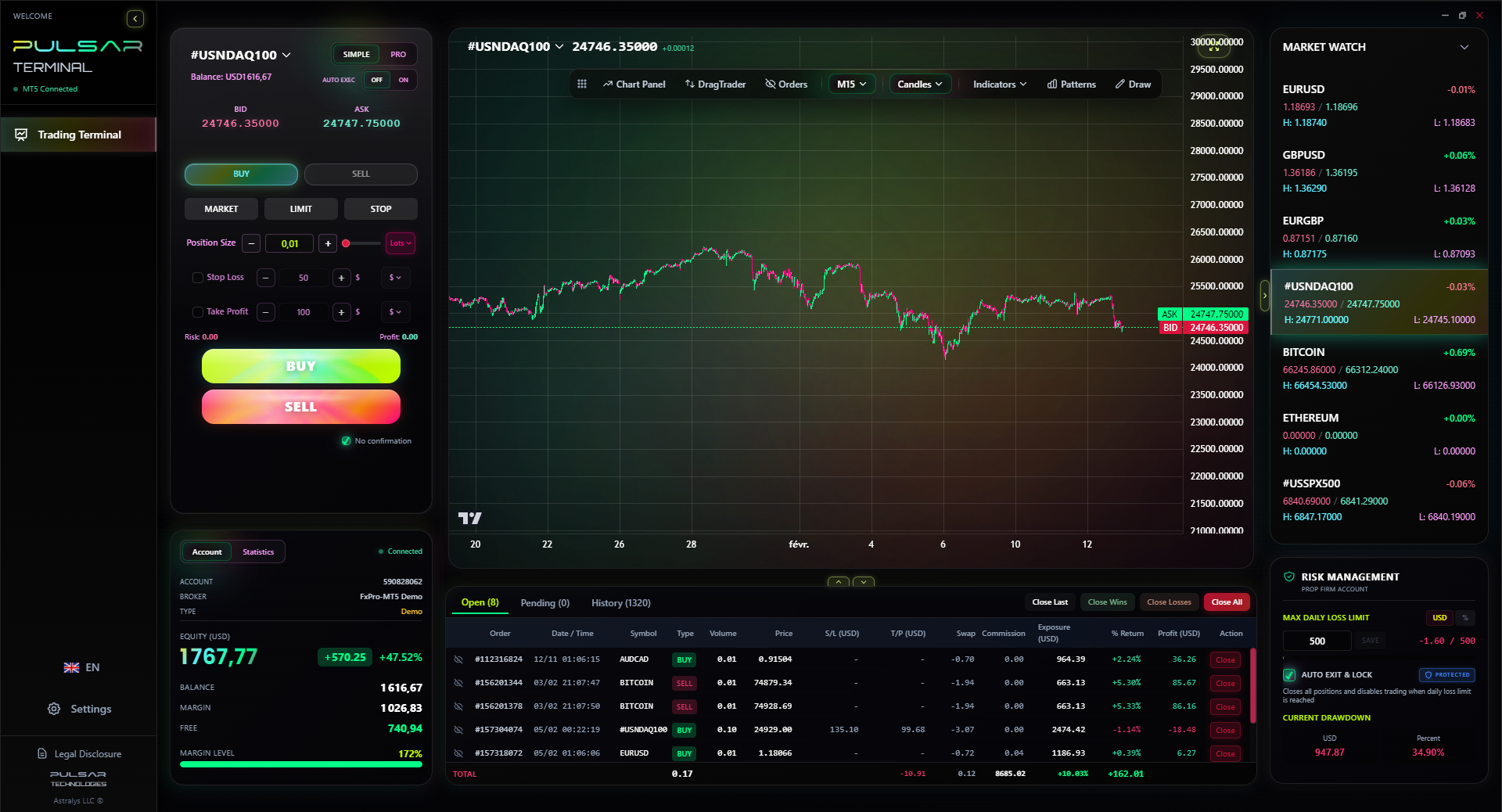
Managing the strict daily loss limits of a prop firm challenge is a huge psychological burden, which is why automating it with a tool like Pulsar Terminal can be the difference between passing and failing.
Pulsar Terminal
เครื่องมือ MT5 ครบวงจร: ลากวางคำสั่ง, multi-TP/SL, trailing stop, grid trading, Volume Profile และการป้องกัน prop firm ใช้งานโดยเทรดเดอร์กว่า 1,000 คนทุกวัน
You can't compete with institutional world forex traders using a cracked version of MT4 on a slow laptop. Your setup is your weapon.
- Hardware: A reliable laptop/desktop with a good screen. A backup power solution (UPS/inverter). A stable, low-latency internet connection. This is basic infrastructure.
- Software: Most brokers offer MT4 or MT5. MT5 is better - more timeframes, more order types. But the real edge comes from tools that plug into it. This is where professional-grade software changes the game.
- Trading Journal: This is mandatory. Not a notebook, a detailed spreadsheet or dedicated software. Record every trade: entry, exit, pips gained/lost, reason for entry, emotion. I review mine every Sunday. It's how you find your real edge (e.g., 'I'm good at long EUR/USD trades on Tuesday mornings, but I lose on GBP/JPY scalps').
- Economic Calendar: You must know when major news (NFP, CPI, Central Bank decisions) is coming out. These events cause massive volatility and widen the spread instantly. I don't trade during high-impact news. It's like swimming in a hurricane.
Having the right tools turns you from a gambler into a business operator. It's the difference between having a roadside mechanic shop and a proper garage.
“When you need the money from a trade, you'll overtrade, ignore your stop loss, and blow your account. Trade to grow capital, not to pay tomorrow's rent.”
Let me save you some money and heartache.
- Chasing Bonuses: Brokers offering 100% deposit bonuses? It's a trap. The terms and conditions will tie your money up with impossible trading volume requirements. Your capital is not truly yours. I learned this with a $500 'bonus' that locked my $500 deposit until I traded 10 million units. Ignore bonuses.
- Trading During Illiquidity: The worst thing you can do is trade right before or after a major holiday (like Christmas Day or early January 1st). The spread on EUR/USD can blow out from 1 pip to 20 pips. Your stop loss gets hit instantly by the spread, not by price movement. I lost $200 this way on New Year's Day years ago.
- Ignoring the Swap Rate: If you hold a trade overnight, you pay or earn a small interest fee called a swap. For some pairs (like longing USD/TRY), the negative swap can be huge and eat your profits. Always check the swap rate if you're a swing trader.
- Overleveraging: Nigerian brokers might offer 1:1000 use. This is a weapon of mass destruction for your account. I never use more than 1:30, even on small accounts. use amplifies losses faster than gains. Use a position size calculator religiously.
- Signal Services: If someone could reliably predict the market, they'd be trading with their own billions, not selling you signals for $50 a month. Every signal service I ever tried failed in the long run. Learn to read the charts yourself.
💡 เคล็ดลับจาก Winston
use is like fire. A controlled, small flame cooks your food. An uncontrolled inferno burns your house down. Never confuse the two.
The goal isn't to make one big trade. The goal is to build a process that generates consistent returns over years. This is how you transition from a guy who trades to a professional world forex trader.
Start with a Prop Firm Path: This is one of the best ways for a Nigerian to access larger capital. You pass a challenge with a small fee, and if you succeed, you trade the firm's capital for a split of the profits. It forces discipline. The key is finding a reputable firm with clear rules. The challenge is managing the strict daily loss limits, which is where smart trade management tools become essential.
Treat It Like a Business: You need a business plan. What's your monthly profit target? Your max allowable loss? Your weekly market analysis schedule? You need to separate your personal finances from your trading capital. Open a separate bank account for trading funds.
Continuous Education: The market changes. New patterns emerge. You have to keep learning. Not from hype YouTube videos, but from books, reputable courses, and analyzing your own journal.
It's a marathon. My first three years were basically breaking even after all costs. Year four is when my equity curve started to steadily climb. Be patient with yourself. The market will be here tomorrow.
FAQ
Q1Is forex trading illegal in Nigeria?
No, it's not illegal for individuals to trade forex. It's a legal activity. However, the regulatory environment for retail traders is not as developed as in countries like the UK or US. The CBN regulates currency flows, and the SEC oversees securities activities, which includes forex trading. The responsibility falls on you to choose a properly regulated international broker.
Q2What is the minimum amount I need to start trading forex in Nigeria?
You can start with as little as $50 with some brokers. However, I strongly advise against it. With a small amount, the pressure to overleverage is immense, and transaction costs (spreads, funding fees) eat a huge percentage of your capital. A more realistic starting point that allows for proper risk management is $500-$1000. It's better to save up than to start underfunded.
Q3Which broker is best for Nigerian traders?
There's no single 'best' broker. You need one that: 1) Is regulated by a top-tier authority (FCA, ASIC, CySEC), 2) Accepts reliable funding methods for Nigerians (crypto, bank wire), 3) Has a stable trading platform (MT4/MT5), and 4) Offers reasonable spreads on major pairs. Brokers like IC Markets, Exness, and Pepperstone are popular choices among experienced Nigerian traders for these reasons. Always do your own verification.
Q4How do I avoid forex scams in Nigeria?
Scams are rampant. Avoid: anyone guaranteeing profits, 'account managers' who ask for direct access to your money, brokers not listed on a major regulator's website, and signal sellers with fake track records. Your money should only go to the regulated broker's official account. Your trades should only be placed by you. If it sounds too good to be true, it is.
Q5Can I make a living trading forex from Nigeria?
Yes, it's possible, but it's incredibly difficult and takes years of disciplined practice. Don't believe anyone who says you can quit your job in 6 months. You need substantial saved capital (not borrowed money), a proven, profitable strategy, and iron-clad psychology. Most successful traders I know treat it as a secondary income for years before even considering it as a primary living. Focus on consistency over get-rich-quick dreams.
Q6Do I pay tax on forex trading profits in Nigeria?
The tax situation for individual forex traders in Nigeria is complex and not always clearly enforced. Trading with an international broker may not automatically generate local tax records. However, according to Nigerian law, all income is potentially taxable. It is your responsibility to understand and comply with tax regulations. Consulting with a Nigerian tax professional who understands financial trading is highly recommended as your trading business grows.
บทเรียนจาก Prof. Winston
สรุปสาระสำคัญ:
- ✓Verify your broker's license on the regulator's official website, not their marketing.
- ✓Use crypto (USDT) for efficient funding; plan for 1-5 day withdrawals.
- ✓Stick to major pairs (EUR/USD, GBP/USD); avoid exotic pairs with 50+ pip spreads.
- ✓Never use use above 1:30, even if 1:1000 is offered.
- ✓Trade the European session (7 AM - 4 PM WAT) for best liquidity and tight spreads.
บทความนี้มีประโยชน์แค่ไหน?
คลิกดาวเพื่อให้คะแนน
ข้อมูลเชิงลึกการเทรดรายสัปดาห์
การวิเคราะห์และกลยุทธ์รายสัปดาห์ฟรี ไม่มีสแปม
เกี่ยวกับผู้เขียน
Olumide Adeyemi
ผู้บุกเบิกการเทรดในแอฟริกาตะวันตก
หนึ่งในนักการศึกษาฟอเร็กซ์ที่กระตือรือร้นที่สุดของไนจีเรีย 8 ปีประสบการณ์เทรดจากลากอส เชี่ยวชาญกลยุทธ์ทุนต่ำและความท้าทาย prop firm สำหรับเทรดเดอร์ในแอฟริกา
ความคิดเห็น
คำเตือนความเสี่ยง
การซื้อขายตราสารทางการเงินมีความเสี่ยงสูงและอาจไม่เหมาะสำหรับนักลงทุนทุกคน ผลการดำเนินงานในอดีตไม่ได้รับประกันผลลัพธ์ในอนาคต เนื้อหานี้มีวัตถุประสงค์เพื่อการศึกษาเท่านั้นและไม่ควรถือเป็นคำแนะนำในการลงทุน โปรดทำการวิจัยของคุณเองก่อนการซื้อขาย
คุณอาจชอบสิ่งนี้

Cara Trading Forex Sukses: 7 Prinsip dari Trader Profesional
Cara trading forex sukses dengan 7 prinsip trader pro: manajemen modal, disiplin, journal trading, backtest. Data nyata, bukan janji profit palsu.
Jam Trading Forex Terbaik untuk Trader Indonesia: Panduan Lengkap dengan Tabel Waktu
Panduan jam trading forex untuk trader Indonesia. Tabel 4 sesi dunia, jam emas 20:00-00:00, sesi mana yang harus dihindari. Data akurat + tips dari trader berpengalaman.
Top 5 Sàn Forex Uy Tín Nhất 2026: Review Jujur dari Trader Indonesia
Top 5 sàn forex uy tín 2026 untuk trader Indonesia. Review jujur: spread, deposit, withdraw, dukungan lokal. Exness, XM, IC Markets & lebih.
รับ Pulsar Terminal
เครื่องคำนวณทั้งหมดนี้ถูกสร้างไว้ใน Pulsar Terminal พร้อมข้อมูลเรียลไทม์จากบัญชี MT5 ของคุณ
รับ Pulsar Terminal