


Most traders think prop firms are the obvious answer if you don't have enough capital.

Daniel Harrington
นักวิเคราะห์การเทรดอาวุโส · ผู้เชี่ยวชาญ MT5
☕ 9 นาทีอ่าน
สิ่งที่คุณจะได้เรียนรู้:
- 1The Real Cost of a Prop Firm Challenge (It's Not Just the Fee)
- 2Personal Account Trading: The Freedom Has a Price Tag Too
- 3Side-by-Side: The Numbers That Actually Matter
- 4The Math on Profit: Which Path Actually Makes You More Money?
- 5Who Should Choose Prop Firms (And Who Definitely Shouldn't)
- 6My Verdict After 12 Years: It Depends on One Thing
Most traders think prop firms are the obvious answer if you don't have enough capital. That's only half true, and making that assumption without looking at the full picture has cost a lot of people serious money. I've traded both sides of this, and the reality is messier than the YouTube ads make it sound. By the end of this, you'll know exactly which path fits your situation, with actual numbers to back the decision.

The prop firm path offers leverage but demands hidden costs—challenge fees, drawdown rules, profit splits—while personal accounts demand less capital but require discipline and slower growth. The real truth: neither is 'better' without knowing your actual numbers and risk tolerance first.
The Real Cost of a Prop Firm Challenge (It's Not Just the Fee)
Everyone quotes the entry fee when they talk about prop challenges. FTMO's $200k challenge runs $1,080. My Forex Funds (before the SEC situation) was cheaper. The Funded Trader's $200k Royal Challenge costs around $1,097 as of 2025. But the fee is not the real cost.
The real cost is your time and probability. Most firms don't publish pass rates, but independent surveys put the average challenge pass rate between 8% and 15%. That means statistically, you'll pay for 6-12 challenges before getting funded. On a $300k account level, that's potentially $3,000-$5,000 in fees before you see a payout. I speak from experience here: I burned through four FTMO challenges between 2021 and 2022 before I finally changed my risk approach.
Here's the other cost people miss: psychological pressure. Trading with a 5% daily drawdown limit and a 10% maximum drawdown changes how you trade. You stop taking valid setups because you're too close to the limit. That's not a trading problem. That's a rules problem.
One practical tool that actually helps with this: I now use Pulsar Terminal's Prop Firm Protection on my funded accounts, which automatically closes all positions before I hit the daily loss limit, with a built-in 5% safety buffer. During a particularly bad FTMO stretch in late 2023, that feature alone saved my account while I was away from the screen during a volatile NFP release.
For context on what the spread definition and execution quality look like across prop firm brokers vs personal accounts, the differences matter more than most people admit.

💡 เคล็ดลับจาก Winston
Before you start any prop challenge, trade your exact strategy for 30 days on a demo account with self-imposed 5% daily and 10% total drawdown limits. If you can't pass your own challenge, you won't pass the real one.

That moment you realize the $1,080 fee is just the entry price — the real cost is months of your time grinding to pass the challenge without hitting the 5-10% drawdown limit.
“The real cost of a prop firm challenge isn't the entry fee. It's the 6-12 attempts most traders take before they finally pass.”
Personal Account Trading: The Freedom Has a Price Tag Too
Trading your own capital gives you something prop firms can't: no rules. You can hold through a drawdown. You can pyramid into a position. You can leave a trade open over the weekend without anyone threatening to close your account.
But that freedom bites back hard.
I started with a $4,200 personal account in 2013. I blew it in 11 weeks. Not because I didn't know what I was doing technically, but because there were no guardrails. When you're trading your own money and you're down 18%, you start making decisions that have nothing to do with your strategy. You revenge trade. You over-use. The psychological contract between you and your capital is completely different from trading someone else's money.
The minimum viable personal account for forex trading, in my opinion, is $10,000. Below that, your position sizes are either too small to matter or you're forced to take on disproportionate risk per trade to make the numbers meaningful. The position size calculator I use daily shows this clearly: on a $2,000 account risking 1% per trade, you're risking $20. That's a $0.20/pip position on EUR/USD (2-pip spread eats 10% of your risk budget immediately).
With a personal account, you also pay for your own data, your own platform, and your own losses in full. No profit split. No payout waiting periods. If you make 8% this month, all 8% is yours.
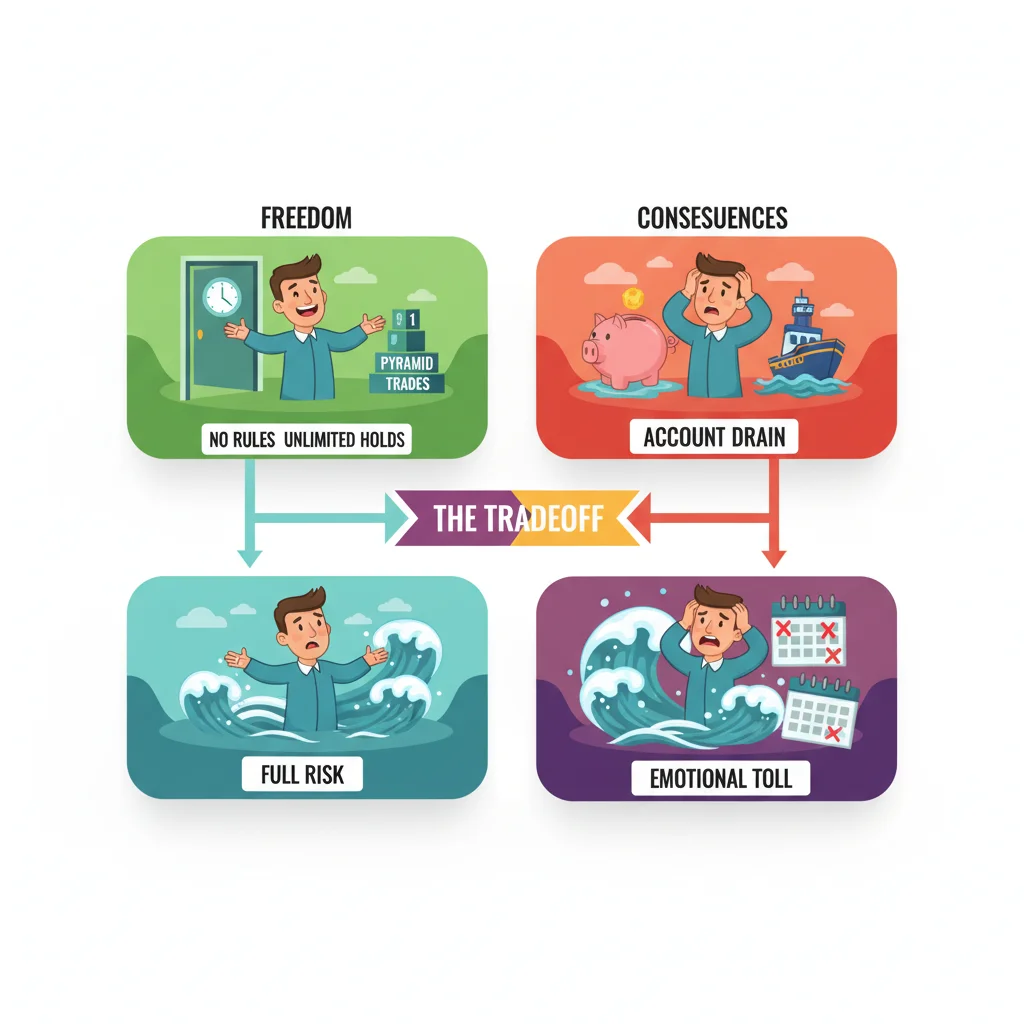
Personal accounts offer unlimited trading freedom—but that freedom comes with unlimited downside risk. A $4,200 account can vanish faster than prop firm risk limits would ever allow.
“Trading your own capital gives you something prop firms can't: no rules. But that freedom bites back hard.”
Side-by-Side: The Numbers That Actually Matter
Here's a direct comparison across the variables that determine which path makes financial sense for you. I've used current 2025-2026 numbers where available.
| Factor | FTMO $100k | The Funded Trader $100k | Personal $10k Account |
|---|---|---|---|
| Upfront Cost | $540 (challenge fee) | $549 (challenge fee) | $10,000 (your capital) |
| Profit Target (Phase 1) | 10% ($10,000) | 10% ($10,000) | No target |
| Max Daily Loss | 5% ($5,000) | 5% ($5,000) | None (self-imposed) |
| Max Total Drawdown | 10% ($10,000) | 10% ($10,000) | None (self-imposed) |
| Profit Split | 80% (up to 90%) | 80-90% | 100% |
| Scaling Available | Yes (up to $2M) | Yes (up to $1.5M) | Only with deposits |
| Weekend Holding | Allowed | Restricted (news events) | Fully flexible |
| Payout Waiting Period | 14 days (first), 14 days thereafter | 14 days | Instant |
| EA/Automation Allowed | Restricted (no HFT) | Partially allowed | Fully flexible |
The scaling path is where prop firms genuinely win. If you pass the FTMO challenge and keep performing, you can reach $400k in managed capital within 12-18 months purely through scaling, without adding personal capital. That's not achievable on a personal $10k account in the same timeframe unless you're compounding at 30%+ per month (and if someone is promising you that, run).
For EUR/USD guide traders specifically, the execution environment on prop firm accounts is worth checking carefully. Most firms use demo-style MT4/MT5 accounts with simulated fills, which can behave differently from a live ECN account.
💡 เคล็ดลับจาก Winston
Never risk more than 0.5% per trade during the first two weeks of a prop challenge. Your only job in week one is to not lose the account. The profit target has 30 days. Your daily loss limit can end you in a single bad session.
“Traders calculate their potential prop firm earnings using their personal account returns — but those two numbers are often completely incompatible.”
The Math on Profit: Which Path Actually Makes You More Money?
Let's run an actual calculation so you can see this clearly instead of guessing.
Scenario A: Prop Firm ($100k funded account) Assume you generate 5% monthly gain consistently (hard but achievable for experienced traders).
Monthly gross: $100,000 x 5% = $5,000 Your cut at 80% split: $4,000/month Challenge fee already paid: $540 (sunk cost, one time)
Scenario B: Personal Account ($10,000) Same 5% monthly performance.
Monthly gross: $10,000 x 5% = $500 Your cut: $500/month (100%)
The prop firm path generates $3,500 more per month on identical skill and identical percentage performance. The use of trading larger capital wins here by a landslide.
But here's where the math gets complicated. That 5% monthly on a prop firm account requires you to stay within a 5% daily drawdown. In my own trading (mostly XAU/USD guide and EUR/USD), there are months where I draw down 6-7% intraday before recovering to close up 3%. On a personal account, that's fine. On a prop account, you're disqualified.
Common mistake: traders calculate their potential prop firm earnings using their personal account percentage returns. Those two numbers are often incompatible because the strategies that work without drawdown constraints don't always survive within them.
So the formula you actually need is: what is your constrained return? What do you make in months where your intraday drawdown never exceeds 4% (giving yourself 1% buffer from the 5% limit)? Use that number in your prop firm math, not your unconstrained personal account average.

The math is undeniable: $100k at 5% monthly = $4,000/month after the 80% split. Personal $10k account at 5% = $500/month. Same skill, 8x the reward on a funded account.
“Traders calculate their potential prop firm earnings using their personal account returns — but those two numbers are often completely incompatible.”
Who Should Choose Prop Firms (And Who Definitely Shouldn't)
After trading both environments for years and watching hundreds of students go through the same decision, the pattern is pretty clear.
Prop firms make sense if:
- You have a documented strategy with at least 6 months of consistent results
- Your maximum intraday drawdown rarely exceeds 3-4% in your personal trading
- You don't have $25,000+ in personal capital to trade meaningful size
- You're comfortable with rules-based trading and don't need flexibility to hold through multi-day drawdowns
- You trade during liquid hours (London/New York overlap) rather than relying on gap trades or weekend exposure
Personal accounts make more sense if:
- You use swing trading strategies that require holding through larger drawdowns (see the swing trading strategy approach for context)
- Your edge depends on position sizing flexibility, pyramiding, or martingale-style approaches
- You have enough capital that the percentage returns on your own account are meaningful in dollar terms
- You've tried prop challenges and failed repeatedly because of the rules, not because of skill
- You trade instruments with high weekend gap risk (indices, commodities) where forced position closure destroys your edge
Warning: if you're new to trading and you see prop firms as a way to skip the learning phase, you're about to pay a lot of challenge fees for an education you could get cheaper elsewhere. The challenge structure does not protect beginners. It just charges them repeatedly for failing.
One type of trader who consistently does well in prop environments: systematic traders using rules-based EAs with hard stop losses and defined risk per trade. The structure of prop firm rules actually aligns with how good algorithmic strategies work. Check the MACD indicator setups and rule-based RSI indicator strategies I've covered before if you want to build that kind of approach.
💡 เคล็ดลับจาก Winston
Withdraw from your funded account every single payout cycle. Don't let profits sit there growing. The prop firm is not a savings account, and history has shown these businesses can disappear faster than you expect.
“The challenge structure does not protect beginners. It just charges them repeatedly for failing.”
My Verdict After 12 Years: It Depends on One Thing
People want a clean answer. Here's the closest I can give you.
If your trading strategy is consistently profitable with controlled drawdowns, prop firms offer use that personal accounts can't match at equivalent capital levels. The math is just undeniable. $100k at 5% monthly generating $4,000 (after split) beats $10k at 5% generating $500, every single month.
But. That profitability has to be real, and it has to survive the specific constraint structure of the firm you're using. Not all prop firms are equal here. FTMO is the most tested and the most trusted in terms of actually paying out. The Funded Trader has had scaling issues. MyForexFunds was shut down by regulators in 2023, which burned a lot of traders who had funded accounts and pending payouts. These are not minor risks.
My personal setup right now is a hybrid. I run a personal $35,000 account for my higher-volatility setups and swing trades on GBP/USD guide and Gold. I run two FTMO accounts ($50k and $100k) for my lower-timeframe systematic approach. The personal account gives me freedom. The prop accounts give me size.
If I had to pick just one for someone starting out with under $5,000 in total capital and 12-18 months of documented trading results: prop firm, specifically FTMO, with a $25k or $50k challenge. Keep the challenge fee low, focus entirely on surviving the drawdown limits, and scale from there. Don't go straight for the $200k challenge because the psychological weight of that much notional capital, combined with tight drawdown limits, is a different experience than the numbers suggest.
Disclaimer: This article is for educational purposes only and does not constitute investment advice. Trading forex and CFDs carries significant risk of loss. Past performance is not indicative of future results. Always do your own research and consider your financial situation before trading. Never risk money you cannot afford to lose.
บทเรียนจาก Prof. Winston

สรุปสาระสำคัญ:
- ✓FTMO $1,080 challenge fee is just the start—account restrictions and drawdown rules cost you flexibility traders need.
- ✓Personal accounts let you pyramid and hold weekends, but require sufficient capital to survive extended drawdowns alone.
- ✓5% monthly gains on $100k funded account beats personal account profits until you factor in challenge failure rates.
- ✓Choose prop firms only if your strategy has documented consistent profits with controlled drawdowns—otherwise, save capital first.
❓ คำถามที่พบบ่อย
Q1Can I trade the same strategy on a prop firm account that I use on my personal account?
Not always. The key constraint is intraday drawdown. If your personal strategy regularly draws down 6-8% intraday before recovering, it will likely violate a prop firm's 5% daily loss limit and get your account closed. Before attempting a challenge, run your strategy's historical trades through a filter: how many days would have triggered a 5% daily loss? If it's more than 2-3% of your trading days, you need to either modify the strategy or stick to personal accounts.
Q2What happens to my funded account if the prop firm goes out of business?
You lose access to the capital and any pending payouts. This is exactly what happened when MyForexFunds was shut down by the CFTC and Ontario regulators in August 2023. Traders with funded accounts and unpaid profits lost those funds. This risk is real. The best protection is to withdraw profits frequently (don't let them accumulate), diversify across two prop firms if you're running multiple accounts, and only use well-established firms with a long track record of paying out.
Q3Is there a minimum personal account size where prop firms stop making sense?
Yes. Once your personal account exceeds roughly $50,000-$75,000 and you're trading a strategy with consistent returns above 3% monthly, the prop firm profit split (typically 20% going to the firm) starts to become a meaningful drag. At $100k personal capital generating 5% monthly, you're giving up $1,000/month to a prop firm for the same percentage performance you could keep entirely. Above that threshold, the calculus shifts toward personal accounts unless you specifically need the scaling path to access higher capital.
Q4Do prop firms allow trading during high-impact news events like NFP?
It varies by firm. FTMO allows trading during news events on most account types, but they do prohibit holding positions within 2 minutes of major news on some account configurations. The Funded Trader restricts opening new trades 2 minutes before and after high-impact news. Always read the specific rules for the firm and account type you're using. News trading violations are one of the most common reasons accounts get flagged for rule breaches, not just drawdown violations.
Q5How long does it realistically take to pass a prop firm challenge?
The challenge phase at most firms (FTMO Phase 1, for example) has a 30-calendar-day window with no minimum trading days. But rushing is a trap. Traders who try to hit the 10% profit target quickly by front-loading risk in the first week are the ones who blow out. A realistic and sustainable pace for a well-structured strategy is 2-4% per week, which means a 10% target is achievable in 3-5 weeks. Build in buffer time. There's no prize for finishing fast, but there's a real penalty for failing by Day 29.
บทความนี้มีประโยชน์แค่ไหน?
คลิกดาวเพื่อให้คะแนน
ความคิดเห็น
นำหน้าตลาด
รับการวิเคราะห์ตลาดรายสัปดาห์ กลยุทธ์การเทรด และเคล็ดลับ MT5 ส่งตรงถึงกล่องจดหมาย ไม่มีสแปม ยกเลิกเมื่อไหร่ก็ได้
เกี่ยวกับผู้เขียน
Daniel Harrington
นักวิเคราะห์การเทรดอาวุโส
Daniel Harrington เป็นนักวิเคราะห์การเทรดอาวุโสที่สำเร็จการศึกษาระดับ MScF (ปริญญาโทวิทยาศาสตร์การเงิน) เชี่ยวชาญด้านการจัดการสินทรัพย์เชิงปริมาณและการบริหารความเสี่ยง ด้วยประสบการณ์กว่า 12 ปีในตลาดฟอเร็กซ์และอนุพันธ์ ครอบคลุมการเพิ่มประสิทธิภาพแพลตฟอร์ม MT5 กลยุทธ์การเทรดอัลกอริทึม และข้อมูลเชิงปฏิบัติสำหรับนักเทรดรายย่อย
รับ Pulsar Terminal
เครื่องคำนวณทั้งหมดนี้ถูกสร้างไว้ใน Pulsar Terminal พร้อมข้อมูลเรียลไทม์จากบัญชี MT5 ของคุณ
รับ Pulsar Terminalคุณอาจชอบสิ่งนี้

คำเตือนความเสี่ยง
การซื้อขายตราสารทางการเงินมีความเสี่ยงสูงและอาจไม่เหมาะสำหรับนักลงทุนทุกคน ผลการดำเนินงานในอดีตไม่ได้รับประกันผลลัพธ์ในอนาคต เนื้อหานี้มีวัตถุประสงค์เพื่อการศึกษาเท่านั้นและไม่ควรถือเป็นคำแนะนำในการลงทุน โปรดทำการวิจัยของคุณเองก่อนการซื้อขาย