

Bid
/bɪd/since 1970sBid — Bid price is what your broker will pay you when you sell a currency pair — it's your 'exit door' price for getting out of a trade.
§1So, what IS this 'Bid' thing anyway?
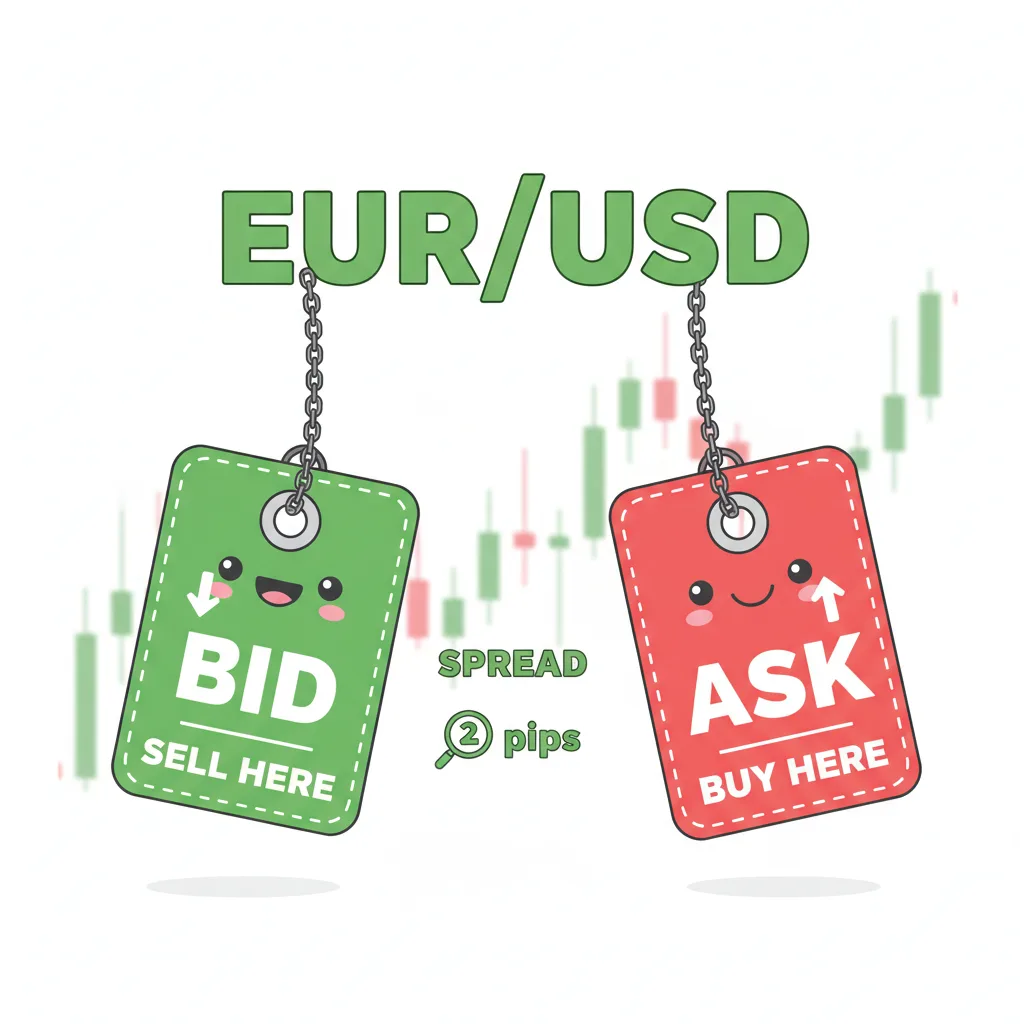
Okay, picture this: you're at a flea market with an old vinyl record. You want to sell it. The dealer looks at you and says, 'I'll give you $10 for it.' That's their bid — what they're willing to pay to take it off your hands. In forex trading, the Bid price works exactly the same way! It's the price your broker will pay you when you want to sell a currency pair. Think of it as the 'exit door' price — when you want to get out of a trade by selling, this is what you'll get. I've seen traders get this backwards in their first year (trust me, I've been there), and it's not pretty. The Bid is always the lower number in that price quote you see, and it's paired with its flashier sibling, the Ask price. Together, they're like the two sides of a coin — you can't have one without the other.
§2The math (don't run away — it's simpler than it looks!)
Here's the beautiful part: the Bid price itself isn't some complex formula you need to memorize. It's just a number! But it plays a crucial role in the one formula every trader needs to know: Spread = Ask Price - Bid Price. That's it! That little subtraction gives you the spread, which is basically the cost of doing business in the forex world. Think of it like a toll bridge — you've got to pay it to cross from one side of the trade to the other. If the Ask is 1.0803 and the Bid is 1.0801, the spread is 0.0002 (or 2 pips). That's your transaction cost right there. The broker makes their money from this difference — they buy from you at the Bid (a bit cheaper) and sell to you at the Ask (a bit pricier). It's how the market stays liquid and why you can trade anytime.
§3Here's how it plays out in real life
Let's walk through a real example so this clicks. Say EUR/USD is quoted as 1.0801 / 1.0803. That first number, 1.0801, is the Bid. If you think the euro is going to fall against the dollar, you'd open a sell position at that Bid price of 1.0801. You're essentially selling euros you don't own yet (thanks to leverage, but that's another story). Fast forward: your prediction was right! The price drops. To close your position and lock in profits, you need to buy back those euros. You'd do that at whatever the current Ask price is — let's say it's now 1.0780. Your profit? The difference between where you sold (1.0801) and where you bought back (1.0780), minus that spread you paid upfront. See how the Bid was your entry point for selling? It's not just a number on your screen — it's the price that actually executes your trade when you click 'sell'.
§4The weird exceptions nobody warns you about
Now, here's where things get quirky. First up: JPY pairs. While most currency pairs measure pips to the fourth decimal place (like 0.0001), Japanese Yen pairs measure to the second decimal. So if USD/JPY is quoted as 155.25 / 155.28, the Bid is 155.25 and that spread of 0.03 is actually 3 pips. Yeah, it's weird — JPY just likes to be different. Then there's spread widening. During major news events or when liquidity dries up (like trading EUR/USD during Asian hours), that gap between Bid and Ask can blow wide open. I've seen spreads on exotic pairs jump to 10+ pips during volatility. It's like the market suddenly charges surge pricing! Different broker models handle this differently too — some bake their profit into the spread, while others charge commissions. Know which one you're dealing with.

§5
Let's look at three concrete scenarios. First, selling EUR/USD: You see it at 1.0801/1.0803 and think it's going down. You sell at the Bid (1.0801). It drops to 1.0750/1.0752. To close, you buy at the Ask (1.0752). Your profit: 1.0801 - 1.0752 = 0.0049 (49 pips). Second, closing a buy trade: You bought EUR/USD earlier at 1.0790. Now it's at 1.0801/1.0803. To close and take profit, you sell at the Bid (1.0801). Profit: 1.0801 - 1.0790 = 0.0011 (11 pips). Third, during news volatility: Spreads widen! Normally EUR/USD might have a 0.5 pip spread, but during an NFP announcement, it could jump to 5 pips. Your sell order still executes at the Bid, but that Bid might be much lower relative to the Ask than usual.
| Scenario | Pair | Action | Price Used | Why? |
|---|---|---|---|---|
| Going short | EUR/USD | Sell | Bid (1.0801) | Entry for sell positions |
| Closing long | EUR/USD | Sell | Bid (1.0801) | Exit for buy positions |
| Wide spread | Exotic pair | Sell | Bid (much lower) | Market volatility increases costs |
§6Where this whole Bid/Ask thing even came from
Believe it or not, the modern forex market with its floating exchange rates and Bid/Ask quotes is a relatively recent invention. Back in the day, currencies were pegged to the US dollar under the Bretton Woods system. That all changed in the early 1970s when that system collapsed. Suddenly, currencies could float freely against each other, and voilà — we got the birth of the forex market as we know it. At first, only the big players could play: banks, hedge funds, corporations with deep pockets. Then the 1990s internet revolution happened, and retail forex trading was born! Online brokers brought streaming quotes to our laptops, making terms like 'Bid' and 'Ask' part of everyday trader vocabulary. The concept itself dates back even further to organized exchanges in the 19th century, but it took technology to put it in our hands.
§7Key takeaways
- The Bid is your 'sell price' — it's what you get when you exit a trade by selling, whether you're closing a buy position or opening a sell.
- Always remember: Bid is lower, Ask is higher. That difference is the spread (0.5-10+ pips), which is your transaction cost on every trade.
- During volatile markets or with exotic pairs, spreads can widen dramatically — I've seen traders blow accounts by not accounting for this!
- JPY pairs play by different rules: pips are measured to the second decimal place, not the fourth like most other currency pairs.
§8Frequently asked questions
QWhat's the Bid price in simple terms?
QHow is Bid different from Ask?
QWhen do I actually use the Bid price?
QWhy is Bid always lower than Ask?
QWhat makes the Bid price move around?
§See also
§References
- Forex Trading Basics: Bid and Ask Prices — The Trading Mentor Research
- History of Foreign Exchange Markets — Financial History Review