


I remember the first time I placed a 5-lot trade.

Olumide Adeyemi
Batı Afrika Yatırım Öncüsü ·  Nigeria
☕ 10 dk okuma
Neler öğreneceksiniz:
- 1What 5 Lots Actually Means (It's Not Just a Number)
- 2Capital, Margin, and use: The Nigerian Reality Check
- 3The Hidden Costs That Will Eat Your Profits
- 4Psychology and Market Impact: You're Not Invisible Anymore
- 5A Realistic Path for the Nigerian Trader
- 6Brokers, Platforms, and Execution for Large Sizes
- 7Final Word: It's About Survival, Not Glory
I remember the first time I placed a 5-lot trade. It was on GBP/USD, and my hands were literally shaking. I had a decent run of profits with mini lots, got arrogant, and decided to 'go big.' The trade moved 20 pips against me in under a minute. That was a $1,000 loss. In Naira terms back then, that was over ₦400,000 gone before I could even blink. I learned the hard way that 5 lots in forex isn't just a bigger trade, it's a different beast entirely. This guide isn't about how to trade 5 lots, it's about understanding why trading that size will likely blow up your account if you're not prepared.
When we say '5 lots' in forex, we're almost always talking about 5 standard lots. Forget the theory for a second. Let's talk real money.
A standard lot is 100,000 units of the base currency. So, 5 lots is 500,000 units. If you're trading EUR/USD, you're controlling half a million Euros. For USD/JPY, you're controlling half a million US Dollars.
The critical number every Nigerian trader must burn into their brain is the pip value. For most major pairs where the quote currency is USD, one pip for a standard lot is $10. Therefore, for 5 standard lots:
One pip movement = $50.
Let that sink in. If GBP/USD moves 50 pips - a common daily swing - your P&L swings by $2,500. At an exchange rate of ₦1,500/$, that's ₦3,750,000. Your entire trade can make or lose a decent car's worth of Naira in a single price swing. This isn't trading anymore, it's a high-stakes financial maneuver. You need to understand position sizing backwards and forwards before you even think about this.

Example: Trade: Sell 5 lots EUR/USD at 1.0850. Pip Value: $50 per pip. If price rises to 1.0900 (50 pips against you): Loss = 50 pips * $50 = $2,500. In Naira (at ₦1,500/$): ₦3,750,000.
This scale changes everything about your psychology, your broker's margin requirements, and the market's behavior towards your order.

💡 Winston'ın İpucu
If your hand shakes when you hit the buy button, your position is too large. Your psychology is your most important indicator.
“Trading 5 lots in forex isn't just a bigger trade, it's a different beast entirely.”
This is where most Nigerian traders get their first, and often last, shock. You see a broker like Exness or IC Markets offering 1:500 use and think, 'Great! I can control 5 lots with very little money!' Technically true. Practically, a suicide pact.
Let's do the real math. To open a 5-lot position on EUR/USD, you're controlling 500,000 Euros. At a rate of 1.08, that's $540,000 in notional value.
The Margin Trap
With 1:500 use, your required margin is (Notional Value / use). So, $540,000 / 500 = $1,080. That's about ₦1.6 million. It looks like you can 'afford' it. But margin is just the deposit, not the risk. Your account equity must cover the floating losses. If that $1,080 is most of your $1,500 account, a 30-pip move ($1,500 loss) triggers a margin call. Game over.
The Sustainable Capital Requirement
To responsibly trade 5 lots, you shouldn't be thinking about minimum margin. You should be thinking about risk capital. A conservative rule is to risk no more than 1-2% of your account per trade. If a 50-pip stop loss on your 5-lot trade equals $2,500, then $2,500 should be 1% of your account.
That means you need a $250,000 trading account.
Let me be brutally honest: if you don't have at least $50,000-$100,000 in dedicated, risk-capital you can afford to lose, you have no business trading 5 standard lots. You're just gambling with use. The brokers aren't wrong to offer it, but most traders use it to destroy themselves. I learned this after blowing a $10,000 account trying to mimic 'pro' trade sizes. The use wasn't my tool, it was my executioner.
“One pip movement on a 5-lot trade is worth $50. Your entire trade can make or lose a car's worth of Naira in a single swing.”
When you're trading micro lots, spreads and commissions feel like a nuisance. At 5 lots, they become a major business expense. Ignoring them is like opening a shop and forgetting to pay rent.
1. The Spread: This is the broker's cut. On a standard account, a 1.5 pip spread on EUR/USD is common. For your 5-lot trade, that's 1.5 pips * $50 = $75 gone the moment you click 'Buy'. Your trade starts $75 in the hole. To just break even, the market has to move 1.5 pips in your favor first.
2. Commissions (ECN/Raw Accounts): You might opt for a raw spread account from a broker like Pepperstone to get spreads near 0.0 pips. But they charge a commission, say $7 per standard lot per round turn (open and close). For 5 lots: 5 lots * $7 * 2 = $70 per round turn. Notice how it's eerily similar to the spread cost? There's no free lunch.
3. Swap Fees (Overnight Financing): Holding a 5-lot position overnight? The swap fee can be shocking. If you're paying 0.5% annualized on the notional value, the daily cost on a $500,000 position is meaningful. Over a week, it can add up to hundreds of dollars, turning a marginally profitable swing trade into a loser. This makes a swing trading approach with large size very expensive.
Here’s a quick comparison of opening a 5-lot EUR/USD trade:
| Cost Type | Standard Account (1.5 pip spread) | ECN Account (0.1 pip spread + $7/lot commission) |
|---|---|---|
| Cost to Open | 1.5 pips * $50 = $75 | (0.1 pips * $50) + (5 lots * $3.5) = $5 + $17.5 = $22.50 |
| Total Round Turn | ~$150 | ~$45 + |
While the ECN account is cheaper, it requires even tighter trade management because your break-even is so close. Every cost counts when each pip is worth a day's salary for many people.
“One pip movement on a 5-lot trade is worth $50. Your entire trade can make or lose a car's worth of Naira in a single swing.”
Trading 0.1 lots, you're a ghost in the machine. The market doesn't know you exist. Trading 5 lots, you become part of the noise. This changes two things fundamentally: your mind and the market's reaction to your order.
Your Psychology: The emotional weight of a $50-per-pip move is immense. A 10-pip retracement is a $500 paper loss. Will you hold your conviction, or will you panic and close? I've seen seasoned traders freeze when their screen flashes a $2,000 drawdown on a single position. The fear of loss becomes paralyzing, often leading to early exits on good trades or, worse, doubling down on bad ones.
Slippage & Order Execution: With a market order for 5 lots, you're not always going to get the pretty price you see on your chart. In fast markets, or on less liquid pairs (avoid exotic pairs with this size!), your order can move the price. You might suffer slippage, getting filled a few pips worse than expected. On entry, that's an extra $100-$150 cost. On a stop loss, it can mean the difference between a $2,000 loss and a $2,500 loss. This is why limit orders and patience are non-negotiable at this level.

Warning: If you're trading 5 lots based on a gut feeling or a shaky RSI indicator divergence, you are statistically doomed. Your strategy must be rock-solid, back-tested, and executed with robotic discipline. The market punishes hesitation and emotional decisions at this scale with extreme prejudice.
💡 Winston'ın İpucu
Never calculate your profit or loss in Naira while the trade is open. It will cloud your judgment. Focus on the charts and your plan.
“The dream isn't to trade 5 lots. The dream is to have an account so large that trading 5 lots represents a small, managed risk.”
So, should you ever trade 5 lots? Maybe, but not the way you're thinking. Here's a realistic ladder to climb, not jump.
Step 1: Master the Micro (0.01 - 0.1 Lots) This is where you learn. Your risk is ₦500-₦5,000 per trade. Focus on consistency over 6-12 months. Can you be profitable? Not lucky, but systematically profitable? If not, adding zeros will only amplify your losses. Practice scalping strategies or swing trading with tiny size to learn the rhythms.
Step 2: Scale to Mini Lots (0.5 - 1.0 Lots) Moving to 1 mini lot (0.1 standard lots) means each pip is $1. A 50-pip move is $50 (₦75,000). This is serious money for most. You need a proven strategy and an account sized so that a string of losses won't cripple you. This step is about scaling your proven process, not your ego.
Step 3: The Mental Jump to Standard Lots Going from 1 mini lot (0.1) to 1 standard lot (1.0) is a 10x jump in risk. This is a bigger psychological hurdle than going from 1 to 5 lots. Master this first. Can you calmly hold a 1-lot position through normal volatility? If the answer isn't a definitive 'yes,' forget about 5.
Step 4: Position Sizing as a Function of Account Growth Your lot size should be a calculation, not a desire. Use a position size calculator. If you have a $20,000 account and risk 1% ($200) with a 40-pip stop loss on EUR/USD, your position size is: $200 / (40 pips * $10 per pip per lot) = 0.5 lots. Not 5 lots. To trade 5 lots with that same 40-pip, 1% risk stop, you'd need a $2,000,000 account. Let that guide you.
The dream isn't to trade 5 lots. The dream is to have an account so large that trading 5 lots represents a small, managed risk. That's the real goal.
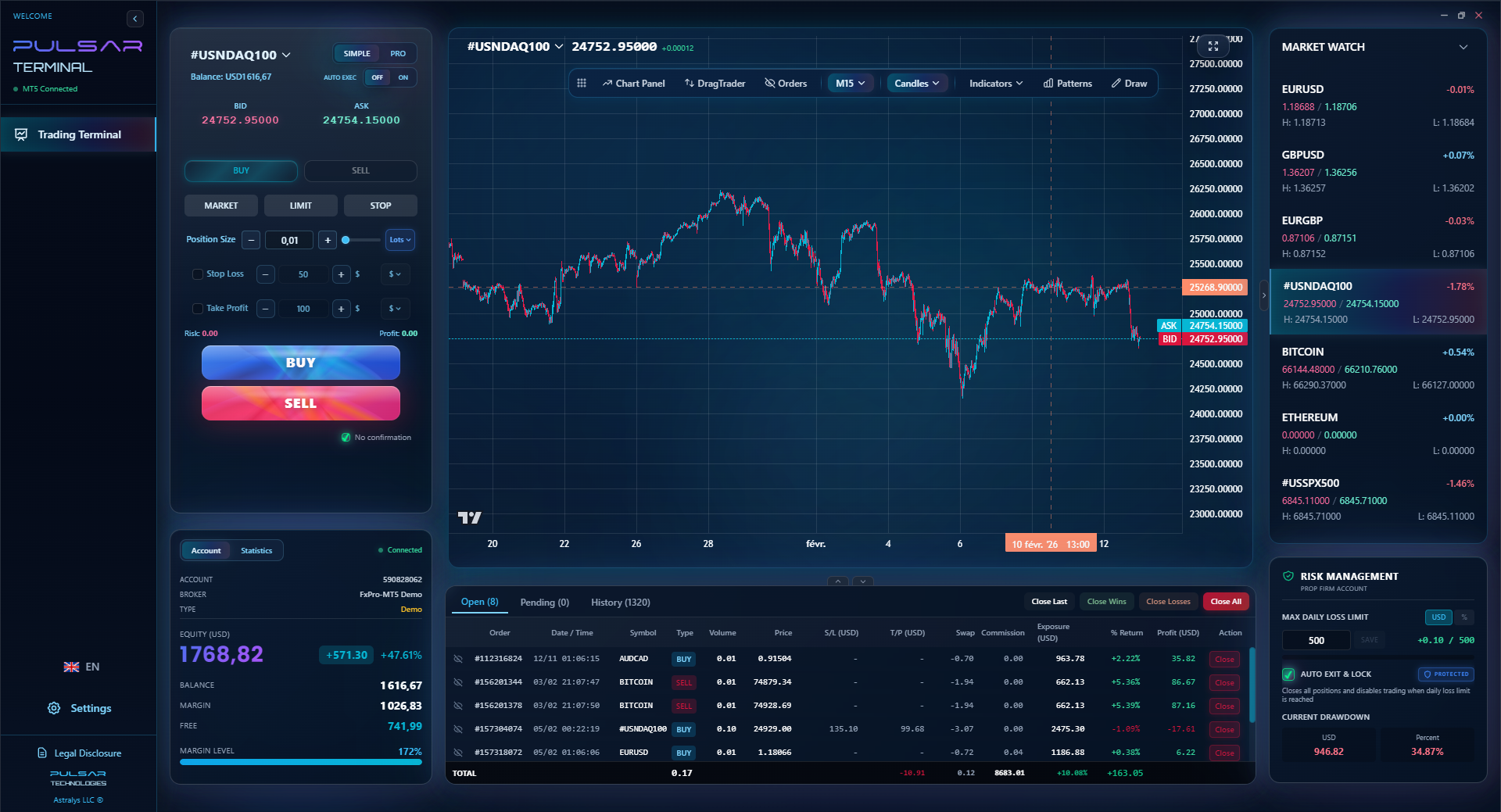
Managing a partial closure or setting a multi-level take-profit on a 5-lot trade is critical for risk management, and Pulsar Terminal lets you drag-and-drop these orders directly onto your MT5 chart.
Pulsar Terminal
Hepsi bir arada MT5 aracı: sürükle-bırak emirler, çoklu TP/SL, trailing stop, grid trading, Volume Profile ve prop firm koruması. Her gün 1.000'den fazla trader tarafından kullanılıyor.
“The dream isn't to trade 5 lots. The dream is to have an account so large that trading 5 lots represents a small, managed risk.”
Not all brokers are built for this. Trading 5 lots with a shady offshore bucket shop is asking for trouble - requotes, artificial slippage, and platform 'malfunctions' when you're in profit are common. You need a broker with deep liquidity and a reputation to uphold.
Regulation Matters: Stick with brokers regulated by top-tier authorities like the UK's FCA or Australia's ASIC (though use is capped) for your main account. For higher use, brokers regulated by the FSCA (South Africa) or CySEC (Cyprus) like XM are common choices among experienced Nigerians. They have the liquidity pools to handle your order without messing with you.
Platforms are Key: You'll live on MetaTrader 5 (MT5). MT4 is outdated for large-scale trade management. You need one-click trading, advanced order types, and reliable mobile execution. This is where tools that integrate with MT5 become vital.

Pro Tip: When testing a broker for large size suitability, don't just look at spreads. Open a demo account and place simulated 5-lot orders during major news events (like NFP). Watch for slippage, platform stability, and how quickly your orders are filled. If the demo chokes, the live account will fail you at the worst possible moment.
“Using high use to trade large size is the #1 reason traders get margin calls.”
I'll leave you with a story. A trader I mentored once hit a hot streak. He turned $5,000 into $50,000 in a few months trading 1 and 2 lots. Feeling invincible, he put on a 5-lot trade on gold (XAU/USD). Gold is even more volatile - the pip value on 5 lots of gold can be over $500. He didn't have a stop loss. 'It's coming back,' he said. It didn't. A $15,000 drop in gold wiped out his entire $50,000 account in one afternoon. He hasn't traded since.
Trading 5 lots in forex is not a measure of success. It's a measure of your capital base and your risk discipline. For 99% of Nigerian traders, the relentless pursuit of trading 'big lots' is the fastest route to zero. Focus on percentage returns, not Naira amounts. A 10% monthly return on a ₦1,000,000 account is ₦100,000. That's a fantastic income. You don't need 5 lots to achieve it. You need consistency.
Build your strategy, build your account, and let your position size grow naturally as a result. Don't force it. The market has a brutal way of humbling those who try to skip the steps. I know because I was one of them. Trade smart, not just big.
FAQ
Q1How much money do I need in Naira to trade 5 lots safely?
There's no 'safe' amount, but for responsible risk management, you'd need a capital base where a 5-lot trade risks only 1-2% of your account. If you use a 30-pip stop loss (a $1,500 risk on 5 lots), that $1,500 should be 1% of your account. So you need a $150,000 account. At ₦1,500/$, that's approximately ₦225,000,000. If that number shocks you, it should. It shows why trading 5 lots with a small account is pure, leveraged gambling.
Q2Can I trade 5 mini lots instead of 5 standard lots?
Absolutely, and this is a critical distinction. 5 mini lots = 0.5 standard lots. The pip value is $5, not $50. The capital requirement and risk are 90% lower. This is a far more realistic and sane size for a retail trader building their way up. Always clarify 'mini' or 'standard' when talking lot sizes.
Q3Which forex pairs are best for trading large sizes like 5 lots?
Stick to the major currency pairs with the highest liquidity: EUR/USD, USD/JPY, GBP/USD, and USD/CHF. These have the tightest spreads and deepest order books, minimizing your slippage and costs. Avoid exotics (like USD/NGN isn't even a retail pair) and even minor pairs like EUR/GBP. The lower liquidity can lead to terrible fills on a 5-lot market order.
Q4Do Nigerian brokers allow trading 5 lots?
There are virtually no 'Nigerian' forex brokers in the retail sense. Nigerian traders use international brokers. Most reputable international brokers like IC Markets or Exness will allow 5-lot trades, as their systems can handle it. The limit isn't the broker, it's your account equity and margin level. The real question isn't 'can I,' it's 'should I.'
Q5How does the Naira exchange rate affect trading 5 lots?
It affects your funding and your profit/loss in Naira terms. A weaker Naira (e.g., ₦1,500/$ vs. ₦800/$) means you need more Naira to deposit the same dollar amount. Conversely, if you profit $10,000, converting at ₦1,500 gives you ₦15 million, a much larger Naira sum than at a stronger rate. This currency risk adds another layer of complexity to managing a large-dollar trading account.
Q6Is it better to use high use to trade 5 lots with less money?
No. This is the most dangerous misconception. High use (like 1:500) reduces the margin requirement, not the risk. If you use high use to control 5 lots with a small account, a tiny move against you will wipe out your equity. use amplifies losses just as fast as profits. Using high use to trade large size is the #1 reason traders get margin calls.
Prof. Winston'ın Dersi
Önemli Noktalar:
- ✓5 standard lots = $50 per pip. Know this number cold.
- ✓You need ~$250k capital to risk 1% on a 50-pip stop with 5 lots.
- ✓Spreads & commissions cost $75+ per 5-lot round turn.
- ✓At 5 lots, your market orders can cause slippage.
- ✓Scale from micro lots, don't jump to standard lots.
Bu makale ne kadar faydalıydı?
Bir yıldıza tıklayın
Haftalık Trading Analizleri
Ücretsiz haftalık analiz ve stratejiler. Spam yok.
Yazar hakkında
Olumide Adeyemi
Batı Afrika Yatırım Öncüsü
Nijerya'nın en aktif forex eğitmenlerinden biri. Lagos'tan 8 yıllık ticaret deneyimi. Afrika'lı trader'lar için düşük sermaye stratejileri ve prop firma yarışmaları uzmanı.
Yorumlar
Risk Uyarısı
Finansal araçlarla işlem yapmak önemli riskler taşır ve tüm yatırımcılar için uygun olmayabilir. Geçmiş performans gelecekteki sonuçları garanti etmez. Bu içerik yalnızca eğitim amaçlıdır ve yatırım tavsiyesi olarak değerlendirilmemelidir. İşlem yapmadan önce her zaman kendi araştırmanızı yapın.
Bunları da beğenebilirsiniz

Cara Trading Forex Sukses: 7 Prinsip dari Trader Profesional
Cara trading forex sukses dengan 7 prinsip trader pro: manajemen modal, disiplin, journal trading, backtest. Data nyata, bukan janji profit palsu.
Jam Trading Forex Terbaik untuk Trader Indonesia: Panduan Lengkap dengan Tabel Waktu
Panduan jam trading forex untuk trader Indonesia. Tabel 4 sesi dunia, jam emas 20:00-00:00, sesi mana yang harus dihindari. Data akurat + tips dari trader berpengalaman.
Top 5 Sàn Forex Uy Tín Nhất 2026: Review Jujur dari Trader Indonesia
Top 5 sàn forex uy tín 2026 untuk trader Indonesia. Review jujur: spread, deposit, withdraw, dukungan lokal. Exness, XM, IC Markets & lebih.
Pulsar Terminal'ı Edinin
Tüm bu hesaplayıcılar MT5 hesabınızdan gerçek zamanlı verilerle Pulsar Terminal'e entegredir.
Pulsar Terminal'ı Edinin