


You've probably seen the ads or heard the whispers: 'Earn 30% monthly returns on gold with Aarudhra.' It sounds too good to be true, right? That's because it is.

Rajesh Sharma
Kıdemli Forex Analisti ·  India
India
☕ 12 dk okuma
Neler öğreneceksiniz:
- 1The Aarudhra Gold Trading Scam: How It Worked
- 2Real Gold Trading in India: Your Regulated Options
- 3The Real Costs of Trading Gold (No 30% Returns Here)
- 4How to Start Trading Gold Legitimately: A Step-by-Step Guide
- 5Red Flags: How to Spot the Next Aarudhra
- 6A Realistic Approach to Trading Gold Prices
- 7Final Word: Trade the Market, Not the Dream
You've probably seen the ads or heard the whispers: 'Earn 30% monthly returns on gold with Aarudhra.' It sounds too good to be true, right? That's because it is. Let's cut through the noise. Aarudhra Gold Trading isn't a trading platform; it's one of India's biggest financial scams, a classic Ponzi scheme that's wiped out savings. I'm not here to just warn you. I'm here to show you exactly what a real gold trading setup looks like - the regulated brokers, the actual costs, and the strategies that work without fairy-tale promises.
Aarudhra Gold Trading Private Limited (AGTPL) wasn't trading gold. They were trading on people's desperation for quick returns. The model was brutally simple and effective: promise the moon, pay early investors with money from new ones, and vanish.
They offered monthly returns of 10% to 30%. Let that sink in. That's 120% to 360% per year. No legitimate asset class on earth delivers that consistently. To sweeten the deal, they threw in 'monthly payouts,' 'free' gold coins, and referral commissions. It was a textbook Ponzi scheme, designed to create a frenzy of new deposits to fund the old ones.
The scale is staggering. Over one lakh (100,000) depositors lost approximately ₹2,438 crore. The Economic Offences Wing (EOW) and the Enforcement Directorate (ED) have been on the case for years. The main accused, V Rajasekhar, was finally detained by Interpol in Abu Dhabi in late 2023. As of late 2025, the ED has seized cash and properties, uncovering that 'dummy individuals' in menial jobs were listed as company directors. This wasn't a business; it was a carefully constructed theft.

Warning: Any 'investment' offering fixed, guaranteed monthly returns above 1-2% in gold should set off deafening alarm bells. Gold is a volatile commodity. Its price moves up and down. Anyone promising you steady, sky-high income from it is lying.
The tragedy is that this scam exploited a genuine cultural trust in gold. People believed they were investing in something solid and familiar. Instead, they were handing their money to criminals. Understanding this scam is your first lesson in financial self-defense. The next step is learning what real gold trading actually involves, which is far more about patience and risk management than fantasy profits.

💡 Winston'ın İpucu
A promise of high, steady returns from a volatile asset is a logical contradiction. It's the most reliable sign of a fraud.
“Aarudhra Gold Trading wasn't trading gold. They were trading on people's desperation for quick returns.”
So, if Aarudhra was fake, what's real? In India, you have several legitimate, regulated paths to get exposure to gold prices. Each has its own rules, costs, and purpose. Forget 'monthly returns.' Think in terms of capital appreciation, portfolio diversification, and hedging against inflation.
Sovereign Gold Bonds (SGBs): The Safest Bet
Issued by the Government of India via the RBI, SGBs are as safe as it gets. You're lending money to the government with gold as the underlying asset. You get two benefits: the potential price appreciation of gold and a fixed interest of 2.5% per annum paid semi-annually. The big win? If you hold them to maturity (8 years), the capital gains are completely tax-free. It's a long-term, set-and-forget investment, not a trading vehicle.
Gold ETFs: The Stock Market Route
Gold Exchange Traded Funds (ETFs) are regulated by SEBI and trade on the stock exchange like any other share. You buy units that represent physical gold stored in a vault. This is for you if you want to trade gold price movements without the hassle of physical storage. You need a Demat account. They're liquid - you can buy and sell during market hours. The cost? An annual expense ratio, typically between 0.5% to 1%. For active trading, this is one of the most efficient ways. I often use Gold ETFs for medium-term swing trading setups when I see a clear technical trend on the charts.
Digital Gold: Convenient but Watch the Fine Print
This is the 'gold' you buy on Paytm, PhonePe, or Google Pay. It's easy, with minimum investments as low as ₹1. Important note: as of now, typical digital gold products are not regulated by SEBI or RBI. SEBI has issued public advisories about this. While platforms partner with entities like MMTC-PAMP to store physical gold, the lack of formal securities market protections is a gap. The costs are hidden in the buy-sell spread (often 2-5%) and potential storage fees after a few years. It's better for small, incremental saving than active trading.
Gold Futures: For the Active Trader
This is where real, short-term gold 'trading' happens. You trade contracts for future delivery of gold on the Multi Commodity Exchange (MCX). This is leveraged, high-risk, and requires a dedicated commodity trading account. It's not for beginners. You're speculating on price direction over days, weeks, or months. The spread and brokerage costs are your main friction here. I'll be honest, my first foray into gold futures years ago ended in a quick loss because I didn't respect the use. It's a powerful tool, but you need solid risk management, like using a position size calculator for every single trade.
“Forget 'monthly returns.' Think in terms of capital appreciation, portfolio diversification, and hedging.”
Let's talk numbers. Real numbers. The fantasy of Aarudhra made costs seem irrelevant. In the real world, costs are what separate profitable traders from losers. Here’s what you actually pay.
| Method | Key Costs & Fees | Who It's For |
|---|---|---|
| Physical Gold (Jewellery/Coins) | GST: 3% on gold + 5% on making charges. Making charges: 8-25%. Resale discount: 2-5% less than market price. | Long-term holders, not traders. |
| Sovereign Gold Bonds (SGBs) | No direct fee. Capital gains tax-free at 8-year maturity. Earns 2.5% p.a. interest. | Long-term, conservative investors. |
| Gold ETFs | Brokerage (₹20 per trade is common). Annual Expense Ratio: 0.5% - 1%. STCG taxed as per slab, LTCG at 12.5%. | Medium-term investors & traders. |
| Digital Gold | GST: 3% on purchase. Buy-Sell Spread: 2% - 5%. Storage fees after 3-5 years (~0.3%-1% p.a.). | Small, casual savers. |
| Gold Futures | Brokerage + Exchange fees. Spread on the contract. Requires margin. High risk due to use. | Experienced, active traders. |
See the difference? The cheapest ways to gain exposure (ETFs, SGBs) involve patience. The 'convenient' way (digital gold) has hidden spreads that eat into returns. The active way (futures) has use that can blow up your account if you're careless.

Example: Let's say you buy ₹1,00,000 of digital gold. With a 3% GST, you immediately 'pay' ₹3,000. If the gold price doesn't move and you sell, the 3% buy-sell spread might cost you another ₹3,000. You need a 6% price increase just to break even. An ETF might have a 0.1% spread and ₹20 brokerage. You need far less movement to be profitable.
I learned this the hard way early on. I was scalping gold futures, making 5-10 point gains. I felt clever until I tallied my brokerage and fees for the month. They had completely erased my small profits. I was just generating commissions for my broker. Now, I factor in all costs before I even place a trade. It changes your entire approach.
“Forget 'monthly returns.' Think in terms of capital appreciation, portfolio diversification, and hedging.”
Ready to do this for real? Here’s a practical roadmap. We’re building a foundation, not a get-rich-quick scheme.
Step 1: Choose Your Vehicle. Are you a long-term investor or an active trader? If former, open a Demat account and start with Gold ETFs or SGBs. If you're drawn to active trading, you need to study first. Paper trade gold futures or ETF price action for at least 3 months. I don't care how bullish you are. Do it.
Step 2: Find a Regulated Broker. This is non-negotiable. For ETFs/SGBs, use a SEBI-registered stockbroker like Upstox, Angel One, or ICICI Direct. For gold futures, you need a broker with MCX access. Do your due diligence. Read reviews, check their regulatory status on SEBI's website. Don't just go for the one with the flashiest ads. I personally use a combination of a primary broker for execution and platforms like TradingView for analysis.
Step 3: Learn the Charts (XAU/USD is King). While you trade in INR, the global price of gold is set in USD. The benchmark chart you need to watch is XAU/USD (the ticker for gold priced in US dollars). Your Indian gold futures and ETF prices will largely follow this. Learn to read this chart. Understand support/resistance, and basic indicators like the RSI indicator or MACD indicator. My first profitable gold trade came from simply buying an ETF when XAU/USD bounced off a major support level that had held for years. It's not always complicated.
Step 4: Practice Risk Management Before Profit. Decide your risk per trade. Is it 1% of your capital? 0.5%? Stick to it. Use stop-losses on every single trade, no exceptions. A margin call is a preventable disaster, not bad luck. Your goal in the first year is not to make money. Your goal is to not lose your capital while you learn.
Step 5: Start Small and Journal. Start with a position so small that losing it won't affect your sleep. Record every trade: entry, exit, reason, emotion. Review it weekly. This journal will teach you more than any guru. My own journal from 2018 is full of cringe-worthy entries like 'Felt good, went big' next to a significant loss. The lesson wasn't about gold; it was about me.
💡 Winston'ın İpucu
Your first profit target in trading should always be to keep your losses small and educational. Protecting capital is job number one.
“Your goal in the first year is not to make money. Your goal is to not lose your capital while you learn.”
Scams evolve, but their core ingredients don't. Arm yourself with this checklist. If you see even one of these, run.
- Guaranteed High Returns: 'Earn 15% monthly guaranteed.' Reality doesn't offer guarantees, especially not in double digits.
- Complex or Vague Explanations: If they can't simply explain how the profits are generated, or if it involves secret 'algorithms' or 'international arbitrage,' it's nonsense.
- Pressure to Act Fast: 'Offer closing tomorrow!' or 'Only for the first 100 investors!' This is psychological manipulation to shut down your critical thinking.
- Lack of Regulatory Details: A legitimate entity will proudly display its SEBI, RBI, or MCX registration number. If you can't find it, or they brush off the question, it's a major warning.
- Focus on Referrals: If the business model seems more about recruiting new members than the actual product (gold, in this case), you're likely in a Ponzi or pyramid scheme.
- Difficulty Withdrawing: Early on, withdrawals are smooth to build trust. The first sign of trouble is often delayed payments, excuses about 'system upgrades,' or new fees to access your own money.
I once nearly got caught in a similar forex robot scam early in my career. The promise was 5% a week. The website looked professional. What saved me? I asked for a live, verifiable track record from a third-party platform. They couldn't provide it. That hesitation saved me thousands. Always demand verifiable, real-time proof, not glossy brochures or screenshot testimonials.

Pro Tip: Before investing a single rupee in any platform, search its name alongside keywords like 'scam,' 'complaint,' 'SEBI warning,' and 'ED raid' on Google. Read the results on independent forums, not just the company's website.
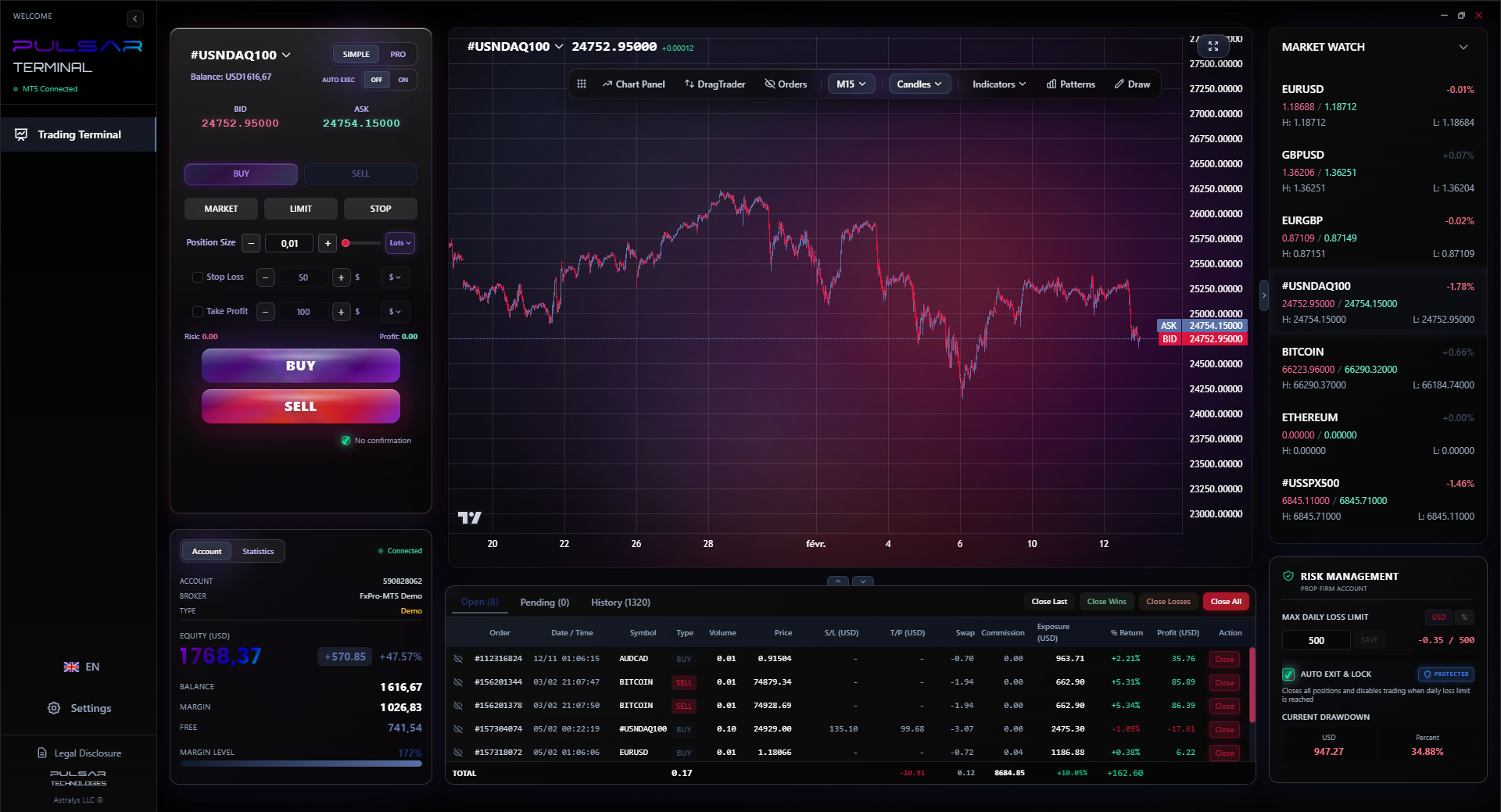
Managing multiple trades and strict stop-losses is critical to avoid disaster, which is why tools like Pulsar Terminal that automate these on MT5 are so valuable.
Pulsar Terminal
Hepsi bir arada MT5 aracı: sürükle-bırak emirler, çoklu TP/SL, trailing stop, grid trading, Volume Profile ve prop firm koruması. Her gün 1.000'den fazla trader tarafından kullanılıyor.
“Your goal in the first year is not to make money. Your goal is to not lose your capital while you learn.”
Let's replace the scam fantasy with a trader's reality. Gold isn't a magic income generator. It's a cyclical, sentiment-driven asset. Here’s how I view it in my portfolio.
Gold acts as a hedge. When confidence in currencies or stocks drops, money often flows into gold. I don't try to predict these major shifts daily. Instead, I look for technical setups on the XAU/USD guide chart and use gold ETFs or futures to take a position with a clear risk point.
For example, in early 2026, gold was in a strong uptrend, breaking past $4,600/oz. Chasing it straight up is risky. I waited for a pullback to a previous resistance-turned-support zone, identified using basic trend lines and volume. I entered a small long position in a Gold ETF, with a stop-loss below that zone. The trade wasn't based on a 'gut feeling' or a guru's tip. It was based on price action and a defined risk. The profit wasn't 30%. It was a modest 8% over several weeks, which is a fantastic return for a managed trade.
The key is alignment. Your trading style must match your vehicle. Don't try to day-trade using SGBs. Don't use high-use futures for a multi-year investment thesis. Pick one method, learn its intricacies, and master your psychology around it. The market will test your patience and discipline far more than your intelligence.
💡 Winston'ın İpucu
If you wouldn't be comfortable explaining the investment's mechanics to a skeptical friend, you shouldn't put money into it.
“The market will test your patience and discipline far more than your intelligence.”
The Aarudhra Gold Trading story is a painful lesson in what happens when greed meets deception. But it also draws a clear line in the sand. On one side are the scams, selling dreams of effortless wealth. On the other is the real financial markets: challenging, risky, but transparent and governed by rules.
Your path forward is on the regulated side. Start by opening a Demat account with a reputable broker - not to trade tomorrow, but to have the tool ready. Spend the next month learning. Watch the XAU/USD chart every day. Read the EUR/USD guide to understand how major currency pairs move, as that often impacts gold. The principles are the same.
Understand that real trading success is a slow grind. It's about preserving capital on your bad days so you have capital to deploy on your good days. It's about the boring stuff: risk management, trade journals, and continuous learning.
Forget Aarudhra. Forget 30% monthly returns. Embrace the reality of 1-2% good trades per month, compounded over time with strict discipline. That's the real game. And it's the only one where you don't risk becoming just another line in an ED charge sheet. It's harder, but it's honest, and the money you make is actually yours to keep.
FAQ
Q1Is Aarudhra Gold Trading real or fake?
It is a confirmed fake investment scam, a Ponzi scheme under investigation by the ED and EOW. It has defrauded investors of over ₹2,438 crore. There is no legitimate gold trading associated with this entity.
Q2What are the safest ways to invest in gold in India?
The safest regulated methods are Sovereign Gold Bonds (SGBs) issued by the Government of India and Gold Exchange Traded Funds (ETFs) regulated by SEBI. Both are transparent, traded through formal channels, and carry no risk of the entity itself vanishing with your money.
Q3Can I still get my money back from Aarudhra Gold Trading?
The Enforcement Directorate (ED) is actively investigating and attaching assets. If you are a victim, you should immediately file a formal complaint with the Economic Offences Wing (EOW) in your state and follow the legal process. Recovery depends on the assets seized and the court's eventual distribution process, which can take years.
Q4What is the difference between digital gold and Gold ETFs?
Digital gold (on Paytm, etc.) is a convenient way to buy small amounts, but it is not currently regulated by SEBI/RBI as a security, has higher hidden costs (spread), and is less liquid. Gold ETFs are SEBI-regulated securities traded on the stock exchange, have lower explicit costs (expense ratio), and are designed for easier buying/selling like shares.
Q5How much money do I need to start real gold trading?
For Gold ETFs, you can start with the price of a single unit, which can be a few thousand rupees. For a futures trading account, brokers often have minimum deposit requirements of ₹25,000-₹50,000, but you should only use a small fraction of that for your initial risk capital. The key is to start with an amount you can afford to lose while learning.
Q6What should I look for in a legitimate gold trading broker?
Look for a SEBI registration number for stock/ETF brokers or MCX membership for commodity futures brokers. Check their website for clear fee disclosures. Read independent reviews and ensure they provide secure, official trading platforms (like their own terminal or access to MetaTrader). Avoid any broker promising managed accounts with high guaranteed returns.
Prof. Winston'ın Dersi
Önemli Noktalar:
- ✓Ponzi schemes promise impossible returns (10-30% monthly).
- ✓Real gold trading costs 0.5-5% in fees/spreads.
- ✓Only use SEBI/RBI regulated platforms (ETFs, SGBs).
- ✓Risk a maximum of 1-2% of capital per trade.
- ✓Global gold price (XAU/USD) drives Indian prices.
Bu makale ne kadar faydalıydı?
Bir yıldıza tıklayın
Haftalık Trading Analizleri
Ücretsiz haftalık analiz ve stratejiler. Spam yok.
Yazar hakkında
Rajesh Sharma
Kıdemli Forex Analisti
Hindistan ve Güney Asya piyasalarında 10 yılı aşkın deneyim. NSE döviz türevleriyle başlayıp uluslararası forex'e geçiş yaptı. USD/INR ve gelişmekte olan piyasa pariteleri uzmanı.
Yorumlar
Risk Uyarısı
Finansal araçlarla işlem yapmak önemli riskler taşır ve tüm yatırımcılar için uygun olmayabilir. Geçmiş performans gelecekteki sonuçları garanti etmez. Bu içerik yalnızca eğitim amaçlıdır ve yatırım tavsiyesi olarak değerlendirilmemelidir. İşlem yapmadan önce her zaman kendi araştırmanızı yapın.
Bunları da beğenebilirsiniz

Cara Trading Forex Sukses: 7 Prinsip dari Trader Profesional
Cara trading forex sukses dengan 7 prinsip trader pro: manajemen modal, disiplin, journal trading, backtest. Data nyata, bukan janji profit palsu.
Jam Trading Forex Terbaik untuk Trader Indonesia: Panduan Lengkap dengan Tabel Waktu
Panduan jam trading forex untuk trader Indonesia. Tabel 4 sesi dunia, jam emas 20:00-00:00, sesi mana yang harus dihindari. Data akurat + tips dari trader berpengalaman.
Top 5 Sàn Forex Uy Tín Nhất 2026: Review Jujur dari Trader Indonesia
Top 5 sàn forex uy tín 2026 untuk trader Indonesia. Review jujur: spread, deposit, withdraw, dukungan lokal. Exness, XM, IC Markets & lebih.
Pulsar Terminal'ı Edinin
Tüm bu hesaplayıcılar MT5 hesabınızdan gerçek zamanlı verilerle Pulsar Terminal'e entegredir.
Pulsar Terminal'ı Edinin