


I was staring at my screen in late 2024, watching a USD/NGN trade I had no business being in.

Olumide Adeyemi
Batı Afrika Yatırım Öncüsü ·  Nigeria
☕ 9 dk okuma
Neler öğreneceksiniz:
- 1What Account Management in Forex Actually Means (Hint: It's Not What You Think)
- 2The 1% Rule (And Why You're Probably Ignoring It)
- 3Position Sizing for Naira Accounts: The Practical Details
- 4use: Your Tool, Not Your Strategy
- 5The Weekly & Monthly Tally: Facing the Music
- 6Avoiding the 'Managed Account' Scam & Embracing Self-Reliance
- 7The Psychology: Where Your Rules Meet Your Emotions
I was staring at my screen in late 2024, watching a USD/NGN trade I had no business being in. My account was down 22% in a single session. The CBN had just announced another policy shift, and my 'feeling' about the Naira's direction was obliterated. That wasn't trading. That was gambling with a spreadsheet open. That moment, more than any win, burned the absolute necessity of proper account management in forex into my brain. It's not about fancy strategies. It's about surviving long enough in the Lagos market to let a strategy work. Let's talk about what that actually means for you, right now.
First, let's kill a dangerous misconception. In Nigeria, when people hear 'account management,' they often think of some guy on WhatsApp promising to trade your money for a 30% cut. That's not what we're talking about here. That's a great way to lose everything. The SEC has been screaming warnings about this for years, and they're right.
Real account management in forex is the boring, systematic process of controlling your own risk. It's the set of rules you follow to make sure one bad trade, or one crazy CBN announcement, doesn't wipe you out. It's about preserving your capital so you can fight another day. Think of it as the defensive strategy for your trading career. You can have the best entry signals in the world, but without this, you're just building on sand.
For us trading with international brokers like Exness or IC Markets, it's entirely on us. No one is coming to save you from a margin call. Your broker's regulator in Cyprus or Australia doesn't care about your Naira deposits. Your survival is your responsibility. This guide is about taking that control.

💡 Winston'ın İpucu
Your first profit target should always be to get to breakeven on a trade. Move your stop-loss to your entry once price moves in your favor by 1.5x your initial risk. This turns a risky bet into a free one.
“Real account management in forex is the boring, systematic process of controlling your own risk.”
This is the cornerstone. The single most important rule in account management in forex. You risk no more than 1% of your total account balance on any single trade.
I know what you're thinking. "1%? That's too small. I need to make real money." I thought the same thing. Back in 2021, I funded a $500 account. I saw a setup on GBP/JPY and thought, 'This is it.' I risked 5% ($25). The trade went against me immediately. Losing that $25 felt like a punch. It was 5% of my account gone in minutes. The psychological pressure it created made me overtrade, trying to win it back. I blew the account in two weeks.
The Math of Survival
Let's do the real math. If you risk 1% per trade and have a losing streak (which you will), how much does it hurt?
| Consecutive Losses | Account Loss (Risking 1%) | Account Loss (Risking 5%) |
|---|---|---|
| 5 Losses | -4.9% | -22.6% |
| 10 Losses | -9.6% | -40.1% |
See the difference? At 5% risk, ten bad trades and you're almost halfway to zero. At 1%, you're down less than 10%. You're still in the game. You can recover from a 10% drawdown. Recovering from 40% requires a 67% return just to break even. That's when desperation sets in.

Warning: Your 'risk' is not your position size. It's the distance in pips from your entry to your stop-loss, multiplied by the value per pip. If you don't know this calculation cold, stop trading now and learn it. Use a position size calculator until it's second nature.
This rule is non-negotiable. It's the price of admission. If you're not following it, you're not managing your account, you're hoping.
“At 5% risk, ten bad trades and you're almost halfway to zero. At 1%, you're down less than 10%. You're still in the game.”
Okay, you agree with the 1% rule. Now, how do you actually apply it when your brain is thinking in Naira but your broker account is in USD? This is where most Nigerian traders get it wrong.
Let's say you have a $1,000 account with a broker like XM or Pepperstone. 1% risk is $10. You want to buy EUR/USD. You place your entry at 1.0850 and your stop-loss at 1.0830. That's a 20-pip risk.
The formula is: Position Size = (Account Risk in $) / (Pips Risked * Pip Value in $) For a standard lot (100,000 units), 1 pip on EUR/USD = $10. So, for a mini lot (10,000 units), 1 pip = $1.
We need to risk $10 over 20 pips. $10 / 20 pips = $0.50 per pip. Since a micro lot (1,000 units) gives a $0.10 pip value on EUR/USD, a $0.50 per pip value means a position size of 5 micro lots (or 0.05 mini lots).

Example: $1,000 Account, 1% Risk = $10. EUR/USD trade with 20-pip SL. Pip Value Needed = $10 / 20 = $0.50 per pip. Micro Lots = $0.50 / $0.10 = 5 Micro Lots (0.05 standard lots).
That's it. No guesswork. If your stop-loss is wider because you're swing trading on the 4-hour chart, your position size must be smaller. Period. This discipline is what separates the consistent trader from the perpetual depositor.
And for those using Naira-denominated accounts? The principle is identical. Just convert your 1% risk into your account currency first, then do the same math. The market doesn't care what currency your account is in; a pip's value is still a pip.
“At 5% risk, ten bad trades and you're almost halfway to zero. At 1%, you're down less than 10%. You're still in the game.”
Brokers offer Nigerian clients use like 1:500 or even 1:1000. It's a trap dressed as an opportunity. use amplifies everything: your gains and your losses. Used recklessly, it's the fastest route to a margin call.
Here's the truth: High use doesn't make you a better trader. It just means you can place a bigger position with less money. And without strict account management, that bigger position will blow you up. I learned this trading gold (XAU/USD). With high use, I could control a full lot with a small margin. When gold moved $10 against me (a normal fluctuation), it wiped out a huge chunk of my balance because my position was way too big for my account.
Think of use like a powerful car engine. A professional driver (with rules, a risk plan) can use it to perform efficiently. A novice will crash it. Your position sizing, based on the 1% rule, automatically dictates how much use you're effectively using. If you're sized correctly, your effective use will be sensible, even if your broker offers 1:1000.
Don't chase the highest use offer. Choose a broker with strong regulation and good execution, like IC Markets or Pepperstone, and use their use responsibly. Your goal is to grow the account, not to have the biggest number on the use slider.
💡 Winston'ın İpucu
If you can't state your maximum loss on a trade before you enter it, in Naira, you have no business being in that trade. Period.
“High use doesn't make you a better trader. It just means you can place a bigger position with less money.”
Account management isn't just about the trade entry. It's about the review. You must have a routine.
Every Sunday night, I do two things:
- I look at my trading journal. How many trades did I take? Did I follow my rules? What was my win rate? Most importantly, what was my average win size versus my average loss size (your risk-to-reward ratio)?
- I check my account statement. I note the balance, the equity, and the total gain/loss for the week. I don't lie to myself. If I'm down, I acknowledge it. I look for patterns: Was I overtrading? Did I move stop-losses? This is where you catch bad habits before they become account killers.
At the end of the month, I do a deeper review. I calculate my expectancy: (Win Rate % * Average Win) - (Loss Rate % * Average Loss). Is it positive? If not, my strategy is broken, not the market.

Pro Tip: Withdraw profits periodically. If you have a great month and grow your $1,000 account to $1,300, pull out the $300 profit. Send it to your Nigerian bank account. Buy something tangible. This does two things: it makes the money real, and it resets your account to its 'base' capital, forcing you to protect it all over again. It breaks the cycle of seeing profits as just numbers on a screen to be gambled away.
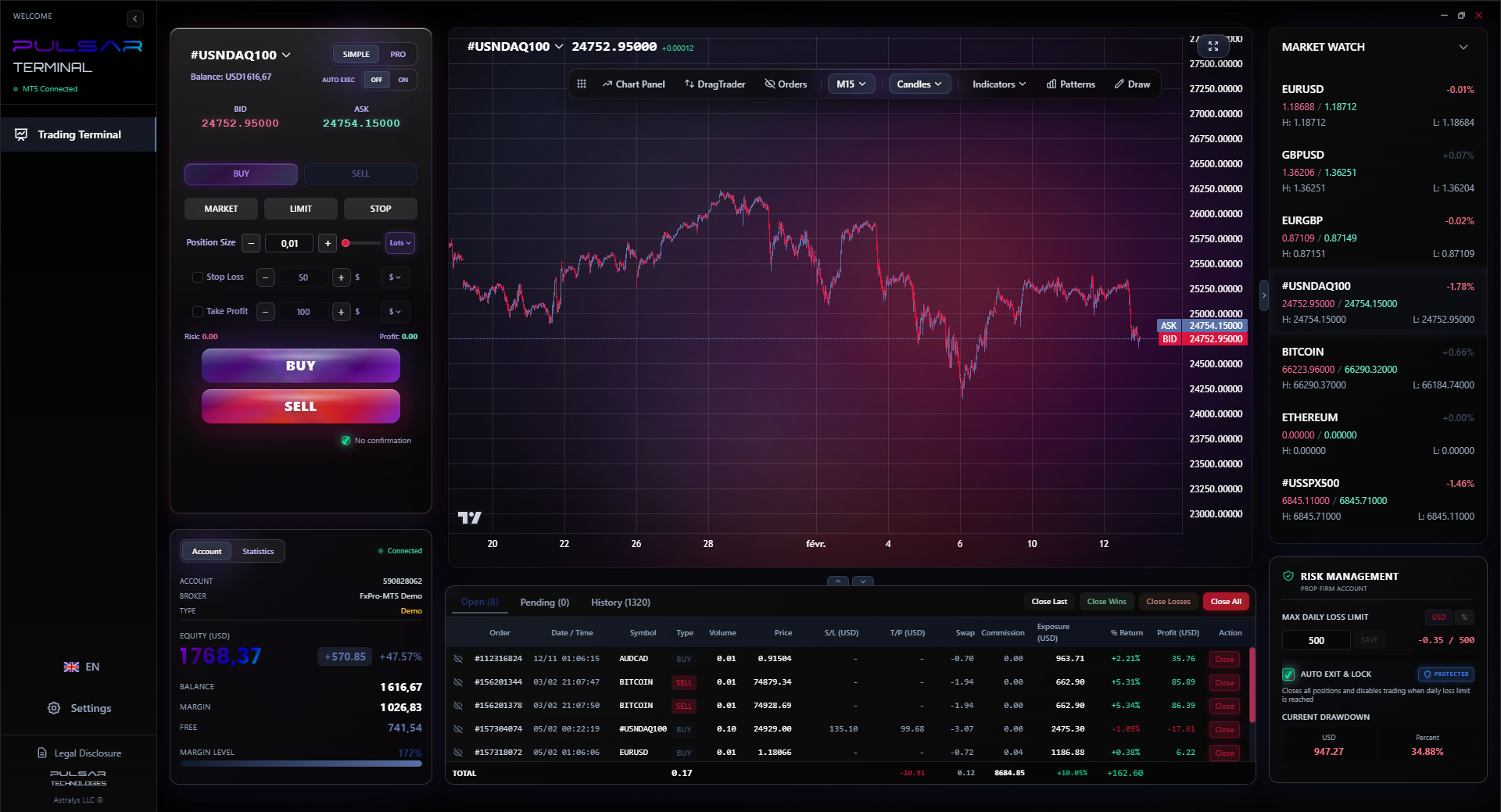
Sticking to your weekly review and profit-taking rules is easier when your trade management is automated, which is exactly what Pulsar Terminal helps you do on MT5.
Pulsar Terminal
Hepsi bir arada MT5 aracı: sürükle-bırak emirler, çoklu TP/SL, trailing stop, grid trading, Volume Profile ve prop firm koruması. Her gün 1.000'den fazla trader tarafından kullanılıyor.
“High use doesn't make you a better trader. It just means you can place a bigger position with less money.”
This needs its own section because the temptation is huge in Nigeria. You see the flashy cars, the screenshots of profits, the promises of "I'll trade for you, just bring your capital." Please, listen to me.
These are almost always scams. The SEC isn't warning people for fun. The structure is simple: they use your money to pay 'returns' to earlier investors (a Ponzi scheme), or they simply blow your account through reckless trading and disappear. If they were so good, why would they need your Naira? They'd be trading their own millions.
Real, licensed fund management exists, but it's for large institutional money and has nothing to do with managing your $500 MT4 account. The path for you is self-reliance.
That means:
- Educate Yourself: Learn what a pip really is. Understand the spread. Study price action.
- Use Technology Wisely: Tools like Pulsar Terminal can help automate parts of your risk management (like setting multiple take-profits or trailing stops), but you still set the rules. They execute your plan, they don't create it.
- Start Small: Use a broker with a low minimum deposit. Practice your account management rules with $50 or $100. Treat it as seriously as a $10,000 account. The habits you form now will save you (or cost you) later.
The greatest power you have in trading is control over your own risk. Don't ever give that away to some anonymous 'guru' on social media. Your account, your management, your responsibility.
💡 Winston'ın İpucu
Review your trades based on whether you followed your rules, not on whether you made money. A rule-following loss is a better trade than a rule-breaking win.
“Your first profit target should always be to get to breakeven on a trade.”
All these rules are useless if you don't have the discipline to follow them when it hurts. And it will hurt.
The market will test you. You'll have a trade in profit, and you'll be tempted to close it early before it hits your target, just to lock in a win. You'll have a trade hitting your stop-loss, and you'll want to delete the stop, hoping it'll come back. This is the moment. This is where account management in forex is won or lost.
I keep a sticky note on my monitor: "The Rule is The Rule." It reminds me that my pre-calculated 1% risk, my stop-loss placement, my take-profit level - these are not suggestions. They are orders from my past, rational self to my present, emotional self.
When you feel that itch to break your rules, walk away. Shut the laptop. The market will be there tomorrow. An account that's down 2% because you followed your rules is in a fantastic position. An account that's up 10% because you broke every rule and got lucky is in mortal danger. Luck always runs out. Discipline compounds.
Build the habit. One trade at a time. Protect your capital like it's the last Naira you have, because in trading, it very well could be.
FAQ
Q1Is it legal for someone in Nigeria to manage my forex trading account?
It's a legal minefield. For someone to legally manage investments (including forex) on your behalf in Nigeria, they must be a licensed Fund Manager or Investment Adviser registered with the Securities and Exchange Commission (SEC). The guys on Instagram or WhatsApp offering to trade for you almost never have this license. The SEC consistently warns against them. It's incredibly risky and often ends in total loss.
Q2I only have 50,000 Naira to start. Is the 1% rule still realistic?
Absolutely, but you have to be practical. With a small account, you need to trade smaller instruments or use micro lots. If 50,000 Naira is about $33, 1% is roughly $0.33. This means you need very tight stop-losses or to trade pairs where the pip value is tiny. This is why many traders start with a slightly larger base - it gives more flexibility. The rule itself, however, is non-negotiable regardless of size.
Q3What's a good profit target per month with proper account management?
If you're consistently making 5-10% per month on your capital, you are an exceptional trader. Seriously. The internet is full of lies. Aiming for 2-5% per month with solid risk management is a fantastic, realistic goal. Compounded over a year, that turns a $1,000 account into $1,268 (at 2% monthly) or $1,795 (at 5% monthly). Focus on consistency, not moonshots.
Q4How do I handle withdrawals and taxes on trading profits in Nigeria?
Withdrawals are processed by your international broker to your chosen method (bank transfer, e-wallet). The conversion back to Naira will be at the prevailing rate, which can be volatile. On taxes, the current situation is complex. Trading profits are generally considered taxable income. However, the practical enforcement on retail forex trading with offshore brokers is inconsistent. You should consult a Nigerian tax professional for advice specific to your situation. Don't rely on broker forums for tax advice.
Q5Can copy trading be a form of account management?
It can be a tool, but it's not management. When you copy a trader, you are delegating your trade decisions but NOT your risk management. You are still responsible for sizing your account appropriately. If you copy a trader with a $100,000 account using 3 lots on a trade, and you have a $1,000 account, the copy will proportionally size it for you, but you must still ensure that sized position aligns with your 1% risk rule. Most copy platforms don't do this math for you. The responsibility stays with you.
Q6My broker offers a 'managed account service.' Is this safe?
Extreme caution. Most reputable international brokers (the ones we recommend) do NOT offer traditional 'we trade for you' managed accounts. They provide platforms for self-trading. Any 'service' offered directly by a broker or a third-party through them needs intense scrutiny. Check the regulatory status of the entity doing the managing. In 99% of cases for Nigerian clients, it's safer and smarter to learn to manage your own account.
Prof. Winston'ın Dersi
Önemli Noktalar:
- ✓Risk a maximum of 1% of your account per trade. No exceptions.
- ✓Calculate your position size *before* you click buy or sell.
- ✓use is for efficiency, not for gambling.
- ✓Withdraw profits regularly to make them real.
- ✓Self-manage your account. Never give control to unlicensed strangers.
Bu makale ne kadar faydalıydı?
Bir yıldıza tıklayın
Haftalık Trading Analizleri
Ücretsiz haftalık analiz ve stratejiler. Spam yok.
Yazar hakkında
Olumide Adeyemi
Batı Afrika Yatırım Öncüsü
Nijerya'nın en aktif forex eğitmenlerinden biri. Lagos'tan 8 yıllık ticaret deneyimi. Afrika'lı trader'lar için düşük sermaye stratejileri ve prop firma yarışmaları uzmanı.
Yorumlar
Risk Uyarısı
Finansal araçlarla işlem yapmak önemli riskler taşır ve tüm yatırımcılar için uygun olmayabilir. Geçmiş performans gelecekteki sonuçları garanti etmez. Bu içerik yalnızca eğitim amaçlıdır ve yatırım tavsiyesi olarak değerlendirilmemelidir. İşlem yapmadan önce her zaman kendi araştırmanızı yapın.
Bunları da beğenebilirsiniz

Cara Trading Forex Sukses: 7 Prinsip dari Trader Profesional
Cara trading forex sukses dengan 7 prinsip trader pro: manajemen modal, disiplin, journal trading, backtest. Data nyata, bukan janji profit palsu.
Jam Trading Forex Terbaik untuk Trader Indonesia: Panduan Lengkap dengan Tabel Waktu
Panduan jam trading forex untuk trader Indonesia. Tabel 4 sesi dunia, jam emas 20:00-00:00, sesi mana yang harus dihindari. Data akurat + tips dari trader berpengalaman.
Top 5 Sàn Forex Uy Tín Nhất 2026: Review Jujur dari Trader Indonesia
Top 5 sàn forex uy tín 2026 untuk trader Indonesia. Review jujur: spread, deposit, withdraw, dukungan lokal. Exness, XM, IC Markets & lebih.
Pulsar Terminal'ı Edinin
Tüm bu hesaplayıcılar MT5 hesabınızdan gerçek zamanlı verilerle Pulsar Terminal'e entegredir.
Pulsar Terminal'ı Edinin