


I was staring at my screen in late 2025, watching EUR/USD chop around 1.0850.

Olumide Adeyemi
Batı Afrika Yatırım Öncüsü ·  Nigeria
☕ 10 dk okuma
Neler öğreneceksiniz:
- 1What "AI in Forex" Actually Means (Spoiler: It's Not One Thing)
- 2The Nigerian Reality: Regulations, Costs & Connectivity
- 3How to Use AI to Build Your Edge (Without Coding a PhD)
- 4The Real Dangers & Pitfalls (From My Losses)
- 5A Practical, Step-by-Step Start for a Nigerian Trader
- 6The Future & My Personal Take
I was staring at my screen in late 2025, watching EUR/USD chop around 1.0850. My AI trading bot, which I'd spent two months 'training,' had just executed three losing trades in a row, wiping out a $400 chunk of my account. The promise was perfect predictions. The reality was a fancy algorithm getting wrecked by a simple news spike from the ECB. That moment, right there in my Lagos apartment, taught me more about the real value of AI in forex trading than any flashy sales page ever could. It's not a magic box. It's a tool, and like any tool in a trader's kit, you need to know exactly how it works, when it breaks, and what it really costs.
When brokers and software companies shout about AI, they're usually talking about a few specific things. It's crucial you know the difference before you spend a single naira.
Algorithmic Trading Bots: These are the most common. You set rules (like, buy when the RSI indicator is below 30), and the bot executes trades for you, 24/7. The 'AI' part might be in how it slightly adjusts those rules based on recent market data. I used one from a popular platform for scalping GBP/JPY. It worked great in a steady market, making 5-8 pips here and there. Then, BOJ intervention rumors hit the wires. The bot didn't understand 'rumors.' It kept trading its pattern and gave back a week's profit in 20 minutes.
Signal Services: These claim to use AI to analyze the market and send you buy/sell alerts. Many are just rebranded technical analysis. A real test? I subscribed to one that charged $99/month. Their 'AI-powered' signal for XAU/USD (gold) told me to buy at $2,340. It went to $2,320, hit my stop-loss, then rocketed to $2,380. The AI saw a pattern, but it missed the underlying momentum shift that was obvious on a basic volume profile. Tools like those in Pulsar Terminal, which visualize order flow, would have shown the buying pressure building.
Market Analysis & Forecasting Tools: These scan news, social media, and economic calendars to predict volatility. They can be useful for avoiding landmines. I remember one tool flagging high uncertainty around a Nigerian inflation data release. It didn't tell me which way to trade, but it told me to reduce my position size or stay out entirely. That's a helpful, realistic use of AI.

Warning: The biggest red flag is any AI that promises 'guaranteed profits' or '100% accuracy.' That's a straight-up scam. The market is fundamentally unpredictable. The best AI can do is improve your probability, not guarantee the outcome.

💡 Winston'ın İpucu
An AI is only as smart as the data it's fed. If you train it on clean, trending data but the market goes choppy, it becomes a very expensive idiot.
Trading with AI in Nigeria isn't the same as trading in London or New York. We have our own set of hurdles you must plan for.
Regulations Are Evolving Fast: The CBN and SEC are getting serious. The new Nigerian Foreign Exchange Code (2025) and the Investments and Securities Act (2025) are big deals. They're building a framework for transparency. For you, this means the wild west days are ending. Any AI tool or broker you use must operate with integrity. The SEC now has sharper teeth for market manipulation, which includes spoofing by algorithms. Always check if your international broker, like Exness or IC Markets, has a strong global license, as local forex brokerage licensing is still taking shape.
The Cost of Power & Data: An AI bot running 24/7 needs a stable internet connection and a computer that's always on. Can your generator fuel or inverter battery handle that during a 12-hour Lagos power cut? Data costs add up, too. Continuous market data streaming and bot execution can use 5-10GB per month easily. Factor this into your trading costs.
Naira Volatility is a Feature, Not a Bug: AI models trained on stable currencies often break down on USD/NGN pairs. The spread can be enormous, and liquidity can vanish. I learned this the hard way trying to use a volatility-based AI scalper on USD/NGN. The model assumed certain slippage limits that were constantly breached, turning small winning trades into losers. Sometimes, the old-fashioned way - understanding local market drivers - beats the algorithm.
Broker Selection is Critical: You need a broker with:
- Low Latency: Fast execution so your AI's orders aren't outdated.
- API Access: For connecting custom trading bots.
- Reliable Naira Deposits/Withdrawals: This is non-negotiable.
| Broker Consideration | Why It Matters for AI Trading |
|---|---|
| Execution Speed | A slow broker turns your AI's good signal into a bad fill. |
| Spreads on Major Pairs | AI scalping strategies die on wide spreads. |
| API Stability | If the broker's API crashes, your bot is blind. |
Brokers like Pepperstone and XM are popular here for their tech infrastructure, but always test their demo API first.
“The winning trader of 2027 won't be the pure AI quant or the pure chartist. It will be the trader who uses AI to handle the grunt work.”
You don't need to build Skynet. The most effective use of AI is as a super-powered assistant to your existing strategy.
Start as a Filter, Not a Commander
Instead of letting an AI trade for you, use it to filter the noise. Set up alerts based on complex conditions that would take you hours to monitor. For example: "Alert me only if EUR/USD is above its 200-day average, the MACD indicator is bullish on the 4H chart, AND there's been a 15% increase in buy-side volume in the last hour." This brings you only the highest-probability setups from your own playbook.
Backtest Relentlessly (With a Grain of Salt)
Every AI strategy must be backtested over years of data, including different market regimes (trending, ranging, volatile). But remember: past performance is not future results. A strategy that killed it in 2020-2021 might get slaughtered in 2023's sideways markets. I once optimized a bot for the trending market of 2022. It performed beautifully... until mid-2023, when it proceeded to lose 12% in two months because the market changed character.

Pro Tip: When backtesting, always include the spread and a realistic simulation of slippage. A strategy that shows a 10% profit in a vacuum might be a 5% loss once real trading costs from your broker are factored in.
The Discretionary Override
This is the golden rule. The AI suggests, you decide. Never give an AI tool the ability to trade without your ability to push the big red 'stop' button. Your human judgment is needed for context that data can't see: geopolitical tensions, unexpected central bank comments, or even recognizing that the chart is forming a classic head-and-shoulders pattern your AI might miss.
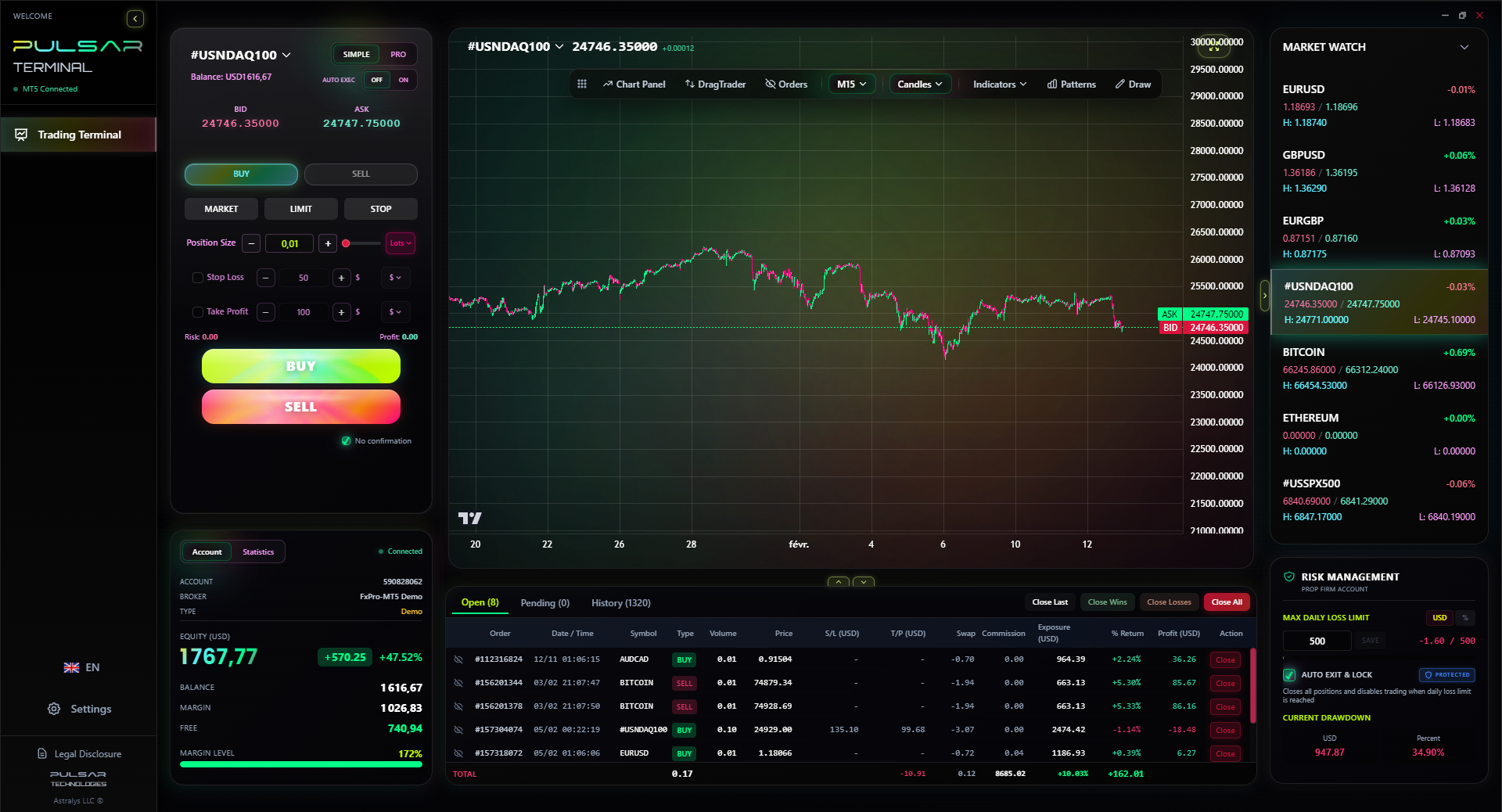
Integrating a tool like Pulsar Terminal can bridge this gap. Its chart pattern recognition can alert you to classic formations, while its advanced order management lets you execute complex multi-TP/SL strategies quickly when your AI filter flags an opportunity, keeping you in control.
When your AI filter flags a high-probability setup, tools like Pulsar Terminal let you execute complex multi-take-profit and trailing stop strategies on MT5 with one click, turning signals into managed trades.
Pulsar Terminal
Hepsi bir arada MT5 aracı: sürükle-bırak emirler, çoklu TP/SL, trailing stop, grid trading, Volume Profile ve prop firm koruması. Her gün 1.000'den fazla trader tarafından kullanılıyor.
Let's talk about how you can lose money, fast. I've done it so you might not have to.
Over-Optimization (Curve-Fitting): This is the killer. You tweak your AI's parameters so perfectly to past data that it becomes useless for the future. It's like tailoring a suit to fit a mannequin perfectly, but it won't fit any real person. My first major bot loss ($700) came from this. I had it perfectly tuned to trade AUD/USD during the Asian session in Q1 2024. It made 3% a week. In Q2, market dynamics shifted slightly. The bot kept forcing the old pattern and lost everything it had gained, plus more.
Black Box Blind Faith: If you don't understand why the AI is making a decision, you're just gambling. I once used a sentiment analysis AI that gave a 'strong buy' on USD/NGN. I couldn't see its reasoning. I took the trade. It turned out the AI was overweighting positive sentiment from a few outlier tweets, missing the broader negative fundamental picture. The trade failed.
Technical Failure: The internet goes down. The broker's server disconnects. Your laptop overheats. Your AI is dead in the water, potentially leaving losing trades open with no management. I learned to always have a manual backup plan and set hard stop-losses on every position, AI-managed or not, to prevent a technical glitch from causing a margin call.
Complacency: The biggest risk isn't the AI failing. It's you switching off your brain. You start trusting the system completely, stop doing your own market analysis, and lose your trading instincts. That's when you get wiped out by the one event the AI couldn't foresee.
💡 Winston'ın İpucu
The first rule of using an AI assistant is to always know how to turn it off. Your finger on the 'disable' button is your ultimate risk management tool.
“My first major bot loss came from over-optimization. I had it perfectly tuned to past data, making it useless for the future.”
Ready to experiment? Here's a safe, sane path. Don't skip steps.
- Education First, Tool Second: Before you even look at AI software, be a solid manual trader. Have a strategy that works for you in swing trading or day trading. You need a baseline to judge if the AI is helping or hurting.
- Choose Your Weapon Wisely:
- For Beginners: Start with AI-powered market scanners or alert systems (like TradingView's screener). They don't trade for you, they just find opportunities.
- For Intermediate: Explore bot platforms like MetaTrader's Strategy Tester or cloud-based services like Zorro Trader. You can code or use visual builders to create logic.
- For Advanced: Look into Python libraries (like
backtrader,TA-Lib) connected to a broker API. This is where true customization lives.
- The Demo-Only Mandate: Run any AI system on a demo account for at least 2-3 months. Go through different market conditions. Track every trade and compare its performance to what you would have done manually.
- Start Small & Isolate: When you go live, use the smallest possible capital. Dedicate a separate $100-$500 account just for the AI. This isolates its performance from your main trading capital.
- Review Weekly, Not Daily: Don't micromanage. AI needs time to work. But do a rigorous weekly review. Is it performing as expected in the demo? Is it adapting? If not, pull the plug, go back to demo, and tweak.

Example: Your AI bot makes 50 trades in a month on demo. 30 are wins, 20 are losses. Your average win is 8 pips, your average loss is 5 pips. That's a positive expectancy. Now, apply your broker's actual average spread (e.g., 1.2 pips for EUR/USD). Does the math still work? If not, the strategy isn't viable live.
Where is this all going? In Nigeria, I see AI becoming more of a regulatory focus. The SEC will want oversight on advanced algorithms to ensure market fairness. For us traders, the future is in hybrid models.
The winning trader of 2027 won't be the pure AI quant or the pure discretionary chartist. It will be the trader who uses AI to handle the grunt work - sifting through thousands of assets, monitoring correlations, managing risk exposure across a portfolio, and executing predefined order structures flawlessly.
Your human role will evolve to strategy design and contextual oversight. You'll set the goals and parameters ("Find mean-reversion opportunities in commodities with low correlation to the Naira"), and the AI will scout and manage the trades within those guardrails. Tools that offer advanced trade management, like automated trailing stops or breakeven triggers, will become standard features inside these hybrid systems, letting you focus on the big picture.
My final, hard-earned opinion? AI in forex trading is an incredible amplifier. It can amplify your discipline, your backtesting, and your efficiency. But it can also amplify your losses, your overconfidence, and your mistakes at lightning speed. Respect it, test it mercilessly, and never forget that the most important intelligence in your trading isn't artificial. It's yours.
FAQ
Q1Is AI forex trading legal in Nigeria?
Yes, using AI tools to assist your trading is legal. However, forex trading itself falls under the oversight of the CBN and SEC. The key is to use reputable, licensed international brokers (like those regulated by ASIC or CySEC) that accept Nigerian clients, as they provide the stable platform and API access needed for AI trading. Always ensure your activities comply with the new Nigerian Foreign Exchange Code (2025).
Q2How much money do I need to start AI forex trading?
You need two separate pools of capital. First, the cost of the AI software/subscription, which can range from $50 to $500+ per month. Second, your trading capital. I strongly advise starting with a dedicated demo account for 2-3 months. When you go live, start with an amount you can afford to lose completely - think $200-$500 - in a separate account from your main funds. This lets you test the system's real-world performance without risking your financial stability.
Q3Can AI trading bots guarantee profit?
Absolutely not. Any service that guarantees profit is a scam. The forex market is inherently risky and unpredictable. AI bots can execute a strategy with discipline and speed, but they cannot control market events, news, or black swan events. They follow their programming, which is based on historical data and probabilities, not certainties. My own experience shows they have losing periods, sometimes severe ones.
Q4What's the best AI forex trading software for beginners?
For a complete beginner, I'd avoid full automation software. Start with AI-enhanced analysis tools. Use a platform like TradingView with its stock/forex screeners and alert systems. You can set up complex, AI-assisted conditions to find trades, but you manually execute them. This teaches you how the AI thinks without handing over control of your money. It's the safest way to learn.
Q5Do I need to know how to code to use AI in trading?
Not necessarily, but it helps. Many platforms offer 'no-code' or 'low-code' visual builders where you drag and drop logic blocks (e.g., IF RSI < 30 THEN BUY). However, to truly customize and understand what's happening, basic coding knowledge (especially in Python or MQL5 for MetaTrader) is a massive advantage. It lets you peer inside the 'black box' and adjust the logic to fit your specific view of the market.
Q6How does Naira volatility affect AI trading strategies?
It breaks most off-the-shelf strategies. AI models are often trained on major currency pairs (like EUR/USD) with high liquidity and relatively low volatility. USD/NGN can have wild swings, huge spreads, and sudden liquidity gaps. An AI scalper or arbitrage bot designed for stable markets will often fail here. Any AI strategy for Naira pairs must be specifically designed and extensively tested for these unique, high-volatility conditions.
Prof. Winston'ın Dersi
Önemli Noktalar:
- ✓AI is a tool, not a strategy. You must supply the core trading logic.
- ✓Backtest with real costs (spread + slippage) or your results are fantasy.
- ✓Never let an AI trade without a discretionary override and hard stop-loss.
- ✓Start with AI as a filter/scanner, not an auto-execution system.
Bu makale ne kadar faydalıydı?
Bir yıldıza tıklayın
Haftalık Trading Analizleri
Ücretsiz haftalık analiz ve stratejiler. Spam yok.
Yazar hakkında
Olumide Adeyemi
Batı Afrika Yatırım Öncüsü
Nijerya'nın en aktif forex eğitmenlerinden biri. Lagos'tan 8 yıllık ticaret deneyimi. Afrika'lı trader'lar için düşük sermaye stratejileri ve prop firma yarışmaları uzmanı.
Yorumlar
Risk Uyarısı
Finansal araçlarla işlem yapmak önemli riskler taşır ve tüm yatırımcılar için uygun olmayabilir. Geçmiş performans gelecekteki sonuçları garanti etmez. Bu içerik yalnızca eğitim amaçlıdır ve yatırım tavsiyesi olarak değerlendirilmemelidir. İşlem yapmadan önce her zaman kendi araştırmanızı yapın.
Bunları da beğenebilirsiniz

Cara Trading Forex Sukses: 7 Prinsip dari Trader Profesional
Cara trading forex sukses dengan 7 prinsip trader pro: manajemen modal, disiplin, journal trading, backtest. Data nyata, bukan janji profit palsu.
Jam Trading Forex Terbaik untuk Trader Indonesia: Panduan Lengkap dengan Tabel Waktu
Panduan jam trading forex untuk trader Indonesia. Tabel 4 sesi dunia, jam emas 20:00-00:00, sesi mana yang harus dihindari. Data akurat + tips dari trader berpengalaman.
Top 5 Sàn Forex Uy Tín Nhất 2026: Review Jujur dari Trader Indonesia
Top 5 sàn forex uy tín 2026 untuk trader Indonesia. Review jujur: spread, deposit, withdraw, dukungan lokal. Exness, XM, IC Markets & lebih.
Pulsar Terminal'ı Edinin
Tüm bu hesaplayıcılar MT5 hesabınızdan gerçek zamanlı verilerle Pulsar Terminal'e entegredir.
Pulsar Terminal'ı Edinin