


I watched the USD/ZAR chart in late 2023, convinced a bearish flag was forming after a sharp drop.

David van der Merwe
Gelişen Piyasalar Yatırımcısı ·  South Africa
☕ 11 dk okuma
Neler öğreneceksiniz:
- 1What Exactly Is a Bearish Flag? It's Not What You Think
- 2Spotting Real Flags in the South African Market
- 3Your Entry, Stop Loss, and Take Profit Strategy
- 4Risk Management with FSCA Rules in Mind
- 5Mistakes I've Made (So You Don't Have To)
- 6Best Pairs and Timeframes for South African Traders
- 7Making It Stronger: Adding Other Tools to Your Analysis
- 8The Psychology: Why This Pattern Works (And Tricks You)
I watched the USD/ZAR chart in late 2023, convinced a bearish flag was forming after a sharp drop. The flag consolidation looked perfect, a neat little channel sloping up. I went short with 2 lots as it broke the lower trendline at R18.45. It promptly reversed, ripped through the top of my flag, and stopped me out for a R4,200 loss. I'd seen the pattern but ignored the broader market context - the SARB was about to make a hawkish statement. That trade taught me a brutal lesson: a textbook pattern is just a pretty picture without the right backdrop. Let's make sure you don't make the same expensive mistake.
Most guys get this wrong straight out the gate. They see any old pullback after a down move and call it a flag. That's a quick way to get your account liquidated. A real bearish flag forex pattern is a specific, high-probability setup that shows sellers are just catching their breath before another leg down.
Think of it like this: the market takes a steep dive (the flagpole), then it has a shallow, controlled bounce that feels weak (the flag). That bounce is where all the hopeful buyers get trapped. The pattern is confirmed when price slices through the bottom of that bounce channel, telling you the sellers are back in control.
The Two Critical Parts
- The Flagpole: This needs to be a near-vertical, high-momentum move down. On the hourly or 4-hour chart for something like GBP/ZAR, you want to see a clean, aggressive decline with big red candles. This establishes the dominant trend force.
- The Flag: This is the consolidation. It should slope slightly against the main trend (upwards or sideways). The key? It must be contained within parallel trendlines and should retrace no more than 38% to 50% of the flagpole's length. If it retraces more, the selling momentum is probably gone.

Warning: A deep retracement that looks more like a 61.8% Fibonacci level isn't a flag. It's a potential trend reversal. Don't force the trade.
The magic of this pattern is its measuring implication. The projected move after the breakout is often roughly equal to the length of the flagpole. It gives you a clear profit target, which is gold for planning your position size calculator.

💡 Winston'ın İpucu
A flag that retraces more than 50% of the pole isn't resting. It's reconsidering the entire move. Walk away.
Trading this pattern on the JSE or with ZAR pairs adds a layer of spice. Our market is volatile, and liquidity in exotics like USD/ZAR or EUR/ZAR can make patterns messier. You need a sharper eye.
First, volume. I don't care what platform you use, you need to check volume on the breakout. The flag consolidation should see volume dry up. When price breaks below the lower flag trendline, volume should spike. On MT4/MT5, you're looking at the tick volume histogram. If that breakout bar is wimpy and low volume, it's likely a fakeout. I got caught by this on a EUR/ZAR trade last year; the breakout had no juice and reversed hard.
Second, time frame alignment. A flag on the 15-minute chart is cute, but it means nothing if the 4-hour chart is showing a massive bullish engulfing candle. I only take bearish flag signals that are aligned with the higher-timeframe trend. For ZAR pairs, the daily chart direction, often driven by commodity prices or SARB policy, is king.
Here’s a local reality check: the average spread on USD/ZAR can be 5 pips, and on EUR/ZAR it can hit 14 pips. Your flag channel needs to be wide enough to absorb that spread plus give you a clear breakout signal. Drawing your trendlines on the body of the candles, not the wicks, helps filter out some of this market noise.

Pro Tip: Use the MACD indicator as a filter. During the flag consolidation, the MACD should be recovering toward the zero line but not crossing above it. It shows weakening bullish momentum within the bearish structure. A cross above zero often kills the setup.
“A textbook pattern is just a pretty picture without the right market backdrop.”
This is where you make or lose your money. Being vaguely "short" isn't a plan. You need exact numbers.
Entry: Don't jump the gun. Wait for the price candle to close below the lower flag trendline. I enter on a retest of that broken trendline (now resistance) or on a small pullback after the close. Market orders on the initial spike can get you a bad price. For a scalping strategy on lower timeframes, you might enter at the break, but for swing trades, patience pays.
Stop Loss: Your stop goes above the flag pattern. The safest place is just above the upper flag trendline. This protects you if the pattern fails and the breakout was fake. Never, ever place your stop just above a recent swing high inside the flag. That’s suicide. A proper stop should mean the pattern logic is invalidated.
Take Profit: The classic target is derived by measuring the flagpole. Take the height of the pole in pips and project that same distance down from the point of the breakout. I usually take 50-60% of my position off at this first target. The remainder, I might let run with a trailing stop, especially if price is approaching a major support level on the daily chart.
📊 Example: Flagpole on USD/ZAR = 150 pips drop (from R18.80 to R18.65). Flag consolidates. Break occurs at R18.70. First profit target = R18.70 - 150 pips = R18.55. My stop loss is at R18.85 (above the flag). My risk is 150 pips. My potential reward is 150 pips. That's a 1:1 risk-reward ratio minimum.
You can know every pattern in the book, but without risk management, you're just a gambler with a chart. In South Africa, the FSCA use cap of 30:1 for retail traders is actually your friend. It stops you from blowing up in one trade.
Let's talk numbers. That study saying 72% of new accounts blow up in six months? The main culprit is position sizing. On a R20,000 account, risking 5% per trade is R1,000. If your stop loss on a USD/ZAR bearish flag trade is 150 pips, and each pip on a standard lot is about R7.40 (depending on the rate), you can do the math.
R1,000 risk / (150 pips * R7.40 per pip) = roughly 0.9 lots. That's your max position size. Most newcomers would see that flag and throw 2 or 3 lots at it, risking 15-20% of their account. One loss, and they're crippled. Use a position size calculator religiously.
Also, remember the pending use changes. If you're using an offshore broker offering 500:1, you're playing with fire. The proposed 1:200 cap by 2026 is coming for a reason - our Rand can gap overnight on political news. High use plus volatility equals a guaranteed margin call. I learned this the hard way with the ANC conference news a few years back; a 300-pip gap against me on high use wiped out a month's profits.
Manage your total exposure. Don't have three bearish flag trades open on different ZAR pairs at once. They're all correlated to Rand strength/weakness. You're not diversified; you're just overexposed.
💡 Winston'ın İpucu
The best bearish flags form after breaking a major psychological level, like R19.00 on USD/ZAR. The break creates the momentum; the flag organizes the next wave of sellers.
“The FSCA use cap of 30:1 isn't a restriction; it's a guardrail against your own worst impulses.”
Let me save you some money by sharing my own blunders.
Mistake 1: Trading the Pattern in a Vacuum. My intro story is the prime example. I saw a beautiful flag on USD/ZAR but ignored the scheduled SARB interest rate decision. The pattern broke correctly, then reversed instantly on the news. The lesson: Check the economic calendar. No bearish flag trade before major SA data (CPI, SARB repo rate) or big US data that moves the Dollar.
Mistake 2: Ignoring Higher Timeframe Support. I shorted a perfect-looking flag on GBP/USD, targeting a 100-pip move. It broke, went 20 pips in my favor, then reversed. Why? It hit a major weekly support level that I hadn't even looked at. The pattern was right, but the bigger picture was stronger. Now, I always zoom out to the daily and weekly to see what major S&R levels are in the target zone.
Mistake 3: Being Too Eager on the Entry. This is the classic FOMO. The flag is forming, and you're just waiting for the break. The moment price ticks below the trendline, you smash the sell button. Often, you're entering on a false spike or wick. Wait for a candle close. The market isn't going anywhere. If it's a real breakout, you'll get a chance. This patience alone improved my win rate on these setups by at least 20%.
Choosing the right broker platform matters here too. Slippage on a volatile breakout can ruin your risk calculations. I've had better, more predictable fills with brokers like IC Markets or Pepperstone on their raw spread accounts during these events compared to some others with less stable liquidity.
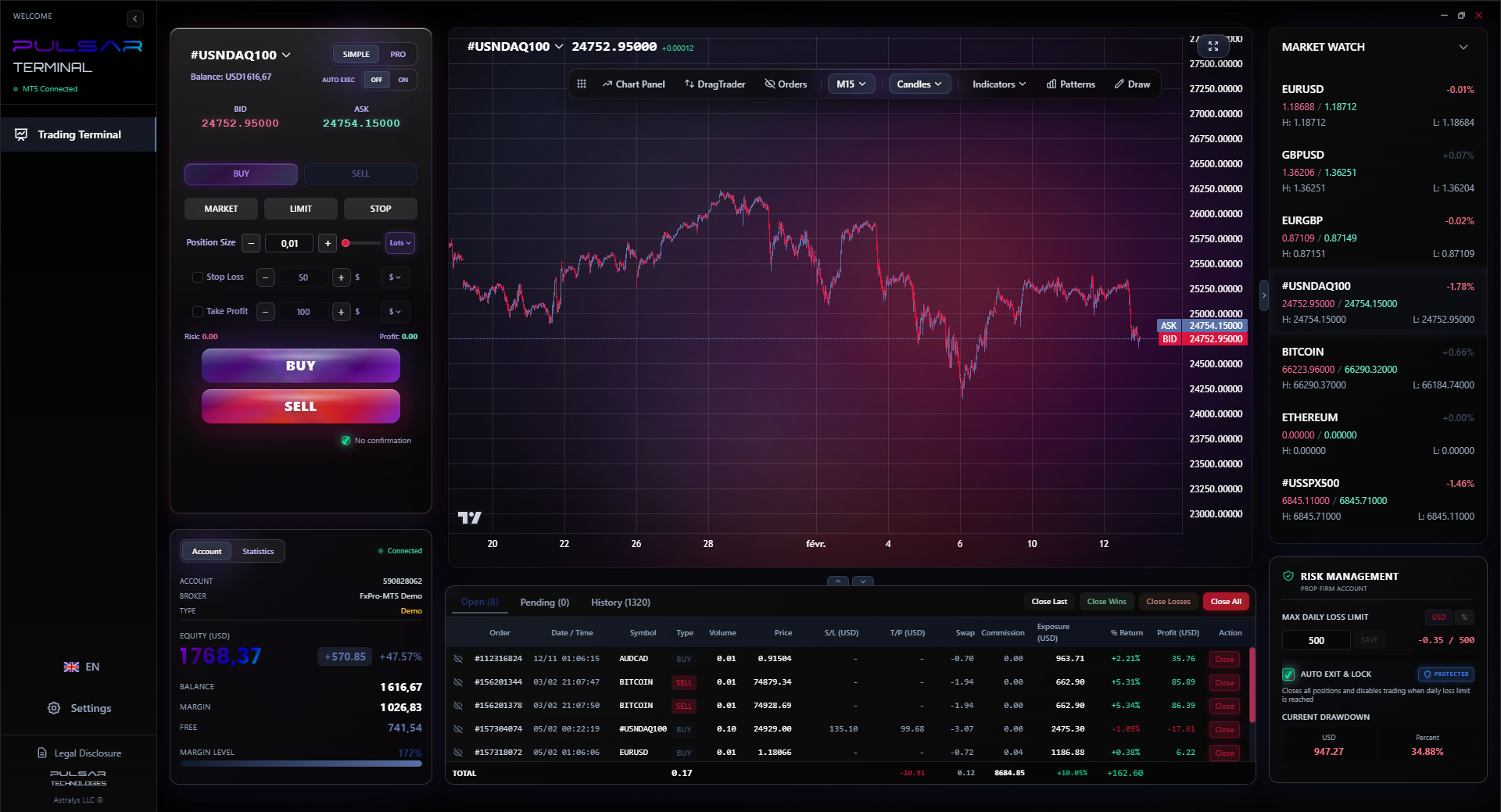
Managing multiple bearish flag trades with precise stops and targets is complex, but tools like Pulsar Terminal let you drag-and-drop all your orders and set automatic trailing stops directly on your MT5 charts.
Pulsar Terminal
Hepsi bir arada MT5 aracı: sürükle-bırak emirler, çoklu TP/SL, trailing stop, grid trading, Volume Profile ve prop firm koruması. Her gün 1.000'den fazla trader tarafından kullanılıyor.
Not all pairs are created equal for this pattern. You want pairs with good trending behavior and enough volatility to create clear flagpoles.
| Pair | Why It Works | What to Watch |
|---|---|---|
| USD/ZAR | High volatility, clear trends driven by US/SA yield differentials. Flagpoles are often sharp. | Wide spreads (avg. 5 pips). Mind local market hours (8am-5pm SAST) for best liquidity. |
| EUR/USD | The world's most liquid pair. Clean, technical patterns with tight spreads. | Less volatile than ZAR pairs, so flags may be smaller. Use it to practice the pattern. Our EUR/USD guide has more context. |
| GBP/ZAR | Another volatile exotic that trends well. Often moves on UK and SA news. | Spreads can be very wide (10+ pips). Requires a larger stop, so adjust position size down. |
| XAU/USD (Gold) | Not a forex pair, but a CFD we all trade. Forms excellent bearish flags during Dollar-strength cycles. | Requires understanding of Gold's drivers. Check our XAU/USD guide for specifics. |
For timeframes, I use a multi-timeframe approach:
- Identification: I scan the 4-hour and daily charts for the initial strong downtrend (flagpole).
- Execution: I zoom into the 1-hour or 30-minute chart to draw the precise flag boundaries and wait for the breakout candle.
- Management: I monitor the trade on the 1-hour, but my stop and target are based on the 4-hour structure.
Avoid the 1-minute and 5-minute charts for this pattern unless you're a seasoned scalper. The noise will generate false signals constantly. For most, this is a swing trading pattern, not a scalp.
“Your job is to be the institutional trader setting the trap, not the retail buyer walking into it.”
A bearish flag alone is good. A bearish flag with confluence is great. You need other tools to shout "yes, this is the one!"
1. The RSI Divergence: This is my favorite filter. As the price makes that upward-sloping flag (higher lows), check the RSI indicator. Often, you'll see the RSI making lower highs during the same period. This is bearish divergence and signals weakening buying momentum inside the flag. It's a powerful confirmation. I passed on a USD/ZAR flag last month because the RSI was strong. It would have been a losing trade.
2. Moving Average Resistance: Is the flag consolidation happening right into a key moving average, like the 50 or 200-period EMA on the 4-hour chart? That's a beautiful confluence. The MA acts as dynamic resistance, adding more weight to the probability of the breakdown.
3. Previous Support Turned Resistance: Did the flagpole break down through a key previous support level? If yes, that old support now becomes resistance. If the flag is forming just below that level, it adds to the selling pressure narrative.
Don't use ten indicators. It creates confusion. Pick one or two that make sense to you - like RSI and a key MA - and use them consistently as a filter. It will stop you from taking low-quality, desperate trades when you're bored.
💡 Winston'ın İpucu
If you can't immediately see where to place your stop loss, you don't have a valid pattern. Clarity is non-negotiable.
This pattern works because it traps people. The flagpole scares weak hands into selling. The subsequent bounce (the flag) looks like a relief rally or a reversal. Retail buyers jump in, thinking they're getting a discount. The pros and institutions use this bounce to add to their short positions at better prices. When the breakout happens, all those new buyers are suddenly wrong, and their panic selling fuels the next leg down.
The pattern tricks you in two ways:
- It makes you doubt the trend. After a big move down, a bounce feels natural. Your brain tells you "it's gone down too much, it must go up." The pattern exploits this mean-reversion bias.
- It tests your patience. Watching a flag form for 8, 10, 20 candles is tedious. The urge to "get in early" before the breakout is huge. You convince yourself you see the breakdown starting. This is almost always a mistake.
Your job is to be the institutional trader, not the retail buyer. Wait for their trap to be set (the flag) and then spring it (the breakout). This requires discipline, which is the one thing no broker, not Exness, XM, or anyone else, can provide for you. You have to build it yourself, one patient trade at a time.
FAQ
Q1What's the minimum success rate I should expect with bearish flag trades?
If you're selective and wait for high-quality setups with confluence (like RSI divergence), a 55-65% win rate is realistic. The key is your risk-reward ratio. Even at 55%, if you're consistently aiming for a 1:1.5 or better R:R, you'll be profitable. Most fail because they take every flag-looking squiggle and have poor R:R.
Q2How do I handle a false breakout from a bearish flag?
Your stop loss above the flag should handle it. That's its job. The moment price closes back inside the flag, and especially if it breaks the upper trendline, the pattern is failed. Do not move your stop. Do not "give it more room." Take the loss, which should be a small, pre-defined percentage of your account, and move on. Revenge trading the failed pattern is a classic account killer.
Q3Are bearish flags reliable on exotic pairs like USD/ZAR?
They can be, but you need to account for higher volatility and wider spreads. The flag channel needs to be proportionally larger to be valid. A 20-pip channel on USD/ZAR is probably just noise. Look for cleaner patterns on the 4-hour chart rather than lower timeframes. Also, be extra cautious around South African market news, which can cause erratic moves in ZAR pairs.
Q4What's the difference between a bearish flag and a bearish pennant?
Both are continuation patterns. The key difference is the consolidation shape. A flag has parallel trendlines (a channel). A pennant has converging trendlines (a small symmetrical triangle). The trading principles (flagpole, breakout, measured move) are very similar. Don't get hung up on the name; focus on the structure.
Q5Can I use this pattern for prop firm challenges?
Absolutely, but with extreme caution. Prop firms have strict daily and overall loss limits. A single failed bearish flag trade with poor position sizing can blow your challenge. Use a tiny position size (0.01-0.05 lots on a $100k eval) to ensure a stop loss hit doesn't breach your daily loss limit. The pattern's clear stop and target levels are actually well-suited for the disciplined planning prop firms require.
Q6Does the FSCA 30:1 use limit affect trading this pattern?
It affects your position size, which is a good thing. With 30:1 on a major pair like EUR/USD, you can't over-use as easily. It forces you to be more precise with your entry and stop placement. On a R20,000 account, 30:1 gives you buying power of R600,000. You still need to calculate your position based on your pip risk, not your maximum available use.
Prof. Winston'ın Dersi
Önemli Noktalar:
- ✓Wait for the candle close below the flag. Market orders on spikes get poor fills.
- ✓Place your stop loss above the flag's upper boundary, not a recent high.
- ✓Measure the flagpole. Project that distance down for your first profit target.
- ✓Risk a maximum of 1-2% of your account on any single flag trade.
- ✓Filter with RSI divergence. It confirms weakening momentum inside the bounce.
Bu makale ne kadar faydalıydı?
Bir yıldıza tıklayın
Haftalık Trading Analizleri
Ücretsiz haftalık analiz ve stratejiler. Spam yok.
Yazar hakkında
David van der Merwe
Gelişen Piyasalar Yatırımcısı
Johannesburg merkezli, gelişmekte olan piyasa dövizlerinde 11 yıllık deneyime sahip trader. ZAR pariteleri, FSCA düzenlemeli ticaret ve Güney Afrika piyasa analizi uzmanı.
Yorumlar
Risk Uyarısı
Finansal araçlarla işlem yapmak önemli riskler taşır ve tüm yatırımcılar için uygun olmayabilir. Geçmiş performans gelecekteki sonuçları garanti etmez. Bu içerik yalnızca eğitim amaçlıdır ve yatırım tavsiyesi olarak değerlendirilmemelidir. İşlem yapmadan önce her zaman kendi araştırmanızı yapın.
Bunları da beğenebilirsiniz

Cara Trading Forex Sukses: 7 Prinsip dari Trader Profesional
Cara trading forex sukses dengan 7 prinsip trader pro: manajemen modal, disiplin, journal trading, backtest. Data nyata, bukan janji profit palsu.
Jam Trading Forex Terbaik untuk Trader Indonesia: Panduan Lengkap dengan Tabel Waktu
Panduan jam trading forex untuk trader Indonesia. Tabel 4 sesi dunia, jam emas 20:00-00:00, sesi mana yang harus dihindari. Data akurat + tips dari trader berpengalaman.
Top 5 Sàn Forex Uy Tín Nhất 2026: Review Jujur dari Trader Indonesia
Top 5 sàn forex uy tín 2026 untuk trader Indonesia. Review jujur: spread, deposit, withdraw, dukungan lokal. Exness, XM, IC Markets & lebih.
Pulsar Terminal'ı Edinin
Tüm bu hesaplayıcılar MT5 hesabınızdan gerçek zamanlı verilerle Pulsar Terminal'e entegredir.
Pulsar Terminal'ı Edinin