


Most articles telling you to find the 'best app for gold trading' in India are selling you a fantasy.

Rajesh Sharma
Kıdemli Forex Analisti ·  India
India
☕ 10 dk okuma
Neler öğreneceksiniz:
- 1The Digital Gold Reality Check: You're Not Buying What You Think
- 2The Hidden Cost Breakdown: Where Your Money Really Goes
- 3The 24-Month Tax Rule Change (And Why It Matters)
- 4App & Platform Comparison: Minimums, Partners, and Real Use
- 5Digital Gold is for Investing, Not Trading
- 6Safety & Security Checklist: What to Verify Before You Buy
- 7When to Look Beyond Digital Gold: Better Alternatives
- 8Final Verdict: How to Choose Your Best App
Most articles telling you to find the 'best app for gold trading' in India are selling you a fantasy. They talk about convenience and low minimums, but they skip the part where you can lose 5% of your money before the price even moves. The real story isn't about which app icon looks prettiest. It's about navigating a market that's not regulated by SEBI, where the buy-sell spread eats your returns, and a new tax rule just changed the game. I've traded gold for over a decade, and I'll show you what actually matters when you pick a platform.
Let's get this straight from the start. When you buy 'digital gold' on most Indian apps, you're not buying a financial security. You're buying a claim on physical gold held in a vault by a private company. This is the single most important fact, and most investors gloss right over it.
SEBI, the market regulator, made this crystal clear in November 2025. They issued an advisory saying digital gold products are not under their purview. That means you don't have the same protections as someone buying a Gold ETF or a Sovereign Gold Bond. If the platform or its gold partner has a problem, you're not covered by SEBI's investor safety net.

Warning: The 1:1 backing promise is only as good as the company making it. Always check who the vaulting partner is (MMTC-PAMP, SafeGold, Augmont).
The industry knows this is a problem. The India Bullion and Jewellers Association (IBJA) is trying to set up a Self-Regulatory Organisation (SRO) by April 2026 to audit vaults and set capital rules. But as of today, it's a promise, not a guarantee. This doesn't mean all apps are scams, but it does mean you must understand the extra layer of counterparty risk you're taking on. For a more traditional, SEBI-regulated approach, you might consider a Gold ETF though the trading mechanics are different.
This is where most traders blow up. They see a gold price on an app and think, "That's what I pay." Wrong. The real cost is buried in fees and taxes that can take a 5% bite out of your capital before you even start.
Let me walk you through a real example from last year. I tested a ₹10,000 purchase on a popular platform to see the real impact.
The ₹10,000 Test Purchase:
- Advertised Gold Price: ₹6,500 per gram
- Your Instinct: 10,000 / 6500 = 1.538 grams acquired.
- The Reality:
- GST Hits First: A mandatory 3% Goods and Services Tax is applied. So, ₹291.26 of your ₹10,000 immediately goes to the government.
- Actual Investment: ₹9,708.74 is left to buy gold.
- The Spread: The platform's buy price is always higher than its sell price. Let's assume a conservative 2.5% spread.
- Effective Purchase: You're buying at an inflated price. In reality, you might only get the equivalent of 1.48 grams for your money.
You've instantly lost money. To break even, the international gold price needs to rise by roughly the GST amount PLUS the spread. That's a 5.5% hurdle on a conservative estimate.
The Storage and Exit Trap
It gets worse. Many apps offer 'free' storage for 3-5 years. After that? They start charging 0.5% to 1% per year. And if you want physical delivery, you'll pay minting charges and another round of GST (5%) on those making charges. The buy-sell spread applies again when you sell. This two-way friction is a silent killer of returns. Always use a position size calculator that factors in the total cost of the trade, not just the ticket price.

💡 Winston'ın İpucu
The 3% GST on the full purchase is a silent killer. On a ₹10k trade, ₹291 vanishes before you own a single gram. Always calculate your effective entry price after GST.
“Your 5% 'profit' can be a 2% loss after GST and the spread.”
The government changed the rules on you, and most app interfaces haven't caught up. For the financial year 2024-25 onwards, the tax treatment for digital gold shifted. This isn't a small detail, it's a major strategic factor.
Here’s the new lay of the land:
| Holding Period | Tax Treatment | Key Detail |
|---|---|---|
| Less than 24 months | Short-Term Capital Gains (STCG) | Profit is added to your total income, taxed at your income tax slab rate (could be 30%+). |
| More than 24 months | Long-Term Capital Gains (LTCG) | Taxed at a flat 12.5%. No indexation benefit allowed. |
The old 36-month rule for LTCG is gone. This sounds good - a shorter holding period for lower tax. But the catch is the removal of indexation. Indexation adjusted your purchase price for inflation, lowering your taxable profit. Now, you pay 12.5% on the full nominal profit.
What this means for your strategy: If you're in a high tax bracket (say 30%), holding for over 24 months to get the 12.5% rate is a no-brainer. But if you're a shorter-term trader, those STCG taxes will demolish your returns. I learned this the hard way on an early trade. I made a ₹50,000 profit over 18 months, only to see ₹15,000 of it vanish to taxes because it pushed me into a higher slab. I now plan every digital gold trade with a 24-month calendar in mind. This rule makes swing trading digital gold far less attractive from a tax perspective.
Okay, with the ugly truths out of the way, let's look at the actual apps. The 'best' one depends entirely on your goal: micro-savings, strategic allocation, or convenience.
The Payment App Giants (Paytm, PhonePe, Google Pay, Amazon Pay):
- Best for: Spare-change investing, incredible convenience.
- The Hook: They partner with MMTC-PAMP or SafeGold. You can buy gold with ₹1 from your UPI balance. It's frictionless.
- The Catch: The interface is simple, maybe too simple. It's easy to forget about the spread and tax implications. It's a savings product, not a trading platform. I use my PhonePe gold for parking small, recurring amounts I won't touch for years.
The Investment/Fintech Apps (Groww, 5Paisa, Jupiter):
- Best for: Investors who want gold alongside other assets.
- Key Distinction: Be careful here. Apps like Groww offer SEBI-regulated Gold ETFs and non-regulated digital gold. They're often in separate sections. Know which one you're clicking on. The digital gold part has the same risks and costs as the payment apps.
- Minimums: Vary. 5Paisa starts at ₹50, Jupiter at ₹1.
The Pure-Play Platforms (DigiGold, Aura Gold):
- Best for: Those focused solely on gold, often with more transparent vaulting info.

Pro Tip: Your choice should hinge on the gold provider (MMTC-PAMP is a government joint venture, which some prefer) and the app's transparency about the live buy/sell spread. Don't just pick the shiniest interface.
If your goal is active trading on international price movements with use, you're not looking for these Indian digital gold apps. You'd need a forex/CFD broker like Exness or IC Markets to trade XAU/USD, which is a whole different beast with its own risks like margin calls.
💡 Winston'ın İpucu
That 'free storage' period? Mark its end date in your calendar. An annual 1% fee might not sound like much, but on a ₹5 lakh holding, that's ₹5,000 a year for doing nothing.
“The best app is the one that makes you forget you're buying gold, for years at a time.”
This is my core argument after watching thousands of clients. The structure of digital gold in India makes it a terrible vehicle for trading. The costs are too high and the execution is too slow.
Think about it. A typical 2-5% round-trip cost (spread + GST impact) means you need a massive price move just to break even on a short-term trade. Compare that to a Gold ETF, where the brokerage and spread might total 0.5% or less. Or compare it to forex gold (XAU/USD), where the spread can be as low as a few dollars per ounce with a broker like Pepperstone.
I tried to 'trade' digital gold early on. I'd buy on Paytm on a dip and try to sell a week later for a 3% gain. On paper, it worked. After the spread and GST friction, my 'winning' trade was often up less than 1%. One losing trade would wipe out five winners. It was a loser's game.
Digital gold works for one thing: long-term, set-and-forget, rupee-cost-averaging investment. Use it like a digital piggy bank. Set up a SIP for ₹500 a week and forget about it for 5+ years. The high entry costs get diluted over a very long timeframe. Trying to time the market with it is like trying to win a Formula 1 race in a Maruti Alto. The vehicle isn't built for it. For active strategies like scalping, you need a completely different instrument and platform.
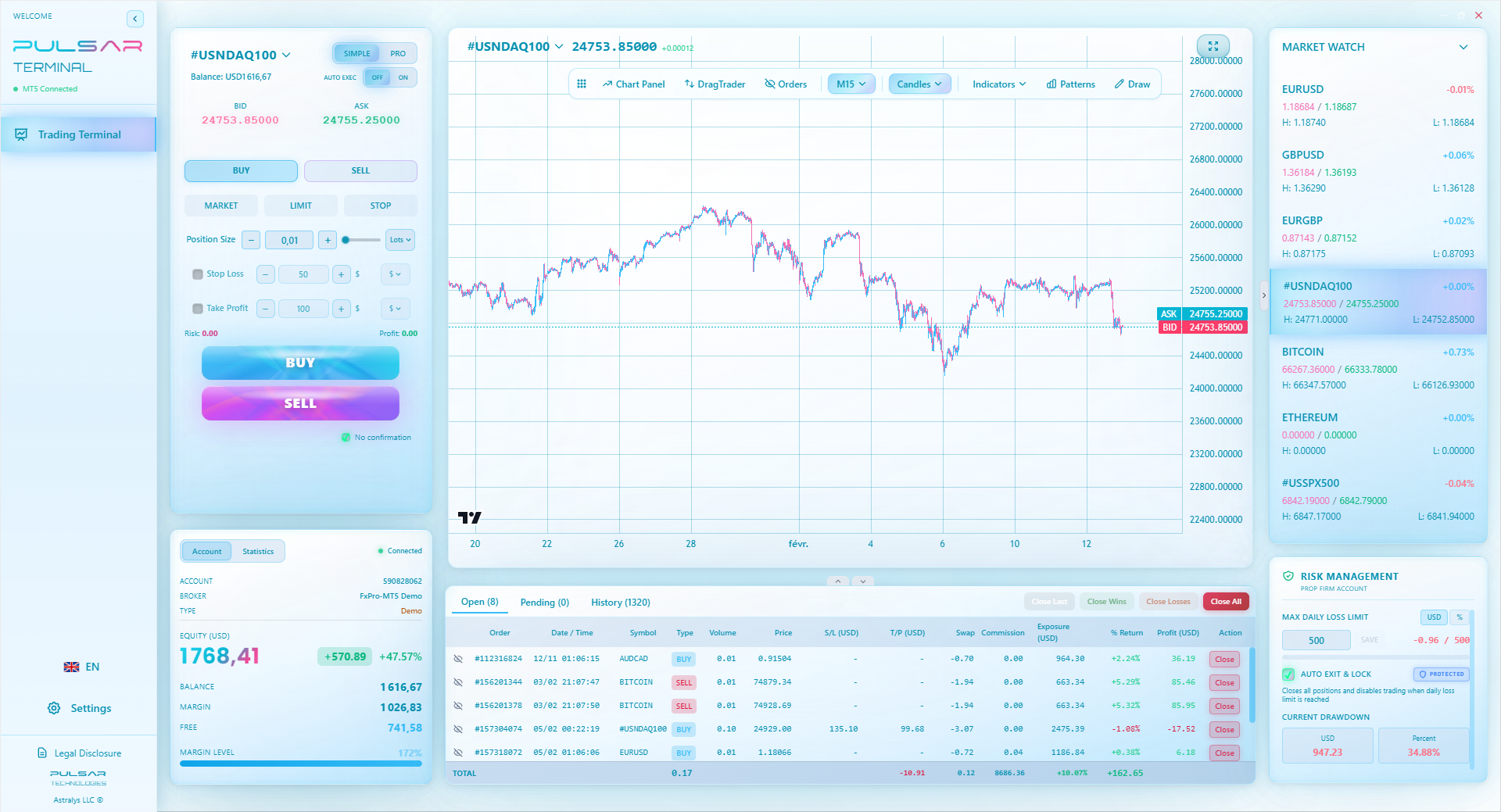
If your gold strategy involves active trading on price movements, you need precise tools for entries, exits, and risk management on a real trading platform.
Pulsar Terminal
Hepsi bir arada MT5 aracı: sürükle-bırak emirler, çoklu TP/SL, trailing stop, grid trading, Volume Profile ve prop firm koruması. Her gün 1.000'den fazla trader tarafından kullanılıyor.
Since SEBI isn't watching, you have to do your own due diligence. Don't skip this.
- Who Holds the Gold? The app should clearly state its vaulting partner. MMTC-PAMP, SafeGold, and Augmont are the major, reputable ones. If you can't find this info in two clicks, walk away.
- Is the Gold Insured? The physical gold in the vault should be fully insured against theft, loss, and damage. Look for this confirmation.
- Audit Reports: Do they publish regular audit reports from a third party verifying the physical gold matches the digital claims? The upcoming SRO will mandate this, but leading platforms may already do it.
- Company Background: A quick search on the platform owner and the gold provider is wise. How long have they been in business?
- Exit Process: Understand exactly how you sell. Is it instant at the quoted price? Are there hidden delays or conditions? Read the terms for physical delivery carefully - those charges will shock you.
Your money is only as safe as the weakest link in this chain. The convenience of a ₹1 investment isn't worth the risk if the platform is shaky.
💡 Winston'ın İpucu
The new 24-month LTCG rule is a trap for the impatient. If you sell at 23 months, your profit could be taxed at 30%. If you sell at 25 months, it's 12.5%. That date is now your most important trade parameter.
“SEBI isn't watching. You have to do your own homework.”
Digital gold isn't the only way to get exposure. Sometimes, it's the wrong way. Here’s when you should consider something else.
- If You Want SEBI Protection: Buy Sovereign Gold Bonds (SGBs). You get interest (2.5% p.a.), exemption from LTCG tax if held to maturity (8 years), and they're backed by the Government of India. The lock-in period is the trade-off.
- If You Want Liquidity for Trading: Buy Gold ETFs on the stock exchange. Lower costs (just brokerage), real-time pricing, and instant settlement. You can even use limited use. They track the price better than digital gold.
- If You Want International use: This is for experienced traders only. You trade XAU/USD (forex gold) through international brokers. This gives you use, 24/5 markets, and direct exposure to the dollar price. The risks are exponentially higher (you can lose more than your deposit), but the costs (spreads, commissions) for active trading are far lower. You'll need to understand tools like the RSI indicator or MACD indicator to navigate this market.
- If You Actually Want the Jewellery: Just save cash and buy it. The conversion charges from digital to physical are punitive. You're almost always better off buying directly from a jeweller, especially with the new restrictions on jewellery imports as of April 2026.
So, what's the best app for gold trading in India? For 95% of people, it's not about 'trading' at all.
For the typical Indian investor: The 'best' app is the one you already use for payments (PhonePe, GPay) that has a reputable gold partner (check this!), because the barrier to starting a savings habit is zero. Use it only for a long-term, multi-year SIP. Ignore the daily price. Treat the 5% friction cost as a one-time fee for a decade-long holding. That's its purpose.
If you're more sophisticated: Use a stock brokerage app to buy Gold ETFs for more efficient, tradable exposure. Keep digital gold for the small, forget-about-it savings bucket.
If you're a trader: You're in the wrong article. You need a forex brokerage account, not a digital gold app. The tools, costs, and risks are in a different universe.
The bottom line? Digital gold is a useful financial innovation with serious caveats. It democratizes access but at a high cost. Pick your platform based on safety (vaulting partner), then convenience. Never forget the 24-month tax clock ticking on every purchase. And for god's sake, don't try to trade it.
FAQ
Q1Is digital gold regulated by SEBI or RBI?
No. SEBI issued an advisory in November 2025 explicitly stating digital gold products do not fall under its regulatory purview. The RBI also does not regulate it. Your protection relies on the platform's partner (like MMTC-PAMP) and the upcoming industry self-regulation.
Q2What is the single biggest hidden cost in digital gold?
The combined impact of the 3% GST (charged upfront on your entire purchase amount) and the buy-sell spread (typically 2-5%). This creates an immediate 5%+ hurdle you need the gold price to overcome just to break even on your investment.
Q3How long must I hold digital gold for long-term capital gains tax?
For holdings sold after 24 months (2 years), profits are taxed as Long-Term Capital Gains at a flat rate of 12.5% (no indexation benefit). If sold before 24 months, profits are added to your income and taxed at your slab rate, which can be over 30%.
Q4Can I convert my digital gold to physical jewellery?
Yes, most platforms offer this, but it's often a bad deal financially. You will pay delivery charges, minting/making charges, and an additional 5% GST on those making charges. It's usually cheaper to sell your digital gold and use the cash to buy jewellery directly.
Q5What is the minimum amount I can invest in digital gold?
Very low. Platforms like PhonePe, Jupiter, and DigiGold allow you to start with just ₹1. Others like 5Paisa have a ₹50 minimum, and Groww starts at ₹10. This low barrier is a key feature.
Q6Is digital gold better than a Gold ETF?
It depends. Digital gold is better for tiny, recurring investments (SIPs) due to its ₹1 minimum. Gold ETFs are better for larger, lump-sum investments or active trading due to significantly lower costs (brokerage vs. GST+spread), real-time trading, and SEBI regulation.
Q7Who are the main vaulting partners I should look for?
The three major, reputable partners are MMTC-PAMP (a government joint venture), SafeGold, and Augmont Goldtech. Always verify which partner backs the gold on the app you are using.
Prof. Winston'ın Dersi
Önemli Noktalar:
- ✓GST + Spread creates a 5%+ entry cost hurdle.
- ✓The 24-month tax cliff is critical for profits.
- ✓Verify the vault partner (MMTC-PAMP, SafeGold).
- ✓It's for long-term SIPs, not short-term trades.
Bu makale ne kadar faydalıydı?
Bir yıldıza tıklayın
Haftalık Trading Analizleri
Ücretsiz haftalık analiz ve stratejiler. Spam yok.
Yazar hakkında
Rajesh Sharma
Kıdemli Forex Analisti
Hindistan ve Güney Asya piyasalarında 10 yılı aşkın deneyim. NSE döviz türevleriyle başlayıp uluslararası forex'e geçiş yaptı. USD/INR ve gelişmekte olan piyasa pariteleri uzmanı.
Yorumlar
Risk Uyarısı
Finansal araçlarla işlem yapmak önemli riskler taşır ve tüm yatırımcılar için uygun olmayabilir. Geçmiş performans gelecekteki sonuçları garanti etmez. Bu içerik yalnızca eğitim amaçlıdır ve yatırım tavsiyesi olarak değerlendirilmemelidir. İşlem yapmadan önce her zaman kendi araştırmanızı yapın.
Bunları da beğenebilirsiniz

Cara Trading Forex Sukses: 7 Prinsip dari Trader Profesional
Cara trading forex sukses dengan 7 prinsip trader pro: manajemen modal, disiplin, journal trading, backtest. Data nyata, bukan janji profit palsu.
Jam Trading Forex Terbaik untuk Trader Indonesia: Panduan Lengkap dengan Tabel Waktu
Panduan jam trading forex untuk trader Indonesia. Tabel 4 sesi dunia, jam emas 20:00-00:00, sesi mana yang harus dihindari. Data akurat + tips dari trader berpengalaman.
Top 5 Sàn Forex Uy Tín Nhất 2026: Review Jujur dari Trader Indonesia
Top 5 sàn forex uy tín 2026 untuk trader Indonesia. Review jujur: spread, deposit, withdraw, dukungan lokal. Exness, XM, IC Markets & lebih.
Pulsar Terminal'ı Edinin
Tüm bu hesaplayıcılar MT5 hesabınızdan gerçek zamanlı verilerle Pulsar Terminal'e entegredir.
Pulsar Terminal'ı Edinin