


If you ask ten traders for the best books to read for forex trading, you'll get twenty different answers.

Olumide Adeyemi
Batı Afrika Yatırım Öncüsü ·  Nigeria
☕ 9 dk okuma
Neler öğreneceksiniz:
If you ask ten traders for the best books to read for forex trading, you'll get twenty different answers. Most lists just recycle the same old titles without any real-world context. I've spent over a decade and a small fortune on trading books - some were life-changing, others were a complete waste of time and money. Let's cut through the noise. I'll show you which books actually helped me build a career, and which ones you can safely ignore, especially from our perspective here in Nigeria.
Here's the truth most gurus won't tell you: 80% of trading books are either outdated, irrelevant to retail forex, or just repackaged common sense. They're written for a generic, often American, audience. The classic example? Books heavy on trading NYSE stocks or futures don't translate well to the 24-hour, use-heavy world of EUR/USD or GBP/NGN pairs. I learned this the hard way. Early on, I bought a popular book on 'tape reading' and spent months trying to apply it to forex charts. It was useless. The market structure is completely different. The best books to read for forex trading aren't about giving you a secret indicator code. They're about building the right mindset and a strong, adaptable process. They teach you how to think, not what to think. For us in Nigeria, we also need material that acknowledges our unique challenges: internet reliability, currency conversion stress, and finding a trustworthy broker like Exness or IC Markets. A good book should make you better at managing these realities, not just drawing lines on a chart.
You can have the best strategy in the world, but if your head isn't right, you'll blow your account. This isn't a maybe; it's a guarantee. The first category of the best books to read for forex trading must be about the mind.
Trading in the Zone by Mark Douglas
This is the bible. I re-read it every year. Douglas breaks down the probabilistic nature of markets in a way that finally clicked for me. He argues that you must accept that any single trade is a unique event with an uncertain outcome. Your job is to execute your edge over a series of trades. This book cured me of revenge trading. After a nasty three-loss streak on USD/JPY, I used to double down to 'get my money back.' Douglas's lessons helped me see that as gambling, not trading. Now, after a loss, I'm more likely to reduce my position size, not increase it.

Warning: This book is dense. Don't expect a quick read. It requires real introspection. If you find yourself arguing with the concepts, that's probably the part you need most.
The Mental Game of Trading by Jared Tendler
This is the modern, practical companion to Douglas. Tendler, a mental game coach, tackles specific problems like tilt, fear, and confidence. He provides actual exercises. One that saved me thousands: the 'Pre-commitment' ritual. Before I enter any trade, I write down my exact entry, stop-loss, and take-profit levels, and my maximum risk (usually 1% of my account). I use a simple notebook, but a tool like a position size calculator is essential for this. This act alone prevents emotional, off-plan trades.
These books won't give you a single trading signal. But they will give you the discipline to follow your own signals, which is infinitely more valuable.

💡 Winston'ın İpucu
A book's value isn't in its purchase price, but in the marginal improvement it makes to your trading system. If a $30 book helps you avoid one 0.5% mistake, it's paid for itself forever.
“The best books for forex trading teach you how to think, not what to think.”
Once your mind is prepared, you need to understand what you're looking at. Forget complex indicators at first. You need to learn the language of price itself.
Japanese Candlestick Charting Techniques by Steve Nison
This is the definitive reference. It's not a cover-to-cover read, but an essential desk companion. Knowing what a Doji, Hammer, or Engulfing pattern suggests about market sentiment is foundational. I remember spotting a clear bullish engulfing pattern on the 4-hour chart of XAU/USD (gold) after a pullback. Combined with support from a previous swing low, it gave me the confidence to enter. That trade ran for over $50 per ounce. The pattern didn't cause the move, but it signaled a potential shift in momentum.
Technical Analysis of the Financial Markets by John J. Murphy
Known as 'The Bible,' this book covers everything from chart types to trends, indicators, and intermarket analysis. It's complete. The key takeaway for forex traders is the section on trend analysis. Murphy engrains the concept of 'the trend is your friend.' Fighting a strong daily trend on a 5-minute chart is a recipe for disaster, a lesson I paid for many times before it stuck. Understanding support and resistance from this book directly feeds into any swing trading or breakout strategy you'll later develop.
These books provide the grammar. You'll learn what a 'sentence' (a price bar) is and how they form 'paragraphs' (trends). Without this, trying to use an RSI indicator or MACD indicator is like trying to critique a novel in a language you don't speak.
Now we get to the fun part: putting it all together. These books offer frameworks, not holy grails. You must adapt them.
The New Trading for a Living by Alexander Elder
Elder's 'Three Pillars' of trading - Psychology, Technical Analysis, and Risk Management - is a fantastic model. His introduction of the 'Force Index' and his triple screen trading system were eye-opening for me. I don't use his exact system anymore, but the methodology of analyzing multiple timeframes (e.g., using the daily chart for trend direction and the 1-hour for entry) is now core to my process. It forces discipline and improves timing.

Pro Tip: Elder's emphasis on a trading diary is non-negotiable. My early diary entries are cringe-worthy - full of excuses. Over time, they became clinical reports. This evolution marked my growth from a gambler to a trader.
Currency Trading and Intermarket Analysis by Ashraf Laidi
This one is specifically for forex traders and is brilliant for understanding the bigger picture. Laidi connects forex moves to bonds, equities, and commodities. For instance, understanding how a rise in US Treasury yields typically strengthens the USD can give you a huge contextual advantage. It moves you from just looking at charts to understanding why the charts might be moving. This book helped me anticipate a major EUR/USD drop by following the divergence between ECB and Fed policy outlooks, something pure chart analysis missed.
Remember, you test these strategies in a demo account first. I spent six months paper trading Elder's concepts before risking a naira.
💡 Winston'ın İpucu
The most important chapter in any trading book is the one on risk management. Read it twice. Underline it. If the book doesn't have one, put it down.
“Risk management isn't a chapter in a book; it's the foundation of every single trade.”
This is the shortest section but the most important. No list of the best books to read for forex trading is complete without hammering this home. You can skip some strategy books, but you must master this.
The Handbook of Portfolio Mathematics by Ralph Vince
It's a tough, math-heavy read. You don't need all of it. The core concept you must understand is the 'Kelly Criterion' and, more practically, 'Optimal f.' It mathematically proves why risking a fixed percentage of your capital on each trade (like 1%) is so powerful. It prevents ruin and maximizes geometric growth. My biggest single mistake ever was risking 8% on a 'sure thing' GBP/USD trade during Brexit. I was right on the direction, but a 50-pip spike hit my stop-loss before the move continued 200 pips in my predicted direction. That loss took weeks to recover from psychologically and financially. A proper risk model, which you can set up with a position size calculator, makes such disasters impossible.
Risk management isn't a chapter in a book; it's the foundation of every single trade. It dictates your position size, your sleep quality, and your longevity in this business. A broker with reliable execution, like Pepperstone or XM, is part of your risk management system - slippage on a stop-loss can be the difference between a small loss and a margin call.
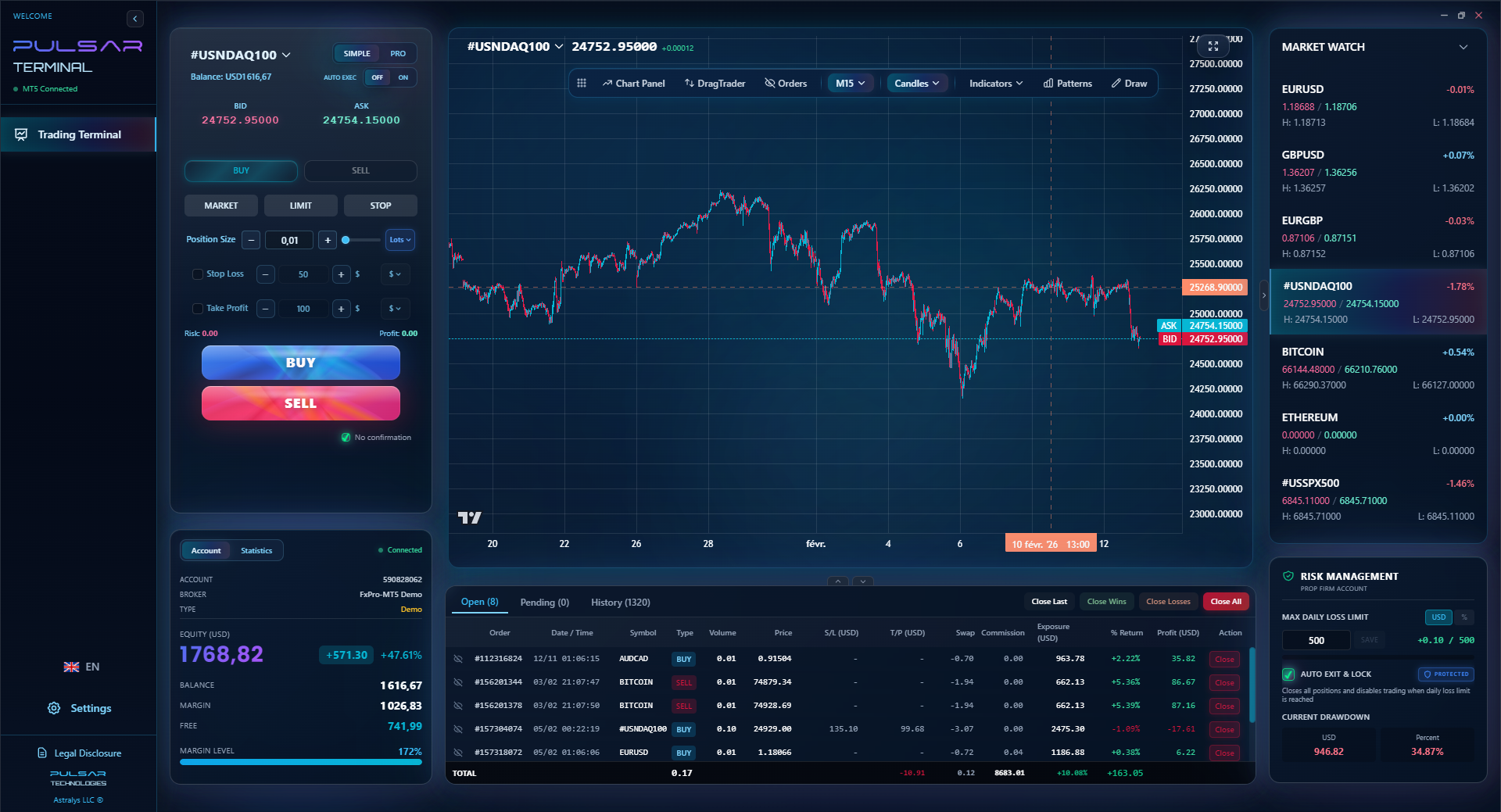
Proper risk management requires precise order execution, and tools like Pulsar Terminal allow you to set multi-level take-profits and stop-losses with one click directly on your MT5 chart, turning book theory into disciplined practice.
Pulsar Terminal
Hepsi bir arada MT5 aracı: sürükle-bırak emirler, çoklu TP/SL, trailing stop, grid trading, Volume Profile ve prop firm koruması. Her gün 1.000'den fazla trader tarafından kullanılıyor.
Being told what to read is helpful, but knowing what to avoid can save you time and money.
- Get-rich-quick 'systems': Any book with a title like 'The Secret Forex Millionaire System' or that promises monthly returns of 20%+. They are selling a dream, not education. I bought one early on that was just a complicated way of plotting moving averages. It lost money in live testing.
- Extremely niche advanced texts: Books on high-frequency trading algorithms or market microstructure. Unless you're building a quant fund, this is irrelevant for retail traders. The knowledge won't help you trade EUR/USD on MT5.
- Autobiographies of legendary floor traders: Books like Market Wizards are fantastic for inspiration and psychology gems, but don't try to copy the specific bond trading tactics of Paul Tudor Jones. The markets they traded don't exist anymore in the same form. Read them for the mindset, not the methods.
Focus on the core pillars first: psychology, basic technicals, a single strategy, and ruthless risk management. Everything else is a distraction in your first few years.
💡 Winston'ın İpucu
Your trading library should evolve. A book on scalping might be relevant for your first two years, then a book on swing trading becomes more important as your capital and patience grow.
“My first trading journal was on a Nokia notepad. It was ugly, but it began the habit.”
How do you make this work practically in Nigeria? Here's my advice.
- Start Digital, But Go Physical for Key Books: Use PDFs or e-books for initial reads, but buy physical copies of Trading in the Zone and your main strategy book. The act of writing notes in the margins, highlighting, and having it on your desk is powerful. You can find them on Amazon or through local book vendors in Lagos or Abuja.
- Form a Study Group: Connect with 2-3 other serious traders. Read a book together, a chapter a week, and discuss it. This accountability forces you to engage deeply. We did this with The Mental Game of Trading, and the shared insights were incredible.
- Apply Immediately: Don't just read. If a book discusses a chart pattern, open your MT4 platform on a demo account and find 50 examples. If it talks about a trading journal, start one that afternoon. My first journal entry was on a Nokia notepad. It was ugly, but it began the habit.
- Contextualize for Naira: Always do the math in naira. If a book says 'risk 1%', calculate what 1% of your 500,000 Naira account is. Understand the pip value for your preferred pairs. This grounds the theory in your reality. Managing a $10,000 account is a different psychological game from managing a ₦5,000,000 account, even if the percentage risk is the same.
The goal isn't to collect books. It's to internalize principles. The best books to read for forex trading are the ones that get worn out, covered in notes, and revisited every time you hit a rough patch in the markets.
FAQ
Q1I'm a complete beginner in Nigeria. What's the very first book I should read?
Start with Trading in the Zone by Mark Douglas. It's challenging, but it sets the correct mental framework from day one. Pair it with Japanese Candlestick Charting Techniques as a reference. Understanding psychology and basic price action is more important than any specific strategy when you're starting.
Q2Are books about stock trading useful for forex?
Some are, but be very selective. Books on general trading psychology, risk management, and broad technical analysis (like Murphy's) are excellent. Books focused on stock valuation, earnings reports, or exchange-specific rules are not useful. Always ask: 'Does this concept apply to a 24-hour, decentralized, currency-paired market?'
Q3How many books do I really need to read?
You don't need a library. You need mastery of a few core concepts. I'd say 4-5 books deeply understood are worth more than 50 skimmed. Master one book from each category in this guide: Psychology, Market Mechanics, Strategy, and Risk Management. Then, trade and re-read them. You'll discover new insights each time.
Q4What's a common mistake traders make when reading these books?
They try to adopt every single system and indicator from every book, creating a confusing, contradictory mess on their charts. I did this. I had 15 indicators running, all giving different signals. Pick ONE coherent framework from a strategy book, learn it inside out on a demo account, and only then consider adding nuances from other sources.
Q5Should I read books on forex trading scams?
Yes, but not first. Once you've read the core books, a book like The Wolf of Investing can be a useful reality check about industry pitfalls. Your primary defense, however, is your own education and sticking to well-regulated brokers. If an opportunity sounds too good to be true (like 100% monthly returns), it is.
Q6Can books alone make me a profitable trader?
Absolutely not. Books provide the knowledge and mindset. Profits come from applying that knowledge through consistent practice, disciplined execution, and proper risk management on a live platform. Think of books as your flight manual, but you still have to log thousands of hours in the cockpit (demo and live trading) to become a pilot.
Prof. Winston'ın Dersi
Önemli Noktalar:
- ✓Master psychology first with 'Trading in the Zone'.
- ✓Use 'Murphy's Bible' for technical analysis fundamentals.
- ✓Risk a maximum of 1-2% per trade, always.
- ✓Adapt strategies from books; don't copy them blindly.
Bu makale ne kadar faydalıydı?
Bir yıldıza tıklayın
Haftalık Trading Analizleri
Ücretsiz haftalık analiz ve stratejiler. Spam yok.
Yazar hakkında
Olumide Adeyemi
Batı Afrika Yatırım Öncüsü
Nijerya'nın en aktif forex eğitmenlerinden biri. Lagos'tan 8 yıllık ticaret deneyimi. Afrika'lı trader'lar için düşük sermaye stratejileri ve prop firma yarışmaları uzmanı.
Yorumlar
Risk Uyarısı
Finansal araçlarla işlem yapmak önemli riskler taşır ve tüm yatırımcılar için uygun olmayabilir. Geçmiş performans gelecekteki sonuçları garanti etmez. Bu içerik yalnızca eğitim amaçlıdır ve yatırım tavsiyesi olarak değerlendirilmemelidir. İşlem yapmadan önce her zaman kendi araştırmanızı yapın.
Bunları da beğenebilirsiniz

Cara Trading Forex Sukses: 7 Prinsip dari Trader Profesional
Cara trading forex sukses dengan 7 prinsip trader pro: manajemen modal, disiplin, journal trading, backtest. Data nyata, bukan janji profit palsu.
Jam Trading Forex Terbaik untuk Trader Indonesia: Panduan Lengkap dengan Tabel Waktu
Panduan jam trading forex untuk trader Indonesia. Tabel 4 sesi dunia, jam emas 20:00-00:00, sesi mana yang harus dihindari. Data akurat + tips dari trader berpengalaman.
Top 5 Sàn Forex Uy Tín Nhất 2026: Review Jujur dari Trader Indonesia
Top 5 sàn forex uy tín 2026 untuk trader Indonesia. Review jujur: spread, deposit, withdraw, dukungan lokal. Exness, XM, IC Markets & lebih.
Pulsar Terminal'ı Edinin
Tüm bu hesaplayıcılar MT5 hesabınızdan gerçek zamanlı verilerle Pulsar Terminal'e entegredir.
Pulsar Terminal'ı Edinin