


I remember a trade on USD/ZAR back in 2020 that should have netted me a clean R1,200 profit.

David van der Merwe
Gelişen Piyasalar Yatırımcısı ·  South Africa
☕ 11 dk okuma
Neler öğreneceksiniz:
- 1Why Spreads Matter More Than You Think
- 2The FSCA Rulebook: Your First Filter
- 3Spread-Only vs. Commission Accounts: The Real Cost
- 4Top FSCA Brokers for Low Spreads: The 2026 Line-Up
- 5Beyond the Spread: The Hidden Costs That Bite
- 6Picking Your Partner: Style Matters
- 7Your Final Checklist Before You Deposit a Cent
I remember a trade on USD/ZAR back in 2020 that should have netted me a clean R1,200 profit. The setup was perfect, my exit was hit... but my broker's 'average' spread on the pair was a whopping 45 pips during the London open. By the time my order filled, my profit was just R380. That's when I stopped looking at just use and bonuses, and started obsessing over spreads. For us trading in ZAR, with our market growing over 6% a year, every pip saved is money in your pocket, not the broker's. Let's break down who actually offers the tightest spreads without cutting corners on safety.
You might think a pip or two difference on the EUR/USD spread is small change. It's not. It's the silent tax on every single trade you make. If you're a scalper taking 10 trades a day, or a swing trader holding positions for weeks, that cost compounds fast. It's the difference between a strategy that's profitable on paper and one that makes real money in your account.
Think of it this way: the spread is the dealer's immediate profit. A 1-pip spread on EUR/USD means you're already 1 pip in the red the moment you click 'buy'. You need the market to move that far just to break even. Now, imagine that spread is 0.1 pips. Your break-even point is almost at your entry. This is why finding the best forex brokers with low spreads isn't just about being cheap, it's about giving your strategy the best possible chance to work.

Example: Let's do the math. Say you trade 10 standard lots of EUR/USD per month (that's 1,000,000 units per trade). A 1-pip spread costs you $100 per trade ($10 per pip * 10 pips). Over 10 trades, that's $1,000 in spread costs. With a 0.2-pip spread, the cost drops to $200. You've just saved $800 a month, which is more than many people's electricity bill.
I learned this the hard way early on. I was using a popular 'beginner-friendly' broker with slick marketing. Their spreads looked okay on the website, but in reality, they widened dramatically during news events. I got stopped out of a GBP/USD trade not because my analysis was wrong, but because a 3-pip spread ballooned to 15 pips during the CPI release. The market reversed and went my way, but I was already out. That loss stung, and it was entirely due to cost structure, not market direction.

💡 Winston'ın İpucu
A broker's reliability during a news spike is worth ten times their advertised 'from' spread. Test them when the US Non-Farm Payrolls report drops.
“The spread is the silent tax on every single trade you make.”
Before you even look at a spread, check the regulator. In South Africa, the Financial Sector Conduct Authority (FSCA) is the main watchdog. Trading with an FSCA-licensed broker isn't just a suggestion, it's your primary layer of protection. It means they have to follow strict rules on how they handle your money.
What FSCA Regulation Actually Means for You
Client fund segregation is the big one. This means your trading capital is held in separate bank accounts from the broker's own operating money. If the broker goes under (it happens), your funds should be safe and accessible. An unregulated offshore broker might offer crazy low spreads or 1000:1 use, but if they vanish, your money likely does too. I've had friends learn this lesson the expensive way.
The FSCA also caps use for retail traders at 30:1 on major forex pairs. This might feel restrictive if you've seen offers for 500:1 elsewhere, but honestly, it's a good thing. It forces better risk management. You can't blow up your account as quickly. When you're hunting for the best forex brokers with low spreads, start with the FSCA list. It immediately filters out the dodgy operators.

Warning: Just because a broker is regulated in Cyprus (CySEC) or Australia (ASIC) doesn't mean their South African clients fall under that jurisdiction's compensation schemes. Always verify they hold a specific FSCA license (FSP number). Your recourse is here, in SA.
A quick note on tax: yes, your trading profits are subject to tax by SARS. Keep a detailed log of all your trades. The spread you pay is a direct cost, which reduces your taxable profit. A good broker will give you clear statements, making tax time less of a nightmare.
“I'll pay a slightly higher spread for a broker with flawless execution and instant, free withdrawals.”
Brokers typically offer two main account structures, and choosing the right one is crucial for your style.
Standard/Classic (Spread-Only) Accounts: These are simple. The broker makes money from the spread alone - there's no separate commission. The spreads are wider, but what you see is what you pay. This can be great for beginners or those trading smaller sizes where a fixed commission would eat a larger percentage of potential profit. For example, a broker might offer a fixed 1.3 pip spread on EUR/USD with no commission.
Raw/ECN/Pro (Commission-Based) Accounts: These accounts connect you more directly to the interbank market. Spreads can be razor-thin, often starting from 0.0 pips on majors, but you pay a commission per lot traded. This is usually the choice for high-volume traders, scalpers, and algorithmic traders. The total cost (spread + commission) is often lower if you trade significant volume.
Here’s a quick comparison of how the costs can play out on a 1 standard lot (100,000 units) trade of EUR/USD:
| Account Type | Example Spread | Commission | Total Cost (in $) |
|---|---|---|---|
| Spread-Only | 1.3 pips | $0 | $13.00 |
| Commission-Based | 0.1 pips | $3.50 per side | $4.50 ($0.10 spread + $3.50 comm) |
As you can see, for a single lot, the commission account is cheaper. But if you're trading a 0.01 mini-lot, the $3.50 commission would be disproportionately huge. You need to use a position size calculator and be honest about your typical trade volume. I made the mistake of opening a Raw ECN account when I was just starting with $500. The $7 round-turn commission on a single mini-lot was killing my small gains. I switched to a spread-only account until my capital and position sizes grew.
“I'll pay a slightly higher spread for a broker with flawless execution and instant, free withdrawals.”
Based on live testing, client reports, and my own experience, here are the standouts. Remember, 'lowest' isn't always best - execution speed, platform stability, and customer service matter just as much.
IC Markets: My personal go-to for raw spreads. Consistently shows 0.0-0.1 pips on EUR/USD during major sessions on their Raw Spread account. Commission is $3.50 per lot, per side. Execution is frighteningly fast, which is vital for scalping strategies. They're regulated by the FSCA and ASIC. Minimum deposit is $200. The only gripe? Their support can be slow during peak times.
Pepperstone: Another heavyweight. Their Razor account is comparable to IC Markets, with spreads from 0.0 pips and a $3.50 round-turn commission per lot. Where they shine is their platform suite (they have excellent MT4/MT5 and cTrader integration) and their customer service is top-notch for SA traders. Also FSCA-regulated. No minimum deposit on some account types, which is a nice touch.
Tickmill: Offers a very clear choice. Their Pro Account gives you spreads from 0.0 pips with a $2 per side commission. Their Classic Account has no commission but spreads around 1.6 pips. This makes it easy to choose based on your style. FSCA-regulated, minimum deposit of $100. I've found their execution to be reliable, especially on less liquid pairs like ZAR crosses.
FP Markets: A solid all-rounder. Their Raw ECN account offers spreads from 0.0 pips. They have deep liquidity and are particularly strong on Asian and commodity pairs. Also regulated by the FSCA. A good option if you trade a broad range of instruments beyond just major forex.
Exness: Known for flexible conditions. They offer competitive spreads from 0.0 pips and have a unique model with unlimited use on their offshore entity (use with extreme caution!). Their FSCA entity adheres to the 30:1 cap. Minimum deposits can be very low ($10), making them accessible. Good for testing strategies with small capital.
XM: A favourite for beginners and those who want accounts in ZAR. You won't get the absolute lowest spreads here (they start around 0.8 pips on EUR/USD), but they offer commission-free trading, a low $5 minimum deposit, and a ton of educational resources. They're a regulated, safe starting point while you learn.

Pro Tip: Don't just look at the advertised 'from' spread. Check the average spread over a week, especially during the volatile Sydney-Asia handover and London open. A broker might advertise 0.0 pips but only maintain it for 2 hours a day. Use third-party spread comparison tools.
💡 Winston'ın İpucu
If you're calculating your trading costs and haven't factored in the swap for holds over 48 hours, you're not calculating your real costs. It's like ignoring fuel consumption on a long trip.
“Your trading style should dictate your broker choice, not the other way around.”
The spread is the main cost, but it's not the only one. Brokers have other ways to make money, and you need to be aware of them.
Overnight Financing (Swap Rates): If you hold a position past 5pm New York time (the forex daily close), you'll pay or receive a swap fee. This is based on the interest rate differential between the two currencies. For long-term swing trading, these costs can add up. Some brokers offer 'swap-free' Islamic accounts, but these often have wider spreads or admin fees to compensate.
Deposit and Withdrawal Fees: This is a big one for South Africans. Does the broker charge for a FPS/EFT deposit from your local bank? Do they absorb the international SWIFT fees? Some brokers offer free deposits via specific local payment processors. A R200 withdrawal fee on a R1000 profit is a 20% hit you never saw coming.
Inactivity Fees: If you don't trade for a certain period (often 3-12 months), some brokers will start charging a monthly maintenance fee. Read the terms.
Currency Conversion Fees: If your account is in USD but you deposit in ZAR, the broker will convert it. Their exchange rate often includes a markup of 1-2%. It's sometimes cheaper to use a third-party service like Wise to convert your money first.
I got caught by the swap rate trap early on. I was long AUD/JPY (a classic carry trade) and holding for weeks. The positive swap was earning me a few dollars a night. Then, the RBA cut rates, and the swap flipped negative. I didn't notice, and over a month, it eroded hundreds of dollars from my profit. Now I check the swap rates on every potential trade, especially if I'm using the MACD indicator or other tools that might suggest a longer-term trend hold.
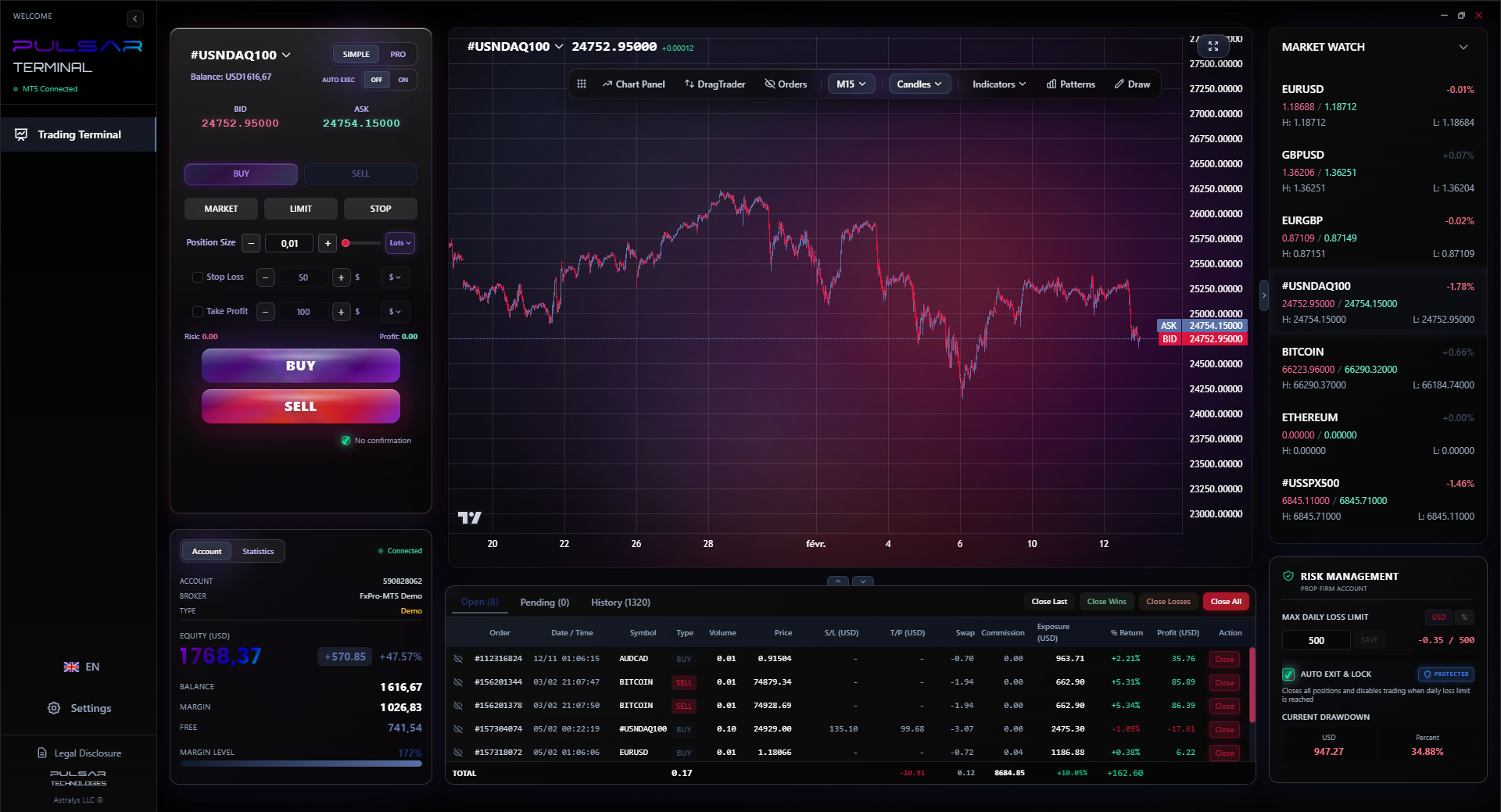
When you're trading with tight spreads on fast-moving markets, managing multiple take-profit levels and a trailing stop manually is nearly impossible; Pulsar Terminal lets you set it all up with one click directly on your MT5 chart.
Pulsar Terminal
Hepsi bir arada MT5 aracı: sürükle-bırak emirler, çoklu TP/SL, trailing stop, grid trading, Volume Profile ve prop firm koruması. Her gün 1.000'den fazla trader tarafından kullanılıyor.
“Your trading style should dictate your broker choice, not the other way around.”
Your trading style should dictate your broker choice. Here’s a quick guide:
The Scalper: You need the absolute lowest total cost (spread + commission) and the fastest, most reliable execution with no requotes. Slippage is your enemy. Look squarely at IC Markets, Pepperstone, or Tickmill's Pro account. A 0.5 second delay or a 0.3 pip slippage can turn 10 profitable scalps into 5 losers. I scalp the EUR/USD during London hours, and I wouldn't use a broker with an average spread above 0.3 pips for that.
The Swing Trader: You hold trades for days or weeks. Ultra-low spreads are less critical than stability, low swap rates, and trustworthiness. You might prefer a spread-only account to avoid commissions on fewer, larger trades. A broker like FP Markets or XM could be a great fit. Your bigger concern is avoiding a margin call during a weekend gap, not the 0.2 pip difference on entry.
The Beginner/Part-Time Trader: You're learning, trading small sizes. Your priorities are safety (FSCA regulation), low minimum deposit, good educational tools, and simple cost structures. A commission-free account from XM or AvaTrade makes sense. You don't need a raw ECN account yet. Focus on learning, not optimizing for the last cent of spread.
The Algorithmic/EA Trader: You need a broker with stable, low-latency servers, expert advisor-friendly policies, and raw spread accounts. IC Markets and Pepperstone are the usual favourites in the algo community for a reason. They can handle high order volumes without freezing up.
💡 Winston'ın İpucu
The easiest way to compare brokers? Take your most common trade size and instrument, and ask each broker for the exact total cost (spread + all fees) for a round-turn trade. The one with the clearest, lowest answer often wins.
“A broker that makes it difficult to get your profits out is a broker you shouldn't be with.”
Ready to choose? Run through this list first.
- Verify the FSCA License: Go to the FSCA website, find their register, and type in the broker's name or FSP number. Do it yourself.
- Open a Demo Account: Don't just look at numbers. Trade on their demo for a week. Test execution speed during high volatility (like at 3pm SA time when the US data drops). See if spreads widen unacceptably.
- Calculate the REAL Total Cost: For your typical trade size and frequency, calculate the cost on a spread-only vs. a commission account. Use real numbers from their demo or live spread tables.
- Test Customer Support: Call their SA support line. Email them with a question. How long do they take to respond? Are they helpful? You'll need them when you have a withdrawal question.
- Read the Withdrawal Policy: How do you get your money out? What are the fees? What's the processing time? This is the most important test of a broker.
- Check Deposit Methods: Do they offer Instant EFT, Ozow, or other local methods with no fees? This saves you money and hassle.
My rule of thumb? I'll pay a slightly higher spread for a broker with flawless execution and instant, free withdrawals. A broker that makes it difficult to get your profits out is a broker you shouldn't be with, no matter how low their spreads are.
FAQ
Q1Is it safe to use an international broker not regulated by the FSCA?
It's riskier. While many international brokers like Pepperstone or IC Markets are reputable and regulated elsewhere (like ASIC), if they don't have an FSCA license, your recourse as a South African resident is limited. You'd have to pursue complaints through a foreign regulator, which is complex. For peace of mind and local protection, an FSCA-licensed entity is always the safer choice.
Q2What is a 'good' spread for EUR/USD?
For a commission-based (Raw/ECN) account, anything consistently below 0.3 pips is excellent. For a standard spread-only account, an average spread between 0.8 and 1.5 pips is competitive. Be wary of brokers advertising 'from 0.0 pips' - check the average over a full trading day. The global average is around 0.6 pips.
Q3Do low-spread brokers have worse execution or more slippage?
Not necessarily. In fact, the top low-spread brokers (like IC Markets, Pepperstone) typically invest in the fastest technology and deepest liquidity pools to offer both tight spreads and fast execution. Slippage can happen with any broker during extreme volatility. The key is to check reviews and test on a demo to see if requotes or excessive slippage are common.
Q4Can I trade ZAR pairs with low spreads?
ZAR pairs (like USD/ZAR, EUR/ZAR) naturally have much wider spreads than majors due to lower liquidity. You won't see 0.1 pip spreads here. However, the best brokers will offer competitive spreads on these pairs relative to the market. Expect spreads of 30-80 pips on USD/ZAR, for example. Compare this across a few FSCA brokers before trading.
Q5How does the FSCA's 30:1 use limit affect me?
It limits how much you can borrow from the broker. At 30:1, you need about 3.33% margin to open a position. This protects you from extreme losses. While it may feel restrictive compared to offshore 500:1 offers, it promotes responsible trading. It forces you to use proper position size calculator and manage risk, which is a good thing for long-term survival.
Q6Are there any brokers with both low spreads and no minimum deposit?
Yes, a few. Pepperstone offers accounts with no minimum deposit. Fusion Markets (which offers tight spreads) also has no minimum. Exness allows you to start with as little as $10. Remember, just because you can start small doesn't mean you should trade without a proper risk plan.
Prof. Winston'ın Dersi
Önemli Noktalar:
- ✓Always verify the FSCA license first, before checking spreads.
- ✓Calculate total cost (spread + commission + fees) for your typical trade size.
- ✓Test execution speed on a demo during high volatility.
- ✓Prioritize brokers with free, fast local ZAR deposit/withdrawal options.
- ✓Match the account type (Standard vs. Raw) directly to your trading volume and style.
Bu makale ne kadar faydalıydı?
Bir yıldıza tıklayın
Haftalık Trading Analizleri
Ücretsiz haftalık analiz ve stratejiler. Spam yok.
Yazar hakkında
David van der Merwe
Gelişen Piyasalar Yatırımcısı
Johannesburg merkezli, gelişmekte olan piyasa dövizlerinde 11 yıllık deneyime sahip trader. ZAR pariteleri, FSCA düzenlemeli ticaret ve Güney Afrika piyasa analizi uzmanı.
Yorumlar
Risk Uyarısı
Finansal araçlarla işlem yapmak önemli riskler taşır ve tüm yatırımcılar için uygun olmayabilir. Geçmiş performans gelecekteki sonuçları garanti etmez. Bu içerik yalnızca eğitim amaçlıdır ve yatırım tavsiyesi olarak değerlendirilmemelidir. İşlem yapmadan önce her zaman kendi araştırmanızı yapın.
Bunları da beğenebilirsiniz

Cara Trading Forex Sukses: 7 Prinsip dari Trader Profesional
Cara trading forex sukses dengan 7 prinsip trader pro: manajemen modal, disiplin, journal trading, backtest. Data nyata, bukan janji profit palsu.
Jam Trading Forex Terbaik untuk Trader Indonesia: Panduan Lengkap dengan Tabel Waktu
Panduan jam trading forex untuk trader Indonesia. Tabel 4 sesi dunia, jam emas 20:00-00:00, sesi mana yang harus dihindari. Data akurat + tips dari trader berpengalaman.
Top 5 Sàn Forex Uy Tín Nhất 2026: Review Jujur dari Trader Indonesia
Top 5 sàn forex uy tín 2026 untuk trader Indonesia. Review jujur: spread, deposit, withdraw, dukungan lokal. Exness, XM, IC Markets & lebih.
Pulsar Terminal'ı Edinin
Tüm bu hesaplayıcılar MT5 hesabınızdan gerçek zamanlı verilerle Pulsar Terminal'e entegredir.
Pulsar Terminal'ı Edinin