


You know what's funny? Most traders spend years hunting for complex strategies, but one of the most reliable setups is a simple flag on a chart.

David van der Merwe
Gelişen Piyasalar Yatırımcısı ·  South Africa
☕ 11 dk okuma
Neler öğreneceksiniz:
- 1What Exactly Is a Bullish Flag Pattern?
- 2Spotting the Pattern in ZAR Pairs & Popular FX
- 3Your Entry, Stop Loss, and Take Profit Strategy
- 4Mistakes I Made (So You Don't Have To)
- 5Boosting Your Edge: Combining with Indicators
- 6Choosing a Broker as a South African Trader
- 7Putting It All Together: A Live Trade Walkthrough

You know what's funny? Most traders spend years hunting for complex strategies, but one of the most reliable setups is a simple flag on a chart. The bullish flag pattern in forex has a win rate that can push 70% when you get the context right. Yet, I see guys in Jo'burg and Cape Town blow accounts because they treat every little consolidation like a guaranteed breakout. This isn't about guessing; it's about spotting a specific story of momentum taking a breather before the next leg up. Let's break down how to trade it properly, with a heavy dose of Rand-centric reality.
Think of it like this: a rugby team makes a massive break down the field (that's the flagpole), then they huddle for a quick strategy chat (that's the flag). The bullish flag pattern forex traders love is just that - a sharp, near-vertical price rise (the pole), followed by a tight, sloping consolidation (the flag). The key is that the consolidation slopes against the main trend. So after a big up move, price drifts slightly lower in a parallel channel or a small rectangle. It shows profit-taking, not panic selling. The big money hasn't left; it's just catching its breath. I learned this the hard way early on. I'd see any pullback after a green candle and jump in, missing the crucial structure. A true flag's consolidation should be orderly, contained, and on lower volume (or lower volatility in forex). If the pullback is chaotic and deep, you're probably looking at a reversal, not a continuation pattern.
The Anatomy of the Setup
You need two clear parts. First, the Flagpole: This is the initial impulsive wave. It should be strong, preferably on significant news or a clear technical break. For a pattern to be valid, this pole needs to be substantial. I don't bother if the initial move is only 30 pips on the EUR/USD; I want conviction. Second, the Flag: This is the consolidation area. It can be slightly down-sloping, horizontal, or even slightly up-sloping (a pennant), but it must be tight. The classic rule is that the flag should retrace no more than 50% of the flagpole. If it retraces more, the pattern's strength is in question. I use a simple position size calculator at this stage to work out my potential risk based on where I'd place my stop-loss.

Warning: Don't confuse a flag with a full trend reversal. A deep, wide consolidation that eats most of the pole's gains is often a sign the move is exhausted. The flag should look like a pause, not a U-turn.

Trading from SA, you've got a unique perspective. Our beloved Rand pairs (USD/ZAR, EUR/ZAR) are volatile beasts. A bullish flag on USD/ZAR can be explosive, but the spreads are wider and the moves can be news-driven. I prefer to practice this pattern on major pairs like EUR/USD first, where liquidity is deep and patterns tend to be cleaner. That said, when you see a flag on the ZAR, the moves can pay for a month's worth of data bundles. Back in 2023, I caught a beautiful bullish flag on USD/ZAR on the daily chart. The pole was a 500-pip rally from around R18.20, the flag consolidated for about a week between R18.60 and R18.80, and the breakout gave another 400 pips. My entry was on the break of R18.85, stop at R18.55. The key is adjusting your timeframes. On volatile pairs, the 4-hour and daily charts filter out a lot of the noise that makes 15-minute charts unusable for this pattern.

Pro Tip: For SA traders, always check the JSE closing time and major local data releases (like CPI or SARB announcements) when looking at ZAR pairs. A flag forming during low liquidity can be a fakeout. I got stopped out more than once ignoring this.
Major pairs like GBP/USD or Gold (XAU/USD) are fantastic for this strategy. The liquidity is so high that the technical patterns often play out with textbook precision. If you're new to this, start there before tackling the local stuff. You can get a great foundation by studying our dedicated XAU/USD guide to see how flags behave in different asset classes.

💡 Winston'ın İpucu
A flag that forms after a gap up is often exceptionally strong. The gap represents a vacuum of selling pressure, and the flag is just filling that vacuum before the next leg.
“The bullish flag pattern isn't about guessing; it's about spotting a specific story of momentum taking a breather.”
This is where the rubber meets the road. Getting the structure right is only 40% of the battle. The other 60% is your trade plan.
Entry: The classic entry is on a breakout above the upper flag boundary. Don't try to be a hero buying at the bottom of the flag - you're not that smart (neither am I). Wait for the price to close convincingly outside the consolidation. I use a break of the high of the preceding candle inside the flag. Sometimes, if the flag is very tight, I'll enter on a retest of the broken boundary.
Stop Loss: Your stop must go below the lowest point of the flag. If the flag's low is at 1.0850, place your stop at 1.0840 or 1.0835. This ensures you're wrong if the pattern fails and price slices through support. Never place your stop inside the flag; that's just asking for a random whip to take you out. Protecting your capital is rule number one, and a clear stop level is non-negotiable. The last thing you want is a surprise margin call because you were too optimistic.
Take Profit: The measured move target is the most common approach. You take the height of the flagpole and project it upward from the point of breakout. Example: Flagpole runs from 1.0800 to 1.0900 (100 pips). Flag consolidates. Price breaks out at 1.0880. Your initial profit target is 1.0880 + 100 pips = 1.0980. For a more advanced approach, consider scaling out. Take 50% of your position at the measured move target, and let the rest run with a trailing stop. This balances locking in profits and catching a potential extended trend.

Example: On a EUR/USD trade, flagpole = 1.1000 to 1.1100 (100 pips). Flag low = 1.1070. Breakout at 1.1105. Stop loss = 1.1065 (5 pips below flag low). Take Profit 1 = 1.1205 (100-pip projected move). Risk = 40 pips (1.1105 - 1.1065). Reward = 100 pips. Reward/Risk = 2.5:1.
I've paid my tuition to the market on this pattern. Here’s what to avoid.
- Trading Flags in a Downtrend: This is the cardinal sin. A bullish flag is a continuation pattern. It must occur within a larger uptrend on a higher timeframe. If the weekly chart is bearish, a little flag on the 4-hour chart is likely a trap. Always zoom out. I lost R4,000 on a beautiful-looking GBP/USD flag because I ignored the dominant daily downtrend.
- Ignoring Volume/Volatility: In forex, we don't have volume like stocks, but we have volatility. The flag consolidation should see a noticeable drop in volatility (smaller candle ranges). If the candles during the 'flag' are just as wild as the pole, it's not consolidating - it's churning, and that's dangerous.
- Placing the Stop Too Tight: I used to put my stop just below my entry, thinking I was being smart with risk. All it did was get me stopped out before the real move began. Respect the pattern's geometry. Your stop belongs below the flag, period.
- Forcing the Pattern: Not every consolidation is a flag. If you have to squint and imagine the lines, it's not there. Wait for the clear, obvious ones. Patience is a strategy. This is true for all swing trading approaches.
- Chasing the Breakout: If you miss the initial breakout, don't FOMO in 50 pips higher. Wait for a pullback to retest the breakout level as new support. If it doesn't retest, let it go. There's always another trade. This discipline saved me from countless bad entries, especially when using a scalping strategy mindset on a swing trade.
💡 Winston'ın İpucu
The best flags are boring. If the consolidation period makes you anxious or excited, it's probably not a true flag. True flags are periods of indecision and low volatility.
“Your stop loss must go below the lowest point of the flag. Never place it inside; that's just asking for a random whip to take you out.”
The pattern alone is good. The pattern with confluence is great. Don't use indicators to define the flag, but to confirm the strength of the breakout.
- RSI (Relative Strength Index): During the flag consolidation, you want to see the RSI (set to 14) pull back from overbought territory (say, from 70 to 50 or 60), but not crash into oversold. This shows the bullish momentum is cooling off, not reversing. A breakout accompanied by RSI turning back up is a strong signal. Our guide on the RSI indicator dives deeper into these nuances.
- MACD (Moving Average Convergence Divergence): Look for the MACD histogram to be positive during the pole, shrink towards zero during the flag, and then expand again on the breakout. The signal line can often give a crossover confirmation right at the breakout point. It's a classic momentum confirmation tool.
- Moving Averages: The flag consolidation often takes place above key moving averages (like the 20 or 50-period EMA). These averages can act as dynamic support during the pullback. A breakout that also clears a key moving average resistance adds another layer of confirmation.
Remember, these are supporting actors. The pattern is the star. If the indicator disagrees but the price action is textbook, I'll usually side with the price action. I once missed a 200-pip move on AUD/USD because the MACD was looking a bit weak, but the flag breakout was pristine. Lesson learned.
Your broker choice directly impacts trading this pattern. You need two things: tight spreads on the breakout, and reliable execution without requotes.
- Spreads: When you enter on a breakout, you're often buying at the market. A wide spread on a major pair can instantly put you 2-3 pips in the red. For ZAR pairs, spreads are naturally wider, but compare brokers. Look for consistent pricing, especially during SA market hours.
- Execution: A 'fast market' warning or a requote when you're trying to catch a breakout can ruin the trade and your mood. You need a broker with a reputation for solid execution. Many SA traders use global brokers regulated internationally, which offer better trading conditions.
- Platform: You'll be drawing trendlines. Make sure your platform (like MT4/MT5) has reliable drawing tools. Some brokers offer superior charting packages. Based on my experience and deep research into local options, brokers like IC Markets and Pepperstone are popular among serious SA traders for their raw spreads and excellent MT4/MT5 integration. For those starting with smaller capital, XM offers very flexible account options. Always check their specific regulations and how they handle ZAR deposits and withdrawals - the last thing you want is a 7-day wait for your profits.
Pro Tip: Open a demo account with your shortlisted broker and practice drawing flags and entering breakout orders. Test their execution speed during London and New York opens, when you're most likely to see real breakouts happen.
💡 Winston'ın İpucu
When projecting your profit target from the flagpole, measure from the breakout point, not the top of the pole. This is a common measuring error that leads to unrealistic targets.
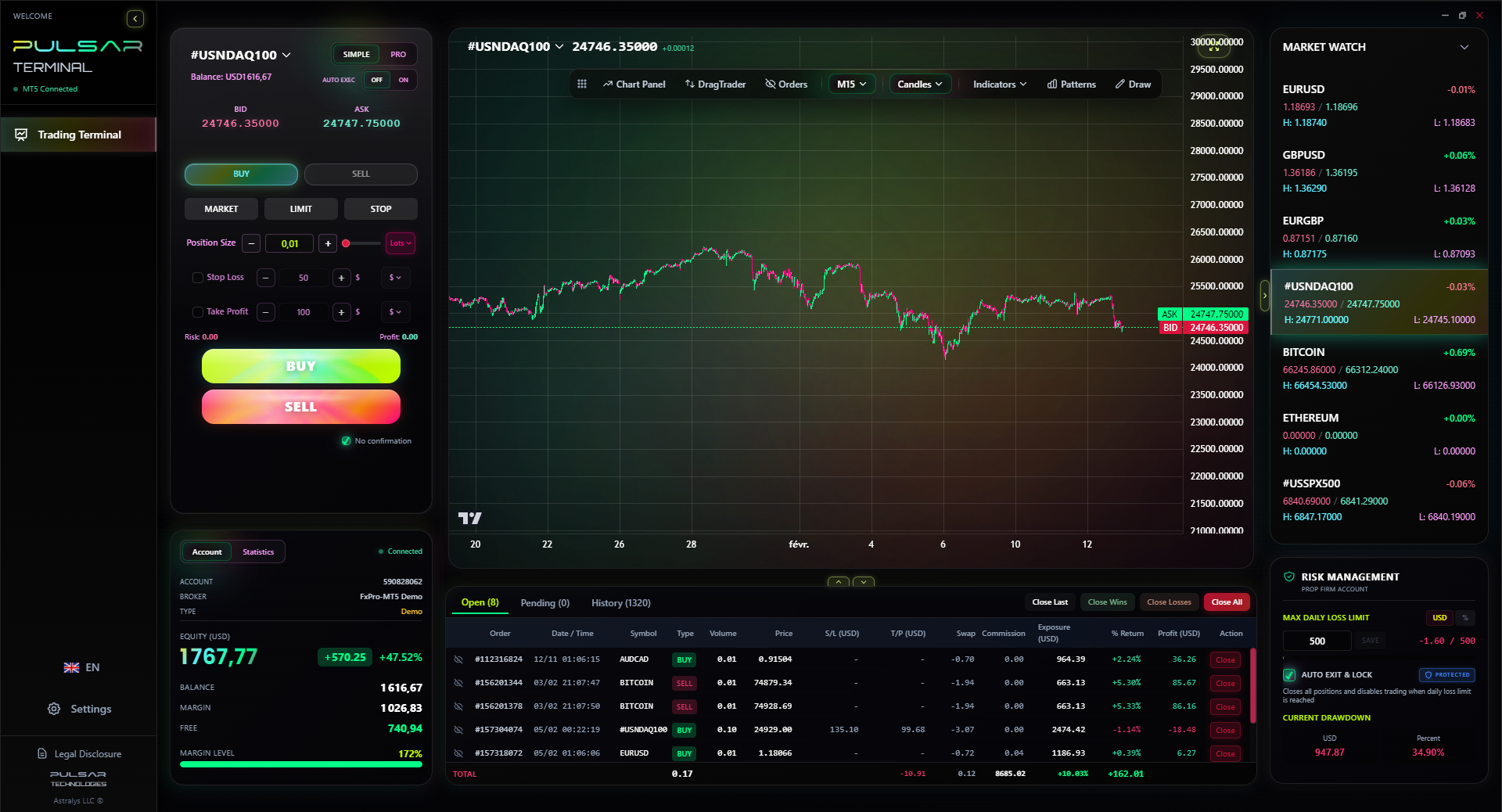
Managing multiple take-profit levels and trailing stops on a fast-moving flag breakout is much easier when your trading terminal automates it for you.
Pulsar Terminal
Hepsi bir arada MT5 aracı: sürükle-bırak emirler, çoklu TP/SL, trailing stop, grid trading, Volume Profile ve prop firm koruması. Her gün 1.000'den fazla trader tarafından kullanılıyor.
“The best flags are boring. If the consolidation period makes you anxious or excited, it's probably not a true flag.”
Let's walk through a hypothetical but realistic trade on EUR/USD, the way I'd do it now.
Step 1: The Trend. I'm on the daily chart. EUR/USD has clearly bottomed and is making higher highs and higher lows. The overall trend is up.
Step 2: The Pole. On the 4-hour chart, a strong news-driven rally pushes price from 1.0720 to 1.0820 - a clean 100-pip pole.
Step 3: The Flag. Over the next two days, price drifts down in a tight, slightly descending channel between 1.0800 and 1.0780. The candles get smaller. Volatility drops. The pullback is about 40 pips, less than 50% of the pole. Good.
Step 4: Confluence. The 50-period EMA on the 4H chart sits at 1.0775, right at the flag's support. RSI dipped from 65 to 55.
Step 5: Entry & Risk. Price breaks above 1.0805. I enter a buy stop order at 1.0808. My stop loss is at 1.0775 (below the flag low and the EMA). Risk per lot: 33 pips. I use my position size calculator to ensure this risk is only 1% of my account.
Step 6: Management. My measured move target is 1.0808 + 100 pips = 1.0908. I'll place a limit order for half my position there. For the other half, I'll move my stop to breakeven once price moves 50 pips in my favor, and then trail it. This is where automation helps immensely, letting you lock in profits without staring at the screen all day.
That's the blueprint. It requires patience to find, discipline to enter, and calm to manage. But when it works, it's one of the most satisfying moves you'll catch.
FAQ
Q1What's the minimum timeframe to trade a bullish flag pattern in forex?
You can spot them on any timeframe, but for reliability, I wouldn't go below the 1-hour chart. The 4-hour and daily charts are ideal as they filter out market noise. Flags on the 5-minute chart are often false and get eaten alive by the spread.
Q2How often do bullish flag patterns actually work?
No pattern works 100% of the time. A well-identified bullish flag pattern in a strong trend can have a historical success rate of 60-70%. The key is your risk management. Even a 60% win rate is highly profitable if your winning trades are bigger than your losers (a positive risk-reward ratio).
Q3Can I trade this pattern on USD/ZAR?
Absolutely, but with caution. ZAR pairs are more volatile and prone to gaps. Use wider stops, trade smaller position sizes, and stick to the higher timeframes (4H or Daily). The patterns can be just as valid, but the ride will be bumpier than on EUR/USD.
Q4What's the difference between a bullish flag and a bearish flag?
It's the same structure, just inverted. A bearish flag has a sharp downward flagpole, followed by a slight upward (or sideways) consolidation flag. The breakout is then to the downside, continuing the downtrend.
Q5Should I use fundamental analysis with this pattern?
It can only help. If a bullish flag is forming right before a major Central Bank announcement or high-impact news, be extra careful. The news can override the technical pattern. Ideally, you want the pattern to form and break in a relatively calm fundamental environment, or better yet, with the fundamentals aligning with the trend.
Q6How long does a flag typically last?
There's no fixed rule, but as a guide, the consolidation should be shorter in duration than the move that preceded it (the pole). A flag lasting 3-5 candles on the timeframe you're watching is common. If the consolidation drags on for too long, the momentum may fade.
Prof. Winston'ın Dersi
Önemli Noktalar:
- ✓The flag must slope against the main trend (downtight after an uptrend).
- ✓Flag consolidation should retrace less than 50% of the pole.
- ✓Always place your stop loss below the flag's lowest point.
- ✓Use the flagpole height to project a minimum profit target.
- ✓Trade the pattern in the direction of the higher timeframe trend.
Bu makale ne kadar faydalıydı?
Bir yıldıza tıklayın
Haftalık Trading Analizleri
Ücretsiz haftalık analiz ve stratejiler. Spam yok.
Yazar hakkında
David van der Merwe
Gelişen Piyasalar Yatırımcısı
Johannesburg merkezli, gelişmekte olan piyasa dövizlerinde 11 yıllık deneyime sahip trader. ZAR pariteleri, FSCA düzenlemeli ticaret ve Güney Afrika piyasa analizi uzmanı.
Yorumlar
Risk Uyarısı
Finansal araçlarla işlem yapmak önemli riskler taşır ve tüm yatırımcılar için uygun olmayabilir. Geçmiş performans gelecekteki sonuçları garanti etmez. Bu içerik yalnızca eğitim amaçlıdır ve yatırım tavsiyesi olarak değerlendirilmemelidir. İşlem yapmadan önce her zaman kendi araştırmanızı yapın.
Bunları da beğenebilirsiniz

Cara Trading Forex Sukses: 7 Prinsip dari Trader Profesional
Cara trading forex sukses dengan 7 prinsip trader pro: manajemen modal, disiplin, journal trading, backtest. Data nyata, bukan janji profit palsu.
Jam Trading Forex Terbaik untuk Trader Indonesia: Panduan Lengkap dengan Tabel Waktu
Panduan jam trading forex untuk trader Indonesia. Tabel 4 sesi dunia, jam emas 20:00-00:00, sesi mana yang harus dihindari. Data akurat + tips dari trader berpengalaman.
Top 5 Sàn Forex Uy Tín Nhất 2026: Review Jujur dari Trader Indonesia
Top 5 sàn forex uy tín 2026 untuk trader Indonesia. Review jujur: spread, deposit, withdraw, dukungan lokal. Exness, XM, IC Markets & lebih.
Pulsar Terminal'ı Edinin
Tüm bu hesaplayıcılar MT5 hesabınızdan gerçek zamanlı verilerle Pulsar Terminal'e entegredir.
Pulsar Terminal'ı Edinin