


Here's a number that should make you sit up straight: 89%.

Olumide Adeyemi
Batı Afrika Yatırım Öncüsü ·  Nigeria
☕ 10 dk okuma
Neler öğreneceksiniz:
- 1CFD Forex: It's Not What You Think (And That's the Risk)
- 2The Game Just Changed: Understanding ISA 2025
- 3The Real Costs: Spreads, Taxes, and That 89% Loss Rate
- 4Picking Your Broker: The Nigerian Trader's Checklist
- 5A Practical Trading Setup for Nigerian Markets
- 6Managing Your Money (and Your Mind)
- 7Your First Steps (and How to Avoid Scams)
Here's a number that should make you sit up straight: 89%. That's the upper end of the estimated percentage of retail CFD traders who lose money. In Nigeria, with over 300,000 active retail traders and a market that grew 300% in a single month, that statistic represents a lot of burned capital. Trading CFD forex here isn't just about charts and pips; it's about navigating a unique regulatory shift, understanding very real tax obligations, and picking brokers that won't disappear with your money. I've traded through Naira fluctuations, regulatory gray areas, and everything in between. Let's talk about how you can trade smarter, not just harder.
Alright, let's clear this up first. When we talk about cfd forex in Nigeria, you're not actually buying US dollars or British pounds. You're buying a Contract for Difference (CFD) on the price movement of that currency pair. Think of it as a bet with your broker on which way the price will go. You profit from the difference between the entry and exit price.
The big appeal? use. Brokers might offer you 1:500, even 1:2000. That means with ₦20,000, you can control a ₦10,000,000 position. Sounds like a shortcut to riches, right? It's actually the shortcut to a margin call. I learned this the hard way early on. I put ₦50,000 on a EUR/USD trade with high use. The market moved just 25 pips against me - a tiny move - and my entire account was wiped out. Poof. Gone. That use amplifies losses as fast as it amplifies gains.

Warning: A CFD is a derivative. You don't own the underlying asset. This is crucial for tax purposes (more on that later) and means you're exposed to the broker's solvency. If they go under, your money might too.
The other half is the forex market itself - the global exchange of currencies. It's the most liquid market in the world, open 24/5. For Nigerian traders, pairs like EUR/USD, GBP/USD, and USD/JPY are the main playgrounds. But you've also got exotic pairs like USD/NGN (though often with wider spreads) and commodity CFDs like gold (XAU/USD), which behaves like a currency. If you're new to forex, start with our EUR/USD guide to understand the most traded pair first.

💡 Winston'ın İpucu
The market's job is to take your money. Your job is to not give it to them. Every rule you create - the 1% risk, the no-late-trading rule - is a wall around your capital. Build the walls high first, then learn to attack.
“High use is the shortcut to a margin call, not a shortcut to riches.”
For years, trading CFD forex in Nigeria was a wild west. The SEC basically said, "You're on your own." That changed in March 2025. The Investments and Securities Act (ISA) 2025 is a big deal, and you need to understand it.
What the Law Actually Says
The ISA 2025 makes it illegal for unregistered online forex trading platforms to operate in Nigeria. It empowers the SEC to regulate this space properly. Before, brokers like Exness or XM operated here under their Cyprus or other international licenses. Now, the expectation is that they will need to seek some form of local registration or partnership.
What This Means for You, the Trader
- Broker Safety is (Slowly) Improving: The law aims to weed out shady bucket shops. Over time, you should have more confidence that your broker isn't a scam. But this transition will take time. For now, you still primarily rely on a broker's foreign regulatory status (like FCA or CySEC) as your safety net.
- Your Trading is Legal: The law targets platforms, not individual traders. Your activity is still perfectly legal. Don't let anyone tell you otherwise.
- Expect More Scrutiny: Deposit and withdrawal methods might see more checks as financial institutions align with the new act. Keep your records clean.

Pro Tip: When choosing a broker now, prioritize those with strong international regulation (FCA, ASIC) and who are publicly engaging with the new Nigerian regulatory process. It shows they're here for the long haul.
The Central Bank of Nigeria (CBN) still hates speculative forex trading that pressures the Naira. They've restricted local banks from facilitating it. That's why you deposit to international broker wallets, not a local bank account. This part hasn't changed.
“The 1% risk rule would save 50% of failing traders overnight. It's that simple.”
Let's talk numbers, because this is where dreams meet reality. The 70-89% loss rate isn't a myth; it's a consequence of misunderstood costs and poor risk management.
Your Trading Costs:
- The Spread: This is the difference between the buy and sell price. It's your primary cost. On EUR/USD, a good raw spread account (like Exness or Pepperstone Razor) can be 0.1-0.3 pips plus a small commission. A standard account might have a 0.8-1.0 pip spread with no commission. That spread is a cost you pay on every single trade.
- Overnight Financing (Swap): If you hold a position past 5 PM EST, you pay or earn a small interest fee. On some pairs, like long USD/TRY, this cost can be massive and will eat your account.
The Nigerian Tax Man: FIRS This is non-negotiable. Profits from CFD trading are subject to Capital Gains Tax (CGT) at 10%. You are legally required to declare this income and pay the tax. I set aside 10% of every profitable withdrawal immediately. The FIRS is getting more sophisticated, and trading records from brokers are traceable. Don't ignore this.
Why Do Most Lose? It's not the spread or the tax. It's use and psychology. That 1:1000 use makes a 0.1% move against you a 100% loss. People chase losses, trade without a plan, and treat it like gambling. I blew my second account, about ₦150,000, by revenge trading after that first big loss. I broke every rule I knew. A solid scalping strategy or swing trading plan is useless without the discipline to follow it.

Example: You make a ₦500,000 profit in a year. You owe ₦50,000 to FIRS. Keep it simple. Set it aside from day one.
“The 1% risk rule would save 50% of failing traders overnight. It's that simple.”
With so many options, how do you choose? Don't just go for the one with the flashy ads on Instagram. Here’s my practical checklist, built from 12 years of seeing brokers come and go.
| Priority | What to Look For | Nigerian-Friendly Example |
|---|---|---|
| #1: Regulation | A top-tier license (FCA, ASIC) or strong multi-license (CySEC, FSCA). This is your protection. | Pepperstone (ASIC/FCA), IC Markets (ASIC) |
| #2: Deposits/Withdrawals | Local bank transfers (NGN), USDT, or reliable card processing. Fast, low-fee withdrawals. | HFM (NGN accounts), Exness (instant USDT), XM |
| #3: Costs | Competitive spreads on the pairs you trade. Understand commission vs. spread pricing. | Fusion Markets (low spreads), Exness (raw spreads) |
| #4: Platform & Tools | Reliable MT4/MT5 access. Good execution speed (important for scalping). | All major brokers offer MT5. |
| #5: Minimum Deposit | Start small. You can test with $10-$100. Don't commit big money upfront. | FBS ($1), XTB ($0), XM ($5) |
My Experience: I started with a broker offering "unbeatable" 1:3000 use and bonuses. The withdrawals were a nightmare - endless "verification" delays. I switched to an ASIC-regulated broker (Pepperstone) and never looked back. The use was lower (1:500), but my money was safe, and withdrawals hit my account in 24 hours. Safety first, always.
use Note: Just because a broker like FBS or HFM offers 1:2000+ doesn't mean you should use it. Use a position size calculator and never risk more than 1-2% of your account on a single trade. That's how you survive.
💡 Winston'ın İpucu
A losing trade where you followed your plan is a better trade than a winning trade where you didn't. One builds discipline, the other builds an ego that will eventually bankrupt you.
“Your goal for the first 6 months is not to get rich. Your goal is to not lose money.”
Theory is great, but what do you actually do? Here's a simplified, actionable setup I've used successfully.
Chart & Analysis:
- Timeframe: I use the 4-hour chart for direction and the 1-hour or 15-minute for entry. Trying to scalp on the 1-minute chart as a beginner is a surefire way to lose money quickly.
- Indicators (Keep it Simple):
- 200 EMA: On the 4-hour chart. Price above it suggests a general uptrend, below for downtrend. Don't fight it.
- RSI: I use it to spot overbought (above 70) or oversold (below 30) conditions within the trend. An RSI reading of 75 in a downtrend isn't a buy signal.
- MACD: Good for confirming momentum shifts. I look for the MACD line to cross above the signal line for a potential buy, and vice versa.
A Simple Trade Example (From My Journal):
- Pair: GBP/USD
- Setup: On the 4H chart, price was consistently above the 200 EMA (uptrend). On the 1H chart, price pulled back to a previous support level. The RSI dipped to 35 (oversold in an uptrend).
- Action: I bought at 1.2750.
- Stop Loss: Placed at 1.2720 (30 pips below entry, risking 1% of my account).
- Take Profit: Set at 1.2820 (70 pips target).
- Result: Trade hit TP two days later. A 2.33:1 reward-to-risk ratio.
The key was patience. I waited for the trend, the pullback, and the indicator confluence. I didn't just jump in because I was bored.
Pro Tip: News is your friend and your enemy. Nigerian forex traders often overlook major economic calendars. A US Non-Farm Payrolls announcement can wipe out your careful technical setup in seconds. Know when high-impact news is due and consider staying out.
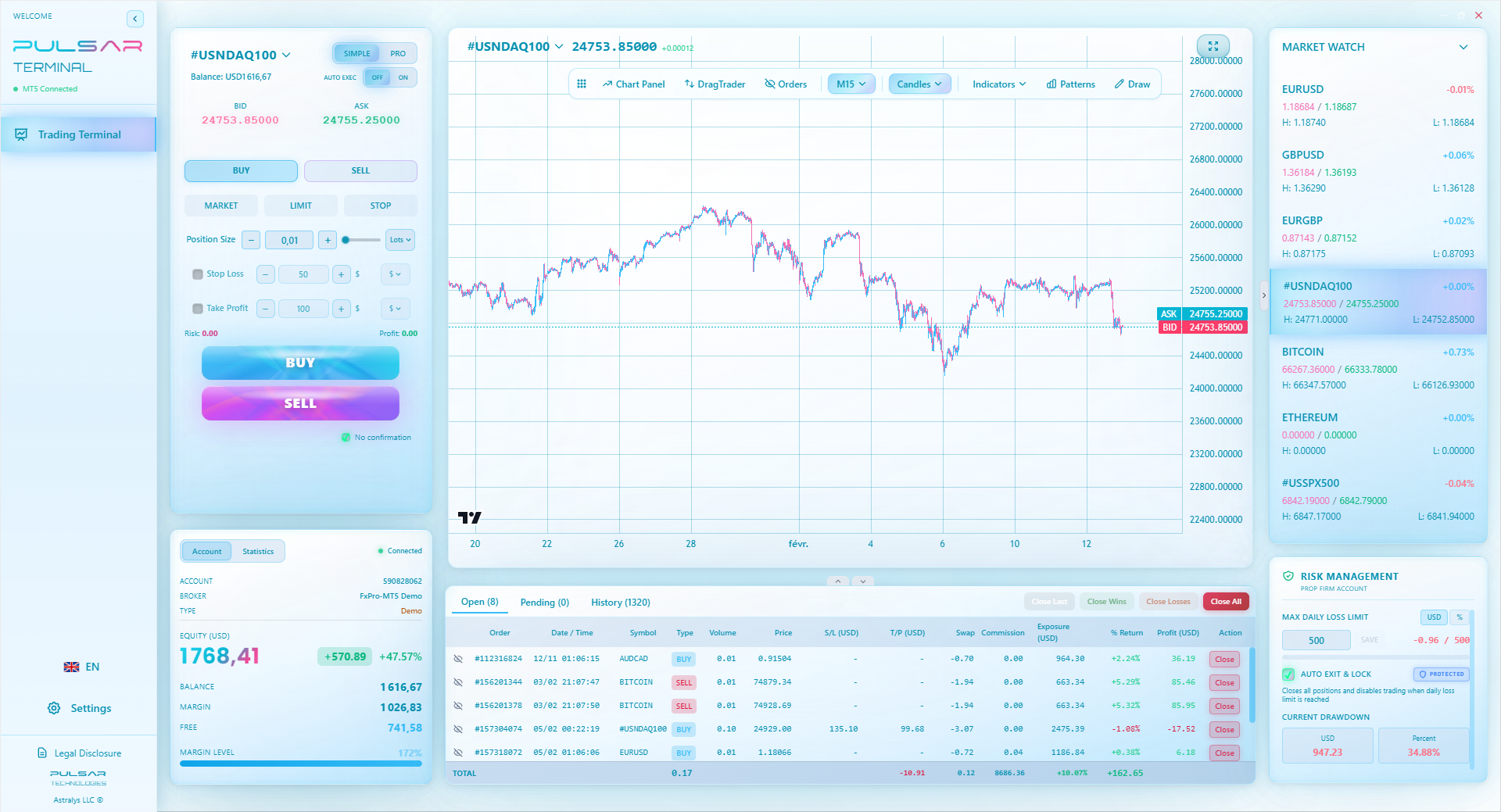
Managing multiple trades and precise stop losses is critical, and a tool like Pulsar Terminal automates this directly on your MT5 platform, letting you set trailing stops and partial closures with a single click.
Pulsar Terminal
Hepsi bir arada MT5 aracı: sürükle-bırak emirler, çoklu TP/SL, trailing stop, grid trading, Volume Profile ve prop firm koruması. Her gün 1.000'den fazla trader tarafından kullanılıyor.
“Your goal for the first 6 months is not to get rich. Your goal is to not lose money.”
This is the most important section. You can have the best strategy in the world, but without proper risk management, you will fail.
The 1% Rule: Never, ever risk more than 1% of your trading account capital on a single trade. If you have a ₦100,000 account, your maximum loss per trade should be ₦1,000. Use a position size calculator religiously. This single rule would save 50% of failing traders overnight.
Psychology is Everything:
- Fear of Missing Out (FOMO): You see a pair rocketing up, you jump in late near the top, and it reverses. I've done it countless times. The market will always present another opportunity.
- Revenge Trading: You take a loss, get angry, and immediately enter another trade to "win it back." This is how you blow accounts. After a loss, walk away. Close the platform.
- Overconfidence: A few winning trades doesn't make you a genius. It's a marathon. Increase your position size slowly, only after consistent profits over months.
Record Everything: Keep a trading journal. Note the pair, entry/exit, reason for the trade, and, most importantly, your emotional state. You'll start to see your own destructive patterns. My journal showed I lost 80% of my trades entered after 10 PM Lagos time. I was tired and impulsive. I now have a hard rule: no trades after 9 PM.
“A losing trade where you followed your plan is better than a winning trade where you didn't.”
Let's get you started on the right foot.
A Safe Launch Plan:
- Education First: Spend a month on a demo account. Not a week, a month. Trade through different market conditions. Our guides on XAU/USD or the MACD indicator are good places to start learning.
- Choose a Regulated Broker: From the list above, pick one with strong regulation and good Naira deposit options. Open a live account with the minimum deposit.
- Trade Micro Lots: Start with 0.01 lots. Your goal for the first 6 months is not to get rich. Your goal is to not lose money. Preserve capital.
- Implement the 1% Rule: From your very first trade. Make it a non-negotiable habit.
Red Flags – Nigerian Scam Specials:
- "Signals gurus" promising 100% weekly returns. If they could do that, they wouldn't be selling signals for ₦5,000 a month.
- Brokers with only a "contact us" address and no visible regulation.
- Account managers who pressure you to deposit more to "recover losses." A legitimate broker never calls you to trade.
- "Prop Firms" that are just dressed-up bonus schemes with impossible rules. If it sounds too good to be true, it is.
The path is simple but not easy. Learn continuously, manage risk obsessively, and keep your emotions in check. The 89% are losing because they won't do these boring, disciplined things. Be in the 11%.
💡 Winston'ın İpucu
If you can't explain your trade setup in one simple sentence ('buying the pullback to the 200 EMA in an uptrend'), you don't have a setup. You have a hope. Complexity is the enemy of execution.
FAQ
Q1Is CFD forex trading legal in Nigeria?
Yes, it is legal for individuals to trade. The new ISA 2025 law targets unregistered trading platforms, not individual traders. You are allowed to use internationally regulated brokers.
Q2How much tax do I pay on forex trading profits in Nigeria?
You pay a 10% Capital Gains Tax (CGT) on your net profits from CFD forex trading. You are responsible for declaring this to the Federal Inland Revenue Service (FIRS) and paying the tax owed.
Q3What is a good broker for beginners in Nigeria?
Q4Why do most CFD forex traders lose money?
The primary reasons are excessive use of use, lack of a disciplined trading plan, poor risk management (not using stop losses), and emotional trading (like revenge trading). Most lose because they treat it like gambling, not a skilled profession.
Q5What use should I use as a beginner?
Use the lowest use your broker offers, or self-impose a limit of no more than 1:10 or 1:20. High use (1:500, 1:1000) dramatically increases risk and is the fastest way to lose your entire deposit. Focus on learning, not amplifying gains.
Q6Can I trade with the Nigerian Naira (NGN)?
Some brokers, like HFM, offer NGN-denominated trading accounts. However, most global forex pairs are quoted in USD. You'll typically deposit Naira, it gets converted, and you trade USD-based pairs. Always check the conversion fees.
Q7What's the single most important tip for a new trader?
Risk management. Before you even think about a trade strategy, master the 1% rule. Never risk more than 1% of your account on a single trade. This is the discipline that separates survivors from the 89% who blow up their accounts.
Prof. Winston'ın Dersi
Önemli Noktalar:
- ✓Risk only 1% of capital per trade. No exceptions.
- ✓ISA 2025 targets platforms, but your 10% CGT obligation is real.
- ✓Prioritize broker safety (FCA/ASIC) over flashy use offers.
- ✓Master one simple setup before adding complexity.
Bu makale ne kadar faydalıydı?
Bir yıldıza tıklayın
Haftalık Trading Analizleri
Ücretsiz haftalık analiz ve stratejiler. Spam yok.
Yazar hakkında
Olumide Adeyemi
Batı Afrika Yatırım Öncüsü
Nijerya'nın en aktif forex eğitmenlerinden biri. Lagos'tan 8 yıllık ticaret deneyimi. Afrika'lı trader'lar için düşük sermaye stratejileri ve prop firma yarışmaları uzmanı.
Yorumlar
Risk Uyarısı
Finansal araçlarla işlem yapmak önemli riskler taşır ve tüm yatırımcılar için uygun olmayabilir. Geçmiş performans gelecekteki sonuçları garanti etmez. Bu içerik yalnızca eğitim amaçlıdır ve yatırım tavsiyesi olarak değerlendirilmemelidir. İşlem yapmadan önce her zaman kendi araştırmanızı yapın.
Bunları da beğenebilirsiniz

Cara Trading Forex Sukses: 7 Prinsip dari Trader Profesional
Cara trading forex sukses dengan 7 prinsip trader pro: manajemen modal, disiplin, journal trading, backtest. Data nyata, bukan janji profit palsu.
Jam Trading Forex Terbaik untuk Trader Indonesia: Panduan Lengkap dengan Tabel Waktu
Panduan jam trading forex untuk trader Indonesia. Tabel 4 sesi dunia, jam emas 20:00-00:00, sesi mana yang harus dihindari. Data akurat + tips dari trader berpengalaman.
Top 5 Sàn Forex Uy Tín Nhất 2026: Review Jujur dari Trader Indonesia
Top 5 sàn forex uy tín 2026 untuk trader Indonesia. Review jujur: spread, deposit, withdraw, dukungan lokal. Exness, XM, IC Markets & lebih.
Pulsar Terminal'ı Edinin
Tüm bu hesaplayıcılar MT5 hesabınızdan gerçek zamanlı verilerle Pulsar Terminal'e entegredir.
Pulsar Terminal'ı Edinin