


Here's a fact that will ruin your day: if you're trading a standard lot on EUR/USD with a 2-pip spread, you're down $20 the second you click 'buy'.

Olumide Adeyemi
Batı Afrika Yatırım Öncüsü ·  Nigeria
☕ 10 dk okuma
Neler öğreneceksiniz:
Here's a fact that will ruin your day: if you're trading a standard lot on EUR/USD with a 2-pip spread, you're down $20 the second you click 'buy'. That's not a market move. That's the broker's cut, taken straight from your balance before the trade even starts. Most traders in Lagos and Abuja fixate on charts and indicators, completely blind to the mechanics of the bid-ask spread. They're fighting a war where the battlefield itself charges a toll every time you take a step. Let's break down this fundamental, and frankly predatory, cost of doing business.
Every single forex quote you see is actually two prices, not one. It's the core difference between bid and ask price in forex. The bid price is what the market (or your broker) is willing to pay you for the currency pair. If you're selling EUR/USD, you sell at the bid. The ask price (sometimes called the offer) is the price you must pay to buy the currency pair. You buy at the ask.
Think of it like a bureau de change on Allen Avenue in Ikeja. They have a board: "Buying USD/NGN at 1500, Selling USD/NGN at 1520." If you walk in with dollars to sell for naira, you get their 'buy' rate (the bid). If you want to buy dollars with naira, you pay their 'sell' rate (the ask). The forex market works the same, just electronically and at lightning speed.
The immediate problem? The ask is always higher than the bid. That gap is the broker's profit, called the spread. Your trade is in a hole from the very first second. I learned this the hard way in 2015, scalping GBP/JPY. I'd nail the direction, price would move 5 pips in my favor, and my account would barely budge. I was trading against a 7-pip spread on a volatile pair, a classic mistake for a scalping strategy. I was basically working for my broker.

Warning: Never look at just the 'price' on your chart. Your platform shows either the bid or the mid-price. Your actual entry is always at the less favorable of the two (ask for buy, bid for sell). This is the number one reason demo accounts feel easier - they often simulate tighter spreads.
Let's move from theory to your bank account. The spread isn't a percentage; it's measured in pips. One pip is typically 0.0001 for most pairs like EUR/USD. But the cost in your local currency is what matters.
The Cost in Cash
Here’s a simple formula: Spread Cost = Spread in Pips × Pip Value × Lot Size.
Let's say you're trading USD/NGN (which many Nigerian brokers offer as a CFD). Assume:
- Spread: 50 NGN (yes, it can be that wide on exotics)
- You buy 1 standard lot (100,000 units)
- Pip Value for USD/NGN: For a 100,000 unit trade, a 1 NGN move = 100,000 NGN. So 1 pip (0.01 NGN?) Let's simplify with a real example.
Actually, let's use a major pair where the math is clearer. You trade 0.1 lots (10,000 units) of EUR/USD with Pepperstone.
- Spread: 0.7 pips (a good raw spread account)
- Pip Value for 0.1 lots: $1
- Your immediate cost: 0.7 pips × $1 = $0.70
Now convert that to Naira at 1500/$: ~₦1,050 gone instantly. For a 1-lot trade, that's ₦10,500. That's not a "fee," it's a direct loss baked into your entry. Use our position size calculator to see this in real-time for your trades.
Comparing Broker Spreads
Spreads vary wildly. A broker like Exness might show super tight spreads on EUR/USD (0.1 pips) during London hours, but that's often on a zero-commission account where they make money elsewhere. IC Markets and Pepperstone offer raw spreads but charge a commission per lot. You must add the commission to the spread to get the true cost.
| Broker Model | EUR/USD Spread | Commission per 1 Lot (Round Turn) | Total Entry Cost for 1 Lot |
|---|---|---|---|
| Wide Spread, No Commission | 1.5 pips | $0 | $15 (₦22,500) |
| Raw Spread + Commission | 0.2 pips | $7 | $7 + $2 = $9 (₦13,500) |
The "raw spread" account is cheaper in this example. But you have to do this math for your typical trade size. For nano lots (0.01), the wide-spread account might be simpler, even if more expensive per pip.

💡 Winston'ın İpucu
Your first profit target should always be greater than the spread. If it's not, you're just donating to your broker's Christmas party fund.
“You're fighting a war where the battlefield itself charges a toll every time you take a step.”
The spread on your screen isn't fixed. It's a live animal, and it bites hardest when you're most vulnerable. This is where traders get slaughtered.
Major Economic News: When US Non-Farm Payrolls or ECB rate decisions hit, the spread on EUR/USD can blow out from 0.7 pips to 20, 30, even 50 pips in a millisecond. I got caught in this in 2020. I had a buy limit order placed 5 pips above the market on GBP/USD before a CPI release. The news hit, my order filled, and the spread was 18 pips. I was down $180 on a 1-lot trade before the chart even started moving. The trade eventually went my way, but the massive spread ate over half the profit.
Illiquid Sessions & Exotic Pairs: Trading USD/NGN or EUR/NGN? These are exotic pairs. Their spreads are permanently wide (often 50-100 pips) because there aren't enough buyers and sellers. Trading them intraday is a spread-paying exercise. Similarly, trading AUD/USD during the Asian session is calmer, but the spread is often wider than during London overlap.
The Stop Loss Trap: This is critical. Your stop loss is triggered at the bid price for a long trade. If the market gaps down or the spread widens violently, your stop can be executed at a far worse price than you set - a phenomenon called slippage. That 'guaranteed' stop loss isn't always guaranteed unless you pay for that specific feature, which again, widens your spread. Understanding your margin call level is tied to this; a widening spread can eat your usable margin faster than the chart price moving.

Pro Tip: Never hold trades over major news events unless you're consciously speculating on volatility. Close them before the announcement. The spread is a tax on uncertainty, and news is peak uncertainty.
You can't avoid the spread, but you can stop letting it rob you. Your entire strategy must account for it.
Strategy Selection
Scalping: This is a spread-paying job. If your strategy aims for 5-10 pip profits, a 2-pip spread means the market has to move 2 pips just for you to break even. You need exceptionally tight spreads and a high win rate. Most Nigerian retail traders fail at scalping for this exact reason.
Swing Trading: This is where you can make the spread irrelevant. If you're aiming for 150-pip moves on XAU/USD (gold), a 50-cent (5-pip) spread is just a 3% entry cost on your target. It becomes a minor factor. Swing trading frameworks naturally overcome the spread's friction.
Pair Selection
Stick to major and minor pairs (EUR/USD, GBP/USD, USD/JPY, AUD/USD). Avoid exotics (USD/NGN, USD/ZAR, USD/TRY) unless you have a very long-term view. The spread on EUR/USD might be 0.7 pips. On USD/TRY, it could be 300 pips. You're fighting an impossible battle.
Order Types
Market Orders: You accept the current spread. Simple, but expensive at volatile times. Limit Orders: You set the price you want. If buying, you set a limit at the bid price or lower. This lets you get the spread instead of paying it. But there's no guarantee it will fill. I use limit orders for 80% of my entries now, patiently waiting for price to come to me. It requires more discipline, but it turns the spread from a cost into a potential reward.
Check the typical spreads for your chosen pair on your broker's site. XM and others publish average spread tables. Don't trust the "from 0.0 pips" marketing. Look at the average during the session you trade.
💡 Winston'ın İpucu
If you can't easily state the spread cost in Naira for your standard trade size, you're not ready to place that trade. Know your overhead.
“A difference of 0.5 pips, over hundreds of trades, is the difference between profitability and blowing up.”
When comparing brokers in Nigeria, everyone looks at use and bonuses. You should be obsessing over the spread and its structure.
ECN/STP Brokers (Raw Spread + Commission): Brokers like IC Markets or Pepperstone pass you directly to liquidity providers. You see the raw interbank spread (e.g., 0.1 pips on EUR/USD) but pay a commission (e.g., $7 per 100k lot round turn). This is usually cheaper for larger volumes. The spread is stable and tight, especially during high liquidity. This is what I use for my main account.
Market Maker Brokers (Wider Spread, No Commission): The broker is the counterparty to your trade. They quote you a spread that includes their profit. It's simpler (no separate commission) but often more expensive overall. Spreads can widen dramatically during news. Some are reputable, but understand the conflict of interest.
The Nigerian Reality: You must ensure the broker is accessible - deposits and withdrawals in naira, local bank support. Then, drill into the spread. Open a demo account and watch the spread on the pairs you trade:
- Check it at 3 AM WAT (Asian session).
- Check it at 10 AM WAT (London session).
- Check it during a simulated news event.
That demo data is more valuable than any promotional material. The spread is the single biggest determinant of your trading cost over time. A difference of 0.5 pips on your usual lot size, over hundreds of trades, is the difference between profitability and blowing up.

Example: Trader A pays 1.5 pip average spread. Trader B pays 0.8 pips. Both make 100 trades of 0.1 lots per month. Trader A pays an extra 0.7 pips per trade. 100 trades * 0.7 pips * $1 pip value = $70 extra cost monthly. That's ₦105,000 a year thrown away for the same trades.
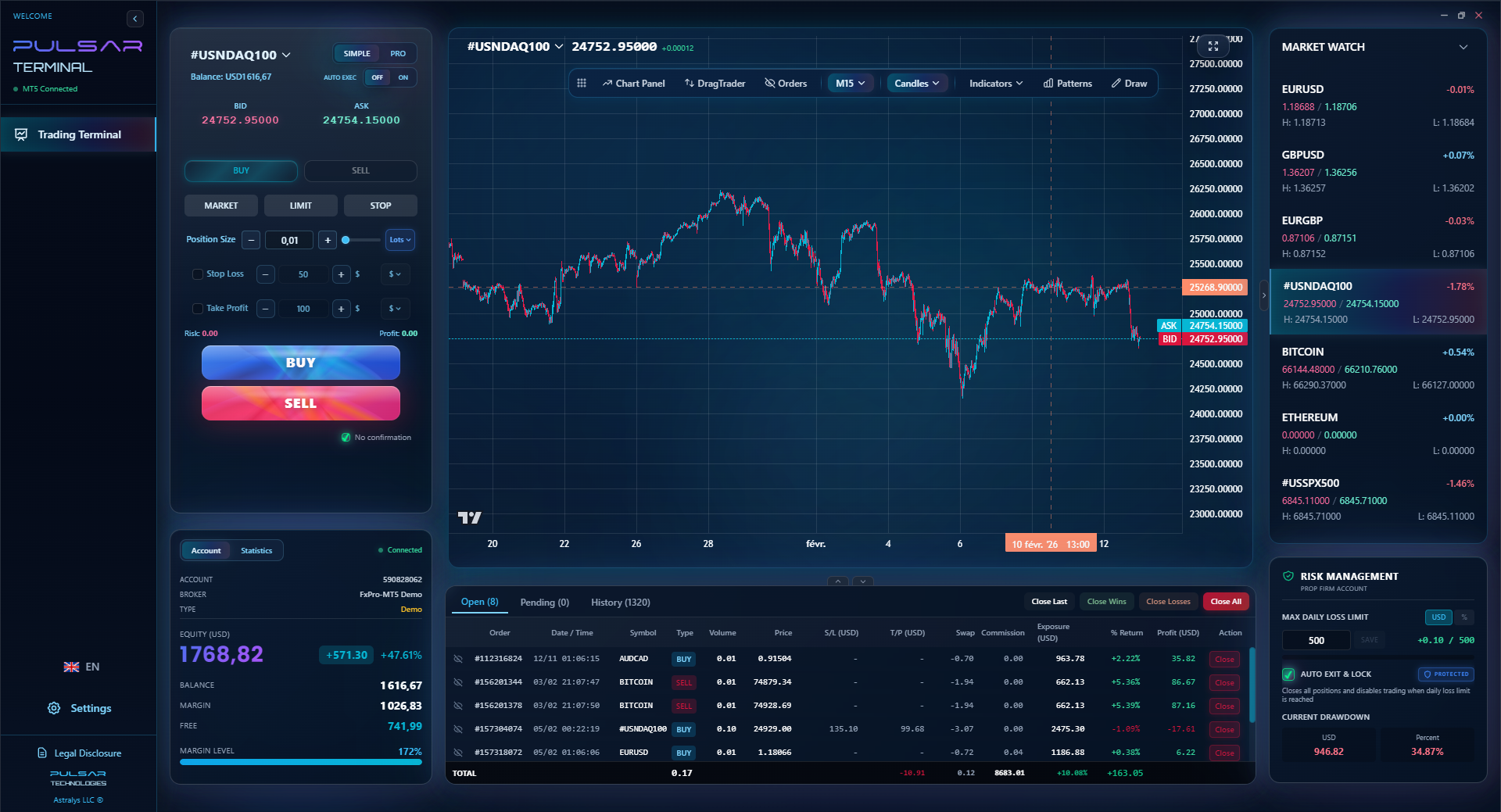
Manually calculating your true breakeven price after the spread for every trade is tedious and error-prone; Pulsar Terminal automates this, displaying it directly on your MT5 chart so you always see your real P&L.
Pulsar Terminal
Hepsi bir arada MT5 aracı: sürükle-bırak emirler, çoklu TP/SL, trailing stop, grid trading, Volume Profile ve prop firm koruması. Her gün 1.000'den fazla trader tarafından kullanılıyor.
The final step is psychological. You must internalize that the spread is a real, tangible loss. It's not a 'fee,' it's the first move against your position.
When you analyze a potential trade, your first question shouldn't be "Where's my target?" It should be "Is my target far enough away to cover the spread and still make a worthwhile profit?"
I keep a simple note on my monitor: "Breakeven = Entry + Spread." If I buy EUR/USD at 1.0850 (ask) with a 1-pip spread, my true breakeven price is not 1.0850. It's 1.0851 (the bid price needs to rise to my entry ask). The market has to move a full pip in my favor just for me to be back at zero.
This changes your risk-reward calculations dramatically. A 1:2 risk-reward ratio where you risk 10 pips to make 20 is actually risk 10 pips to make 20 minus the spread. If the spread is 2 pips, your reward is effectively 18 pips. Your ratio is now 1:1.8. It erodes your edge.
Tools that show your true breakeven line on the chart are useful. This is why I rely on trading software that integrates this reality directly into the platform, so I'm never guessing. Managing multiple trades without this clarity is a fast track to death by a thousand cuts. You think you're slightly up on three trades, but after accounting for the spread you're actually down. It warps your perception.
Adopt this mindset, and you'll start seeing the market not as a place to be right, but as a business with real overheads. The spread is your rent, your light bill, your data cost. You wouldn't open a shop in Lekki without knowing your rent. Don't trade a single pip without knowing your spread.
💡 Winston'ın İpucu
The most honest broker comparison isn't on their homepage; it's the spread on your charts at 2 AM on a Wednesday. Test liquidity when it's scarce.
FAQ
Q1What is the difference between bid and ask price in simple terms?
The bid is the price you get when you sell. The ask is the price you pay when you buy. The ask is always higher. The gap between them is the spread, which is the broker's profit and your immediate cost.
Q2How does the spread affect my profit as a Nigerian trader?
It reduces every single profit you make. If you buy a pair, the price must move above the ask price by at least the spread amount before you start making money. On a 1-lot trade with a 2-pip spread, you start ₦3,000 in the hole (at 1500 NGN/$). It directly lowers your effective risk-reward ratio.
Q3Which forex pairs have the lowest spreads for Nigerians to trade?
Major pairs like EUR/USD, GBP/USD, and USD/JPY consistently have the lowest spreads (often under 1 pip on good accounts). Avoid exotic pairs like USD/NGN or USD/ZAR, as their spreads can be 50-100 pips or more, making short-term trading nearly impossible.
Q4Can I avoid paying the spread?
Not completely. It's the cost of entering the market. However, you can minimize its impact by using limit orders (trying to fill at the bid price when buying), trading during high-liquidity sessions (London/New York overlap), and choosing an ECN broker with a raw spread + commission model, which is often cheaper overall.
Q5Why did my stop loss execute at a worse price than I set?
Stop losses are market orders. If the market gaps or the spread widens suddenly (like during news), your stop loss triggers at the next available bid price, which could be much lower than your set price. This is called slippage. The widening spread is a major cause of this.
Q6Is a 'zero spread' account really zero spread?
No. 'Zero spread' usually means no marked-up spread, but the broker charges a higher commission per trade. You still pay to trade. Sometimes, during low liquidity, even these accounts can show a small spread. Always calculate the total cost (spread + commission) per lot.
Q7How do I calculate the spread cost in Naira?
- Find the spread in pips (e.g., 1.5). 2. Find the pip value for your lot size (e.g., $10 for 1 standard lot). 3. Multiply: 1.5 pips * $10 = $15 cost. 4. Convert to Naira: $15 * 1500 = ₦22,500. This is lost from your balance the moment you enter the trade.
Prof. Winston'ın Dersi
Önemli Noktalar:
- ✓The ask price is always higher than the bid - you buy high, sell low instantly.
- ✓A 2-pip spread on a 1-lot trade costs you $20 (≈₦30k) immediately.
- ✓Spreads explode during news, turning stop losses into traps.
- ✓Swing trading makes the spread irrelevant; scalping makes it your enemy.
- ✓Choose brokers based on real spread data, not advertised use.
Bu makale ne kadar faydalıydı?
Bir yıldıza tıklayın
Haftalık Trading Analizleri
Ücretsiz haftalık analiz ve stratejiler. Spam yok.
Yazar hakkında
Olumide Adeyemi
Batı Afrika Yatırım Öncüsü
Nijerya'nın en aktif forex eğitmenlerinden biri. Lagos'tan 8 yıllık ticaret deneyimi. Afrika'lı trader'lar için düşük sermaye stratejileri ve prop firma yarışmaları uzmanı.
Yorumlar
Risk Uyarısı
Finansal araçlarla işlem yapmak önemli riskler taşır ve tüm yatırımcılar için uygun olmayabilir. Geçmiş performans gelecekteki sonuçları garanti etmez. Bu içerik yalnızca eğitim amaçlıdır ve yatırım tavsiyesi olarak değerlendirilmemelidir. İşlem yapmadan önce her zaman kendi araştırmanızı yapın.
Bunları da beğenebilirsiniz

Cara Trading Forex Sukses: 7 Prinsip dari Trader Profesional
Cara trading forex sukses dengan 7 prinsip trader pro: manajemen modal, disiplin, journal trading, backtest. Data nyata, bukan janji profit palsu.
Jam Trading Forex Terbaik untuk Trader Indonesia: Panduan Lengkap dengan Tabel Waktu
Panduan jam trading forex untuk trader Indonesia. Tabel 4 sesi dunia, jam emas 20:00-00:00, sesi mana yang harus dihindari. Data akurat + tips dari trader berpengalaman.
Top 5 Sàn Forex Uy Tín Nhất 2026: Review Jujur dari Trader Indonesia
Top 5 sàn forex uy tín 2026 untuk trader Indonesia. Review jujur: spread, deposit, withdraw, dukungan lokal. Exness, XM, IC Markets & lebih.
Pulsar Terminal'ı Edinin
Tüm bu hesaplayıcılar MT5 hesabınızdan gerçek zamanlı verilerle Pulsar Terminal'e entegredir.
Pulsar Terminal'ı Edinin