


I lost $1,200 in about 90 seconds back in 2015.

Olumide Adeyemi
Batı Afrika Yatırım Öncüsü ·  Nigeria
☕ 11 dk okuma
Neler öğreneceksiniz:
I lost $1,200 in about 90 seconds back in 2015. I was short on GBP/JPY, thinking a pullback was due after a strong run. The Bank of Japan made an off-schedule statement, yen pairs went berserk, and my stop-loss got blown through like it wasn't even there. The spread widened to 15 pips in a heartbeat. That's the reality of trading the fastest moving forex pairs. It's not just about potential profit, it's about surviving the ride. If you're looking for sleepy, predictable action, look elsewhere. This is where traders get rich or get wrecked.
Forget fancy jargon. A 'fast' pair simply moves more pips per day on average than others. It's about raw distance traveled on the chart, not just speed of execution. This volatility is the engine for big wins (and losses).
Three main ingredients create this speed: liquidity, economic sensitivity, and trading sessions.
Liquidity and the 'Majors'
You'd think the most liquid pairs, like EUR/USD, would be the fastest. Not exactly. High liquidity often means smoother, more controlled movement. It's a busy highway with traffic rules. The real speed demons often involve less liquid, more 'exotic' currencies that can gap or spike violently when big orders hit a thin market.
The News Catalyst
Pairs tied to commodity prices (AUD, CAD, NZD) or sentiment-driven currencies (JPY, CHF) are news magnets. A surprise oil inventory report can send USD/CAD flying 80 pips in minutes. A shift in risk sentiment can hammer AUD/JPY. These pairs don't just react to news, they overreact. That's where the speed comes from.
Session Overlaps
The London-New York overlap (1 PM to 5 PM WAT) is when volume peaks. More volume means bigger players moving bigger money, which can accelerate trends and breakouts on all pairs, but especially on cross-pairs like EUR/GBP or GBP/CHF.

Warning: High speed often comes with wider, more variable spreads. Your broker's quoted spread on EUR/USD might be 0.8 pips, but on GBP/JPY during news, it can balloon to 8-10 pips. That's a huge extra cost you have to overcome just to break even. Always check typical spreads before you trade a volatile pair. You can compare brokers like Exness and IC Markets for their average spreads on these pairs.
My failed GBP/JPY trade taught me this the hard way. I entered based on technicals but ignored the macroeconomic calendar. The pair was a coiled spring, and I provided the liquidity for someone else's profitable exit.
“Trading the fastest pairs isn't just about potential profit, it's about surviving the ride.”
These are the liquid, commonly traded pairs that still pack a serious punch in terms of daily range. You can trade these with most brokers without crazy spreads (under normal conditions).
| Pair | Avg. Daily Range (Pips) | Why It's Fast | Key Driver |
|---|---|---|---|
| GBP/JPY | 140-180 | The 'Dragon' or 'Beast'. Combines a volatile pound with a safe-haven yen. | UK politics, BoJ policy, global risk sentiment. |
| GBP/USD | 100-140 | The 'Cable'. Reacts fiercely to UK and US data/politics. | Brexit fallout (still), BoE vs. Fed policy divergence. |
| EUR/JPY | 90-130 | Another classic yen cross. Slightly tamer than GBP/JPY but still wild. | ECB policy, Asian market risk flows. |
| USD/JPY | 70-110 | The most liquid yen pair. Moves on US-Japan yield differentials. | US Treasury yields, BoJ interventions. |
| EUR/USD | 60-90 | The most traded pair. Has its fast days, but generally more orderly. | Macro ECB/Fed speeches, US GDP, inflation data. |
GBP/JPY is the undisputed king here. I've seen it move 300 pips in a day without a major crisis, just on a cocktail of medium-importance news. A successful scalping strategy on this pair requires iron discipline because a 20-pip profit can reverse into a 40-pip loss in the time it takes to blink.

Example: Let's say you trade a standard lot (100,000 units) on GBP/JPY. A 150-pip daily move equals a $1,250 price change (approx.). That's the potential playground - or battlefield - you're operating in. Always use a position size calculator to manage your risk per trade on these pairs.
EUR/USD might seem slow in comparison, but don't be fooled. During a Fed announcement, it can easily put in a 70-pip candle. For a deeper look at trading it, check our EUR/USD guide.

💡 Winston'ın İpucu
The 'speed' of a pair is meaningless without context. A 100-pip move on GBP/JPY (price ~180.00) is a 0.55% change. A 100-pip move on USD/JPY (price ~150.00) is a 0.67% change. Always think in percentages, not just pips.
“GBP/JPY is the undisputed king of volatility among the majors. I've seen it move 300 pips in a day without a major crisis.”
This is where things get seriously fast and dangerous. These pairs are less liquid, which means when they move, they can do so in sharp, unpredictable jumps.
AUD/JPY and NZD/JPY: These are the premier 'risk barometers'. When global traders are feeling good, they buy these (funding with cheap JPY). When panic hits, they sell them fast. The moves are explosive. I once caught a long ride on AUD/JPY during a China stimulus rumor, banking 85 pips in under an hour. The week before, I'd been stopped out on the same pair for a 50-pip loss on a false breakout.
USD/TRY (US Dollar/Turkish Lira): An exotic that's in a league of its own. It doesn't just move fast, it trends for months with insane volatility driven by unorthodox local monetary policy. Spreads are huge, and gaps are common. This is not for the faint of heart or the undercapitalized.
GBP/AUD and GBP/CAD: These cross-pairs remove the USD. They become hyper-focused on the relative economic stories of the two countries. UK inflation data vs. Australian iron ore prices? That's the kind of matchup that drives these. They can trend beautifully but are prone to sharp reversals.
Trading these requires a broker with reliable execution during volatility. I've had better experiences with platforms like Pepperstone on these pairs during news events, as their Raw spreads tend to hold up better than standard accounts elsewhere.
“GBP/JPY is the undisputed king of volatility among the majors. I've seen it move 300 pips in a day without a major crisis.”
You don't trade the fastest moving forex pairs the same way you trade EUR/CHF on a quiet Tuesday. Your approach must adapt.
News Trading (The High-Stakes Game)
This is about capitalizing on the immediate spike after a data release (like US NFP or CPI). The key is to have orders already in the market (buys above, sells below the current price) or be ready to click the moment the number hits.
My experience: I used to try to 'read' the news and trade manually. I failed more than I succeeded. The slippage was a killer. Now, if I news trade, I use pending orders well away from the price, accepting I'll only catch a monster move. It's a low-probability, high-reward play.
Breakout Trading
Volatile pairs love to break out of consolidations. The trick is filtering false breaks. A break of a 50-pip range on GBP/JPY with increasing volume (tick volume on MT4/5) is more trustworthy than a tiny wiggle.

Pro Tip: On fast pairs, widen your breakout filters. Instead of entering as soon as price touches a trendline, wait for a 15-20 pip break and a close (5-minute or 15-minute candle) beyond the level. It saves you from countless whipsaws, even if you miss the very first pip of the move.
Momentum Pullbacks
This is my preferred method. Wait for the pair to establish a strong, fast directional move (a big green or red candle sequence). Then, wait for it to pull back to a short-term moving average (like the 20 EMA) or a 38.2% Fib level. Enter in the direction of the initial momentum. The MACD indicator can help confirm if momentum is still present on the pullback.
Crucially, your stop-loss must be placed beyond the recent swing low/high that defined the pullback. On these pairs, a tight stop will get hunted and taken out. You need to give the trade room to breathe, which means trading smaller position sizes. This is where swing trading principles can be applied to shorter timeframes.
💡 Winston'ın İpucu
If you find yourself constantly adjusting stop-losses on a fast pair because they're 'too tight,' your position size is too large. Reduce the lot size, place a sensible, wider stop, and let the trade breathe. Your blood pressure will thank you.
“High use on a fast pair is a shortcut to a margin call.”
This is the only chapter that matters if you want to survive. Trading fast pairs without these rules is financial suicide.
- Smaller Position Sizes: Because your stop-losses are necessarily wider (to avoid noise), you must reduce your lot size to keep your dollar risk per trade the same. If you risk 1% per trade on EUR/USD with a 30-pip stop, you might need a 60-pip stop on GBP/JPY. Halve your lot size to maintain that 1% risk.
- Avoid Major News: Unless news trading is your specific strategy, be flat 5 minutes before and 15 minutes after high-impact news events (red calendar news). The volatility is chaotic and spreads widen. It's a casino, not a trading environment.
- Use Trailing Stops: Once a trade moves 1.5x to 2x your initial risk in your favor, consider moving your stop to breakeven. Then, trail it. Letting a 100-pip winner on GBP/JPY reverse into a loss is a special kind of pain. A trailing stop automates locking in profits.
- Beware of Gaps: These pairs can gap open on Sundays or after news. If you're holding over the weekend, you're accepting that risk. Your stop-loss becomes a 'limit' order, and you could be filled far away from your intended price.
- Know Your Margin: Fast moves against you can lead to a margin call quicker than you can say 'volatility'. Use a fraction of your available margin. If your broker offers 500:1 use, use 20:1.
I learned rule #1 after a costly lesson on USD/JPY. I used my standard EUR/USD lot size with a tight stop. Price spiked 25 pips against me on a random headline, took my stop, and then immediately raced 100 pips in my original direction. I was right on the direction, but my position sizing and stop placement were dead wrong.
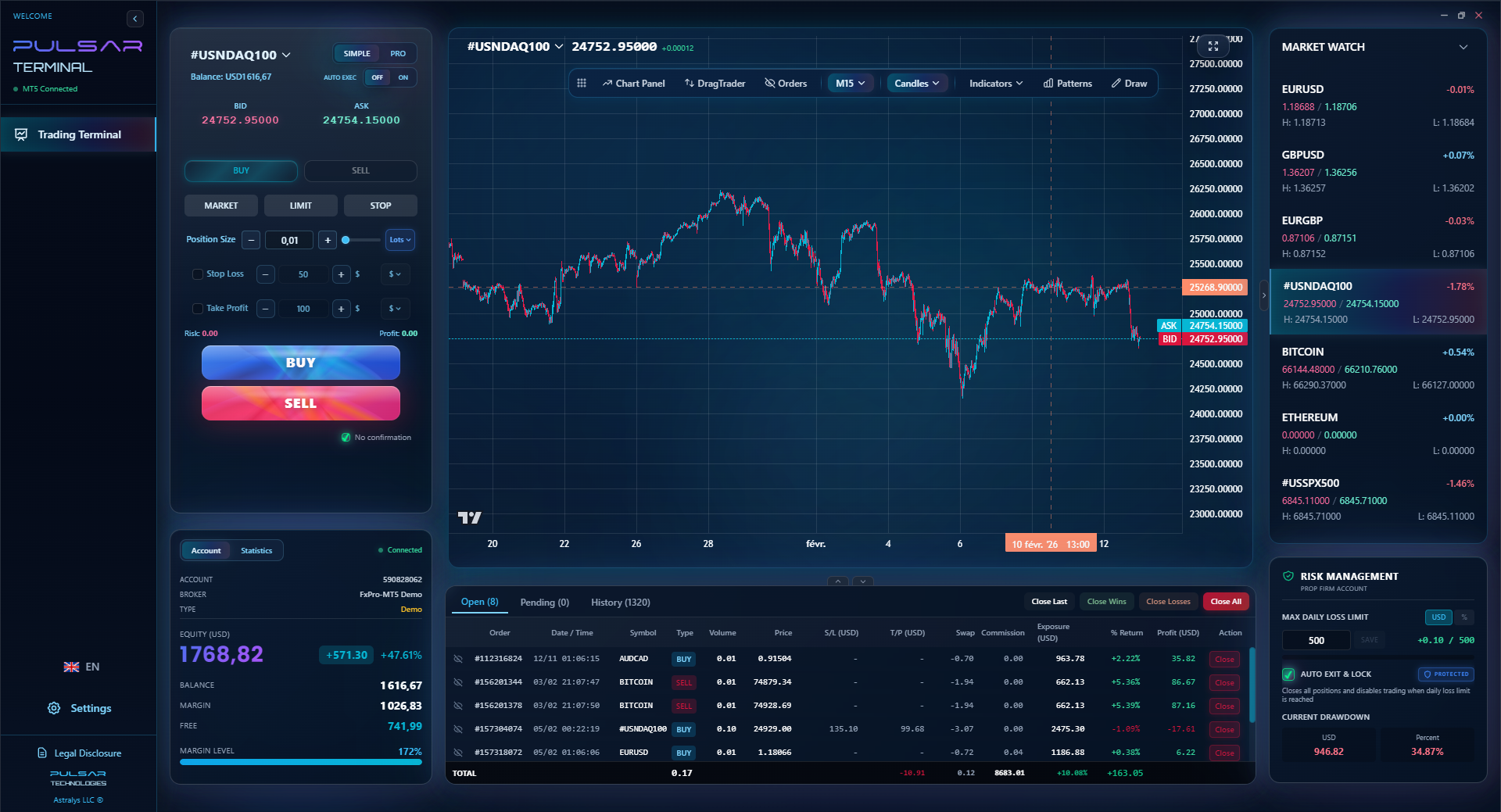
Managing multiple trades and complex exits on volatile pairs is stressful, but tools like Pulsar Terminal automate trailing stops, breakeven moves, and multi-level take-profits directly on your MT5 chart.
Pulsar Terminal
Hepsi bir arada MT5 aracı: sürükle-bırak emirler, çoklu TP/SL, trailing stop, grid trading, Volume Profile ve prop firm koruması. Her gün 1.000'den fazla trader tarafından kullanılıyor.
“High use on a fast pair is a shortcut to a margin call.”
Not all platforms are built for speed. You need a broker that can handle it.
Execution Speed & Spreads: Look for brokers with 'Raw' or 'ECN' accounts that offer tight, variable spreads. Fixed spreads often widen dramatically on fast pairs anyway, so you might as well get the tighter average spread of a Raw account. Check reviews for how they perform during news. XM review often highlights their news trading conditions, for instance.
Platform Stability: MT4/5 is standard, but ensure it's stable. A platform crash during a volatile move is a nightmare.
Advanced Order Types: You need more than just market and limit orders. You need:
- Trailing Stops: To lock in profits on runaway trends.
- Stop-Limit Orders: A variation where your stop becomes a limit order, giving you more price control when getting out.
- One-Cancels-the-Other (OCO): To place both a profit target and a stop-loss simultaneously, where if one triggers, the other cancels.
Technical tools become critical. The RSI indicator can show overbought/oversold conditions during a powerful trend (though it can stay extreme for a long time on these pairs). Volume indicators, while not showing true forex volume, can show tick activity to confirm breakouts.
, the best tool is your own discipline. The charts will scream at you to chase moves or panic out of positions. Having a pre-defined plan for entry, exit, and risk is what separates the consistent trader from the gambler.
💡 Winston'ın İpucu
The best trades on volatile pairs often feel the worst at entry. The ideal entry point is usually during a counter-trend pullback when fear is high. Chasing the initial spike is how amateurs get burned.
“The profit potential is real. But so are the 5-minute, 80-pip drawdowns that can wipe out a week of careful gains.”
Trading the fastest moving forex pairs is like driving a high-performance sports car. It's thrilling, powerful, and can get you to your destination quickly. But it demands respect, skill, and constant attention. One moment of distraction and you're in the wall.
The profit potential is real. The 150+ pip days on GBP/JPY are real. But so are the 5-minute, 80-pip drawdowns that can wipe out a week of careful gains.
Start slow. Paper trade them first. Then move to a live account with tiny, almost insignificant position sizes. Get a feel for the rhythm - the way they consolidate, then explode. Learn where your emotional breaking point is when a trade moves 50 pips against you in seconds.
Use the strategies and risk rules here as your foundation. They're written from my scars and my successes. The fastest pairs aren't for everyone, but for the trader who masters volatility management, they offer a dynamic and potentially rewarding arena that the slower majors simply can't match. Now, go look at a GBP/JPY chart. See that movement? That's not noise. That's opportunity - and risk - singing a duet. Your job is to decide when to dance.
FAQ
Q1What is the absolute fastest forex pair to trade?
GBP/JPY is consistently the fastest among the major and minor pairs, with average daily ranges often exceeding 140 pips. For extreme volatility, exotics like USD/TRY or ZAR pairs can be faster but come with massive spreads and liquidity risks that make them unsuitable for most traders.
Q2Are fast-moving pairs good for beginners?
Generally, no. They are terrible for beginners. The speed amplifies every mistake - overtrading, poor risk management, emotional decisions. Beginners should cut their teeth on a more stable pair like EUR/USD or USD/CHF to learn the basics of order execution and risk without getting chewed up in minutes.
Q3How many pips per day is considered a 'fast' move?
It's relative, but as a rule of thumb, a pair averaging over 100 pips per day (like GBP/JPY, GBP/USD) is considered fast. The standard EUR/USD averages 60-90. A move of 70+ pips in a single hour on any major pair would also be considered a fast-moving period.
Q4Should I use higher use on volatile pairs?
Absolutely not. This is a critical mistake. You should use lower effective use. Because your stop-losses need to be wider to account for volatility, you must reduce your lot size to keep your risk per trade constant. High use on a fast pair is a shortcut to a margin call.
Q5What time of day are forex pairs most volatile?
The London-New York session overlap (1:00 PM to 5:00 PM WAT / West Africa Time) is typically the most volatile period. Also, the first hour of the London open (8:00 AM WAT) and the first hour of the US open (1:30 PM WAT) often see increased movement, especially on pairs involving those currencies.
Q6Can I use scalping strategies on fast pairs?
Yes, but it's advanced. Scalping fast pairs requires a broker with razor-thin spreads, instant execution, and your total focus. A 5-pip target can be hit quickly, but a 10-pip stop-loss can be taken out just as fast. You need a high win rate and impeccable discipline. See our guide on a scalping strategy for more.
Q7Do fast-moving pairs have higher spreads?
Yes, almost universally. The spread (the difference between buy and sell price) is the cost of trading, and it compensates the broker/market for the higher risk of holding a volatile asset. Expect spreads on GBP/JPY to be 2-4 times wider than on EUR/USD, and they can expand dramatically during news events.
Prof. Winston'ın Dersi
Önemli Noktalar:
- ✓GBP/JPY averages 140-180 pips daily range.
- ✓Wider stops require smaller position sizes.
- ✓Avoid trading 5 mins before/after high-impact news.
- ✓Use trailing stops to lock in profits on trends.
- ✓Speed requires ECN brokers with tight spreads.
Bu makale ne kadar faydalıydı?
Bir yıldıza tıklayın
Haftalık Trading Analizleri
Ücretsiz haftalık analiz ve stratejiler. Spam yok.
Yazar hakkında
Olumide Adeyemi
Batı Afrika Yatırım Öncüsü
Nijerya'nın en aktif forex eğitmenlerinden biri. Lagos'tan 8 yıllık ticaret deneyimi. Afrika'lı trader'lar için düşük sermaye stratejileri ve prop firma yarışmaları uzmanı.
Yorumlar
Risk Uyarısı
Finansal araçlarla işlem yapmak önemli riskler taşır ve tüm yatırımcılar için uygun olmayabilir. Geçmiş performans gelecekteki sonuçları garanti etmez. Bu içerik yalnızca eğitim amaçlıdır ve yatırım tavsiyesi olarak değerlendirilmemelidir. İşlem yapmadan önce her zaman kendi araştırmanızı yapın.
Bunları da beğenebilirsiniz

Cara Trading Forex Sukses: 7 Prinsip dari Trader Profesional
Cara trading forex sukses dengan 7 prinsip trader pro: manajemen modal, disiplin, journal trading, backtest. Data nyata, bukan janji profit palsu.
Jam Trading Forex Terbaik untuk Trader Indonesia: Panduan Lengkap dengan Tabel Waktu
Panduan jam trading forex untuk trader Indonesia. Tabel 4 sesi dunia, jam emas 20:00-00:00, sesi mana yang harus dihindari. Data akurat + tips dari trader berpengalaman.
Top 5 Sàn Forex Uy Tín Nhất 2026: Review Jujur dari Trader Indonesia
Top 5 sàn forex uy tín 2026 untuk trader Indonesia. Review jujur: spread, deposit, withdraw, dukungan lokal. Exness, XM, IC Markets & lebih.
Pulsar Terminal'ı Edinin
Tüm bu hesaplayıcılar MT5 hesabınızdan gerçek zamanlı verilerle Pulsar Terminal'e entegredir.
Pulsar Terminal'ı Edinin