


If you're using FNB for your forex trading, you're probably losing money without even realizing it.

David van der Merwe
Gelişen Piyasalar Yatırımcısı ·  South Africa
☕ 10 dk okuma
Neler öğreneceksiniz:
- 1What FNB Forex Actually Is (And Isn't)
- 2The Real Costs: Where Your Money Actually Goes
- 324/5 Global Market vs. 9-to-5 Bank Hours
- 4Why a Regulated Forex Broker Beats Your Bank Every Time
- 5Okay, So When DOES Using FNB Forex Make Sense?
- 6Your Practical Game Plan as a South African Trader
- 7Mistakes I Made (So You Don't Have To)
If you're using FNB for your forex trading, you're probably losing money without even realizing it. It's a harsh truth, but one I learned the expensive way early in my career. Most traders get fixated on FNB forex working hours (08:00 to 17:00 on weekdays, 08:00 to 12:00 on Saturdays for their contact centre), completely missing the bigger picture. This guide isn't just about when you can call them. I'm going to show you why their entire model is designed for people moving money abroad, not for active traders trying to make a profit in the 24-hour global market. I'll prove it with their own fee structures and share exactly what you should be doing instead.
Let's clear this up first. When you hear "FNB forex," you're not talking about a trading platform like MetaTrader. You're talking about a banking service. FNB acts as an Authorised Dealer for the South African Reserve Bank (SARB). Their primary job is to help you, a South African resident, send money overseas or bring it back in, all within SARB's strict exchange control rules.
Their services include international wire transfers, buying foreign cash for travel, and maintaining Foreign Currency Accounts (FCAs). The FNB Banking App lets you buy/sell currencies for these purposes. It's a utility. It's not built for catching a 20-pip move on the EUR/USD during the London open while you're still in bed.
I made this mistake back in 2015. I tried to "trade" by constantly buying and selling USD via my FNB app to send to an overseas account. The spreads were massive, the fees ate every tiny gain, and the delay was painful. I lost about R2,500 in fees and poor rates before I realized I was using a wrench to hammer a nail. FNB's system is for moving value. A dedicated forex broker's platform is for creating value through speculation. They are fundamentally different tools.

Warning: Don't confuse FNB's currency exchange service with active forex trading. One is for compliance and transfers, the other is for speculation and profit. Mixing them up is an expensive lesson.

💡 Winston'ın İpucu
Your bank is for saving and spending. Your broker is for trading. Confusing the two is the first, and most expensive, mistake a new trader makes.
This is where the rubber meets the road. FNB's fees are structured for occasional, large transfers, not frequent trading. Let's break down the numbers that matter.
Transfer Fees: The Obvious Cost
For international transfers online, you'll pay 0.55% commission on amounts over R10,000, with a minimum of R275 and a cap of R550. Need to do it over the phone? That minimum jumps to R550. If you're receiving money from overseas, it's another 0.55% (min R175). Just to move money in and out, you're already down over 1% before you've even placed a trade.
The Hidden Killer: The Exchange Rate Margin
This is the big one. FNB doesn't give you the interbank rate you see on TradingView. They add a margin, typically between 1% and 4%. Let's say you want to convert R100,000 to USD. The real rate is 18.50 ZAR/USD. With a 2% margin, FNB might give you 18.87. That's an instant R2,000 loss on paper before any fee. For major currencies like USD, EUR, and GBP, the margin is tighter (closer to 1-1.5%), but it's still a huge handicap for trading.

Example: Converting R100,000 to USD at a 2% margin. Interbank Rate: 18.50 ZAR/USD = $5,405.41 FNB Rate (18.87 ZAR/USD) = $5,299.39 Instant Loss: R1,961.54 (or $106.02)
Compare this to a broker like IC Markets, where the spread on EUR/USD can be as low as 0.0 pips with a small commission. On a standard lot (100,000 units), a 1-pip spread costs you about $10. FNB's margin on the same notional value would cost you hundreds of dollars. The math doesn't lie.
The "Free" Account That Isn't Free
Yes, opening and maintaining an FNB Foreign Currency Account has no monthly fee. But the cost is baked into the terrible exchange rate you get every time you fund it from your ZAR account. There's no free lunch.
“FNB's forex service is for moving value. A broker's platform is for creating value through speculation.”
This is the core conflict. The forex market sleeps for about 48 hours from Friday night New York close to Sunday evening Sydney open. That's it. It runs 24 hours a day, five days a week. The most volatile, liquid, and profitable sessions often happen when FNB's forex desk is closed.
In South African time (SAST), here’s when the action happens:
- Asian Session (Tokyo): Kicks off around 2:00 AM. Can be slow, but sets the tone.
- London Session: Overlaps from around 10:00 AM to 7:00 PM SAST. This is where volume really picks up.
- London/New York Overlap: The golden hours. From about 2:00 PM to 6:00 PM SAST. This is when you get the biggest moves, the cleanest trends, and the best opportunities for strategies like scalping or swing trading.
- New York Session: Continues until around 11:00 PM SAST.
FNB's dedicated forex contact centre hours? 8 AM to 5 PM weekdays, 8 AM to 12 PM Saturday. You completely miss the New York afternoon volatility and any major news events that hit after 5 PM our time. I remember the Swiss Franc shock in 2015 happened around 11:30 AM SAST. If you had a position with a bank that you couldn't adjust instantly online, you were wiped out. With a real broker, you could at least try to react.
Trading isn't a day job. It's a global opportunity that doesn't care about your timezone. Relying on a service with limited hours means you're leaving money on the table or, worse, holding unmanaged risk overnight.
For active trading, a broker licensed by the Financial Sector Conduct Authority (FSCA) is the only sane choice. Here’s the head-to-head.
| Feature | FNB (Banking Service) | FSCA-Regulated Forex Broker (e.g., Pepperstone) |
|---|---|---|
| Primary Purpose | International Payments & SARB Compliance | Speculative Trading & Investment |
| Access Hours | Limited business hours for support. | Market access 24/5. Support often 24/5. |
| Cost Structure | % Commissions (0.55%) + Large Exchange Rate Margins (1-4%) | Tight Spreads (often <1 pip on majors) +/or small commission per lot. |
| Execution Speed | Slow (bank processing times). | Instant or near-instant execution. |
| Platform | Basic banking app for transactions. | MT4/MT5, cTrader with charts, indicators, automated trading. |
| use | Not offered for speculation. | Up to 30:1 for retail clients (FSCA limit). |
| Risk Management | Basic. | Real-time stop-loss, take-profit, trailing stops orders. |
A broker gives you direct market access. You see the live price, you click, and you're in. You can set a stop-loss order that will protect you if the market gaps against you overnight. You can use a position size calculator to manage your risk precisely. You can analyze the XAU/USD pair with the MACD indicator on the same screen you place trades.
The FSCA's 30:1 use cap protects you from the insane 500:1 offers of the past, but it's still a powerful tool when used responsibly. At a bank, you're trading with your own capital at 1:1. The efficiency and control a proper broker provides are simply non-negotiable for serious trading.
💡 Winston'ın İpucu
If your trading strategy can't survive the 1-4% transaction cost a bank charges, it's not a strategy. It's a gamble. Real trading costs are measured in fractions of a percent.
“The golden hours for trading are from 2 PM to 6 PM SAST, when FNB's forex desk is thinking about going home.”
I'm not saying burn your FNB card. Their forex services are excellent for their intended purpose. You should use FNB when:
- You need to send money overseas: Paying for studies, supporting family, or buying property abroad. They handle the SARB compliance (like using your R1 million discretionary allowance or R10 million foreign investment allowance) seamlessly.
- You're traveling and need foreign cash: Ordering Euros or USD through the app for pickup is convenient.
- You receive foreign income: Like royalties or freelance payments, and need to bring it into South Africa. They'll handle the conversion and the recent 2024/2025 SARB reporting rules for you.
- You want to hold foreign currency long-term: Parking USD in an FCA as a hedge against rand volatility is a smart use of their free account structure.
Think of FNB as your gateway for moving money across borders in a compliant way. Think of your forex broker as your tool for profiting from the movement of currency prices themselves. They are complementary services for different needs.
Based on everything we've covered, here's what I recommend you do. This is the setup that took me from losing with FNB to becoming consistently profitable.
Step 1: Separate Your Banking and Trading. Keep your main bank account (FNB, Standard, etc.) for your salary, bills, and savings. Open an account with a reputable, FSCA-licensed broker like Exness or XM for South African residents. Fund your trading account with capital you can afford to lose.
Step 2: Fund Your Broker Account Efficiently. This is the only touchpoint with your bank. Use a local EFT (ZAR) to deposit into your broker's South African entity. The better brokers have local partnerships so your money never leaves the country initially, avoiding international transfer fees. You'll then trade in USD or EUR pairs on their platform.
Step 3: Trade the Market, Not the Clock. Forget FNB forex working hours. Structure your trading around market sessions. If you have a day job, the London/New York overlap (2 PM - 6 PM SAST) is perfect for evening analysis and trade setup. Use limit orders to enter trades even when you're not watching the screen.
Step 4: Withdraw Profits Smartly. When you take profits, withdraw ZAR back to your local bank account via the broker's local EFT process. Declare the profits to SARS as taxable income. It's straightforward. Trying to shuttle profits through multiple international transfers via FNB will see them vanish in fees.

Pro Tip: Start by trading just one or two major pairs like EUR/USD. Learn their personality. Use a demo account to practice your strategy across different session times before risking real money. The goal is to make the market's 24-hour cycle work for you, not against you.
💡 Winston'ın İpucu
The market's most profitable hours (2-6 PM SAST) are when bank forex desks are winding down. Your edge comes from operating when they're closed.
“Using a bank for active trading is like trying to win Formula 1 in a family sedan.”
Let me be brutally honest about my own errors. It'll save you time and cash.
Pitfall 1: Chasing News with a Bank Account. When the US Non-Farm Payrolls data hits at 3:30 PM SAST, the market can move 50 pips in seconds. I once tried to "buy the rumor" by placing a currency order with FNB ahead of time. The order took 20 minutes to process, I got a terrible rate, and by the time it went through, the news was over and the trend reversed. I lost R800 in minutes on a move I correctly predicted. With a broker, I would have been in and out with a profit in under a minute.
Pitfall 2: Ignoring the Total Cost. I looked at the 0.55% fee and thought "that's not bad." I completely ignored the 2% margin on the exchange rate. My first "successful" trade of converting ZAR to GBP and back a week later netted me a 3% gain on the rate... but after the margin on both conversions and the fees, I actually lost 1.5%. I was paying to play.
Pitfall 3: No Risk Management. Banks don't offer trailing stops or breakeven functions. If a trade went in my favor, I had to manually watch it and call to close. I'd often get greedy, watch it reverse, and end up giving back all the paper gains. A proper trading platform automates this. Managing risk is 80% of the game, and FNB's forex service gives you zero tools for it.
The bottom line? Using a bank for active trading is like trying to win Formula 1 in a family sedan. The engine, brakes, and tires just aren't built for it, no matter how skilled the driver.
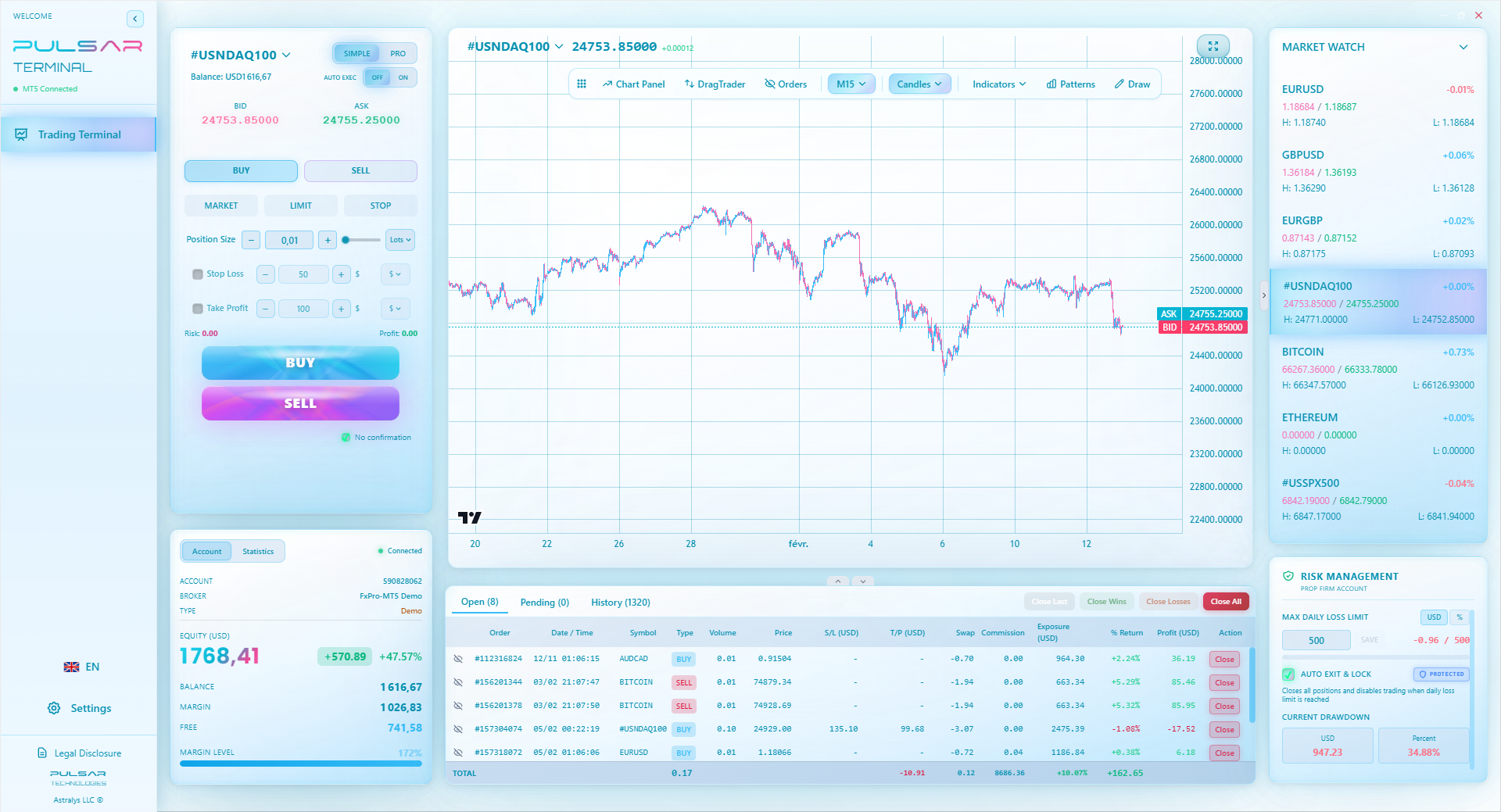
Managing risk in a 24-hour market is impossible manually; tools like Pulsar Terminal automate trailing stops and breakeven orders directly on your MT5 platform, so you can sleep while your trades are protected.
Pulsar Terminal
Hepsi bir arada MT5 aracı: sürükle-bırak emirler, çoklu TP/SL, trailing stop, grid trading, Volume Profile ve prop firm koruması. Her gün 1.000'den fazla trader tarafından kullanılıyor.
FAQ
Q1Can I trade forex directly through the FNB app?
Not in the way a trader means. You can buy and sell foreign currencies for transfer or travel purposes, but you cannot speculate on price movements with use, use advanced order types like stop-losses, or trade on live charts. It's an exchange service, not a trading platform.
Q2What are the exact FNB forex contact centre working hours?
Their dedicated forex contact centre is open Monday to Friday from 08:00 to 17:00, and on Saturdays from 08:00 to 12:00. For general forex inquiries, you can call 0860 1 FOREX (36739) from 07:45 to 16:15 on weekdays. Remember, the global market is open 24/5.
Q3Is it illegal to use an international forex broker as a South African?
No, it's perfectly legal. However, it is highly recommended to use a broker that is licensed by the South African Financial Sector Conduct Authority (FSCA). This ensures they comply with local laws, including the 30:1 use cap for retail clients, and gives you a local recourse if something goes wrong.
Q4How are my forex trading profits taxed in South Africa?
Profits from forex trading are considered taxable income by SARS. You must declare them on your annual tax return. It's your responsibility to keep accurate records of all your trades, profits, and losses. Losses can often be offset against other income, but consult with a tax professional familiar with trading.
Q5What's the single biggest disadvantage of using a bank for trading?
The cost structure. The combination of fixed percentage commissions (0.55%) and the hidden exchange rate margin (1-4%) creates a massive hurdle you have to overcome just to break even. In a market where professional traders fight for small percentage gains, starting 2% in the hole is a nearly impossible strategy.
Q6Can I use my FNB Foreign Currency Account (FCA) to trade?
No, an FCA is just a holding account for foreign currency. It's like a USD savings account. You cannot attach use to it or execute trades from it. It's useful for holding foreign currency you've purchased, but not for active speculation.
Prof. Winston'ın Dersi
Önemli Noktalar:
- ✓FNB's 0.55% fee + 1-4% margin creates a 2%+ trading hurdle.
- ✓The market is 24/5; bank support is 8-5 weekdays.
- ✓Use FNB for SARB-compliant transfers, not speculation.
- ✓An FSCA broker offers real-time execution & risk tools.
Bu makale ne kadar faydalıydı?
Bir yıldıza tıklayın
Haftalık Trading Analizleri
Ücretsiz haftalık analiz ve stratejiler. Spam yok.
Yazar hakkında
David van der Merwe
Gelişen Piyasalar Yatırımcısı
Johannesburg merkezli, gelişmekte olan piyasa dövizlerinde 11 yıllık deneyime sahip trader. ZAR pariteleri, FSCA düzenlemeli ticaret ve Güney Afrika piyasa analizi uzmanı.
Yorumlar
Risk Uyarısı
Finansal araçlarla işlem yapmak önemli riskler taşır ve tüm yatırımcılar için uygun olmayabilir. Geçmiş performans gelecekteki sonuçları garanti etmez. Bu içerik yalnızca eğitim amaçlıdır ve yatırım tavsiyesi olarak değerlendirilmemelidir. İşlem yapmadan önce her zaman kendi araştırmanızı yapın.
Bunları da beğenebilirsiniz

Cara Trading Forex Sukses: 7 Prinsip dari Trader Profesional
Cara trading forex sukses dengan 7 prinsip trader pro: manajemen modal, disiplin, journal trading, backtest. Data nyata, bukan janji profit palsu.
Jam Trading Forex Terbaik untuk Trader Indonesia: Panduan Lengkap dengan Tabel Waktu
Panduan jam trading forex untuk trader Indonesia. Tabel 4 sesi dunia, jam emas 20:00-00:00, sesi mana yang harus dihindari. Data akurat + tips dari trader berpengalaman.
Top 5 Sàn Forex Uy Tín Nhất 2026: Review Jujur dari Trader Indonesia
Top 5 sàn forex uy tín 2026 untuk trader Indonesia. Review jujur: spread, deposit, withdraw, dukungan lokal. Exness, XM, IC Markets & lebih.
Pulsar Terminal'ı Edinin
Tüm bu hesaplayıcılar MT5 hesabınızdan gerçek zamanlı verilerle Pulsar Terminal'e entegredir.
Pulsar Terminal'ı Edinin