


I lost R8,000 in a single afternoon.

David van der Merwe
Gelişen Piyasalar Yatırımcısı ·  South Africa
☕ 10 dk okuma
Neler öğreneceksiniz:
- 1What Are Forex Algorithms, Really?
- 2Why the South African Market is Different
- 3Getting Started: The Path to Building Your Own
- 4The Pitfalls That Will Burn You (And How to Avoid Them)
- 5Tools, Platforms, and Costs for South Africans
- 6Non-Negotiable: Baking Risk Management Into the Code
- 7The Psychological Shift: From Trader to Systems Manager
I lost R8,000 in a single afternoon. Not to a bad trade, but to a forex algorithm I bought online. It was supposed to be a 'set-and-forget' goldmine for USD/ZAR. Instead, it placed 47 trades in two hours during low liquidity, racking up spreads and slippage until my account was gutted. That painful lesson in 2021 taught me that algorithms aren't magic. They're tools, and in the South African market, you need to know exactly how to handle them. This guide is what I wish I'd had before I hit that buy button.
Let's cut through the marketing hype. A forex algorithm, often called an Expert Advisor (EA) on MetaTrader, is just a set of instructions your trading platform follows. It says: "If X happens, then do Y." For example, "If the price crosses above the 50-period moving average and the RSI indicator is above 30, buy."
They come in three main flavours. First, there are the ones you buy or download for free. These are almost always garbage, designed to look good in backtests but fail with real money. Second, you have custom-built algorithms, where you hire a programmer to code your specific strategy. This is better, but expensive. Third, and this is where most successful algo traders end up, you learn to build your own. It's not as hard as you think, especially with modern tools.
The biggest myth? That they remove emotion. They do, but they replace it with a different danger: blind obedience. An algorithm doesn't know a major SARB announcement is due. It will just keep trading, which is how you get wiped out. Your job isn't to find a robot to replace you. It's to build a tool that executes your plan with perfect discipline, while you manage the risks it can't see.

Warning: Be extremely wary of any algorithm sold with promises of guaranteed returns or minimal drawdown. If it was that good, why would anyone sell it for R2,000? They'd just use it with their own capital.

💡 Winston'ın İpucu
An algorithm is only as smart as the person who programmed its rules. If you don't have a profitable manual strategy, automation will just help you lose money faster and more efficiently.
Trading algorithms built for EUR/USD often fail miserably on our local pairs. Here’s why you can't just copy and paste.
Liquidity and Spreads
The ZAR pairs - USD/ZAR, EUR/ZAR, GBP/ZAR - are less liquid than majors like EUR/USD. This means wider spreads and more potential for slippage, especially around the JSE open (9:00 AM) and close (5:00 PM), and during local news. An algorithm that assumes a 1-pip spread will self-destruct when the USD/ZAR spread widens to 50 pips during a volatile political headline. You must build spread buffers into your logic. I once had a scalping strategy EA trigger a buy on USD/ZAR, but by the time the order filled, the spread had eaten the entire profit target. It was a lesson in hard numbers.
Local News and SARB Impact
South African-specific events - budget speeches, CPI data, SARB interest rate decisions, Eskom updates - cause massive, sharp moves. A standard volatility filter might not catch these. Your algorithm needs a local calendar or, more practically, you need to know when to turn it off. I learned this after an algorithm held a short USD/ZAR trade through a surprise SARB rate hike in 2022. The resulting 300-pip spike against me triggered a margin call. Now, I simply disable all automated trading 30 minutes before major local news.
Broker Specifics
You must use an FSCA-regulated broker that properly supports EAs. I've had good, reliable execution for algorithms with Exness and IC Markets from South Africa. Check their policy on ‘minimum distance from market’ for stops and limits. Some local brokers have terrible requotes during fast markets, which can stall or break an EA. Test in a demo account first during our peak volatility times.
“Your algorithm's primary job isn't to make money. Its primary job is to not blow up your account.”
Forget buying a ‘black box.’ The only sustainable path is to develop your own edge and then automate it. Here’s a realistic roadmap.
- Master a Manual Strategy First: You cannot automate what you don't understand. Spend at least 6 months profitably trading a strategy manually. Is it a swing trading approach based on support/resistance? A trend-following method using the MACD indicator? Document every rule: entry, exit, stop loss, position size. My first successful algo was just my manual breakout strategy coded up.
- Learn the Basics of MQL5: This is the coding language for MetaTrader 5. You don't need to be a software engineer. There are countless tutorials and you can often modify existing ‘template’ code. Start by automating just your entry signal, then add the stop loss and take profit rules. Use a position size calculator formula within your code to manage risk consistently.
- Backtest, Then Forward Test: MT5's Strategy Tester lets you backtest. But be skeptical. Optimize for robustness, not for highest profit. Then, run it on a demo account for at least 2-3 months (forward testing). This is where you see how it handles real spreads and execution.
- Start Small with Real Money: When you go live, start with a tenth of your intended capital. The psychological weight is different, even for an algorithm. Monitor it like a hawk for the first 100 trades.

Pro Tip: When backtesting, always use ‘every tick based on real ticks’ mode and factor in a realistic average spread for your chosen pair (e.g., add 8 pips for USD/ZAR). This kills most over-optimised, ‘curve-fitted’ strategies immediately.
I've made these mistakes so you don't have to.
Over-optimisation (Curve-Fitting): This is the #1 killer. You tweak your algorithm's parameters until it makes a fortune on past data. It becomes a perfect historian and a terrible prophet. Avoidance: Use out-of-sample data. Test your optimized parameters on a period of market data it hasn't ‘seen.’ If performance collapses, you've curve-fitted.
Ignoring Costs: Every trade costs the spread. On USD/ZAR, that can be 5-10 pips. An algorithm that aims for 15-pip profits is mostly just paying the broker. Avoidance: Your average profit target must be at least 2.5x the average spread. Always deduct spread costs in your backtest.
No ‘Circuit Breaker’ Logic: What happens if the internet drops? If the broker's server lags? If there's a flash crash? Your EA needs a daily loss limit (e.g., stop all trading if down 3% in a day) and a timeout function. I didn't have this early on, and a runaway EA turned a R1,500 loss into a R5,000 loss before I could manually intervene.
Set-and-Forget Fantasy: The dream of launching an EA and checking back in a year is dangerous. You must review performance weekly. Is drawdown within expectations? Has market volatility changed, making the strategy obsolete? I schedule a Sunday evening review without fail.
A simple table to keep you honest:
| Pitfall | What Happens | The Fix |
|---|---|---|
| Over-optimisation | Great backtest, live failure. | Test on unseen data. Use strong parameters. |
| Ignoring ZAR Spreads | Profits eaten by costs. | Target > 2.5x avg spread. Buffer orders. |
| No Risk Limits | A bad run destroys your account. | Code in daily/weekly loss limits. |
| Neglect | Strategy decays without you noticing. | Weekly performance review. |
💡 Winston'ın İpucu
The South African Rand's volatility isn't a bug, it's a feature. Design your algorithms to expect wide spreads and sharp moves, not to fear them. Use wider stops and fewer, higher-quality signals.
“Free algorithms are rarely profitable in live markets. They are a great way to lose money while learning a harsh lesson.”
Let's talk about the practical setup and what it will cost you in Rands.
The Platform: MetaTrader 5 (MT5) is the standard. It's free with your broker account, and its MQL5 language has the largest community and library of resources. Some brokers like Pepperstone also offer cTrader, which is excellent, but the algo environment is smaller.
Development Costs: If you code it yourself, the cost is just your time. Hiring a programmer on a site like MQL5.com will cost anywhere from R1,500 to R15,000+ for a complex, multi-strategy EA. Always agree on a detailed specification document first.
Running Costs: Your main cost is the spread. There's also potential ‘swap’ or overnight financing charges, which can be significant on ZAR pairs. Some brokers offer premium data feeds for lower latency, but as a retail trader, this is rarely necessary or cost-effective.
VPS (Virtual Private Server): If you want your EA to run 24/5 without using your home PC and internet, you rent a VPS. Good ones near the broker's server (often in London or Amsterdam) cost about $20-$30 per month (R350-R550). Many brokers, including XM, offer a free VPS if you maintain a certain account balance.
My current setup costs me roughly R500 per month: R350 for a reliable VPS and about R150 in average spread costs beyond what I'd pay manually. I consider it a worthwhile fee for perfect, emotion-free execution of my EUR/USD and XAU/USD strategies.
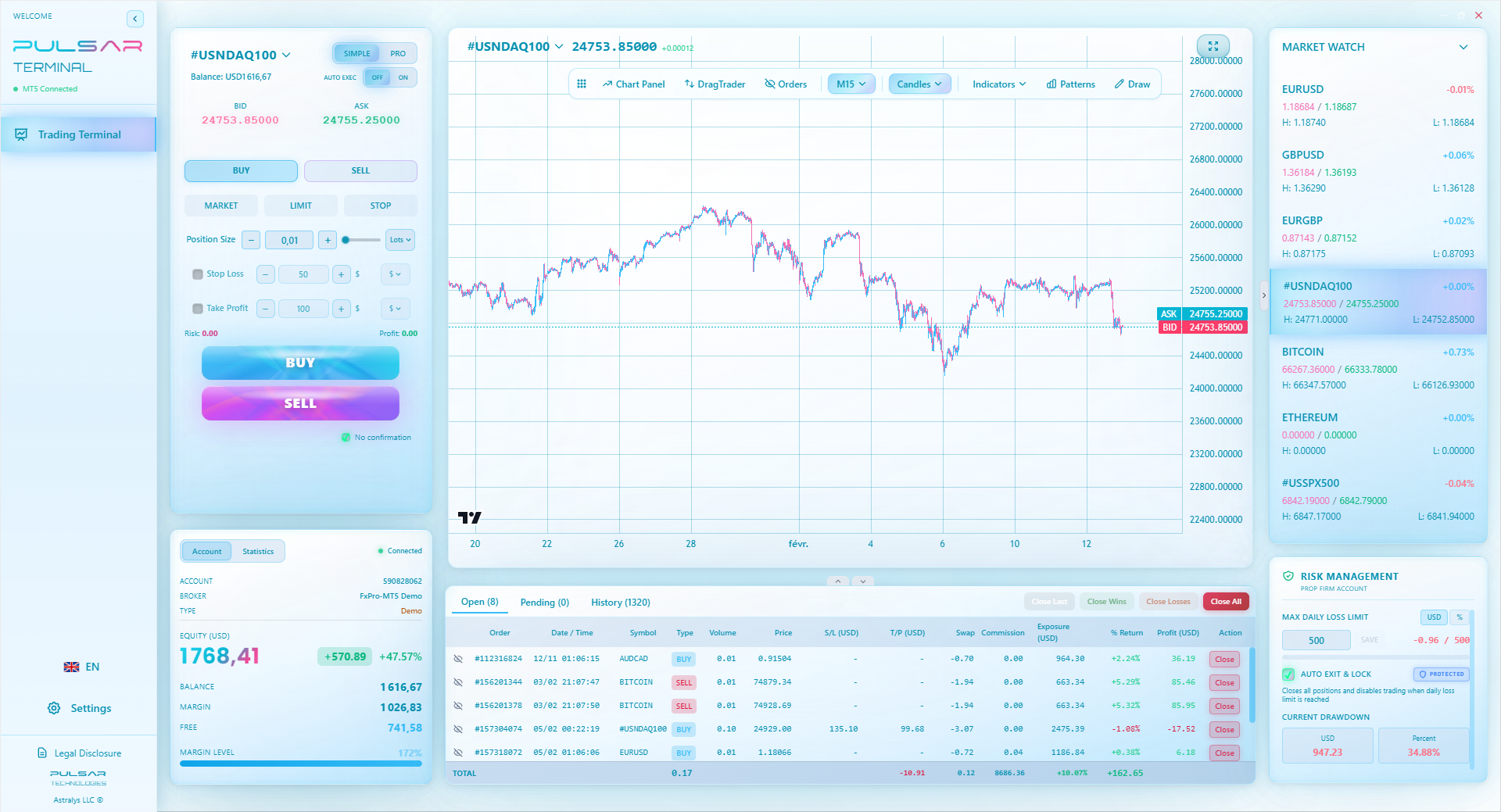
Managing multiple algorithmic trades and their complex exit strategies is far easier with a tool like Pulsar Terminal, which lets you set multi-level take profits and trailing stops directly on your MT5 charts.
Pulsar Terminal
Hepsi bir arada MT5 aracı: sürükle-bırak emirler, çoklu TP/SL, trailing stop, grid trading, Volume Profile ve prop firm koruması. Her gün 1.000'den fazla trader tarafından kullanılıyor.
Your algorithm's primary job isn't to make money. Its primary job is to not blow up your account. Risk management isn't something you do separately; it must be the core of the code.
Position Sizing: This is rule number one. Your EA must calculate every trade size based on a fixed percentage of your current equity or balance, and the distance to your stop loss. Never use a fixed lot size. I code all my EAs to risk a maximum of 0.5% of my account balance on any single trade. This is done using a position size calculator formula directly in MQL5.
Correlation Limits: If you run multiple algorithms, you must prevent them from overexposing you to one currency. Code in a rule that stops new USD/ZAR trades if total exposure across all EAs exceeds a certain level.
Drawdown Limits: The most important safety feature. My EAs are programmed to:
- Stop trading for the day if the account draws down 3% from the day's starting balance.
- Stop trading completely and email me if the account draws down 10% from its peak equity (all-time high).
This automated ‘circuit breaker’ has saved me from disaster more than once. It turns a potentially catastrophic failure into a manageable, planned loss. Remember, a pip definition of risk is meaningless without these overarching rules.
“The discipline you coded into the machine, you must now exhibit yourself.”
This was the hardest part for me. When you automate, your role changes fundamentally. You are no longer the pilot; you are the flight engineer monitoring the systems.
You will feel the urge to intervene. The algorithm will take a losing trade that your gut screams is wrong. You must let it happen, as long as it's within the strategy's defined parameters. Intervening ‘just this once’ corrupts the entire process. You backtested the system, not your gut.
The flip side is you must also manage the wins. When the algorithm has a great week, the temptation is to increase risk, to ‘turbocharge’ it. This is just as dangerous. Stick to the plan. The discipline you coded into the machine, you must now exhibit yourself.
Your success now depends on two things: the quality of the system you built, and your discipline in managing it without interference. One of my most profitable algorithms has a win rate of only 42%. Watching it string together six losses is agonising, but I know its average winning trade is 2.8 times larger than its average loser. I have to trust the math, not my discomfort. That's the real game.
FAQ
Q1Are forex algorithms legal in South Africa?
Yes, using algorithmic or automated trading tools is completely legal in South Africa. The key is that you must be using an FSCA-regulated broker. The algorithm itself isn't regulated, but the platform and broker facilitating the trades are. Always verify your broker's FSP number on the FSCA's website.
Q2How much money do I need to start algorithmic trading?
You need enough to cover three things: your trading capital, development costs, and running costs. Realistically, I wouldn't start live algorithmic trading with less than R20,000 in risk capital. This allows for proper position sizing and withstands the inevitable drawdown periods. You can learn and develop with a demo account for free.
Q3Can I use a free forex algorithm I found online?
You can, but you almost certainly shouldn't. Free algorithms are rarely profitable in live markets. They are often used as marketing tools or are so simplistic they don't account for spreads, slippage, or changing market conditions. They are a great way to lose money while learning a harsh lesson.
Q4What's the biggest advantage of using an algorithm on ZAR pairs?
The biggest advantage is the removal of emotional hesitation during our volatile local news events. An algorithm will execute a stop loss or take profit instantly at the predefined level, whereas a trader might hesitate, hoping a losing USD/ZAR trade will come back. This strict discipline can save you from large, emotionally-driven losses.
Q5Do I need to be a programmer to use forex algorithms?
Not necessarily to use them, but absolutely to understand and manage them effectively. You can hire a programmer, but you must be able to provide crystal-clear trading rules and logic. To truly be in control, learning the basics of MQL5 coding is a massive advantage. It allows you to tweak, fix, and truly own your system.
Q6How do I know if my algorithm is working or just lucky?
Look for consistency over a large sample size (at least 100-200 trades) in forward testing (demo) and live trading. The equity curve should be reasonably smooth upward, not a series of lucky spikes. Compare its live performance to its backtested expectations. If live results are significantly worse, especially on metrics like profit factor or drawdown, it was likely over-optimised.
Prof. Winston'ın Dersi
Önemli Noktalar:
- ✓Master a strategy manually before you try to automate it.
- ✓Always code in daily loss limits (e.g., stop at -3%).
- ✓Factor in realistic ZAR spreads (at least 8 pips for USD/ZAR).
- ✓Your role shifts from trader to systems manager.
Bu makale ne kadar faydalıydı?
Bir yıldıza tıklayın
Haftalık Trading Analizleri
Ücretsiz haftalık analiz ve stratejiler. Spam yok.
Yazar hakkında
David van der Merwe
Gelişen Piyasalar Yatırımcısı
Johannesburg merkezli, gelişmekte olan piyasa dövizlerinde 11 yıllık deneyime sahip trader. ZAR pariteleri, FSCA düzenlemeli ticaret ve Güney Afrika piyasa analizi uzmanı.
Yorumlar
Risk Uyarısı
Finansal araçlarla işlem yapmak önemli riskler taşır ve tüm yatırımcılar için uygun olmayabilir. Geçmiş performans gelecekteki sonuçları garanti etmez. Bu içerik yalnızca eğitim amaçlıdır ve yatırım tavsiyesi olarak değerlendirilmemelidir. İşlem yapmadan önce her zaman kendi araştırmanızı yapın.
Bunları da beğenebilirsiniz

Cara Trading Forex Sukses: 7 Prinsip dari Trader Profesional
Cara trading forex sukses dengan 7 prinsip trader pro: manajemen modal, disiplin, journal trading, backtest. Data nyata, bukan janji profit palsu.
Jam Trading Forex Terbaik untuk Trader Indonesia: Panduan Lengkap dengan Tabel Waktu
Panduan jam trading forex untuk trader Indonesia. Tabel 4 sesi dunia, jam emas 20:00-00:00, sesi mana yang harus dihindari. Data akurat + tips dari trader berpengalaman.
Top 5 Sàn Forex Uy Tín Nhất 2026: Review Jujur dari Trader Indonesia
Top 5 sàn forex uy tín 2026 untuk trader Indonesia. Review jujur: spread, deposit, withdraw, dukungan lokal. Exness, XM, IC Markets & lebih.
Pulsar Terminal'ı Edinin
Tüm bu hesaplayıcılar MT5 hesabınızdan gerçek zamanlı verilerle Pulsar Terminal'e entegredir.
Pulsar Terminal'ı Edinin