


Here's a fact that might surprise you: Bloemfontein traders face the exact same 30:1 use limit as someone in Sandton, but your trading psychology is completely different.

David van der Merwe
Gelişen Piyasalar Yatırımcısı ·  South Africa
☕ 13 dk okuma
Neler öğreneceksiniz:
- 1The Bloemfontein Trader's Mindset: Patience Over Hype
- 2The Rules of the Game: FSCA Regulation & The 30:1 use Cap
- 3Choosing Your Broker: ZAR Accounts & Real Local Costs
- 4Trading the Rand: Mastering USD/ZAR from Bloemfontein
- 5Your Trading Setup: Platforms, Tools & The Load-Shedding Plan
- 6Taxes & SARS: How to Keep Your Profits (Legally)
- 7Mistakes Every Bloemfontein Trader Makes (And How to Avoid Them)
Here's a fact that might surprise you: Bloemfontein traders face the exact same 30:1 use limit as someone in Sandton, but your trading psychology is completely different. While Johannesburg traders chase fast money, you're sitting in a city built on judicial thinking and agricultural cycles. That patience is your secret weapon. I've worked with traders from across the Free State, and the ones who succeed here aren't the loudest - they're the most disciplined. This guide cuts through the noise to show you exactly how to trade forex from Bloemfontein, from finding an FSCA-regulated broker to handling your taxes with SARS.
Trading from Bloemfontein isn't a disadvantage; it's a strategic edge. You're removed from the frantic energy of Gauteng's trading circles, which often leads to overtrading and chasing losses. The judicial, methodical pace of the city translates beautifully to the charts if you let it.
I learned this the hard way. Early in my career, I tried copying the aggressive scalping strategies popular in online forums. I'd enter three, four trades a day on the EUR/USD, convinced more action meant more opportunity. Over one brutal month, I turned a R15,000 account into R9,200. The spreads and commissions alone ate me alive. The turning point was embracing a slower, more analytical approach that suits the local temperament.
Why Your Location is an Advantage
You're trading in the judicial capital. Think like a judge reviewing evidence, not a speculator placing bets. This means waiting for high-probability setups with clear risk parameters. The agricultural economic heartbeat of the Free State teaches you about cycles - bull markets, bear markets, and consolidation periods are just another type of harvest season.

Pro Tip: Your first trading rule should be this: Never place a trade during load-shedding. Seriously. Unstable internet or a sudden power cut can turn a winning trade into a margin call disaster. Have a UPS for your router and computer, or simply don't trade during those two-hour slots.
The most successful Bloemfontein trader I know is a maize farmer. He applies the same patience to watching his USD/ZAR positions as he does watching his crops. He might only take 2-3 trades a month, but his win rate is consistently above 65%. He uses a simple swing trading approach on the daily chart, ignoring the intraday noise completely.

💡 Winston'ın İpucu
The market's noise is loudest on the 1-minute chart. In Bloemfontein, you have the patience for the bigger picture. Trade the 4-hour or daily chart. The signals are fewer, but cleaner, and you'll sleep better.
“Trading from Bloemfontein isn't a disadvantage; it's a strategic edge. Your judicial patience is a secret weapon.”
Let's get the legalities out of the way. All forex trading in South Africa, including right here in Bloemfontein, falls under the Financial Sector Conduct Authority (FSCA). This isn't optional. Trading with an unregulated offshore broker might seem tempting with their 500:1 use offers, but you have zero protection if they disappear with your money.
The FSCA's 30:1 use cap for retail traders is the single biggest rule you need to understand. It means for every R1,000 in your trading account, you can control a position worth R30,000. Some guys moan about this, calling it restrictive. I call it a lifesaver.
Here’s the math: Pre-2021, you could get 100:1 or even 200:1. On a R10,000 account, that's R2 million in exposure. A 0.5% move against you would wipe out your entire capital. Now, at 30:1, that same R10,000 controls R300,000. A 0.5% move is a R1,500 loss - painful, but not catastrophic. It forces proper position size calculator use.
What FSCA Regulation Really Means for You
- Client Money Protection: Your funds must be held in segregated accounts. The broker can't use your deposit for their office rent in Sandton.
- Dispute Resolution: If you have a legitimate issue with an FSCA-licensed broker, you have a formal channel through the FAIS Ombud.
- Transparency: They must clearly show all costs - spreads, commissions, swap fees.

Warning: Just because a broker has ‘FSCA’ on their website doesn't mean they're properly licensed. Go to the FSCA's official website and search their register for the broker's FSP number. I've seen clone sites pretending to be legit brokers. Do your homework.
A common question I get: ‘Can I use an international broker like Pepperstone or IC Markets?’ Yes, but only if they hold a specific FSCA license to operate here. Many top international brands, like IC Markets and Pepperstone, are indeed FSCA regulated for South African clients. This gives you the best of both worlds: global infrastructure with local legal protection.
“The FSCA's 30:1 use cap isn't restrictive, it's a lifesaver. It forces the risk management most traders skip.”
This is where your trading journey truly begins. The right broker for a Bloemfontein trader isn't just about low spreads; it's about accessibility, ZAR-based accounts, and deposit methods that work with FNB or Standard Bank.
Forget the $1,000 minimum deposit myths. You can start small and responsibly. While a R5,000-R20,000 account gives you breathing room, you can learn with less. The key is a broker that offers a Cent or Micro account where 1,000 units (a micro lot) equals R0.10 per pip move on USD/ZAR, not R10.
Here’s a breakdown of popular FSCA-regulated options relevant to you:
| Broker | Min. Deposit (ZAR approx.) | Key Feature for Bloemfontein Traders | USD/ZAR Avg. Spread |
|---|---|---|---|
| XM | ~R90 ($5) | Ultra-low minimum deposit, great for beginners. | 12-15 pips |
| Exness | ~R180 ($10) | ZAR account available, smooth local deposits. | 10-14 pips |
| Khwezi Trade | R500 | Proudly South African, local support. | 8-12 pips |
| Tickmill | ~R1,800 ($100) | Very low raw spreads + commission model. | 5-8 pips (Raw acct) |
| IC Markets | ~R3,600 ($200) | Top-tier execution, great for scalping strategy. | 5-7 pips |
The ZAR Account Advantage: This is non-negotiable. If your broker only offers USD accounts, every deposit and withdrawal involves a currency conversion by your bank at their retail rate (which includes a fat fee for them). A ZAR account means you deposit Rands, your profit/loss is calculated in Rands, and you withdraw Rands. It removes a huge hidden cost. Brokers like Exness and Khwezi offer this.
Payment Methods: Look for Instant EFT via PayFast, Ozow, or SiD. A straight bank transfer can take 2-3 days to clear. I use brokers that integrate with these services - my deposit from my FNB account is in my trading account in under 10 minutes.
My personal setup? I use a Raw/ECN account with IC Markets. Yes, the minimum is higher, but I pay a small commission per trade for spreads that are often below 0.1 pips on EUR/USD. For USD/ZAR, I'm typically looking at 5.2 pips. That cost efficiency adds up over hundreds of trades.
“The FSCA's 30:1 use cap isn't restrictive, it's a lifesaver. It forces the risk management most traders skip.”
This is your home game. Trading USD/ZAR from South Africa means you feel the fundamentals in your bones - you hear about Eskom on the news, you feel the petrol price hike. This intrinsic understanding is a massive edge over a trader in London who only sees the charts.
USD/ZAR is an exotic pair, which means wider spreads and higher volatility. It's not for the faint-hearted, but it offers fantastic opportunities. In April 2025, it hit an all-time high near 19.93. If you caught just a portion of that move, the profits were substantial. But it swings both ways - by April 2026, it had fallen back to near 16.34.
What Moves the Rand?
- Commodity Prices: Gold and platinum. A strong gold price often strengthens the Rand (lowers USD/ZAR). Watch the XAU/USD guide for clues.
- US Dollar Strength: This is the other side of the pair. A strong Dollar (DXY index up) pushes USD/ZAR up.
- Local Politics & Eskom: Investor confidence is key. Load-shedding stages are a crude but real indicator.
- Global Risk Appetite: When global markets are fearful, money flees emerging markets like South Africa, weakening the Rand.
A Trade I Got Wrong: In early 2025, with USD/ZAR around 18.50, I was convinced political stability would push it to 17.80. I went long (bought ZAR). I ignored the soaring US inflation data. The pair ripped to 19.50, and I took a 5% account loss. The lesson? Never trade USD/ZAR in a vacuum. The US side of the equation is often more important.

Example: Let's say USD/ZAR is at 18.5000/18.5010 (a 10 pip spread). You buy 1 standard lot (100,000 units) at 18.5010, betting the Rand will strengthen. If it moves to 18.4000/18.4010, you sell at 18.4000. Your profit is (18.5010 - 18.4000) = 0.1010, or 101 pips. At R10 per pip (for a standard lot), that's R1,010 profit, minus the spread cost of R100 (10 pips x R10).
The best chart for USD/ZAR is the 4-hour or daily. The 1-hour is too noisy. I combine support/resistance levels with the MACD indicator to gauge momentum shifts. And I never, ever hold a USD/ZAR trade through a major South African budget speech or US Fed announcement without a wide stop-loss.
💡 Winston'ın İpucu
Your first profit target should always be to recover your risk. Move your stop-loss to breakeven as soon as possible. A trade that turns risk-free is a gift to your psychology, regardless of its final outcome.
“If you make R100,000 profit, you could owe SARS R30,000. Put at least 30% of every withdrawal into a separate savings account immediately.”
Your trading platform is your office. In Bloemfontein, with our lovely but unpredictable infrastructure, your setup needs to be strong.
MetaTrader 5 (MT5) is the king here. Most local brokers support it. It's stable, has all the indicators you'll need, and allows for automated trading (Expert Advisors). MT4 is still around, but MT5 is the future. Some brokers also offer cTrader, which has a cleaner interface, and TradingView for analysis.
But here's the real talk: the default MT5 tools for order management are clunky. Manually moving stop-losses to breakeven or setting a trailing stop is a hassle that can cause mistakes.
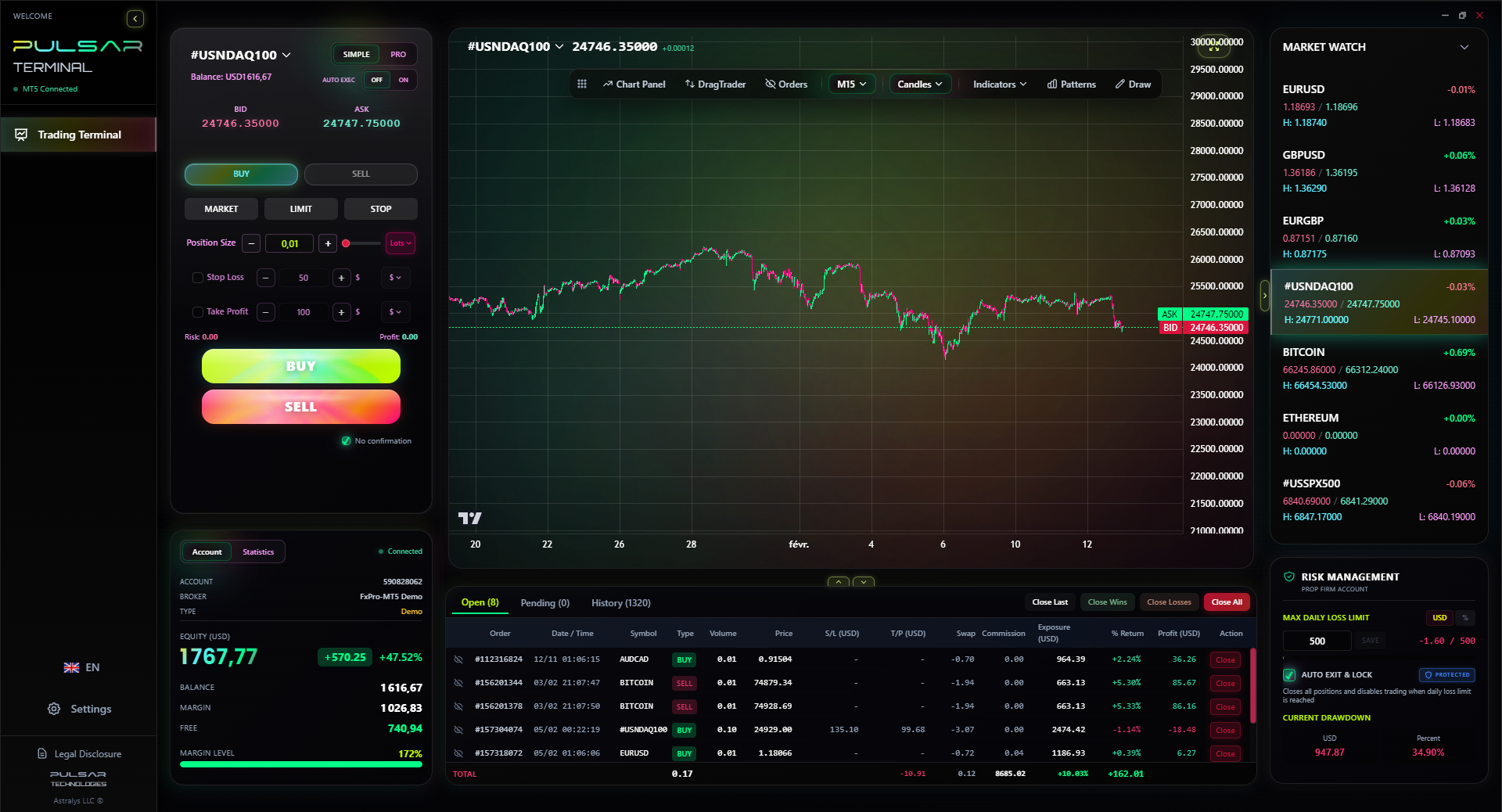
This is where external tools that integrate with MT5 become game-changers. Imagine dragging your stop-loss directly on the chart, or setting a rule like ‘move stop to breakeven when trade is 15 pips in profit’ with one click. Or, if you're testing a prop firm challenge, having a tool that automatically enforces the max daily loss limit so you never accidentally blow it. For managing multiple take-profit levels on a single trade - crucial for a disciplined exit strategy - this kind of functionality is priceless.
The Non-Negotiable Infrastructure List
- A UPS (Uninterruptible Power Supply): A R2,000 investment that will save your trades. Get one that can power your PC and monitor for at least 15 minutes - long enough to close positions gracefully during a surprise blackout.
- Fibre Internet with LTE Backup: Have a mobile router or phone hotspot ready to switch to if the fibre goes down. Pre-load the data.
- A Dedicated Space: This isn't a hobby you do on the couch with the TV on. You need a quiet corner where you can focus on the charts.
I trade from a small study in my house. My setup is simple: two monitors, MT5 on one, TradingView and my trading journal on the other. I keep a physical notebook next to me to jot down my reason for every single trade. When the screen glitches during load-shedding, that notebook has saved me from panic.
Managing complex trades and protecting your capital from a daily loss limit, especially during volatile USD/ZAR sessions, is far easier with tools that automate these rules directly on your MT5 platform.
Pulsar Terminal
Hepsi bir arada MT5 aracı: sürükle-bırak emirler, çoklu TP/SL, trailing stop, grid trading, Volume Profile ve prop firm koruması. Her gün 1.000'den fazla trader tarafından kullanılıyor.
“If you make R100,000 profit, you could owe SARS R30,000. Put at least 30% of every withdrawal into a separate savings account immediately.”
This is the part everyone in Bloemfontein, and across South Africa, dreads, but ignoring it will ruin you. SARS views frequent forex trading as a business, not a hobby. Your profits are taxable as income at your marginal tax rate (up to 45%).
Let me be brutally clear: You are taxed on your net profit. That's your total winning trades, minus your total losing trades, minus your allowable expenses. If you made R50,000 in profits but had R30,000 in losses, your taxable income is R20,000.
Allowable Expenses: This includes data costs, a portion of your internet bill, trading platform fees, brokerage commissions, and even educational courses (if directly related). Keep every single receipt.
The SARS Audit-Proof System
You need to keep records for 5 years. Here’s what I provide my accountant:
- Annual Broker Statement: Every FSCA broker must provide this. It shows your opening balance, all trades, closing balance, and total profit/loss.
- Monthly Deposit/Withdrawal Report: From your broker and your bank statements, proving the money flow.
- Trade Log: A detailed spreadsheet with date, instrument, entry/exit price, pip definition gain/loss, Rand value, and my pre-trade reasoning. This is for my own analysis, but it also shows SARS I'm a professional.
- Expense Folder: Digital scans of all related invoices.
Warning: The single biggest mistake is using trading profits to live on without setting aside tax. If you make R100,000 profit, you could owe SARS R30,000-R40,000. Put at least 30% of every withdrawal into a separate savings account immediately. Treat it like it's not your money.
Exchange Controls: Remember, you have a R1 million Single Discretionary Allowance and a R10 million Foreign Investment Allowance (with SARS tax clearance) per year. Moving profits back from an international broker is straightforward if you have your records. Moving large sums out requires planning. Always use a reputable forex dealer for large conversions, not your local bank branch.
“The biggest psychological trap is ‘stoeltyd’ overconfidence - that feeling after 2 winning trades that you're invincible.”
I've made most of these. Let's save you the tuition fees.
1. Trading Too Big, Too Soon: You get a R5,000 account, use 30:1 use, and put on a full position. A normal 50-pip swing against you creates a margin call. Fix: Risk no more than 1-2% of your account on any single trade. On a R5,000 account, that's R50-R100 max risk.
2. Chasing USD/ZAR During Volatility: News hits, the Rand is moving 200 pips in an hour, and you FOMO in. Fix: If you miss the initial move, wait. The market will always offer another opportunity. Set alerts and wait for a pullback to a logical level.
3. Ignoring the Swap (Overnight Financing): Holding certain USD/ZAR positions over the weekend can incur hefty fees that eat your profit. Fix: Know your broker's swap rates. If you're a long-term trader, factor it into your profit target. Better yet, use an Islamic swap-free account if your strategy involves long holds.
4. No Written Trading Plan: You wing it. Today you're a scalper, tomorrow a swing trader. Fix: Write down your rules. What pairs do you trade? What's your entry signal? Where is your stop-loss and take-profit? What's your daily loss limit? Print it and stick it next to your screen.
5. Going It Alone: Forex can be isolating, especially in Bloemfontein. Fix: Find a community. Join a reputable online trading group (be wary of ‘signal sellers’), or even connect with a few local traders to share ideas (not copy trades). Accountability is powerful.
The biggest psychological trap here is ‘stoeltyd’ overconfidence - that feeling after 2 winning trades that you're invincible. It's always followed by a big loss. I keep a screenshot of my worst losing trade on my desktop background to remind me to stay humble.
💡 Winston'ın İpucu
Keep a 'Why I Lost' journal. Not just the numbers, but the emotion. 'FOMO after news,' 'revenge trade,' 'ignored the weekly resistance line.' Patterns in your losses are more valuable than patterns in the charts.
FAQ
Q1Is forex trading legal in Bloemfontein?
Yes, absolutely. Forex trading is legal throughout South Africa. The key is to use a broker that is licensed by the Financial Sector Conduct Authority (FSCA) to ensure your funds are protected and you're trading within the local regulatory framework, including the 30:1 use cap.
Q2What is the minimum amount I need to start trading forex in Bloemfontein?
Technically, you can start with as little as R90 (with brokers like XM). However, I strongly advise starting with at least R1,500 to R5,000. This allows for proper risk management. Starting with too little often leads to taking excessive risk to see meaningful profits, which is a fast track to losing your account.
Q3How do I pay tax on my forex trading profits in South Africa?
SARS treats consistent forex trading as a business. You must declare your net profit (total wins minus total losses and allowable expenses) as ‘other income’ on your annual tax return (ITR12). It's taxed at your marginal income tax rate. Keep detailed records of all trades, deposits, withdrawals, and expenses for at least five years.
Q4Which currency pairs should I trade as a beginner in Bloemfontein?
Start with major pairs like EUR/USD or GBP/USD. They have the tightest spreads (lower costs) and are less volatile than exotic pairs. While USD/ZAR is familiar, its wider spreads and sharp moves can be punishing for new traders. Get your strategy right on the majors first. Check our EUR/USD guide for a deep dive.
Q5Can I use international brokers like Pepperstone or IC Markets?
Yes, but only if they specifically hold an FSCA license to offer services to South African residents. Both Pepperstone and IC Markets do hold FSCA licenses. This is the safest way to access their global platforms while remaining compliant with local law.
Q6What's the best trading platform for beginners in Bloemfontein?
MetaTrader 5 (MT5) is the most widely supported and beginner-friendly. It's stable, offers demo accounts, and has thousands of free indicators and tutorials available online. Most local brokers offer it. Focus on learning one platform deeply before exploring others.
Q7How do I handle trading during load-shedding?
Have a backup plan. 1) Use a UPS to keep your PC and internet running for 15-30 minutes. 2) Have the MT5 mobile app installed and logged in on your phone, which has battery power. 3) Most importantly, consider not opening new trades during known load-shedding slots, and ensure any open trades have stop-losses set.
Prof. Winston'ın Dersi
Önemli Noktalar:
- ✓Start on majors like EUR/USD, not USD/ZAR
- ✓Never risk more than 2% of your account per trade
- ✓Use a ZAR account to avoid hidden bank fees
- ✓Keep detailed records for SARS for 5 years
- ✓Have a UPS and LTE backup for load-shedding
Bu makale ne kadar faydalıydı?
Bir yıldıza tıklayın
Haftalık Trading Analizleri
Ücretsiz haftalık analiz ve stratejiler. Spam yok.
Yazar hakkında
David van der Merwe
Gelişen Piyasalar Yatırımcısı
Johannesburg merkezli, gelişmekte olan piyasa dövizlerinde 11 yıllık deneyime sahip trader. ZAR pariteleri, FSCA düzenlemeli ticaret ve Güney Afrika piyasa analizi uzmanı.
Yorumlar
Risk Uyarısı
Finansal araçlarla işlem yapmak önemli riskler taşır ve tüm yatırımcılar için uygun olmayabilir. Geçmiş performans gelecekteki sonuçları garanti etmez. Bu içerik yalnızca eğitim amaçlıdır ve yatırım tavsiyesi olarak değerlendirilmemelidir. İşlem yapmadan önce her zaman kendi araştırmanızı yapın.
Bunları da beğenebilirsiniz

Cara Trading Forex Sukses: 7 Prinsip dari Trader Profesional
Cara trading forex sukses dengan 7 prinsip trader pro: manajemen modal, disiplin, journal trading, backtest. Data nyata, bukan janji profit palsu.
Jam Trading Forex Terbaik untuk Trader Indonesia: Panduan Lengkap dengan Tabel Waktu
Panduan jam trading forex untuk trader Indonesia. Tabel 4 sesi dunia, jam emas 20:00-00:00, sesi mana yang harus dihindari. Data akurat + tips dari trader berpengalaman.
Top 5 Sàn Forex Uy Tín Nhất 2026: Review Jujur dari Trader Indonesia
Top 5 sàn forex uy tín 2026 untuk trader Indonesia. Review jujur: spread, deposit, withdraw, dukungan lokal. Exness, XM, IC Markets & lebih.
Pulsar Terminal'ı Edinin
Tüm bu hesaplayıcılar MT5 hesabınızdan gerçek zamanlı verilerle Pulsar Terminal'e entegredir.
Pulsar Terminal'ı Edinin