


Most 'forex descriptions' you read are generic rubbish written by someone who's never placed a real trade.

David van der Merwe
Gelişen Piyasalar Yatırımcısı ·  South Africa
☕ 10 dk okuma
Neler öğreneceksiniz:
Most 'forex descriptions' you read are generic rubbish written by someone who's never placed a real trade. They talk about 'the world's largest market' and '24-hour trading' but completely ignore what it's actually like to trade from South Africa with the Rand. I'm going to give you the real description: the regulations that matter, the actual costs in Rands, the brokers that won't screw you, and the local quirks that can make or break your account. Let's cut through the noise.
Forget the textbook definition. In practice, forex is you betting on the relative value of one currency against another, using borrowed money (use), in a market that's open 24/5. For us in South Africa, it's primarily about trading the ZAR against majors like the USD, EUR, and GBP, or trading other major pairs that don't involve our currency.
The key part of any honest forex description is this: you're not buying currency to go on holiday. You're speculating on price movements, often with very high use. This isn't investing; it's tactical speculation. The 'foreign exchange' part is just the mechanism. The 'trading' part is the skill.
When you buy EUR/ZAR, you're betting the Euro will strengthen against the Rand. Simple, right? The complexity comes from everything else: the spread (your instant cost), the overnight swap fees, the margin requirements, and the psychological pressure of watching your money fluctuate. I learned this the hard way in 2016. I went long USD/ZAR at 14.50, convinced the Rand was doomed. A week later, it was at 13.80. My 2-lot position lost me over R14,000 in real money because I didn't understand position sizing. A proper position size calculator would have saved me that grief.

Warning: Don't confuse forex trading with getting physical currency from your bank. That's a conversion with a massive bank margin. Trading is about profiting from the tiny fluctuations between the bid and ask price in the interbank market.
“The real forex description for South Africa is a market where discipline and local knowledge separate survivors from casualties.”
This is the most critical part of the local forex description. You can't trade safely here without understanding the rules.
The FSCA is Your First Checkpoint
The Financial Sector Conduct Authority (FSCA) is the main watchdog. Any broker seriously offering services to South Africans should be licensed by them. This isn't just a nice-to-have; it's your primary protection. An FSCA license means the broker must segregate client funds, adhere to fair practice, and provide a local channel for complaints. I only use FSCA-regulated entities like IC Markets or Pepperstone for my main accounts. It's not worth the risk.
The FSCA also caps use for retail traders at 30:1. That means for every R1,000 in your account, you can control a position worth R30,000. Some offshore brokers might offer 500:1, but using that is a fantastic way to get a margin call before you've finished your morning coffee.
The SARB and Your Money
The South African Reserve Bank (SARB) controls how money leaves the country. Those R1 million travel allowances? They've tightened the rules significantly. As of late 2025, getting money back from an international broker requires tax compliance checks. This is a headache. The smart move is to use a broker that offers a ZAR-denominated account. You deposit and withdraw in Rands, and they handle the forex on their side. It simplifies everything with SARS too, as your gains and losses are clear in your home currency.

Pro Tip: Always verify a broker's FSCA license number on the FSCA's official website. A fake 'regulation' badge on a website is the oldest trick in the book.

💡 Winston'ın İpucu
Your first R10,000 in trading isn't capital. It's tuition. Expect to pay it to the market to learn. The goal is to keep the tuition fees as low as possible.
“A 1-lot move of 200 pips on USD/ZAR is a R20,000 swing. On a R20,000 account, that's 100%.”
Brokers advertise 'low costs' but hide the real fees in the fine print. Here’s what you actually pay.
The Spread: This is the difference between the buy and sell price. It's your transaction cost. On EUR/USD, a good raw spread is under 0.5 pips. On USD/ZAR, it's wider due to lower liquidity - often 50-150 pips! That means the pair needs to move in your favour by that amount just for you to break even. That's a massive hurdle for a scalping strategy.
| Cost Type | Example on EUR/USD | Example on USD/ZAR | What it Means for You |
|---|---|---|---|
| Spread | 0.3 pips | 80 pips | Your instant loss on trade entry. |
| Commission (if applicable) | $7 per lot | $7 per lot | Added cost per round-turn trade. |
| Overnight Swap | +/- $2 | Can be large +/- R50 | Fee/credit for holding past 5pm NY time. |
Commissions: Common on ECN accounts. It might be $7 per 100k (1 standard lot) traded. So, a 1-lot trade on EUR/USD costs $14 to open and close ($7 each way).
Swap Fees: These are based on interest rate differentials. Holding a USD/ZAR long (buying USD, selling ZAR) overnight often incurs a daily fee because SA interest rates are typically higher. This can eat profits on a swing trading hold.
The Hidden Cost: Slippage. During news events (like SARB rate announcements), your order might fill at a worse price than you wanted. On volatile pairs like ZAR crosses, this can be brutal.

Example: You buy 1 standard lot of USD/ZAR at 18.5000 with an 80-pip spread. Your break-even is 18.5080. If the swap is -R50 per night and you hold for 5 days, you need the price to move to 18.5330 just to cover costs before making a cent. This kills poorly planned trades.
“A 1-lot move of 200 pips on USD/ZAR is a R20,000 swing. On a R20,000 account, that's 100%.”
Choosing your tools is 50% of the battle.
Picking a Broker for SA
Minimum deposits range from $1 (basically a demo account) to $500. Starting with R1,500-R5,000 is realistic. Look for: FSCA regulation, ZAR accounts, low spreads on the pairs you trade, and reliable withdrawals. Based on my experience and the data, here’s a snapshot:
- IC Markets: My go-to for raw spreads. Their 0.0 pip spread on majors is legit, but remember the commission. Great for active trading.
- XM: Popular for beginners due to low minimum deposit and lots of educational resources. Spreads are higher, but no commissions.
- Pepperstone: Excellent all-rounder with great execution and both MT4/MT5 and cTrader.
- Exness: Sometimes offers higher use, but be cautious. Their unique conditions can be useful for specific strategies.
The Platform War: MT4 vs. MT5 vs. cTrader
- MT4: The old faithful. It does everything 95% of traders need. The indicator library is massive. It's stable and familiar.
- MT5: The newer version. It handles more asset types and has a better backtester. For pure forex, MT4 is often enough. I use MT5 when I need advanced order types or to trade equities.
- cTrader: Clean, modern, and has fantastic built-in charting and order execution. Preferred by many professional scalping traders for its transparency.
You deposit via credit card, bank transfer, or sometimes e-wallets. Using a ZAR account with a local transfer (like via FNB) is fastest and cheapest. Avoid international SWIFT transfers unless you have to.
💡 Winston'ın İpucu
If you can't explain your trade setup in one sentence, you don't have a trade. You have a hope. Hope is not a strategy.
“Your first R10,000 in trading isn't capital. It's tuition.”
Trading USD/ZAR, EUR/ZAR, or GBP/ZAR is where you have a potential information edge. You live here. You feel the political and economic mood. But it's a double-edged sword.
The Volatility: ZAR pairs are wildly volatile compared to EUR/USD. A 200-pip daily move is normal. That's great for profit potential but terrifying for risk. You must use tiny position sizes. A 1-lot move of 200 pips on USD/ZAR is a R20,000 swing. On a R20,000 account, that's 100%.
Liquidity and Spreads: Liquidity dries up during SA public holidays and outside major session overlaps (London morning is best). The spread widens dramatically. Never place a market order on a ZAR pair during thin liquidity - you'll get slaughtered.
The News Driver: Local politics, SARB meetings, budget speeches, and load-shedding announcements move the Rand instantly. You need to be glued to local news. I once made R8,000 in 15 minutes shorting USD/ZAR when a positive political announcement hit the wires. I've also lost R5,000 just as fast when a surprise rating downgrade was announced after hours.
Strategy Fit: ZAR pairs are terrible for scalping due to wide spreads. They are better suited for swing trades based on fundamental themes, using technicals for precise entry. The MACD indicator on a 4-hour chart, combined with key support/resistance, can work well for catching these larger swings.
“Your first R10,000 in trading isn't capital. It's tuition.”
I've made these. My friends have made these. Let's save you the money.
- Using Too Much use: The 30:1 FSCA limit is there for a reason. New traders see offshore brokers offering 500:1 and think it's free money. It's a free ticket to a zero-balance account. Start with 10:1 or less until you're consistently profitable.
- Trading ZAR Pairs Like EUR/USD: You can't use the same position size. If you trade 2 lots on EUR/USD, you should be trading 0.1 lots on USD/ZAR for similar risk. Most don't adjust.
- Ignoring Swap Costs: Planning a long-term buy on USD/ZAR? The negative swap will slowly bleed your account. You need a very strong directional view to overcome it. Always check the swap rates before entering a multi-day trade.
- Chasing 'Prop Firm' Dreams with Poor Risk Management: Prop firm challenges are popular. They require strict daily loss limits. Blowing through that because you didn't use a stop-loss is a classic fail. Proper tools that automate risk are key here.
- Not Accounting for SARS: Your trading profits are taxable income. Keep detailed records of every trade. SARS may not track your offshore account, but when you bring the money back, you need to declare it. A messy tax situation is the last thing you want.
💡 Winston'ın İpucu
The market doesn't care about your opinion, your analysis, or your mortgage payment. Trade what you see, not what you believe.
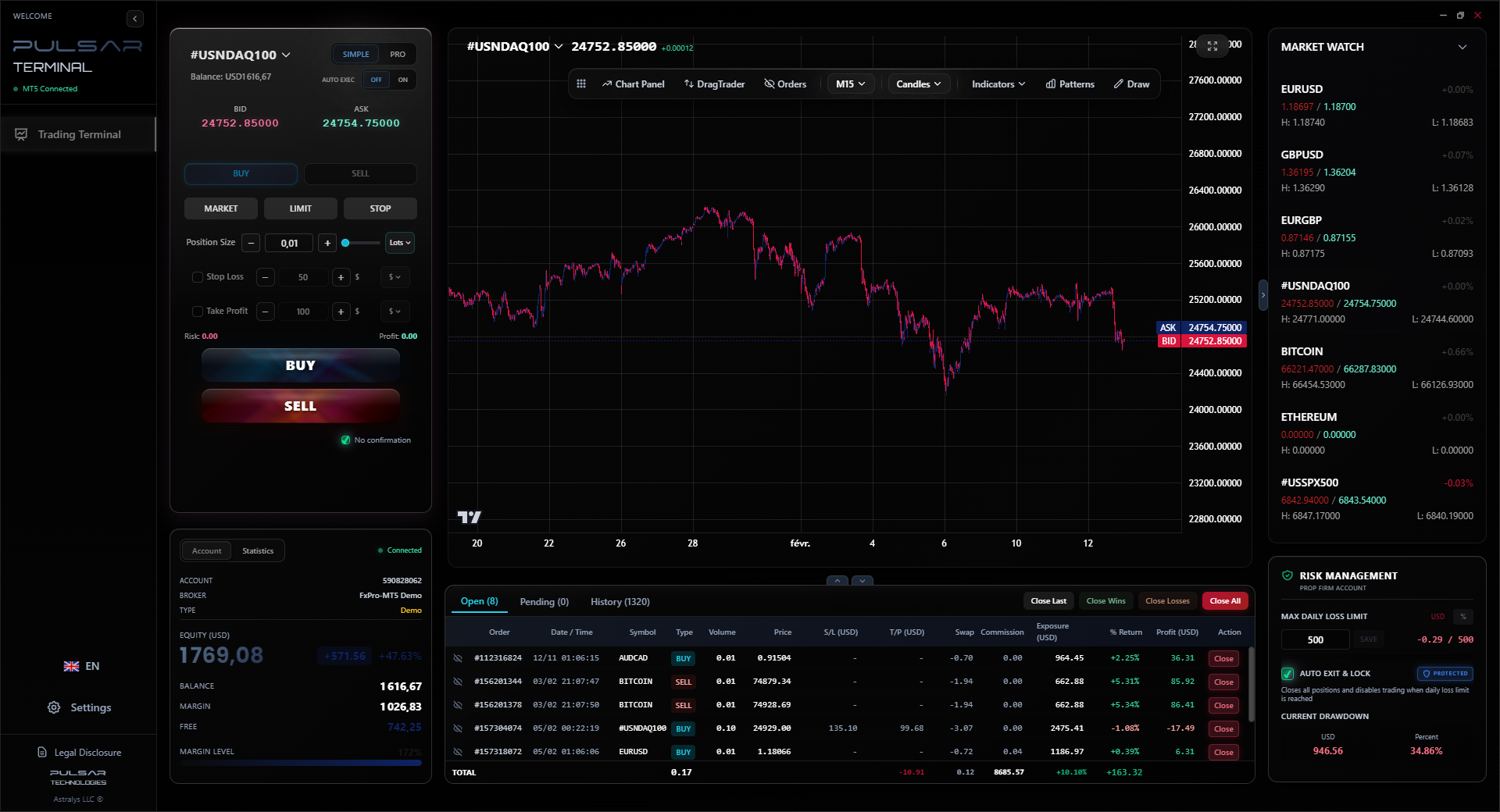
Sticking to a prop firm's daily loss limit or managing multiple take-profit levels on a volatile ZAR trade is manual hell; Pulsar Terminal automates these rules directly on your MT5 platform.
Pulsar Terminal
Hepsi bir arada MT5 aracı: sürükle-bırak emirler, çoklu TP/SL, trailing stop, grid trading, Volume Profile ve prop firm koruması. Her gün 1.000'den fazla trader tarafından kullanılıyor.
“If you can't explain your trade setup in one sentence, you don't have a trade. You have a hope.”
A plan isn't 'I want to get rich.' It's a boring, detailed rulebook.
Start with Capital: Don't start with money you need for rent or varsity fees. R5,000 is a sensible starting point to learn with real stakes without facing financial ruin.
Define Your Market: Will you focus on EUR/USD for its liquidity and tight spreads? Or will you specialise in ZAR swings? Don't jump between both randomly. I focus on 3 pairs max: EUR/USD, USD/ZAR, and XAU/USD (Gold).
Risk Per Trade: Never risk more than 1-2% of your account on a single trade. On a R10,000 account, that's R100-R200. Use your stop-loss to determine your position size, not the other way around. That position size calculator is your best friend.
Have Entry AND Exit Rules: 'I think it will go up' is not a rule. Your rule might be: Buy USD/ZAR if it bounces off the 50-day moving average on the daily chart with confirmation from the RSI indicator being oversold. Stop-loss below the recent swing low. Take profit at the next resistance zone.
Journal Everything: Write down every trade: the reason, the emotion, the outcome. Review weekly. This is how you improve. My journal showed me I lost 70% of my trades entered after 10 PM. I now have a hard rule: no new trades after 8 PM. Problem solved.
The real forex description for South Africa is this: a challenging but accessible market where discipline, local knowledge, and a ruthless focus on costs and regulations separate the survivors from the casualties. Now you know what you're really getting into.
FAQ
Q1Is forex trading legal in South Africa?
Yes, it's completely legal and regulated by the Financial Sector Conduct Authority (FSCA). However, you must use an FSCA-licensed broker or an authorised financial services provider to ensure your funds are protected under South African law.
Q2How much money do I need to start forex trading in South Africa?
You can technically start with as little as $1 (about R18), but that's for practice. A realistic minimum to learn properly without excessive pressure is between R1,500 and R5,000. For serious trading with sensible risk management, R10,000+ is a more practical starting point.
Q3What is the best currency pair for beginners in SA?
Beginners should avoid ZAR pairs initially due to their wide spreads and high volatility. Start with a major pair like EUR/USD. It has the tightest spreads (often below 0.5 pips), high liquidity, and plenty of free analysis available. Check our dedicated EUR/USD guide for specifics.
Q4How are my forex trading profits taxed by SARS?
Net profits from trading are considered income and are taxable by SARS. You must declare them in your annual tax return. Keep careful records of all your trades, deposits, and withdrawals, even if your broker is offshore. Losses can be carried forward to offset future profits.
Q5Can I use use of 500:1 in South Africa?
Not with an FSCA-regulated broker. The FSCA caps use for retail clients at 30:1 to protect traders. Some international brokers not under FSCA jurisdiction may offer 500:1, but using that level of use is extremely risky and not recommended for any sensible trader.
Q6What's the most important tool for a new trader?
A position size calculator. Before anything else - before fancy indicators or signals - knowing exactly how much to risk on each trade is what keeps you in the game. Emotion will tell you to risk more on a 'sure thing.' The calculator keeps you honest. Use ours: position size calculator.
Q7Why is the spread on USD/ZAR so much wider than on EUR/USD?
Liquidity. EUR/USD is the most traded pair in the world, with billions traded every minute. USD/ZAR has far less trading volume, so the market makers (banks and brokers) widen the spread to protect themselves from the higher risk of holding the position. It's your cost for trading a less liquid market.
Prof. Winston'ın Dersi
Önemli Noktalar:
- ✓Verify FSCA license before depositing any money.
- ✓Risk a maximum of 2% of your account per trade.
- ✓ZAR pairs need position sizes 10x smaller than EUR/USD.
- ✓Swap fees can turn a winning swing trade into a loser.
- ✓Your trading profits are taxable income for SARS.
Bu makale ne kadar faydalıydı?
Bir yıldıza tıklayın
Haftalık Trading Analizleri
Ücretsiz haftalık analiz ve stratejiler. Spam yok.
Yazar hakkında
David van der Merwe
Gelişen Piyasalar Yatırımcısı
Johannesburg merkezli, gelişmekte olan piyasa dövizlerinde 11 yıllık deneyime sahip trader. ZAR pariteleri, FSCA düzenlemeli ticaret ve Güney Afrika piyasa analizi uzmanı.
Yorumlar
Risk Uyarısı
Finansal araçlarla işlem yapmak önemli riskler taşır ve tüm yatırımcılar için uygun olmayabilir. Geçmiş performans gelecekteki sonuçları garanti etmez. Bu içerik yalnızca eğitim amaçlıdır ve yatırım tavsiyesi olarak değerlendirilmemelidir. İşlem yapmadan önce her zaman kendi araştırmanızı yapın.
Bunları da beğenebilirsiniz

Cara Trading Forex Sukses: 7 Prinsip dari Trader Profesional
Cara trading forex sukses dengan 7 prinsip trader pro: manajemen modal, disiplin, journal trading, backtest. Data nyata, bukan janji profit palsu.
Jam Trading Forex Terbaik untuk Trader Indonesia: Panduan Lengkap dengan Tabel Waktu
Panduan jam trading forex untuk trader Indonesia. Tabel 4 sesi dunia, jam emas 20:00-00:00, sesi mana yang harus dihindari. Data akurat + tips dari trader berpengalaman.
Top 5 Sàn Forex Uy Tín Nhất 2026: Review Jujur dari Trader Indonesia
Top 5 sàn forex uy tín 2026 untuk trader Indonesia. Review jujur: spread, deposit, withdraw, dukungan lokal. Exness, XM, IC Markets & lebih.
Pulsar Terminal'ı Edinin
Tüm bu hesaplayıcılar MT5 hesabınızdan gerçek zamanlı verilerle Pulsar Terminal'e entegredir.
Pulsar Terminal'ı Edinin