


My screen was a sea of red.

David van der Merwe
Gelişen Piyasalar Yatırımcısı ·  South Africa
☕ 10 dk okuma
Neler öğreneceksiniz:
My screen was a sea of red. It was March 2020, and the USD/ZAR had just ripped through R19.00. I was short, convinced the Rand couldn't weaken further. I wasn't just wrong; I was getting steamrolled. That R15,000 loss in under an hour was my brutal welcome to the real forex game. It's not a casino, but it's not a get-rich-quick scheme either. For the 200,000+ of us trading here, it's a complex, regulated battlefield where knowing the local rules is half the fight. Let's talk about how to play it properly.
First thing's first: trading forex here is completely legal, but you've got to play by the house rules. The referee is the Financial Sector Conduct Authority (FSCA). They're not trying to stop you from trading; they're trying to stop you from getting ripped off.
The biggest rule change in recent years? use. Gone are the crazy 500:1 days. For retail traders like you and me, the FSCA capped it at 30:1. Honestly, that's a good thing. It feels restrictive when you're dreaming of mega-returns, but it saves you from margin calls that wipe you out in seconds. I learned that the hard way pre-cap. A 100:1 position on EUR/USD blew through my stop loss so fast the slippage doubled my loss. The 30:1 rule forces a bit of sanity.
Then there's SARS. Yeah, the taxman wants his share. Your profits are considered income from a trade, not capital gains. You need to declare it. I keep a simple spreadsheet: date, pair, profit/loss. My accountant handles the rest. Trying to hide it isn't worth the hassle.
Finally, watch the Rand rule. The South African Reserve Bank (SARB) doesn't love you using your local bank account to speculate directly against the ZAR. Most of us use our foreign investment allowance (that R10 million per year you can send offshore) to fund an international broker account. Or, you use a local FSCA broker like Khwezi Trade that offers ZAR accounts, which simplifies things.

Warning: If a "broker" offers you 100:1 use and isn't FSCA-regulated, run. They're operating outside the legal framework, and your funds are not protected. It's the easiest way to lose before you even start.

💡 Winston'ın İpucu
The 30:1 use cap isn't a cage, it's a seatbelt. The old 100:1 days let you drive 300km/h down a suburban street. You might feel fast, but the first small bump destroys the car. Trade the size, not the use.
Let's cut through the broker marketing. The forex game isn't free. Your profits get nibbled away by costs, and if you don't know what they are, you'll wonder why you're not making money.
The Spread: This is the broker's cut. It's the difference between the buy and sell price. On the EUR/USD, a good raw spread is around 0.1 pips. Add a commission, and your total cost might be 0.7 pips. On a commission-free account, it might be 0.8 pips or more. That's your starting handicap on every trade.
The Swap/Overnight Fee: Hold a position past 10 PM GMT? You'll pay or earn a small interest fee. It's based on the interest rate difference between the two currencies. Going long on a high-yield currency against a low-yield one can earn you a tiny credit. The opposite costs you. For a swing trading strategy, this adds up.
Here’s a real example from my trading log last month:
- Trade: Short AUD/JPY (holding for 3 days).
- Position Size: 0.5 lots.
- Daily Swap Charge: -$4.21.
- Total Swap Cost over 3 days: -$12.63.
- My profit on the trade was $185. So the swap ate about 6.8% of my profit. Not trivial.
The Minimum Deposit: This is where you start. You can find brokers like XM with a $5 (about R700) minimum. Others like IC Markets ask for $200. My advice? Start with an amount you can afford to lose completely. R2,000 is a common starting point. It's enough to feel the market's movements without risking your rent.

Example: Cost of a 1 Lot EUR/USD Trade Let's say you use a broker with a 0.8 pip spread and no commission.
- 1 Pip on EUR/USD = $10
- Spread Cost = 0.8 pips * $10 = $8 That's R150 (at R18.75/$) gone the moment you click 'Buy'. Your trade needs to move 0.8 pips in your favor just to break even.
“The forex game isn't about getting rich. It's about earning a risk premium for being disciplined, patient, and right more often than you're wrong.”
Your broker is your gateway to the market. Picking the wrong one is like showing up to a soccer match with no boots. You need one that's FSCA-regulated, offers tight spreads on the pairs you trade, and has a platform you can actually use.
For sheer raw speed and low costs, I've used IC Markets for years. Their spreads on majors are often 0.0 pips, with a small commission. The execution is lightning fast, which is critical for a scalping strategy. The $200 minimum is fair for what you get.
If you're starting with very little capital, XM or Khwezi Trade are solid. XM's $5 minimum is unbeatable for testing the waters. Khwezi, being local, makes deposits and withdrawals in Rands a breeze with their R500 minimum.
For a more all-round experience with great research, IG is top-tier, but that R4,000 minimum deposit tells you they're targeting more serious players.
My mistake early on? I chased the broker with the highest use. I didn't look at the spread or the execution quality. I'd get filled at terrible prices during news events. Now, I prioritize stable execution and transparent pricing over everything else. A good position size calculator is more important for managing risk than insane use.
The Platform: MT4/MT5 is King
In South Africa, MetaTrader 4 and 5 are the standard. Everyone uses them. They're reliable, have thousands of indicators (like the RSI indicator and MACD indicator), and support automated trading. If a broker doesn't offer MT4/5, I'm skeptical. It's the common language all local traders speak.
Forget the YouTube "secret systems." The forex game in South Africa requires a strategy that accounts for our timezone, liquidity, and the ZAR's unique volatility.
I focus on two main sessions: the London open (10 AM SAST) and the London/US overlap (3 PM - 5 PM SAST). That's when the big players are active, and spreads are tightest. Trading the Asian session from SA is slow and often not worth it.
My bread and butter is trading GBP/ZAR and USD/ZAR during these times. The volatility is high, but so are the opportunities. The key is understanding what moves the Rand: commodity prices (especially platinum and gold), local political news, and global risk sentiment.
Here's a concrete example of a trade that worked:
- Date: 15 May 2024
- Pair: USD/ZAR
- Thesis: US CPI data came in hot, boosting the USD. ZAR was weakening on poor local manufacturing data.
- Entry: Went long at R18.45.
- Stop Loss: R18.30 (respecting a key support level).
- Take Profit 1: R18.60 (partial close of 50% position).
- Take Profit 2: R18.75 (closed remainder).
- Result: Average exit around R18.675. Profit of 22.5 cents per dollar, or $225 on a 1 standard lot.
The discipline was in the partial close. I banked some profit early and let the rest run with a trailing stop. Greed has killed more trades than bad analysis ever has.

Pro Tip: Don't ignore gold (XAU/USD). South Africa is a major producer, and big moves in gold often telegraph sentiment that later hits the ZAR. I always have an eye on the XAU/USD guide for context.
💡 Winston'ın İpucu
Your trading journal is more important than your strategy. If you're not writing down the 'why' behind every entry and exit, especially the emotional 'why', you're just gambling with a fancy charting tool.
“Greed has killed more trades than bad analysis ever has.”
This is the unspoken 90% of the forex game. The charts are easy. Managing your own head is the hard part.
I have two rules etched on a sticky note on my monitor:
- No Revenge Trading. After that big USD/ZAR loss I mentioned, my instinct was to double my position size immediately to "win it back." That's a guaranteed account killer. I had to walk away for two days.
- The Daily Loss Limit. My rule is 2% of my account. If I hit it, I shut down the platform. No exceptions. One terrible day cannot destroy my month. This single rule has saved my career more times than any indicator.
The market doesn't care about your ego. It doesn't care that you "know" the price should turn. I've sat in losing trades, arguing with the screen, adding to the position because I couldn't admit I was wrong. That's how a R3,000 loss becomes a R10,000 margin call.
The flip side is also true. Taking a small, disciplined profit feels boring. You want the home run. But consistent, boring profits compound. The guy trying to hit a six every ball gets caught out. The guy taking singles wins the match.
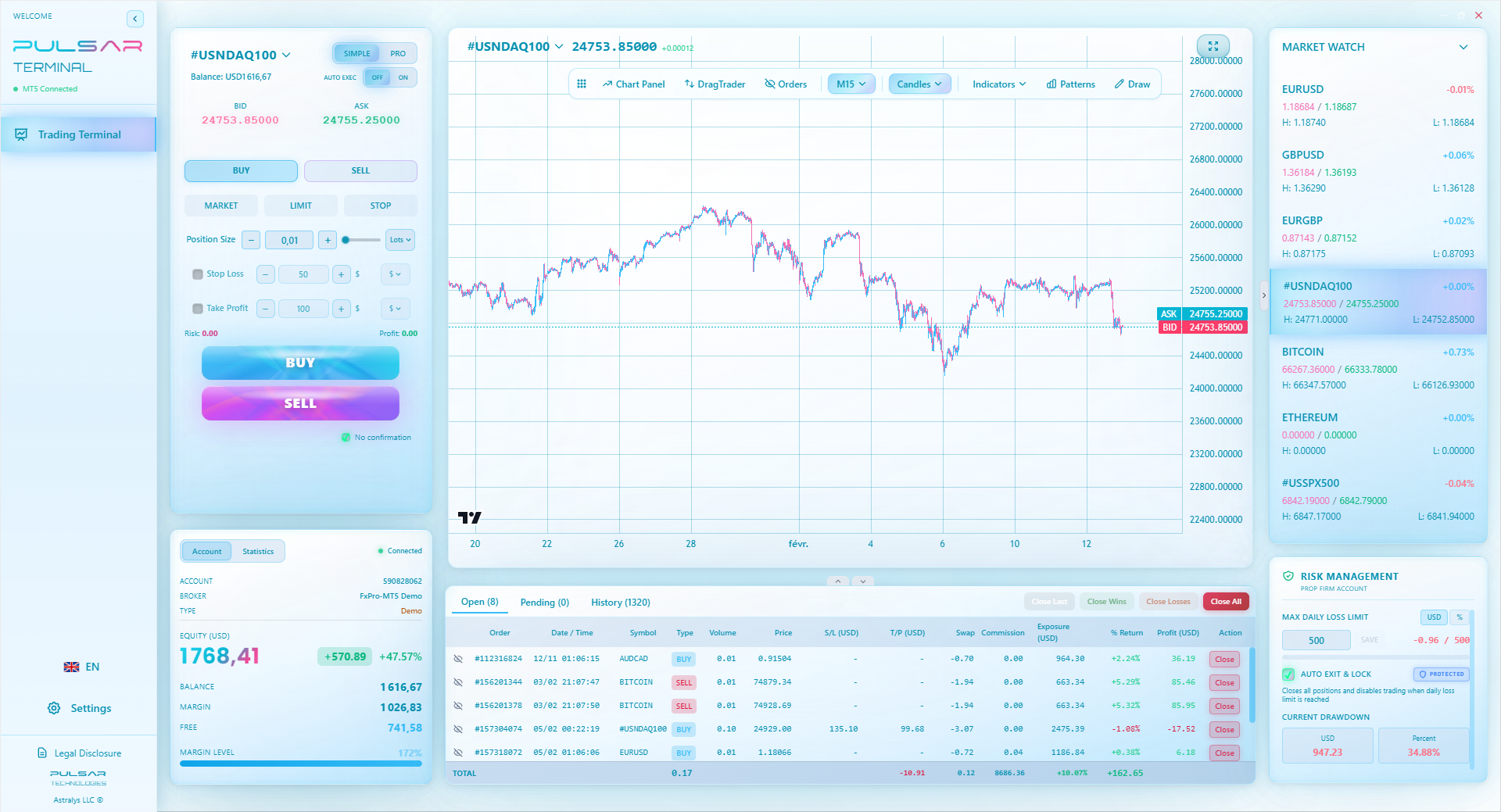
Sticking to a daily loss limit and managing multiple take-profit levels is where most traders fail, but tools like Pulsar Terminal automate these rules directly on your MT5 platform, taking the emotion out of the equation.
Pulsar Terminal
Hepsi bir arada MT5 aracı: sürükle-bırak emirler, çoklu TP/SL, trailing stop, grid trading, Volume Profile ve prop firm koruması. Her gün 1.000'den fazla trader tarafından kullanılıyor.
Let's be brutally honest with the numbers. The stats say 70-80% of retail traders lose. In my experience mentoring locals, it's closer to 9 out of 10 in their first year. They blow up their first R2,000 account learning what a pip really costs them.
But the ones who survive? They can build something real.
- Beginner (First 12-18 months): If you're net positive, you're winning. Don't expect R50k a month. Aim for consistency. R1,000 to R5,000 a month is a fantastic result while you're learning.
- Intermediate (Years 2-4): With a proven strategy and iron-clad psychology, scaling up is possible. A R100,000 account making 5-10% a month is R5,000-R10,000. That's a legitimate secondary income.
- Experienced (5+ years): This is where it becomes a profession. Managing larger capital, the profits scale. A 5% month on R500,000 is R25,000. But the pressure is immense, and the drawdowns are bigger in Rand terms.
My own journey? Year 1: Lost 40% of my starting capital. Year 3: Averaged about R8,000 a month. Now: It's my primary income, but the variance is huge. Some months are up R80,000, others are down R15,000. The average is what counts.
The forex game isn't about getting rich. It's about earning a risk premium for being disciplined, patient, and right more often than you're wrong. It's a marathon of a thousand tiny sprints.
“Your broker is your gateway to the market. Picking the wrong one is like showing up to a soccer match with no boots.”
Okay, you're keen. Here's your actionable to-do list, in order.
- Educate, Don't Deposit. Spend a month on a demo account. Not a week. A month. Trade through a full market cycle. Learn the EUR/USD guide inside out - it's the most liquid pair and the best training ground.
- Choose One Regulated Broker. Pick one from the list above. Open a demo account with them. Get used to their platform and their specific spreads.
- Define One Simple Strategy. Start with support and resistance on the 1-hour chart. That's it. No fancy indicators. Learn to draw lines and identify where price has bounced before.
- Write a Trading Plan. One page. It must state:
- Your daily loss limit (I suggest 1-2%).
- Your maximum position size.
- The specific times you will trade.
- The one strategy you will use.
- Start Absurdly Small. When you go live, deposit the minimum. Trade the smallest possible lot size (0.01 lots, a micro-lot). Your goal for the first three live months is not profit. Your goal is to execute your plan perfectly, win or lose.
The forex game in South Africa is winnable. But you win by not losing first. By respecting the FSCA's rules, understanding the true costs, and, above all, mastering yourself. Now go set up that demo account. The market's waiting, and it doesn't give second chances to the unprepared.
FAQ
Q1Is forex trading legal and safe in South Africa?
Yes, it's completely legal if you use a broker regulated by the Financial Sector Conduct Authority (FSCA). That's the key to safety. The FSCA ensures client funds are segregated, use is capped at 30:1 for retail traders, and brokers operate transparently. Avoid unregulated offshore brokers at all costs.
Q2How much money do I need to start forex trading in South Africa?
You can start with as little as R500-R700 with some brokers. Realistically, I'd suggest a minimum of R2,000 for a live account. This lets you trade micro-lots (0.01) and properly manage risk without your account being too sensitive to small losses. Always start with a demo account first, no matter what.
Q3How are my forex profits taxed by SARS?
SARS views forex trading profits as income from a trade, not capital gains. You must declare these profits in your annual tax return. Keep detailed records of all your trades (entry/exit prices, dates, profits/losses). It's wise to consult with a tax professional who understands trading income.
Q4What is the best trading platform for beginners in SA?
MetaTrader 4 (MT4) is the undisputed standard for beginners and pros alike in South Africa. It's user-friendly, stable, and has all the tools you need. Almost every FSCA-regulated broker offers it. Stick with MT4 or MT5 to avoid platform complications while you're learning.
Q5Can I trade the South African Rand (ZAR) from within South Africa?
Yes, but there's a catch. The South African Reserve Bank (SARB) discourages direct speculation against the ZAR using your local bank account. The common workaround is to use your foreign investment allowance to fund an international broker account, or to use a local FSCA-regulated broker like Khwezi Trade that offers a dedicated ZAR account for this purpose.
Q6Why is use limited to 30:1 for retail traders?
The FSCA imposed the 30:1 use cap to protect retail traders from catastrophic losses. While it limits potential gains, it drastically reduces the risk of a margin call wiping out your entire account from a very small price move. It's a protective rule that forces better risk management, which is a good thing for long-term survival.
Q7What's the most common mistake new South African traders make?
Two big ones: 1) Using too much use and position size, turning a small loss into an account blow-up. 2) Trading without a plan based on hope or emotion, especially trying to 'revenge trade' after a loss. The market punishes indiscipline instantly.
Prof. Winston'ın Dersi
Önemli Noktalar:
- ✓FSCA's 30:1 use is a protective tool, not a limit.
- ✓Real costs (spread, swap) eat 5-10% of profits.
- ✓Start with a demo account for one full month.
- ✓A 2% daily loss limit is non-negotiable for survival.
Bu makale ne kadar faydalıydı?
Bir yıldıza tıklayın
Haftalık Trading Analizleri
Ücretsiz haftalık analiz ve stratejiler. Spam yok.
Yazar hakkında
David van der Merwe
Gelişen Piyasalar Yatırımcısı
Johannesburg merkezli, gelişmekte olan piyasa dövizlerinde 11 yıllık deneyime sahip trader. ZAR pariteleri, FSCA düzenlemeli ticaret ve Güney Afrika piyasa analizi uzmanı.
Yorumlar
Risk Uyarısı
Finansal araçlarla işlem yapmak önemli riskler taşır ve tüm yatırımcılar için uygun olmayabilir. Geçmiş performans gelecekteki sonuçları garanti etmez. Bu içerik yalnızca eğitim amaçlıdır ve yatırım tavsiyesi olarak değerlendirilmemelidir. İşlem yapmadan önce her zaman kendi araştırmanızı yapın.
Bunları da beğenebilirsiniz

Cara Trading Forex Sukses: 7 Prinsip dari Trader Profesional
Cara trading forex sukses dengan 7 prinsip trader pro: manajemen modal, disiplin, journal trading, backtest. Data nyata, bukan janji profit palsu.
Jam Trading Forex Terbaik untuk Trader Indonesia: Panduan Lengkap dengan Tabel Waktu
Panduan jam trading forex untuk trader Indonesia. Tabel 4 sesi dunia, jam emas 20:00-00:00, sesi mana yang harus dihindari. Data akurat + tips dari trader berpengalaman.
Top 5 Sàn Forex Uy Tín Nhất 2026: Review Jujur dari Trader Indonesia
Top 5 sàn forex uy tín 2026 untuk trader Indonesia. Review jujur: spread, deposit, withdraw, dukungan lokal. Exness, XM, IC Markets & lebih.
Pulsar Terminal'ı Edinin
Tüm bu hesaplayıcılar MT5 hesabınızdan gerçek zamanlı verilerle Pulsar Terminal'e entegredir.
Pulsar Terminal'ı Edinin